Wildfire vs. House Fire: Why Your Restoration Approach Needs to Change
Wildfire smoke contamination requires a different approach than house fires when it comes to assessment, cleaning, contents, and verification.
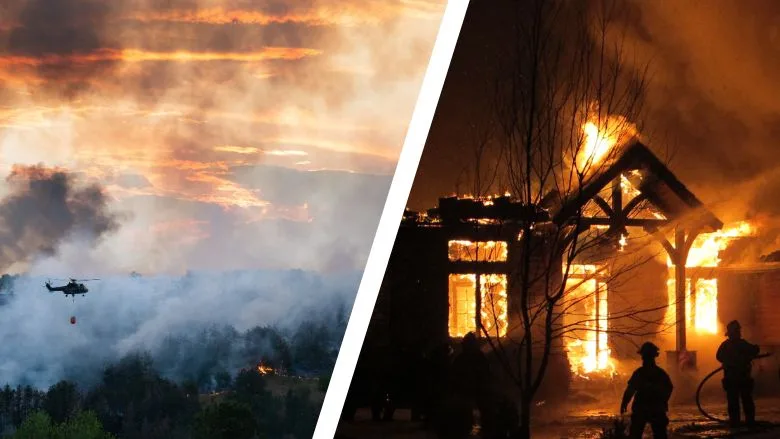
Wildfires and structural fires present different challenges for fire protection and emergency response. Left: A helicopter drops water on a wildfire. Right: Firefighters work to extinguish a house fire.
A fire is a fire, right? We clean the structure, restore the contents, take care of the odor, and get the family back home.
Well, there’s a little more to it than that.
When you’re working on a wildfire loss, the house you’re inspecting may never have actually burned. The roof is there. The furniture is still sitting where the homeowner left it. At first glance, everything might look pretty good.
But looking intact and being unaffected are two different things.
Wildfire restoration requires us to understand what happened outside the home, how that affected the inside, and what evidence we need to make good decisions about both the structure and the contents.
Start with what burned and how smoke got inside
With a typical house fire, we usually have an identifiable source inside the building. We evaluate what burned, how smoke traveled, and where heat, residue, and firefighting water caused damage.
With wildfire, the source may be outside, and exposure can continue as smoke moves through the area. Smoke can enter through open doors and windows, gaps around closed windows, and ventilation systems that bring in outdoor air. A home does not have to burn to experience smoke intrusion.
Looking for quick answers on restoration, remediation and cleaning topics?
Try Ask R&R, our new smart AI search tool.
Ask R&R →
And wildfire does not always mean just burning trees.
When a wildfire moves into a neighborhood, homes, vehicles, and other materials can burn too. EPA notes that ash from burned structures generally contains more harmful chemicals than forest ash. That matters when we’re deciding how to inspect, handle, and clean affected property.
This does not mean every wildfire home has the same contamination. It means we need to investigate instead of assuming.
The structure: Follow the evidence
On a wildfire inspection, I want to know whether the windows were open, whether the HVAC system was running, and whether anyone has already attempted cleaning.
Then I want to follow the evidence. Where are the deposits? Are there streaks around openings? Is there evidence of intrusion into the attic, crawlspace, or HVAC system? Those areas need evaluation when the conditions indicate smoke penetration.
The scope should follow those findings. An intact home may need substantial cleaning, but being in a wildfire area does not automatically mean every wall needs to be opened.
We also need to control how we remove residue. Dry sweeping and other activities that stir up ash can put particles back into the air. Appropriate HEPA vacuuming and damp cleaning can help reduce that problem.
And please do not let deodorization become a substitute for cleaning. Removing an odor and removing contamination are different goals. Berkeley Lab researchers emphasize cleaning first and identify uncertainties about how reactive odor treatments change remaining smoke chemicals.
The contents: Evaluate more than appearance
Now think about everything inside that house.
Clothing, bedding, upholstered furniture, books, electronics, dishes, and children’s belongings involve different materials and different uses.
A washable shirt, a foam cushion, and a computer cannot all be evaluated or cleaned the same way. Smoke contaminants can remain on surfaces or be absorbed into porous materials, which complicates restoration.
For each item, we need to consider its exposure, material, condition, intended use, and whether we can achieve and verify an acceptable restoration result.
A child’s stuffed animal deserves a different conversation than a decorative object on a shelf. Monetary and sentimental value matter too, but they do not replace the need to address contamination.
Wildfire exposure does not automatically make every porous item a total loss. Industry guidance supports evaluating restorability rather than blanket disposal. At the same time, an item looking good after cleaning is not, by itself, proof that all relevant hazards have been addressed.
Coordinate the contents and structure work, too. Returning cleaned belongings while contaminated areas are still being disturbed can undo good work.
Can we start with a simple, inexpensive swab?
Yes - as an initial observation tool.
One practical option is a clean white wipe or swab used to check for visible residue transfer on an accessible, compatible hard surface.
My suggested approach is to photograph the surface first, use a fresh wipe at each location, document the area checked, and photograph the residue collected. Check several representative locations rather than one convenient countertop. Avoid rubbing fragile finishes and use appropriate worker protection.
If you see gray or black transfer, you have documented removable material at that location. That can support further investigation and help show a homeowner something their eyes missed.
But call it what it is: a visual residue screen.
The color does not identify the material, prove it came from the wildfire, or measure its toxicity. Ordinary dust and other sources can also produce dark transfer. A clean-looking wipe does not rule out invisible contamination, airborne chemicals, or contamination inside porous materials.
For formal surface sampling, consistency matters. NIOSH emphasizes selecting appropriate collection media and methods and documenting sampling locations and techniques. An improvised inspection wipe should not be treated as a laboratory sample.
Not all “swab tests” answer the same question
An ATP swab measures ATP associated with biological material. That makes it useful for certain hygiene applications, but it is not a test for wildfire soot, lead, asbestos, or smoke chemicals. A low ATP reading cannot clear a wildfire property.
Consumer lead swabs have limitations too. EPA-recognized lead test kits have specific uses for identifying regulated lead-based paint on designated surfaces. That recognition does not make them clearance tests for wildfire dust.
When you need to identify material, laboratory tape lifts or wipe samples may be appropriate. Laboratories offer collection methods for examining soot, char, and ash, but those analyses do not automatically include testing for metals or other chemicals. Confirm exactly what the laboratory will analyze before collecting anything.
The question should drive the test.
Pre-testing: Make a plan before cleaning changes the evidence
When conditions warrant environmental testing, involve a qualified professional, such as a certified industrial hygienist with relevant wildfire experience, before cleaning or moving contents.
The assessment should establish what contaminants are of concern, where samples belong, which methods to use, and how results will be interpreted. Testing only for soot, char, and ash does not answer every health-related question. Depending on the situation, metals, asbestos, or specific organic chemicals may need investigation.
Heavy residue, proximity to burned structures, persistent odors, disagreements about the scope, or requirements from authorities can justify a formal assessment.
This is also the time to decide what successful completion will look like. Agree on the verification plan before the work starts.
Post-testing: Verify the result you promised
Every job needs a documented completion inspection. Review the work, check for remaining residue, evaluate odor, and confirm that the scoped areas were addressed.
Where identified hazards or project requirements call for laboratory verification, use a qualified professional to assess the results against appropriate criteria. Comparable sampling methods and documented conditions help make before-and-after results meaningful. Simply getting a lower number does not establish that the result is acceptable.
And remember: no odor does not necessarily mean no hazardous chemicals.
The inexpensive wipe has a place in our toolbox. So do professional assessment and laboratory testing. Our responsibility is to understand what each one can tell us - and explain that clearly to the homeowner.
Families need more than reassurance. They need a thoughtful inspection, a defensible restoration plan, and evidence that supports bringing their home and belongings back into use.
Looking for a reprint of this article?
From high-res PDFs to custom plaques, order your copy today!