Verification: How Restorers can Measure What Remains
Understanding, air sampling, moisture verification, and ATP testing to validate restoration project outcomes
The first three articles in this series built a single argument from three directions. Part One established that disinfection reduces viability but does not remove material from the environment, and that the immune system responds to the physical structure of biological material regardless of whether it is alive or dead. Part Two established the tools and mechanisms of physical removal: how surfactant chemistry, mechanical action, and extraction work as a system to reduce what is present on a surface. Part Three established that removal only produces a result when the environment is controlled, because without containment and negative air, the work relocates contamination instead of eliminating it.
All that work leads to a single question that this article exists to answer: how do you know it worked?
Visual inspection is where most restoration projects end their assessment. The surface looks clean. The air smells normal. The moisture meter reads dry. For a certificate of completion, that may be sufficient. For verification, it is not. Verification means measuring what remains in the environment after the work is done, understanding what those measurements tell you, and knowing what they do not say. The distinction matters, because the tools available to restoration professionals are powerful but specific and misinterpreting what they measure is as common as failing to use them at all.
ATP Bioluminescence: What It Measures and What It Does Not
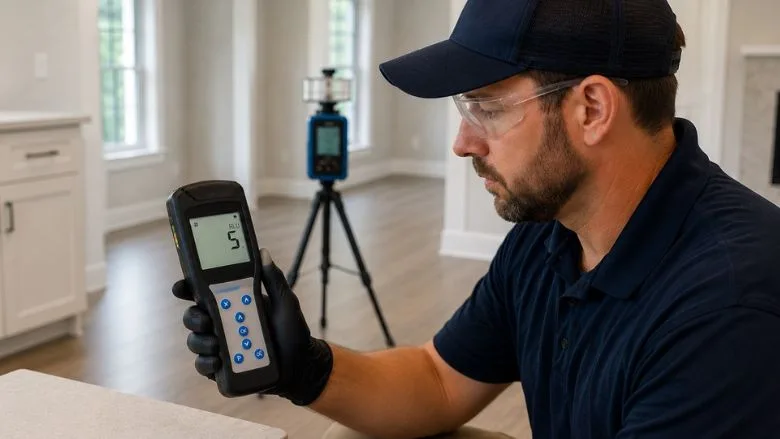
ATP testing detects organic residue on surfaces by measuring adenosine triphosphate, the energy molecule present in all biological material, both living and dead. The process is straightforward: a swab is taken from a defined area of the surface and inserted into a luminometer, which triggers a bioluminescent reaction that produces light proportional to the amount of ATP present. The instrument reports this as a Relative Light Unit reading. A higher RLU means more organic material is present on the surface. A lower RLU means less.
What ATP testing does not do is equally important to understand. It does not distinguish between living organisms and dead ones. It does not identify species. It does not quantify specific allergen proteins. It does not confirm that disinfection occurred. What it confirms is whether organic material is present on a surface, and in what relative quantity. For restoration, that is exactly the right question, because Part One of this series established that the immune system responds to the physical structure of biological material regardless of viability. A surface covered in dead mold spores will produce an elevated ATP reading, and it should, because those dead spores contain the same proteins that trigger immune responses in sensitized occupants. A surface with killed bacteria but an intact biofilm matrix will show organic load, because the extracellular matrix itself is biological material that persists after the organisms that produced it are no longer viable.
ATP measures what your body responds to, not what can replicate, and that is why it aligns with a removal-based standard rather than a disinfection-based one. Disinfection changes what is alive, removal changes what is present, and ATP measures presence.
There are two significant limitations that every restoration professional using ATP needs to understand. The first is standardization. RLU is not a standardized unit across testing platforms. Different manufacturers use different reagent formulations and detection sensitivities, which means a reading of 200 on one system does not mean the same thing as a reading of 200 on another. Published benchmarks for acceptable RLU thresholds in peer-reviewed literature range from 100 to 500, and those benchmarks were established in healthcare environments, not restoration settings. There is no industry-consensus RLU target for a post-remediation surface in a residential or commercial building. A restoration professional who tells an adjuster that the surface passed because it read below 250 is citing a number that has no standardized basis in the restoration context.
Looking for quick answers on restoration, remediation and cleaning topics?
Try Ask R&R, our new smart AI search tool.
Ask R&R →
The second limitation is chemical interference. Research published in PLOS ONE by Omidbakhsh and colleagues demonstrated that certain disinfectant residues interfere with the bioluminescent reaction itself. What this means in practice is that a surface which has been disinfected can return a falsely low ATP reading, not because the organic material has been removed, but because the residual disinfectant chemistry is suppressing the light-producing reaction that the instrument depends on. A technician who disinfects a surface without first cleaning it and then tests with ATP may see a number that looks acceptable when the actual organic load on that surface has not changed. The reading is an artifact of the chemistry, not a reflection of the surface condition.
The solution to both problems is the same: use percentage reduction rather than absolute thresholds. Take a pre-cleaning ATP reading from the surface before any work begins. Perform the cleaning protocol. Take a post-cleaning reading from the same area. The percentage drop between the two readings tells you whether cleaning achieved a measurable reduction, regardless of which testing platform you are using and regardless of what the absolute number says. A surface that went from 2,000 RLU to 35 RLU experienced a 98% reduction in organic load. That number communicates something meaningful. A standalone post-cleaning reading of 35 RLU, presented without the pre-cleaning baseline, does not.
Air Sampling: What a Snapshot Can and Cannot Prove
Air sampling measures airborne particulate concentration and can identify specific biological contaminants, including mold spores by genus and allergen proteins, whether those fragments are viable or dead. In mold remediation, air sampling is the primary tool used for post-remediation clearance. The standard clearance criterion is a comparison: indoor spore concentrations should be at or below the levels found outdoors, and target organisms identified in the original assessment should be absent or present only at background levels. The logic behind this criterion is that outdoor air represents the baseline condition that existed before the mold problem developed. If the indoor environment matches or falls below that baseline after remediation, the work has returned the space to a condition consistent with normal occupancy.
What air sampling captures, however, is a snapshot. A spore trap cassette typically collects air for five minutes at a specific flow rate in a specific location. The result tells you what was in the air at that location during that five-minute window. It does not tell you what was in the air an hour earlier, what will be in the air tomorrow, or what is in the air on the other side of the room. Conditions in a space change. Occupant activity, HVAC cycling, door openings, and temperature fluctuations all affect airborne particulate concentrations from one moment to the next.
This does not mean air sampling is unreliable. It means sampling strategy matters as much as the individual results. A single sample from the center of a remediated room tells you very little on its own. Multiple samples taken across the affected area and the adjacent spaces, combined with outdoor control samples collected at the same time and under the same conditions, produce a picture of the environment that a single sample cannot. The outdoor control sample is not optional, and it is not a formality. It is the baseline against which every indoor result is evaluated. Without it, an indoor spore count of 400 spores per cubic meter has no context. Is that elevated? Compared to what? If the outdoor sample taken at the same time reads 600, then 400 indoors represents a condition where the indoor environment is cleaner than the outdoor air, which is a successful result. If the outdoor sample reads 50, then 400 indoors means something went wrong.
Moisture Verification: Confirming Conditions, Not Outcomes
Moisture verification is a different category of measurement than ATP or air sampling, and it is important to understand why. ATP and air sampling measure the presence of contamination. Moisture verification measures the conditions that allow contamination to develop. A moisture reading does not tell you whether mold is present. It tells you whether the environment will support future mold growth. Neither reading says anything about microbial presence, allergen load, or whether the space is safe for occupancy.
This distinction matters because moisture verification is sometimes treated as clearance, as though the material being dry means the job is done. But drying addresses the condition, not the consequence. If microbial amplification occurred while the material was wet, the material could be dry and still carry an elevated microbial load, because drying stopped the growth but did not remove what grew. That is why moisture verification and biological verification serve different functions and answer different questions, and why both are necessary to confirm that a water loss has been resolved at the level of occupant health, not just at the level of structural drying.
Verification as Scope Defense
Every line item in a restoration scope exists to produce a measurable outcome: containment prevents cross-contamination, cleaning reduces organic load, disinfection reduces viability, and extraction removes what absorbed into the material. Each of those line items can be verified with the tools described in this article, and verification is what proves each step did what it was supposed to do.
When an adjuster questions the scope, verification data is the answer. Pre-cleaning ATP readings of 2,000 RLU and post-cleaning readings of 35 RLU demonstrate that cleaning achieved a 98% reduction in organic load on that surface. Air sampling showing indoor spore counts at or below the outdoor baseline demonstrates that containment held and physical removal was effective in the airborne environment. Moisture readings at target demonstrate that structural drying achieved the conditions necessary to prevent future microbial growth. This is not paperwork added to justify billing. It is evidence that the work produced a measurable result.
The alternative is scope defended by protocol reference alone. "We did it because the standard says to." That statement may be accurate, but it does not answer the adjuster's actual question, which is whether the work was necessary and whether it was effective. Verification data answers both. The restoration professional who collects verification data before, during, and after the work does not add cost to the project. They are building the evidence that justifies every dollar on the invoice and removes the adjuster's basis for questioning whether the work should have been done at all.
The Standard
This is the fourth and final article in this series. Part One established that disinfection reduces viability but does not remove material. Part Two established science and tools of physical removal. Part Three established that removal only produces a result when the environment is controlled. This article establishes that verification is how you prove the result was achieved.
The thread through all four parts is the same: what matters for occupant health is what remains in the environment, not what was applied to it, because the body responds to presence rather than viability, because removal changes the environment in ways that treatment alone does not, and because outcomes measured by verification data are what prove the work succeeded rather than protocol compliance alone.
The restoration professional who understands the science behind disinfection, removal, environmental control, and verification can do something that protocol compliance alone cannot: they can explain why the work was done, prove that it worked, and defend the scope that produced the result with data.Looking for a reprint of this article?
From high-res PDFs to custom plaques, order your copy today!