A Maturing Industry Under Pressure: Applying Porter's Five Forces to Analyze Disaster Restoration, Part 1
The restoration industry is changing, here’s how consolidation, private equity, and the industry maturing are reshaping competition
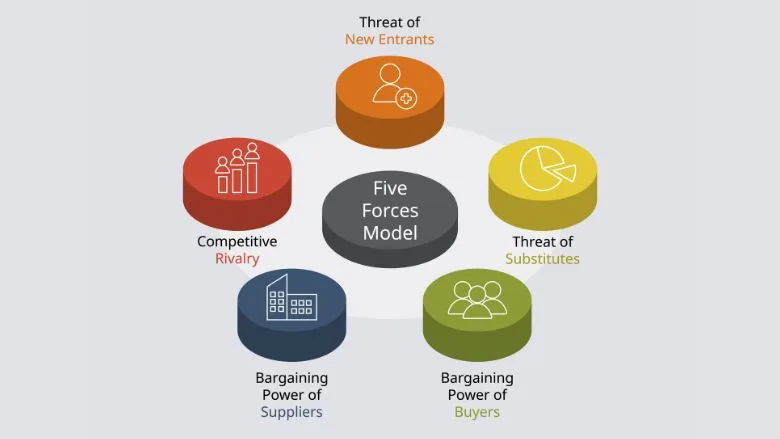
Porter five forces model and analysis to Analyze your Businesses – stock illustration
Editor's Note: This three-part series applies Michael Porter's Five Forces framework to the disaster restoration industry, examining how consolidation, buyer power, and increasing price competition are reshaping the market. While the industry continues to evolve, understanding these forces can help restorers plan accordingly for what lies ahead.
The restoration industry is experiencing significant change as private equity investment, mergers and acquisitions, and national platform growth continue to reshape the competitive landscape. In part one of this series, we examine how disaster restoration evolved from a fragmented trade into a maturing industry, explore Michael Porter's Five Forces framework and analyze how consolidation is changing competition, barriers to entry and long-term opportunities for restoration contractors.
A Trade Becomes an Industry
For most of its history, disaster restoration has behaved less like an industry and more like a loose collection of local contractors and their subs. A water loss, a kitchen fire, or a storm-damaged roof generated a phone call, and a nearby operator—often an owner-operator with a few trucks, a handful of technicians, and a relationship with a local insurance agent—responded. Pricing was negotiated informally, quality varied widely, and barriers to entry were low enough that a motivated tradesperson with drying equipment could compete for work within weeks. The market was deeply fragmented, intensely local, and largely invisible to outside capital.
That picture has changed dramatically over the past two decades, and the pace of change has accelerated in the last several years. Public policy failures, poor wildland management, failing infrastructure, and new building are among a list of factors that have made large-loss events more frequent and more severe, lifting overall demand and making the sector's revenue look both large and durable. Insurance carriers have professionalized and centralized how property claims are managed, inserting standardized estimating software and intermediaries between the homeowner and the contractor. National brands and franchise systems have expanded their footprints, and—most consequentially—institutional capital has arrived in force. The result is an industry that is maturing: consolidating, standardizing, and increasingly governed by the kinds of structural competitive dynamics that define mature sectors rather than the entrepreneurial free-for-all of a young one.
Maturity is not the same as stability. As an industry matures, the sources of competitive advantage shift, the balance of power among participants rearranges, and the basis of competition itself can change—often toward price. Understanding where the disaster restoration industry is heading therefore requires a framework built to analyze exactly these structural forces. The most enduring such framework belongs to Michael Porter.
Michael Porter and the Five Forces
Michael E. Porter, a professor at Harvard Business School, is widely regarded as the most influential thinker on competitive strategy of the past half-century. In 1979 he published "How Competitive Forces Shape Strategy" in the Harvard Business Review, followed by his landmark book Competitive Strategy in 1980 and Competitive Advantage in 1985. He revisited and updated the framework in a widely read 2008 Harvard Business Review article, "The Five Competitive Forces That Shape Strategy."
Porter's central insight was that the profitability and attractiveness of an industry are determined not simply by its competitors, but by five underlying structural forces:
Looking for quick answers on restoration, remediation and cleaning topics?
Try Ask R&R, our new smart AI search tool.
Ask R&R →
- Rivalry among existing competitors — how intensely incumbents compete, and on what basis.
- Threat of new entrants — how easily new players can enter, governed by barriers to entry.
- Bargaining power of buyers — how much leverage customers (or the parties who pay) hold over price and terms.
- Bargaining power of suppliers — how much leverage input providers hold.
- Threat of substitutes — the availability of alternative ways to meet the same need.
The framework's lasting value is that it explains why industries behave as they do—why some are consistently profitable and others chronically margin-starved—and how those dynamics evolve over an industry's life cycle. When the structure of an industry shifts, the forces shift with it. The arrival of private equity, the proliferation of third-party administrators, and the drift toward price competition are not isolated trends in restoration. Each is best understood as a movement of one or more of Porter's forces, and together they describe an industry whose competitive structure is being rewritten.
Private Equity, Roll-Ups, and the Reshaping of Rivalry
What is happening
The single most powerful structural change in restoration has been the entry of private equity (PE) capital and the wave of mergers and acquisitions it set off. The marquee transactions came in close succession. In April 2019, American Securities acquired BELFOR Property Restoration, a global leader in damage recovery and restoration (Restoration & Remediation Magazine, 2019). In March 2019, Blackstone took a major stake in Servpro, the largest restoration franchisor, in a recapitalization reported to value the company at more than $1 billion (Servpro, 2019; S&P Global Market Intelligence, 2019). In 2020, Roark Capital acquired ServiceMaster Brands—the franchisor of ServiceMaster Restore and four sister brands—in a deal that closed October 1, 2020, and was reported at $1.5 billion (Franchise Times, 2020). Alongside these platform deals, PE-backed regional consolidators such as BluSky Restoration have grown through their own acquisitions.
Beneath the headline transactions runs a steadier current of "roll-up" activity, in which a sponsor assembles a national platform by acquiring many small local operators and unifying them under a single brand. The Private Equity Stakeholder Project (PESP) documented the pattern in detail: TSG Consumer's ATI Restoration acquired 15 companies between November 2020 and April 2024; AEA Investors' Blackmon Mooring acquired 11 between March 2020 and November 2024; BluSky (owned by Partners Group and Kohlberg & Company) absorbed ten smaller businesses in the two years from December 2021 to December 2023; and Trivest Partners placed most of 14 restoration acquisitions under a single platform brand, HighGround (PESP, 2024b). A representative example of platform-building from scratch: in April 2024, Alpine Investors created Guardian Restoration Partners by combining three regional companies and, by October, had bolted on three more (PESP, 2024b). Drawing on PitchBook data and company press releases, PESP reported that private equity firms had acquired stakes in at least 49 additional restoration companies in roughly a single year, describing a sector increasingly dominated by institutional owners (PESP, 2024a, 2024b).
Why restoration? PE sponsors look for industries with durable, even counter-cyclical demand; a large base of small, founder-owned businesses available at modest multiples; and an opportunity to create value by professionalizing operations and capturing scale. Restoration checks every box. Demand is non-discretionary—a flooded home must be dried whether or not the economy is strong—and rising disaster frequency strengthens the long-term growth story. The owner base is aging and fragmented, supplying a steady stream of sellers. And the cottage-industry status quo leaves obvious room to consolidate purchasing, share back-office functions, and build regional density.
How rivalry is changing
In Porter's terms, this activity is transforming two forces simultaneously. It is raising barriers to entry—the threat of new entrants—and it is changing the nature of rivalry among incumbents. Where a technician once bought a truck and equipment to compete on a level local field, a well-capitalized national platform now brings advantages a startup cannot match: brand recognition, scale that lowers equipment and insurance costs, the technology stack required to meet carrier requirements, and the balance-sheet strength to absorb the cash-flow swings of catastrophe work. Rivalry, meanwhile, shifts from many small firms competing locally on quality, relationships, and responsiveness to a smaller number of large platforms competing nationally on cost, network coverage, and carrier relationships.
A familiar pattern from other industries
This is not a novel story. The PE roll-up of a fragmented, recurring-revenue service sector has played out repeatedly, and restoration is following a well-worn script. The clearest parallels are in healthcare services—veterinary care and dentistry in particular.
Veterinary medicine offers an especially instructive comparison. A decade ago, corporate and private-equity owners controlled well under ten percent of U.S. clinics; by estimates the American Economic Liberties Project submitted to a joint FTC/DOJ inquiry on roll-ups, that share has since climbed to somewhere between roughly 30 and 50 percent (American Economic Liberties Project, 2024). The same logic that attracts capital to restoration—stable, emotionally driven, recession-resistant demand and a fragmented base of small practices—drew it to vet clinics. The consequences drew scrutiny, though the evidence deserves care: advocates point to steep price increases (the group cites a roughly 60 percent rise in vet prices over a decade and "up to 100%" on some routine services), while industry observers note that whether consolidation itself causes higher veterinary prices has not been cleanly established and merits dedicated study (American Economic Liberties Project, 2024; Veterinary Idealist, 2019). What is better documented sits in adjacent human-healthcare markets: researchers have found that hospital prices rose substantially—on the order of 11 to 54 percent in the most-consolidated metropolitan areas—after merger waves, with the gains accruing to market power rather than to patients (Veterinary Idealist, 2019, citing UC Berkeley research reported by The New York Times). The Federal Trade Commission and state regulators have grown more attentive to "serial acquisitions" that escape antitrust review individually but reshape a market in aggregate, and similar regulatory studies have opened in adjacent fields such as private dentistry (Lexology, 2025; Mondaq, 2026). Dermatology saw a comparable acceleration—from a single private-equity investor in 2011 to roughly thirty groups by early 2018, a trend documented in The New York Times and trade press (Veterinary Idealist, 2019).
The instructive point for restoration is that consolidation is genuinely double-edged. It can deliver real efficiencies—centralized purchasing, professional management, technology investment, and the capacity to mobilize for catastrophe-scale events that would overwhelm a single small operator. But where the services are credence goods—work that customers struggle to evaluate, often while under duress—the same market power that lowers costs can also be turned toward extracting higher fees (although this does not seem to be happening for restoration), thinning service, and squeezing the workers who deliver it. Restoration shares precisely the features that made these other industries vulnerable: customers in distress, asymmetric information, and a payer (the insurer) who is often not the person whose property is being restored.
Challenges to expect, and what can be done
The challenges likely to persist are the predictable byproducts of a maturing, consolidating market. Independent operators will face mounting "grow or sell" pressure as national brands out-resource them. Contractors, large and small, may feel squeezed among downward pricing pressures, revenue targets, and thinning margins. Communities recovering from disasters may find fewer local options and less negotiating leverage. And regulators are likely to pay closer attention as the aggregate effect of many small deals becomes visible.
Several responses can blunt these pressures. Independent firms can compete on the dimensions scale does not automatically win—speed, craftsmanship, local reputation, and genuine customer advocacy—rather than trying to out-price a national platform. In practice that means treating responsiveness as a product: being the firm that answers the 2 a.m. call, arrives first, and communicates clearly with a homeowner in crisis, because the relationship formed in the first hour of a loss is one a distant call center cannot replicate. It means investing in the visible markers of craft—technicians who hold and maintain IICRC certifications, clean and well-marked equipment, and a documented track record of restoring properties fully rather than merely quickly. And it means building a local referral engine—plumbers, property managers, real-estate agents, insurance agents, and past customers—so that demand is rooted in reputation rather than rented from a platform. They can pursue defensible niches (large-loss commercial work, specialty environments such as healthcare or document recovery, or technically demanding remediation) where expertise commands a premium. They can professionalize their own operations and financials so that, if they do sell, they negotiate from strength rather than from the back-of-the-envelope valuation that lives only in an owner's head.
Industry associations and certification bodies can preserve quality standards that resist a race to the bottom, and there are concrete levers for doing so. They can maintain and enforce rigorous, regularly updated certification standards (such as the IICRC's S500 water-damage and S520 mold-remediation standards) so that "restored" means a defined, defensible outcome. They can publish standardized scopes of work and documentation templates that give independents the tools to justify a fair estimate against algorithmic pushback. They can invest in workforce development—apprenticeships, continuing education, and safety training—that raises the floor on competence across the trade and makes credentialed labor a differentiator rather than a cost. And they can serve as a collective voice in front of regulators and carriers, gathering anonymized data on pricing and program terms so that no single contractor has to challenge a national payer alone. And policymakers, learning from the veterinary and dental experience, can scrutinize serial acquisitions for their cumulative competitive effect rather than waving each small deal through in isolation.
In part two, we'll examine the rise of third-party administrators (TPAs) and how they have shifted power throughout the ecosystem. We'll also explore how carriers, TPAs and contractors interact, how buyer power has evolved and what these changes mean for the restoration industry moving forward.
References
American Economic Liberties Project. (2024, September 26). Private equity's stealthy vet takeover leaves pet owners paying the price [Press release]. https://www.economicliberties.us/press-release/private-equitys-stealthy-vet-takeover-leaves-pet-owners-paying-the-price/
Lexology. (2025, August 11). Why US regulators are cracking down on private equity investments in the healthcare sector. https://www.lexology.com/library/detail.aspx?g=270f2e15-a852-4ec3-a142-c2a1496ee743
Mondaq. (2026, March 30). When small deals add up: Antitrust scrutiny of serial acquisitions in veterinary and dentistry, and implications for private equity investments. https://www.mondaq.com/uk/maprivate-equity/1766234/
One Claim Solution. (2024, January 10). C&R report: Carriers and cashflow keep restorers up at night. https://www.oneclaimsolution.com/cr-report-carriers-and-cashflow-keep-restorers-up-at-night/
Porter, M. E. (1979). How competitive forces shape strategy. Harvard Business Review, 57(2), 137–145.
Porter, M. E. (1980). Competitive strategy: Techniques for analyzing industries and competitors. Free Press.
Porter, M. E. (1985). Competitive advantage: Creating and sustaining superior performance. Free Press.
Porter, M. E. (2008). The five competitive forces that shape strategy. Harvard Business Review, 86(1), 78–93.
Private Equity Stakeholder Project. (2024a). Private equity profits from disaster [Report]. https://pestakeholder.org/reports/new-report-private-equity-profits-from-disaster/
Private Equity Stakeholder Project. (2024b, November 21). Disaster recovery industry dominated by private equity (A. Creeks). https://pestakeholder.org/news/disaster-recovery-industry-dominated-by-private-equity/
Restoration & Remediation Magazine. (2019, April 29). Belfor Holdings Inc. acquired by American Securities. https://www.randrmagonline.com/articles/88439-belfor-holdings-inc-acquired-by-american-securities
S&P Global Market Intelligence. (2019, March 26). Blackstone to acquire majority stake in restoration service franchisor Servpro. https://www.spglobal.com/marketintelligence/en/news-insights/trending/D0E9sccJHZpepUWHR-NaSA2
Servpro. (2019, March 26). Servpro announces recapitalization and long-term partnership with Blackstone [Press release]. https://www.servpro.com/news-press-releases/190326
Veterinary Idealist (Davidow, B.). (2018, December 11; updated 2019, May 8). The impact of consolidation on price and quality. https://vetidealist.com/impact-consolidation-price-quality/
Looking for a reprint of this article?
From high-res PDFs to custom plaques, order your copy today!