Restoration logo
search
cart
facebook twitter linkedin youtube
  • Sign In
  • Join Today
  • Sign Out
  • My Account
Restoration logo
  • NEWS
  • PRODUCTS
    • New Products & Technologies
    • Submit Your Product
    • Interactive Product Spotlights
  • CATASTROPHE
    • Fire
    • Hurricane
  • TOPICS
    • Latinos in Restoration
    • Cleaning & Sanitation
    • Contamination
    • Contractor Safety
    • Contents
    • Fire & Smoke
    • Mold
    • Odor
    • Recon & Reno
    • Water
  • EDUCATION
    • Training & Education
    • Business Management
    • Insurance/Legal Matters
    • KnowHow
    • Podcasts
    • Webinars
    • Whitepapers
    • Industry Events
    • Sponsor Insights
    • Ask R&R AI
  • VIDEOS
    • Ask the Expert
    • Ask Annissa
    • Marketing Monday
    • Tech Tip Tuesday
  • BUYER'S GUIDE
  • THE EXPERIENCE
    • Convention & Trade Show
    • R&R Special Issue
  • ABOUT
    • Contact
    • Advertise
  • JOIN
ColumnsManaging Your Restoration BusinessGuest Columns

How Restoration Companies Can Get More Profit from Google Ads

Learn why tracking closed jobs, gross profit, and revenue matter more than focusing on cost per lead alone

By Roy Danino
Digital marketing
Credit: Shutthiphong Chandaeng / iStock / Getty Images Plus
November 17, 2026

Unlike what many business owners and marketers assume, a lower cost per lead doesn't necessarily mean a better Google Ads campaign, and more leads don't necessarily mean better business outcomes.

The reason is simple: not all leads are equal. Some are tire kickers, some are spam. Some are people in an endless state of comparing options and quotes. Some are looking for the absolute lowest price and don't care about quality of work. Others need the job done, are ready to move forward, and are willing to pay more for a company they trust.

When a campaign is optimized around leads alone, the advertising platform can't see those differences. A lead that turns into a profitable job and one that goes nowhere look exactly the same to the platform, so it has no reason to favor one over the other. 

That's the limitation of using leads and calls as the main goal of a campaign. Cost per lead tells you what it costs to generate an inquiry. It doesn't tell you what that inquiry becomes. 

For simplicity, I'll refer mostly to Google Ads throughout this article, but Microsoft Advertising works in the same way, and the same principles apply.


How larger companies solved the measurement problem 

Larger companies had a way around this for years: offline conversion tracking. It wasn't reserved for larger companies, but the cost and technical complexity made it impractical for many smaller advertisers. 

Today, this technology is so widespread that many contractors already use a version of it without necessarily realizing it. Dynamic call tracking connects a phone call back to the ad click that generated it. Offline conversion tracking for job reporting takes the same idea further by linking a business outcome to that same click. 

Looking for quick answers on restoration, remediation and cleaning topics?
Try Ask R&R, our new smart AI search tool.
Ask R&R →

Instead of stopping at the call, it can report what happened afterward, such as whether the lead booked, accepted a proposal, became a customer, and how much the completed job was worth. 

The technology behind that kind of reporting is also far more accessible than it used to be. Many CRMs and field service management systems can now pass downstream outcomes back into advertising platforms directly or through an integration. The measurement advantage that once favored larger advertisers has narrowed considerably.


Closed jobs provide a stronger optimization signal 

We recently published a study that analyzed 126 U.S. home-service companies and $84.1 million in ad spend, comparing businesses using lead-based optimization with those optimizing around completed jobs and financial outcomes. 

Companies optimizing for completed jobs generated a median $1.68 in gross profit for every $1 spent on advertising, compared with $1.22 among companies using lead-based optimization. That's a 38% higher median gross-profit return. 

The job-based group was also far less likely to lose money on advertising: 8% were unprofitable on ad spend, compared with 37% of lead-based companies. 

This doesn't mean every business changing its optimization strategy should expect an immediate 38% improvement. The study shows an association between what businesses optimized toward and the returns they generated.


Measure the whole funnel, then choose what to optimize for 

As you move deeper into the funnel, the signal becomes cleaner. A booked appointment tells you more than a lead, an accepted proposal tells you more than an appointment, and a closed job tells you more than any of them. 

The tradeoff is volume. There will always be fewer closed jobs than leads, so the deepest signal isn't automatically the best optimization target.
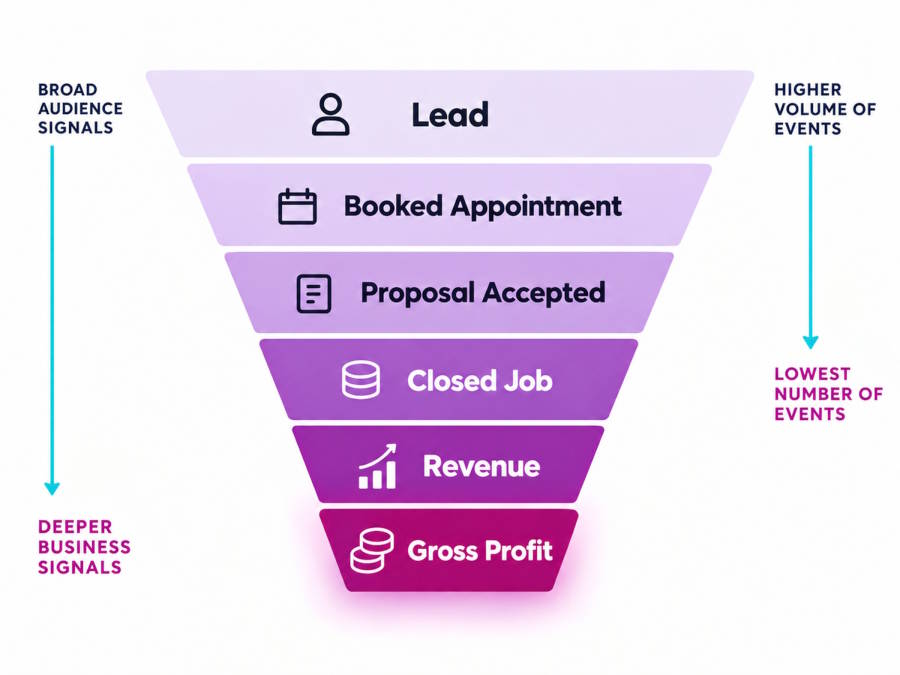
Funnel showing Lead, Booked Appointment, Proposal Accepted and Closed Job stages, followed by Revenue and Gross Profit, with event volume decreasing as the signal gets deeper.

As the funnel moves from leads to closed jobs, the signal becomes cleaner but event volume falls. Revenue and gross profit add value to the closed-job signal. AI-generated image (Google Nano Banana Pro & OpenAI GPT 2.5), customized for R&R Magazine

Measure as much of the funnel as you can reliably track. 

Optimization is a different decision. 

Measurement tells you what happened. Optimization tells the advertising platform what outcome you want it to prioritize. 

A high-volume business may generate enough closed jobs to optimize directly toward them. A smaller company may need to optimize toward a higher-volume stage, such as qualified leads or booked appointments, while still reporting closed jobs and their value for measurement. 

There isn't a universal conversion threshold for making that decision. Volume matters, but so do consistency, timing, and the reliability of the signal. 

Revenue and gross profit take the closed-job signal one step further by attaching value to it. 

Revenue-based optimization is already a major step beyond optimizing for leads, but revenue is still an imperfect signal. A high-revenue job isn't necessarily a high-profit job. 

Gross profit takes that approach one step further. Instead of telling the advertising platform how much revenue a job generated, it tells it how much that job actually contributed to the business. 

Some advertisers still optimize toward revenue rather than gross profit. In some cases, their existing measurement and bidding processes are already built around revenue, and changing them requires additional work. In others, gross-profit optimization has simply never been considered. 

That creates an opportunity regardless of company size. A smaller advertiser that can reliably report gross profit at the job level may be giving Google a better business signal than a much larger advertiser optimizing toward revenue. 

Revenue tells Google which jobs are bigger. Gross profit tells it which jobs contribute to the bottom line of the business.
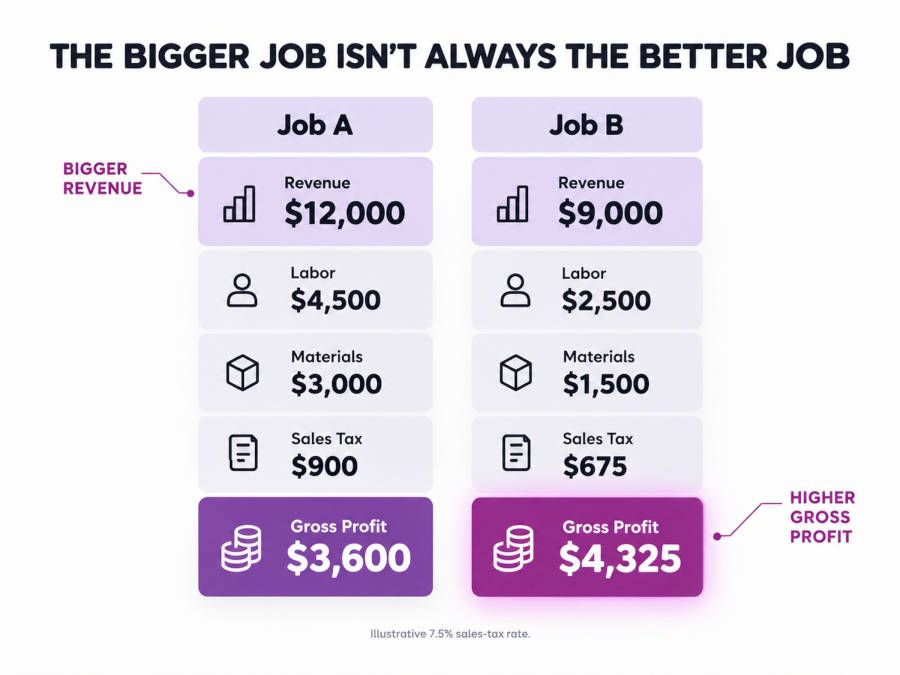
Side-by-side job comparison: Job A has $12,000 revenue and $3,600 gross profit; Job B has $9,000 revenue and $4,325 gross profit after labor, materials and sales tax.

A higher-revenue job can still generate less gross profit once labor, materials and sales tax are deducted. AI-generated image (Google Nano Banana Pro & OpenAI GPT 2.5), customized for R&R Magazine


What to expect 

This isn't a switch that makes Google Ads better overnight. The first change is that the platform starts receiving a more useful definition of success. 

Learn more about marketing strategies for restoration businesses

Over time, that gives the bidding system better information about which searches, users, locations and opportunities are associated with stronger business outcomes. 

The goal isn't to eliminate CPL or stop measuring leads. Both are still useful diagnostic metrics. The goal is to stop treating them as the finish line. 

A lead is only the beginning of the economic outcome. The closer advertising optimization gets to the point where the business actually makes money, the more closely the ad account can reflect what the business is really trying to achieve.

KEYWORDS: restoration business leads restoration business marketing restoration business profitability restoration business strategy

Share This Story

Looking for a reprint of this article?
From high-res PDFs to custom plaques, order your copy today!


Roy danino   headshot

Roy Danino is co-founder of Lachi Media, a performance-driven digital marketing agency specializing in paid search and measurement for home-service companies. He has worked with Google Ads since 2012 and has helped manage more than $250 million in advertising, with a focus on connecting campaign performance to business outcomes: completed jobs, revenue and profit.

Recommended Content

JOIN TODAY
To unlock your recommendations.

Already have an account? Sign In

  • House fire before and after

    Cleaning Isn't Clearance: The Next Evolution in Fire Restoration

    Learn why fire restoration goes far beyond cleaning and...
    Fire and Smoke Damage Restoration
    By: Kevin Coy
  • Women in Restoration Award Winner: Meredith Truitt

    Introducing R&R's 2026 Women in Restoration Award Winner, Meredith Truitt!

    Meet Meredith Truitt, R&R’s 2026 Women in Restoration...
    Restoration Training/Education
    By: Kayla McGowan
  • Digital view of the United States with a Hurricane and coding

    Is Your Restoration Technology Ready for the Upcoming Hurricane Season?

    Here’s how restoration contractors can prepare their...
    Catastrophe Restoration
    By: Taylor Carmichael
You must login or register in order to post a comment.

Report Abusive Comment

Manage My Account
  • Join Restoration & Remediation
  • Manage My Preferences
  • Customer Service

More Videos

Sponsored Content

Sponsored Content is a special paid section where industry companies provide high quality, objective, non-commercial content around topics of interest to the Restoration & Remediation audience. All Sponsored Content is supplied by the advertising company and any opinions expressed in this article are those of the author and not necessarily reflect the views of Restoration & Remediation or its parent company, BNP Media. Interested in participating in our Sponsored Content section? Contact your local rep!

close
  • 5 Questions to Shape Your 2027 Plan
    Sponsored byVioland Management Associates

    Five Questions That Should Shape Every Restoration Company’s 2027 Plan

  • Violand business coaching
    Sponsored byVioland Management Associates

    The Conversation Most Owners Wait Too Long to Have

Popular Stories

Restoration contractor decontaminating a home

Wildfire Smoke Cleanup: When Professional Remediation is Needed, Part 5

Seamless collaboration, faster claims: Cotality Supplement™

Seamless collaboration, faster claims: Cotality Supplement™

Ask The Expert: The Hidden Costs of Workflow Fragmentation in Restoration

The Hidden Costs of Workflow Fragmentation in Restoration

Events

May 19, 2026

Hurricane Response: What’s Changed, Who’s at Risk, and How to Scale Without Breaking

On Demand Hurricane season isn’t what it used to be, and neither is disaster response. In this webinar, our panel will break down what’s changed for hurricane response, and how restorers can scale responsibly without sacrificing their safety, retention, or profitability.

December 10, 2026

Fire Damage Restoration: What We Know, What We Don’t, and What Comes Next

LIVE: December 10, 2026 at 2 PM EST This webinar brings together restoration, industrial hygienists, and safety experts for a practical discussion on what happens from the moment a property is assessed for fire damage through final clearance.

View All Submit An Event

Poll

Thanksgiving Staffing

How does your restoration company handle emergency calls over Thanksgiving?
View Results Poll Archive

Products

2026 National Renovation and Insurance Repair Estimator

2026 National Renovation and Insurance Repair Estimator

Current prices in dollars and cents and detailed descriptions for hard-to-find items needed on most insurance, repair, remodeling, and renovation jobs. All price items include labor, material, and equipment breakouts, plus special charts that tell you exactly how these costs are calculated. Includes many reinstall/salvage cost estimates, hundreds of sample product images and unique architectural items.ISBN 978-1-57218-405-3


See More Products

Submit Your New Product/Technology to R&R!

Would you like to promote a new restoration, remediation or cleaning product/technology with Restoration & Remediation? Fill out the question below to start your submission:

Related Articles

  • How disaster restoration companies can get the most out of google my business

    How Disaster Restoration Companies Can Get the Most Out of Google My Business

    See More
  • Marketing Monday: How Restoration Companies can Turn Social Media into more Calls and Jobs

    How Restoration Companies Can Turn Social Media into More Calls and Jobs

    See More
  • A professionally organized restoration response truck displays drying equipment, chemicals, and tools staged for emergency deployment

    How Restoration Companies Can Track Equipment and Improve Hurricane Response

    See More

Related Products

See More Products
  • COVER pdf.jpg

    How to Get More Restoration Jobs in 14 Days... (ebook)

  • Cover.jpg

    How To Get More Water Damage Jobs (ebook)

  • get paid

    Get Paid! (ebook)

See More Products
×

Stay in the know on the latest restoration & cleaning industry trends.

Get tailored content delivered your way.

JOIN TODAY!
  • RESOURCES
    • Advertise
    • Contact Us
    • Directories
    • Store
    • Want More
    • Submit a Press Release
  • JOIN TODAY
    • Create Account
    • Newsletters
    • Customer Service
    • Manage Preferences
  • SERVICES
    • Reprints
    • Marketing Services
    • Market Research
    • List Rental
    • Survey/Respondent Access
  • STAY CONNECTED
    • LinkedIn
    • Facebook
    • Instagram
    • YouTube
    • X (Twitter)
  • PRIVACY
    • PRIVACY POLICY
    • TERMS & CONDITIONS
    • DO NOT SELL MY PERSONAL INFORMATION
    • PRIVACY REQUEST
    • ACCESSIBILITY

Copyright ©2026. All Rights Reserved BNP Media, Inc. and BNP Media II, LLC.

Design, CMS, Hosting & Web Development :: ePublishing