How Restoration Companies Can Track Equipment and Improve Hurricane Response
Why your telematics, fleet visibility, and documentation matter during CAT response
Restoration companies don’t need to track the weather channel to know when hurricane season arrives. Call volumes start climbing, customers move delayed projects to the top of the list, and crews begin preparing for the possibility that one storm could change the pace of business overnight. In this industry, it only takes a single landfall event to push operations into catastrophe mode.
That urgency reflects a broader shift in the frequency and scale of severe weather events. Climate Central counted 23 separate billion-dollar events in 2025, totaling roughly $115 billion in damages. The average time between those events was 10 days, down from 82 days during the 1980s. Although no hurricane made U.S. landfall in 2025 for the first time in a decade, 4 of the 5 Atlantic hurricanes that did form reached major strength, well above the typical 40% rate.
Hurricane Month
Prepare before the storm with specially-curated articles during the month of May. Learn more!
The forecast for the 2026 Atlantic hurricane season runs slightly below average, with Colorado State University predicting 13 named storms, six hurricanes and two major hurricanes. CSU pegs the probability of a major hurricane making U.S. landfall this year at 32%, but headline forecasts rarely tell the full story for restoration companies. Only one storm making landfall is enough to create widespread operational strain across crews, equipment and response timelines.
For restoration and remediation companies, what matters is that the pace of catastrophe work has changed, and so have the operational expectations from carriers, FEMA, and customers.
Catastrophe Operations Run on a Longer Clock than the Hurricane
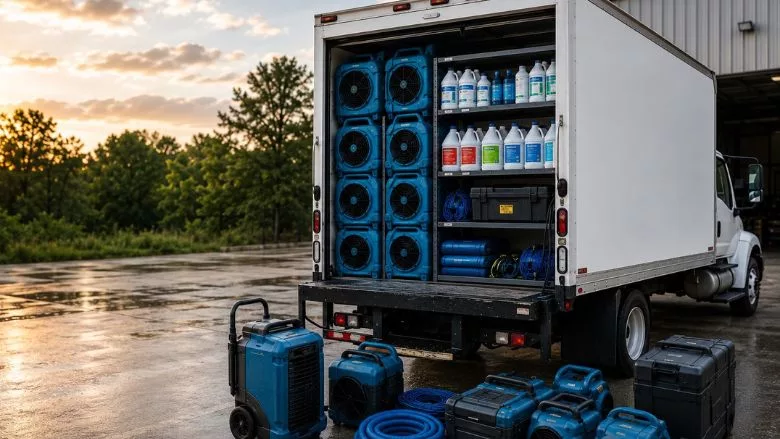
The companies I work with run dozens of crews across multiday jobs at the height of hurricane season. Equipment stays on site for as long as the dryout takes, vehicles bounce between addresses, and field techs change job assignments mid-shift as the calls keep coming in. The job site is a moving target, and so is the location of every dehumidifier, air mover, generator and extraction unit a business owns.
That picture is even more complicated for companies working federal disaster declarations. Companies on the FEMA Disaster Response Registry, or those operating under SAM.gov advance contracts, have to document where their crews are, when they arrived, what equipment was deployed, and how long it ran. The paperwork picks up pace through the response.
Hiring conditions compound the pressure. The 2024 Associated General Contractors workforce survey found that 94% of construction firms had difficulty filling open craft positions, with 54% reporting project delays directly tied to labor shortages. Their 2025 follow-up showed that labor shortages were the leading cause of project delays nationwide. Restoration companies feel the same squeeze. If you can’t hire your way out of a busy season, you have to give your existing crews better information, so they waste less time per job.
Looking for quick answers on restoration, remediation and cleaning topics?
Try Ask R&R, our new smart AI search tool.
Ask R&R →
Vehicles, Tools, and Equipment Belong on the Same Map
Most restoration owners I talk to already track their vehicles in some form. The companies that hold up best during catastrophe events tend to use fleet management to track three things at once: vehicles, tools, and high-value equipment staged at their job sites.
During a busy week, dispatchers can’t afford to call drivers to find out where they are. They need to look at a map, identify the nearest available crew to a new call and route them with an estimated arrival time the customer, or carrier can plan around. Restoration is a service where the response window often determines whether the loss is manageable or catastrophic. A crew that arrives 90 minutes faster on a Category 1 water loss can be the difference between a clean dryout and a demolition-and-rebuild.
That kind of dispatch only works when live vehicle data flows into the office, and it works better when equipment trackers are pinging from job sites alongside the vehicle data. When a project manager can pull up a single map and see that their air movers on a Tuesday job are still running, that the generator from last weekend’s loss is sitting in a customer’s driveway across town, and that the truck heading to the next call is 12 minutes out, most of the operational chaos clears.
More Equipment gets Forgotten than Stolen
During hurricane season, more equipment gets forgotten on job sites than stolen from them. Tools and small equipment get left behind at one site, picked up by another crew the next day, transported to a different job, and never makes it back to the warehouse. Multiply that across 30 active jobs and a company can lose track of tens of thousands of dollars in inventory in a single week. Battery-powered asset tags on dehumidifiers, air scrubbers, moisture meters, and extraction units take the guesswork out of the question.
Recovery is the most visible benefit, but the daily benefit is utilization. Knowing exactly which units are on which job, and how long they’ve been running, lets you pull idle equipment back into rotation faster, bill more accurately for the equipment that actually ran, and finish the dryout cycle without sending a tech back to a closed site to confirm what the moisture readings were 18 hours earlier.
The Insurance Dispute is Won in the Documentation
Most restoration owners have experienced the same cycle. The work gets done, the invoice goes out, and then the back-and-forth begins. A claims handler questions the labor hours, equipment usage, or whether your crew was even on the site as long as it was billed. Meanwhile, payment delays drag on, and margins shrink with every additional call or email needed to defend the work.
The Restoration Industry Association’s 2024 Member Survey found that the top four frustrations restoration professionals named were all related to the insurance carrier relationship. Three recurring themes emerged: payment delays, breakdowns in communication, and administrative friction that erodes margins on every loss.
GPS and telematics data give the contractor the documentation to defend the bill with confidence. Time-stamped arrival and departure records, equipment runtime logs and route history that proves the crew was on site for the hours invoiced all become evidence in the file when a claim is challenged weeks later. Restoration owners who embrace that data discipline tell me their disputes get shorter: The contractor that has the receipts on the first call, ends the back-and-forth faster.
The same logic applies to customer disputes and liability claims. A homeowner who claims a tech wasn’t on site for the four hours billed can be answered with location and timestamp data inside an hour. Dash cam footage from the truck protects the driver in a disputed accident. Good documentation can turn an argument into a five-minute phone call and help avoid litigation or reputational damage.
What to put in Place before June 1
A pre-season operations checklist doesn’t have to be complicated. The companies that ride out catastrophe season cleanest tend to have these basics in place by Memorial Day:
- A live map of every vehicle and a documented dispatch protocol that names the closest available crew to a call
- Asset tags on every piece of equipment over a defined dollar threshold, so the answer to “Where is Unit 47?” never requires a phone tree
- Driver behavior monitoring tied to the insurance program, so the carrier discount is locked in before the next rate review
- Updated SAM.gov registration and Disaster Response Registry entry for any company that wants to work federal-declared events
- A documentation routine that captures arrival, departure, equipment deployment and runtime data on every job, so the claim file is ready to defend before the dispute arrives
The 2026 Atlantic hurricane season may be quieter than the last few. On average, the next billion-dollar disaster is 10 days away regardless of what the cone of uncertainty looks like in August. Restoration companies can prepare for the unpredictable by knowing exactly where their trucks, tools and equipment are — long before the first storm forms.
Looking for a reprint of this article?
From high-res PDFs to custom plaques, order your copy today!