How Wildfires and WUI Fires Impact Standing Buildings, Part 2
How thermal pressure, smoke movement, and fire whirls influence damage and contamination in fire restoration
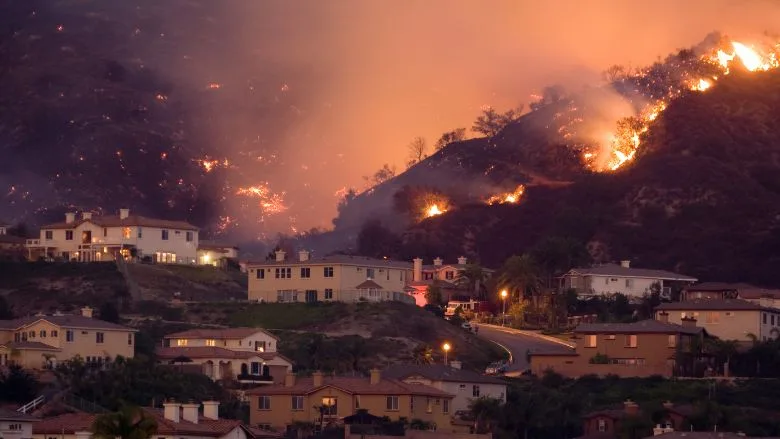
Part 1 of this series provided the reader with an overview of wildfires and WUI fires. Wildfire fuels generally include burning in vegetative fuels such as grass, brush, or forests that produce combustion byproducts, such as soot, char, ash, and other organic debris. In contrast, WUI fires involve both natural and anthropogenic (human created; built) fuels, including plastics, treated lumber, roofing materials, insulation, electronics, vehicles, household chemicals, furniture, and other contents. As a result, WUI fires generate particulate matter along with PAHs, VOCs, SVOCs, heavy metals (e.g., lead, cadmium, chromium, mercury), and under certain combustion conditions dioxins and furans.
Contaminants may deposit onto exterior and interior surfaces, enter attics, wall cavities, HVAC systems, and contents, and persist as settled dust or residue. Structures outside the direct flame-damage area may still be affected where smoke, ash, and combustion byproducts entered through wind-driven infiltration, pressure differentials, ventilation openings, or occupant/worker tracking.
Fire Month
Prepare before wildfires with specially-curated articles during the month of October. Learn more!
Windspeed can cause a wildfire/WUI fire to advance at a faster pace, such as winds greater than 40 mph, and wind gusts greater than 80 mph. Windspeeds can elevate thermal heat release, and pressure-gradient-driven airflow collectively controlled fire behavior, ember transport, smoke dispersion, and structural exposure.
5.0 THERMAL PRESSURES AFFECTING DOWNWIND BUILDINGS WITH SMOKE AND COMBUSTION BYPRODUCTS
5.1 About Thermal Pressures:
Thermal pressures generated during fire events are a primary driver of smoke movement and the transport of combustion byproducts toward downwind buildings. These pressures arise from intense heat release, which produces gas expansion, buoyancy-driven flow, and pressure differentials between the fire environment and surrounding areas. Collectively, these processes govern the migration, dispersion, and infiltration of smoke and contaminants into adjacent and downwind structures.
As fire temperatures increase, gases expand in accordance with fundamental thermodynamic principles, creating pressure differentials that displace surrounding air and smoke-laden combustion products.
Foundational fire science literature, including work referenced by the National Research Council, establishes that temperature-driven gas expansion during fires results in volumetric displacement and outward movement of smoke from the fire source[1]. In addition to thermal expansion, buoyancy-driven flow, commonly referred to as the stack effect, plays a dominant role in smoke transport. Heated gases rise due to reduced density, creating vertical pressure gradients that draw in cooler air while forcing smoke through openings, cracks, vents, wall cavities, attic spaces, and building assemblies. This mechanism contributes to both vertical and lateral smoke movement and is influenced by temperature gradients, building geometry, and leakage pathways[2].
Wind forces further amplify thermally induced pressures. External wind acting on a structure creates pressure differentials across the building envelope, increasing the infiltration potential of smoke into downwind structures. The combined effects of wind pressure and fire-induced thermal gradients are widely recognized as primary drivers of smoke movement in wind-influenced fire environments[1][3].
Looking for quick answers on restoration, remediation and cleaning topics?
Try Ask R&R, our new smart AI search tool.
Ask R&R →
Large fire events can generate localized and regional pressure fields extending beyond the immediate burn area. Research from the Pacific Northwest National Laboratory demonstrates that intense fires produce heat-driven pressure differences capable of strengthening local wind systems and transporting smoke and aerosols over significant distances[4]. This coupling of thermal energy release and atmospheric flow contributes to the widespread distribution of combustion byproducts.
Within and around buildings, pressure differentials govern smoke infiltration pathways. Openings such as doors, windows, vents, soffits, attic penetrations, wall penetrations, and other structural gaps allow smoke intrusion when exterior pressure exceeds interior pressure. Conversely, buildings with positive pressurization systems may resist smoke entry by maintaining higher internal pressure relative to exterior conditions. These principles are consistent with established building science and smoke control engineering practices[1][2].
Wind-structure interaction further influences downwind exposure. Airflow around buildings creates zones of positive pressure, negative pressure, vortices, and recirculation regions that can trap or concentrate smoke. Studies evaluating smoke dispersion around structures confirm that these aerodynamic effects can result in elevated contaminant concentrations at locations removed from the immediate fire source[5].
Fire plume behavior is also influenced by atmospheric shear and prevailing wind conditions. Under wind-driven scenarios, smoke plumes are deflected and transported horizontally, increasing the likelihood of exposure to structures located downwind. This behavior is well documented in fire plume modeling and boundary-layer flow research[6].
5.2 WUI Fire Thermal Pressure Conditions:
Thermal pressure and airflow mechanisms are the primary physical drivers that control how smoke and combustion byproducts generated during a wildfire or WUI fire are transported, dispersed, and ultimately infiltrate downwind buildings. These mechanisms are governed by fire-induced heat release, atmospheric interaction, and building science principles, and they collectively determine exposure pathways and contamination potential.
When materials burn, they generate extremely high temperatures that cause surrounding air and combustion gases to expand rapidly. This expansion creates localized high-pressure zones within the fire area. The resulting pressure gradient forces smoke and combustion byproducts outward from the fire source toward lower-pressure regions, including downwind environments. This is a fundamental driver of initial smoke movement and plume formation.
As gases are heated, their density decreases, causing them to rise. This creates vertical pressure gradients where hot air moves upwards, and cooler air is drawn inward at lower elevations, where together, they created a stack effect, which is the dominant mechanism for both vertical transport and redistribution of smoke within and around structures. This process:
- Lifts smoke into the atmosphere (plume rise)
- Sustains fire growth by drawing in oxygen
- Drives smoke into vertical and concealed building pathways (attics, wall cavities, shafts)
Wind interacting with buildings creates zones of positive pressure (windward side) and negative pressure (leeward side). Wind significantly amplifies thermally driven airflow and is often the controlling factor in downwind smoke transport. During a WUI fire:
- Positive pressure forces smoke into the building through openings
- Negative pressure draws air (and contaminants) through the structure
- Pressure gradients increase air exchange rates, enhancing infiltration
Research from Pacific Northwest National Laboratory demonstrates that large fire events can alter local meteorology and increase regional exposure. Large fires generate enough heat to influence surrounding atmospheric conditions, where heat-driven pressure fields can:
- Strengthen local wind systems
- Create sustained outward flow from the fire perimeter
- Transport smoke and aerosols over long distances
As wind flows around buildings and terrain they creates turbulent airflow patterns, including eddies, vortices, and recirculation zones. This explains why some buildings experience heavy contamination even without direct flame exposure, where they:
- Trap smoke near structures
- Increase localized contaminant concentrations
- Extend exposure duration
- Reintroduce contaminants to building surfaces and openings
Under strong wind conditions, rising smoke plumes are tilted and transported horizontally rather than vertically. This mechanism is especially significant during Santa Ana wind conditions, where high wind speeds can carry contaminants miles from the fire source. Wind shear within the atmospheric boundary layer cause:
- Long-range transport of smoke and fine particles (PM2.5)
- Direct alignment of smoke plumes with downwind structures
- Increased likelihood of prolonged exposure
Buildings experience continuous air exchange with the outdoors. Once outdoor air is inside, internal pressure differences distribute contaminants throughout the structure, affecting both exposed and concealed areas. When exterior pressure exceeds interior pressure, smoke is forced into structures through:
- Vents and soffits
- Doors and windows
- Cracks and construction joints
- Wall cavities and attic spaces
- HVAC systems
Thermal pressure and airflow mechanisms affecting downwind buildings. These combined mechanisms control the movement, distribution, deposition, and infiltration of smoke and combustion byproducts into buildings located downwind of wildfire and WUI fire events. Thermal pressures include:
- Expansion of heated gases creating pressure-driven displacement of smoke
- Buoyancy-driven stack effect transporting smoke vertically and laterally
- Wind-induced pressure differentials increasing infiltration into structures
- Heat-driven atmospheric pressure fields transporting contaminants over distance
- Airflow recirculation and vortex formation concentrating smoke near buildings
- Horizontal plume transport under wind shear conditions
- Pressure-driven movement through vents, soffits, cracks, wall cavities, attic spaces, and mechanical penetrations
5.3 Summary:
- Thermal pressures generated during fires result from the expansion and buoyancy of heated gases, creating pressure differentials that drive the movement of smoke and combustion byproducts away from the fire source. When combined with wind forces, these thermally induced pressures produce airflow patterns that transport contaminants toward downwind buildings.
- Pressure differentials across building envelopes facilitate smoke infiltration through openings, vents, leakage pathways, wall assemblies, attic spaces, and mechanical penetrations, while aerodynamic effects around structures can concentrate or recirculate smoke near building surfaces.
- Accordingly, buildings located downwind of a wildfire or WUI fire are subject to contamination from smoke and combustion byproducts due to the combined effects of thermal expansion, buoyancy-driven flow, wind-induced pressure gradients, plume transport, and building-envelope leakage pathways.
Technical References:
[1] National Research Council “Fire Dynamics and Thermodynamic Expansion Principles in Fire Environments”
[2] Building science and fire protection engineering literature on stack effect and smoke movement.
[3] Fire behavior and wind-driven smoke transport studies.
[4] Pacific Northwest National Laboratory “Atmospheric Transport and Fire-Induced Pressure Field Research”
[5] Studies on airflow, vortex formation, and smoke dispersion around structures.
[6] Fire plume modeling and boundary-layer atmospheric flow research.
6.0 FIRE WHIRLS (“WILDFIRE TORNADOS”) IN WUI FIRE EVENTS
6.1 About Fire Whirls:
Fire whirls, also referred to as fire vortices or pyrogenetic tornadoes, are extreme fire-induced atmospheric phenomena that can develop during high-intensity wildfire events, including those occurring in wildland-urban interface (WUI) environments. These phenomena are driven by intense heat release, strong buoyancy-induced convective updrafts, and localized wind shear generated by the fire environment.
The United States Forest Service defines fire whirls as rotating columns of ascending hot gases, smoke, and flame that are formed when buoyancy-driven updrafts interact with ambient wind shear, producing vertical vorticity[1]. These rotating columns concentrate heat and momentum, significantly increasing localized fire intensity and producing extreme and highly variable wind conditions.
Quantitative fire science research demonstrates that fire whirls can generate localized wind speeds exceeding approximately 80 to 140 mph, with some documented large-scale events producing wind velocities comparable to Enhanced Fujita Scale EF-1 to EF-2 tornadoes. During the 2018 Carr Fire in California, post-incident analysis identified a fire-generated vortex with estimated wind speeds exceeding approximately 140 mph, resulting in structural damage consistent with higher-end tornado intensity in localized areas[2].
Temperatures within fire whirl cores can exceed approximately 1,500°F to over 2,000°F (815°C to 1,100°C), which are significantly higher than surrounding fire conditions due to concentrated combustion and reduced heat dissipation. These elevated temperatures increase radiant heat flux and accelerate material ignition, degradation, and structural failure.
Convective updraft velocities associated with fire whirls can exceed approximately 100 to 200 feet per second (approximately 30 to 60 meters per second), enabling vertical transport of burning debris, embers (firebrands), and combustion byproducts to significant heights. This vertical transport contributes to long-range spotting and ignition of structures well beyond the primary fire perimeter. Peer-reviewed research, including studies published in Frontiers in Environmental Science, confirms that fire whirls are commonly associated with large, high-energy fire events where elevated heat release rates and fuel availability sustain vortex formation[3].
In WUI environments, anthropogenic fuel sources, including structures, vehicles, and synthetic materials, substantially increase total heat release rates compared to vegetation-only fires. This increased fuel loading enhances plume intensity, convective updraft strength, and rotational instability, thereby increasing the likelihood of vortex formation under favorable atmospheric conditions.
As structures ignite, they contribute additional thermal energy and alter plume dynamics, further supporting vortex development. The Carr Fire event demonstrated that fire-induced vortices can produce extreme rotational wind fields, rapid pressure drops within the vortex core, intense localized heating, and structural damage due to combined thermal and mechanical loading.
Fire whirls represent a form of extreme fire behavior in which localized wind systems are generated by the fire itself. These vortices can loft burning debris and large firebrands over distances exceeding approximately 0.5 to 1 mile, increase radiant heat flux to levels capable of igniting adjacent structures, create rapid and unpredictable fire spread patterns, and produce localized damage patterns that may not align with prevailing wind direction. The California Department of Forestry and Fire Protection further recognizes that fire-induced wind phenomena, ember generation, and rapid fire spread are primary contributors to structural ignition and loss in WUI fire events[5][6].
California regulatory agencies recognize that extreme fire behavior, including fire whirls and fire-induced wind effects, presents significant hazards. Under the Cal/OSHA framework, employers must evaluate and control exposure to hazardous environmental conditions, including airborne contaminants and dynamic wind conditions capable of causing respiratory, ocular, and dermal injury. Applicable CCRs include §5141, §3203, and §3380[4].
6.2 WUI Fire Whirl Conditions:
Fire whirl effects represent a substantial amplification of fire behavior beyond typical wind-driven wildfire conditions, producing localized extreme environments with significantly elevated risk to structures and occupants[7][8]. Fire whirls contribute to WUI fire behavior through the following mechanisms:
- Formation of vertically rotating columns of hot gases, smoke, and flame
- Generation of localized wind speeds exceeding approximately 80 to 140 mph
- Convective updrafts exceeding approximately 100 to 200 feet per second enabling vertical transport of debris
- Core temperatures exceeding approximately 1,500°F to 2,000°F
- Increased radiant and convective heat transfer
- Enhanced vertical and horizontal transport of firebrands (embers) over long distances
- Rapid, erratic, and multidirectional fire spread patterns
- Increased structural exposure, ignition potential, and mechanical damage
6.3 Summary:
- Fire whirls, also referred to as wildfire tornados or pyrogenetic vortices, are rotating columns of hot gases, smoke, and flame generated during high-intensity wildfire and WUI fire events through the interaction of convective updrafts, thermal buoyancy, and wind shear.
- Quantitative data demonstrate that these phenomena can produce tornado-like wind speeds exceeding 100 mph, temperatures exceeding 1,500°F, and strong vertical transport capable of lofting burning debris and firebrands over significant distances.
- In WUI environments, increased fuel loads from structural materials and contents amplify heat release rates and plume dynamics, increasing both the likelihood and severity of fire whirl formation.
- These fire-generated vortices significantly intensify fire behavior, contribute to rapid and unpredictable fire spread, and increase structural ignition and damage potential. Accordingly, fire whirls represent a critical component of extreme fire behavior that must be considered in evaluating fire dynamics, exposure pathways, and damage mechanisms in WUI fire events.
Technical References:
[1] United States Forest Service “Fire Whirl Definitions”
[2] Post-incident analysis of the 2018 Carr Fire, California (NWS/Cal Fire/NIST findings)
[3] Frontiers in Environmental Science “Fire whirl and pyrogenetic vortex research”
[4] California Code of Regulations, Title 8 §§5141, 3203, 3380 (Cal/OSHA)
[5] Cal/Fire “Building in the Wildland”
[6] Penn State Inst. of Energy and the Environment “California’s wildfire crisis: Expert insights on causes, spread, and solutions,” 2025
[7] U.S. Department of Agriculture (USDA) “Fire Whirl Research,” 2008
[8] Zhou, K., et al. “Fire whirls induced by a line fire on a windward slope,” International Journal of Wildland Fire, 2024
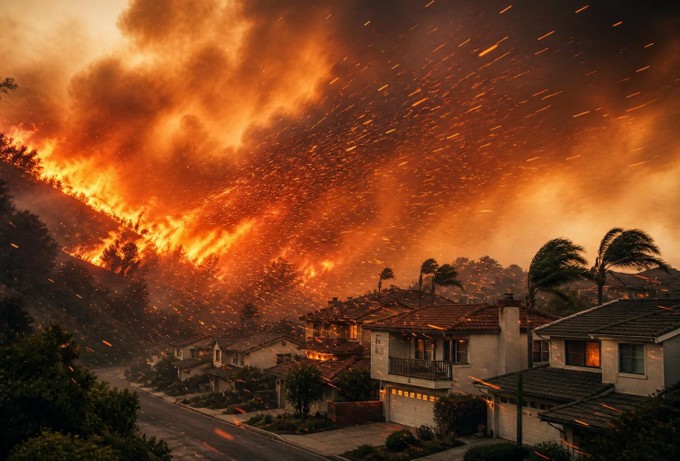
Image courtesy of Patrick Moffett; AI-Generated by Chat GPT
7.0 ZONES OF DESTRUCTION, DAMAGE, AND CONTAMINATION
7.1 Zones and Their Purpose:
Understanding zones in and outside a wildfire or WUI fire are helpful in defining the type and level of destruction, damage, and contamination. Firefighters, for example, commonly divide the incident area into three control zones, the hot zone, warm zone, and cold zone. Hazard assessment specialists may call the burn zone the fire-affected zone, the impact zone, then the smoke deposition zone, buffer zone, and finally the exclusion zone. In fire damage restoration and industrial hygiene assessments, they are commonly known as the burn zone, near-field zone, and the far-field zone. In a WUI fire, the hot zone may include burned lots, damaged structures, ash fields, debris piles, contaminated interiors, and areas where combustion byproducts are still present at hazardous levels.
7.2 Firefighting:
- The “Hot Zone” is the area having the greatest hazards, such as.
- Areas where respiratory protection, PPE, and direct hazard controls are required
- Active flame areas are present
- Burning embers, heavy smoke and ash fallout
- Unstable burned structures
- Areas with downed utilities
- Explosive hazardous materials or chemicals
- The “Warm Zone” is the transition or support area between the hot zone and cold zone. In a WUI fire, the warm zone is often where first responders leave the contaminated area and are decontaminated before entering the clean support area. This may include:
- Decontamination corridors
- Equipment staging
- PPE removal areas
- Entry and exit control points
- Medical monitoring
- Personnel rehabilitation
- Gross decontamination of tools, boots, and clothing
- The “Cold Zone” is the clean or support area outside the immediate hazard area. In a WUI fire, the cold zone should be located upwind and away from smoke, ash, debris, and contaminated runoff whenever possible. This may include:
- Incident command post
- Administrative support
- Clean equipment staging
- Media/public information areas
- Uncontaminated rest areas
- Logistics and planning areas
7.3 Specialists Completing Hazard Assessments:
Terminology often aligns with fire behavior, damage gradients, and industrial hygiene controls, and the agency they are working with, such as FEMA, federal and Cal/EPA, California Office of Emergency Services (Cal/OES), State and County Fire Marshall, and local fire departments, for example:
- Home Ignition Zone (HIZ) is the area (often defined as within 100 feet of a structure) including the building and its immediate surroundings, focusing on mitigation to prevent structure loss.
- Fire Hazard Severity Zone (FHSZ) are maps classifying areas based on fire hazard (fuel, slope, fire weather) into moderate, high, or very high, used to indicate expected fire behavior rather than just risk.
- Noncombustible Zone is a 0–5 foot area around a home where flammable vegetation and materials are removed.
- Island Areas are unburned patches of vegetation or structures within the mapped Burned Area Boundary
Terminology also includes:
- Burn Zone (Fire-Affected / Impact Zone, where the burn zone represents the area within the fire perimeter where combustion has occurred and/or where structures and vegetation have been directly exposed to flame impingement, radiant heat, and convective heating. This area presents the highest level of structural damage, debris instability, and contamination from combustion byproducts.
- Impact Zone (Severe Exposure / Adjacent Damage Zone) that includes areas immediately outside or at the edge of the burn zone where structures may not have burned but were subjected to intense heat, ember intrusion, and heavy smoke impingement. Contamination is often significant despite limited visible fire damage.
- Smoke / Deposition Zone (Downwind Contamination Zone), where this zone extends beyond the visible fire perimeter and is driven by wind and dynamic pressure. It represents areas impacted primarily by transported smoke and airborne combustion byproducts rather than direct flame exposure.
- Buffer / Transitional Zone, which is a gradient area where contamination levels begin to decrease but may still present intermittent or localized hazards that depend on wind shifts, resuspension of ash, or surface disturbance.
- Exclusion Zone (Clean / Background Zone). The exclusion zone is considered outside the influence of the fire in terms of contamination and hazard. It is sometimes used as the baseline or control area for comparison in environmental and industrial hygiene assessments.
7.4 Industrial Hygiene Assessments and the Cleanup and Remediation of Buildings and Contents:
-
Burn Zone (Primary Fire Impact Zone). The burn zone represents the area within the fire perimeter where active combustion and direct thermal destruction occurred. This zone is governed by extreme heat flux, flame impingement, and prolonged combustion, resulting in maximum structural damage and contaminant generation. The size of the burn zone will change as additional vegetation and buildings burn. In the burn zone, there is:
- Complete or partial structural loss
- Ash, char, soot, and debris accumulation
- Pyrolyzed and combusted synthetic materials (plastics, wiring, foams)
- Highest concentrations of combustion byproducts (PM, PAHs, VOCs, SVOCs, heavy metals such as lead and arsenic)
- Unstable structures and debris hazards
- Residual heat and potential ongoing risks
- Homes nearby that experienced direct smoke impingement and thermal exposure
-
Near-Field Zone (Adjacent Impact / High Deposition Zone). The near-field zone extends outward from the burn perimeter and represents areas subjected to intense smoke impingement, radiant heat exposure, and ember intrusion, but without full structural combustion. The near-field zone is generally 1 to 10 kilometers (0.6 to 6.2 miles) away from the burn zone, where downwind thermal pressures, wind, and smoke migrate. This zone is critical because contamination levels can remain substantial despite limited visible property damage. Examples include:
- Flying embers causing secondary fires
- Structures intact but smoke-damaged
- Soot, ash, and fine particulate deposition on surfaces
- Smoke infiltration into interiors, attics, and wall cavities
- HVAC contamination and distribution of particulates
- Heat-related material degradation (warping, off-gassing)
- Elevated concentrations of deposited contaminants (including heavy metals and semi-volatile compounds)
- Significant exposure risk from settled dust and re-aerosolization
- Ongoing off-gassing from materials
- Secondary contamination during cleaning and disturbance
-
Far-Field Zone (Downwind Transport / Deposition Zone). The far-field zone is defined by transport of smoke and combustion byproducts over distance, driven by wind, thermal buoyancy, and atmospheric dispersion. The far-field zone extends beyond the near-field zone, or greater than 6.2 miles. Contamination in the far-field zone is typically more diffuse, but it can still be chemically significant, especially for fine particulates and vapor-phase compounds. When wind conditions are not continuous, and smoke and combustion byproducts are not visible, there should be minimal opportunity to identify:
- Direct flame or heat damage
- Large smoke particulate deposition
- Odor presence
- Visible contamination
7.5 Downwind Effects Resulting in an Inversion Layer:
Temperature inversion occurs when a layer of warmer air overlies cooler air near the surface, suppressing vertical mixing. This traps smoke, particulates, and gases close to the ground, allowing concentrations of smoke contaminants to persist, accumulate, and redistribute laterally. Both the U.S. Environmental Protection Agency and National Oceanic and Atmospheric Administration recognize inversions as a primary driver of degraded air quality during wildfire events. The topography inversion layer along with climate can remain in valleys, low-lying areas, and between mountains and mountain ranges for days and weeks. Normal atmospheric dilution is suppressed where contaminants persist longer than under neutral or unstable atmospheric conditions. This phenomena can create a near-field zone miles away from the hot zone, where smoke containing the mixture of VOCs, SVOCs, PAHs, metals, and combustion particles enters and settles in buildings and contents.
7.6 Summary:
- The burn zone is characterized by severe structural damage, heavy ash and char deposition, and the highest concentrations of hazardous contaminants. It presents the greatest risk to health and safety and requires full hazard controls. This zone defines the origin point of contamination in a WUI event.
- The near-field zone represents an area of significant contamination without full structural loss, where smoke, soot, and fine particulates infiltrate interiors and deposit on surfaces. It often requires professional remediation and detailed hazard assessment, as contamination may not be fully visible but is materially significant.
- The far-field zone is characterized by widespread, lower-level contamination, often without visible damage. While concentrations are reduced compared to closer zones, the geographic extent is much larger, and exposure is primarily through inhalation and settled dust on building exteriors.
- An inversion layer can intensify and prolong contamination in the near-field zone and significantly extend and concentrate impacts in the far-field zone. In valleys or mountainous terrain, far-field areas may temporarily experience exposure conditions similar to near-field environments due to trapped and pooled smoke.
Resources and Technical References:
[1] U.S. Environmental Protection Agency
[2] National Oceanic and Atmospheric Administration
[3] National Institute for Occupational Safety and Health
[4] National Academies of Sciences, Engineering, and Medicine
[5] RIA/IICRC/CIRI “Technical Guide for Wildfire Restoration,” 2025
[6] AIHA “Technical Guide for Wildfire Impact Assessments for the OEHS Professional,” 2025
8.0 HOMES IN THE BURN ZONE: DAMAGE MECHANISMS AND CONTAMINATION
8.1 About Homes In The Burn Zone:
Homes located inside the burn zone of a wildfire or wildland-urban interface (WUI) fire are subjected to the most severe fire exposure conditions, including direct flame contact, prolonged radiant heat, convective heating, and sustained combustion. These exposure mechanisms collectively result in substantially higher damage potential compared to structures located outside the burn perimeter. Fire behavior science establishes that an advancing fire front generates extreme thermal conditions that preheat, dry, and pyrolyze materials ahead of direct flame contact. Heat transfer occurs through radiation and convection, increasing the temperature of structural components and contents to ignition thresholds. Structures within the burn zone are therefore subjected to continuous high heat flux and flame impingement, frequently resulting in full structural involvement and catastrophic loss. Empirical wildfire data confirms the severity of damage within burn zones.
Large-scale analyses of wildfire disasters in the United States demonstrate that structures located within the fire perimeter experience significantly higher rates of destruction due to direct exposure to fire intensity and duration[1]. Documented events, including the Bastrop County Complex Fire, illustrate that a substantial percentage of structures within the burn area were destroyed, reflecting the high loss rates associated with interior burn zones.
High-intensity fire conditions further amplify damage through sustained radiant heat flux and convective heat transfer capable of igniting adjacent materials and maintaining combustion. These conditions result in deformation, melting, cracking, loss of structural integrity, and eventual failure of building components under prolonged exposure.
Research associated with Cornell University confirms that sustained flame contact and high heat flux are primary determinants of structural loss in wildfire events[2]. In contrast, structures located outside the burn zone are generally exposed to indirect fire effects. The National Fire Protection Association identifies that buildings beyond the primary fire front are more commonly affected by ember intrusion, intermittent radiant heat, and smoke, rather than sustained direct flame exposure[3]. As a result, damage patterns outside the burn zone are more variable and typically less severe. The distinction in damage severity is driven by exposure intensity, duration, and fire behavior mechanisms. Within the burn zone, structures are subjected to continuous combustion conditions that significantly reduce survivability.
In addition to structural damaged homes, homes that remain within the burn zone are exposed to contamination from combustion byproducts. The U.S. Environmental Protection Agency identifies wildfire and WUI fire smoke as a complex mixture of particulate matter (PM10, PM2.5), VOCs, PAHs, and other hazardous substances generated during combustion[4]. These contaminants are transported through the atmosphere and deposited onto interior and exterior surfaces.
In WUI fire environments, combustion of structural and synthetic materials introduces additional contaminants, including heavy metals such as lead, copper, and zinc, as well as semi-volatile organic compounds. Cal/EPA and Cal/DPH recognize that post-fire environments may contain hazardous substances resulting from the burning of buildings, vehicles, and household materials[5].
Under the Cal/OSHA framework, these conditions constitute hazardous work environments requiring evaluation and control by employers, and when practical, safety professionals and industrial hygienists. Applicable CCRs include §5141 (Control of Harmful Exposure to Employees), §3203 (Injury and Illness Prevention Program), and §3380 (Personal Protective Equipment). These regulations require identification of hazards, exposure assessment, and implementation of protective measures to reduce exposure risks[6].
8.2 Structures Inside Burn Zone Conditions:
In a WUI fire, a combination of factors result in significantly higher rates of structural destruction, material degradation, and environmental contamination as compared to areas outside the burn perimeter[7][8]. Structures located within the burn zone are subject to:
- Direct flame impingement and sustained combustion
- Prolonged radiant and convective heat exposure
- Continuous high heat flux and thermal degradation of materials
- Increased likelihood of full structural involvement and total loss
- Ignition of structural components, contents, and concealed spaces
- Deposition and absorption of combustion byproducts on and within materials
- Elevated contamination from both natural and anthropogenic fuel sources
8.3 Summary:
- Homes located within the wildfire burn zone are subjected to direct flame contact, prolonged radiant and convective heat exposure, and sustained combustion. These exposure conditions result in significantly higher rates of structural damage and loss compared to homes located outside the burn perimeter[8].
- Scientific and empirical evidence demonstrates that structures within the burn zone experience greater damage due to the intensity, duration, and continuity of fire exposure. In addition to structural damage, homes within the burn zone are exposed to combustion byproducts, including particulate matter, volatile organic compounds, polycyclic aromatic hydrocarbons, and heavy metals[9].
- Contaminants are transported through the atmosphere and deposited onto both exterior and interior building surfaces and contents, resulting in a complex contamination profile. This effect is particularly pronounced in WUI fire environments, where the combustion of structural and synthetic materials contributes additional hazardous substances not typically present in vegetation-only wildfire events[10].
Technical References:
[1] Carlson, A., et al. “Rising rates of wildfire burning destruction in the conterminous United States,” PNAS, 2025
[2] Cornell University “Residential Structure Survivability to Large Wildfire in the United States”
[3] National Fire Protection Association “Wildfire structure ignition and damage mechanisms”
[4] U.S. Environmental Protection Agency “Wildland Fire Research: What’s in Smoke?”
[5] California Environmental Protection Agency; California Department of Public Health “Post-fire environmental health guidance”
[6] Cal/OSHA, California Code of Regulations, Title 8 §§5141, 3203, 3380
[7] Filkov, A., et al. “A review of thermal exposure and fire spread mechanisms in large outdoor fires and the built environment,” International Journal of Fire Safety, 2023
[8] FEMA, “Builder’s Guide to Construction in Wildfire Zones,” FEMA P-737, 2025
[9] U.S. EPA, “Study Shows Some Household Materials Burn in Wildfires Can Be More Toxic Than Others,” 2022
[10] Goftari, E., et al. “Post-Wildfire Indoor Pollution in WUI Areas following the 2025 Los Angeles Fires: Part I,” ACE Publications, 2025
Looking for a reprint of this article?
From high-res PDFs to custom plaques, order your copy today!