Wildfire-Damaged Contents: Cleaning, Safety, and Restoration Limits, Part 6
What restorers should know about worker safety, contents cleaning, and specialized restoration
Part 5 focused on WUI fire smoke that contains a complex mixture of combustion byproducts generated from both vegetative fuels and structural materials, including soot, char, ash, VOCs, SVOCs, PAHs, heavy metals, asbestos fibers, and synthetic combustion residues. These contaminants infiltrate buildings through pressure-driven airflow, HVAC systems, and structural openings, where they deposit onto surfaces, contents, and porous materials. It emphasized the important distinction between limited homeowner cleaning and professional remediation contractor operations, where homeowner cleaning is generally limited to light contamination conditions involving minimal visible soot and odor, and typically includes detergent wiping, laundering, ventilation, and limited HEPA vacuuming. However, homeowner cleaning presents significant limitations, including the lack of a hazard assessment, not having or an inadequate use of appropriate PPE, the inability to address embedded contamination, an increased potential for re-aerosolization and cross-contamination, and the lack of training to remove bonded smoke combustion byproducts. Professional remediation is required when WUI contamination involves moderate to heavy smoke exposure or hazardous substances such as heavy metals and synthetic combustion byproducts. Unlike the homeowner, professional remediation involve a structured, multi-phase process that includes contamination assessment, engineering controls, worker protection, contents triage, removal of contaminated materials, systematic cleaning, odor treatment, and post-remediation verification.
Fire Month
Prepare before wildfires with specially-curated articles during the month of October. Learn more!
17.0 THE HAZARDS CONTENTS CLEANING SPECIALISTS CAN EXPERIENCE WHEN EXPOSED TO WILDFIRE AND WUI FIRES
17.1 Fire Impacted Environments:
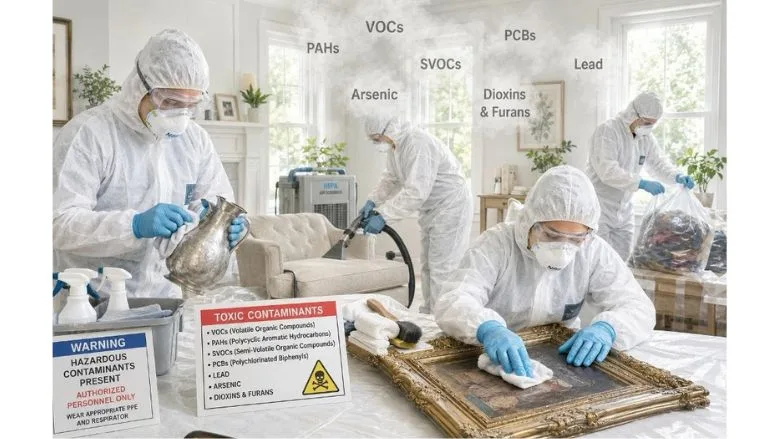
Cleaning fire-impacted environments and contents can expose workers to airborne and surface-deposited combustion byproducts. Smoke, soot, and ash are not ordinary dust. In wildfire and WUI fire losses, residues may contain fine particulate matter, acidic soot, PAHs, VOCs, aldehydes, heavy metals, lead, arsenic, asbestos fibers, dioxins/furans, pesticides, PCBs, and residues from burned plastics, electronics, treated wood, furnishings, vehicles, and household chemicals. CDPH states that burned structural debris can contain hazardous household materials, such as asbestos, heavy metals, PAHs, and PCBs[1][2].
17.2 Primary Worker-Related Hazards During Contents Cleaning Include:
- Inhalation Hazards:
- Dry wiping, brushing, compressed air, leaf blowers, moving contents, or aggressive vacuuming without HEPA filtration can aerosolize soot, ash, lead-containing dust, asbestos fibers, and fine particulate matter. CDPH specifically warns against using leaf blowers because ash can be spread and re-suspended into the air.
- Skin and Eye Contact Hazards:
- Ash and soot can irritate skin and eyes and may contain alkaline or chemical reactive residues. CDPH recommends gloves, long sleeves, long pants, socks, shoes, and washing ash from skin promptly.
- Respiratory Protection Hazards[3]:
-
Employers must protect workers from inhalation hazards associated with airborne contaminants generated during work activities. In wildfire and WUI fire cleanup environments, airborne hazards may include:
- Fine particulate matter (PM2.5 and ultrafine particles), smoke and soot particulates, ash, lead-containing dust, heavy metals, asbestos fibers, PAHs, VOCs, aldehydes, dioxins, furans, mold spores and microbial contaminants, and combustion byproducts from plastics, electronics, treated wood, and household chemicals.
- Regulations require employers to evaluate respiratory hazards and implement feasible engineering controls before relying solely on respirators.
-
Employers must protect workers from inhalation hazards associated with airborne contaminants generated during work activities. In wildfire and WUI fire cleanup environments, airborne hazards may include:
-
Heavy Metal and Lead Exposure Hazards[4]:
- Contents contaminated by WUI fire residues may contain deposited lead, arsenic, cadmium, chromium, copper, zinc, and other metals. Porous and textile contents can retain contaminated dust and become secondary exposure reservoirs.
-
Chemical and Odor Hazards:
- Fire residues may include VOCs, aldehydes, PAHs, acidic gases, chlorinated compounds, and persistent odors. Deodorization methods such as ozone, hydroxyl, or chlorine dioxide may address odor chemistry but do not remove heavy metals, asbestos, or particulate contamination.
-
Cross-Contamination Hazards:
- Moving, packing, laundering, or cleaning contaminated contents without containment and decontamination controls can spread residues to clean rooms, vehicles, storage units, and contractor facilities.
17.3 Regulatory Duties and Applicable Standards
-
For California employers [1][2][3][4][5][6]:
- Fire cleanup work involving smoke, soot, ash, and contaminated contents should be evaluated under Cal/OSHA requirements for injury and illness prevention (IIPP), job hazard assessment (JHA), respiratory protection, PPE, hazardous substances, sanitation, and decontamination. Cal/OSHA’s fire cleanup guidance requires employers to evaluate hazards, use feasible engineering controls, use HEPA vacuuming for ash/soot/dust, and provide appropriate respiratory protection.
- Cal/OSHA states that workers cleaning fire debris should generally be provided elastomeric air-purifying respirators with HEPA or P100-type filtration combined with organic vapor/ formaldehyde cartridges. N95 respirators are limited to areas where only vegetation or untreated wood burned materials are present.
17.4 Summary:
- Contents cleaning specialists working in wildfire and Wildland-Urban Interface (WUI) fire environments may be exposed to hazardous combustion byproducts including soot, ash, fine particulate matter, heavy metals, VOCs, PAHs, asbestos fibers, dioxins/furans, and chemical residues generated from burned vegetation, plastics, electronics, treated wood, furnishings, and household materials. These contaminants may create inhalation, skin, eye, and chemical exposure hazards during cleaning activities.
- Improper cleaning methods such as dry wiping, compressed air, leaf blowers, or non-HEPA vacuuming can aerosolize hazardous particulates and increase worker exposure. Porous and textile contents may retain heavy metals and contaminated dust, creating ongoing secondary exposure risks. Additionally, deodorization methods such as ozone or hydroxyl treatment may reduce odors but do not remove heavy metals, asbestos, or particulate contamination.
- California employers performing fire cleanup operations must comply with Cal/OSHA requirements involving hazard assessment, respiratory protection, PPE, engineering controls, sanitation, and decontamination procedures. Cal/OSHA generally recommends elastomeric respirators equipped with HEPA or P100 filtration and organic vapor cartridges for workers cleaning WUI fire debris and contaminated contents.
Technical References:
[1] Cal/OSHA IIPP 8 CCR 3203 IIPP
[2] Cal/OSHA CCR 5141 Control of Harmful Exposure to Employees
[3] Cal/OSHA CCR 5144 Respiratory Protection
[4] Cal/OSHA CCR 1532.1 Lead in Construction
[5] Cal/OSHA CCR 1529 HazWoper
Looking for quick answers on restoration, remediation and cleaning topics?
Try Ask R&R, our new smart AI search tool.
Ask R&R →
18.0 CLEANABILITY AND LIMITATIONS OF CONTENTS EXPOSED TO A WUI FIRE
18.1 Contents Exposed to a Wildland-Urban Interface (WUI) Fire:[1][2][3][4][5][6][7][8][9]
- Contents (e.g., furniture, appliances, clothing, antiques, musical instruments, works of art, electronics, and other personal property) infiltrates buildings and contaminated or damages contents caused by a complex mixture of combustion byproducts generated from both vegetative fuels and structural/urban materials during a WUI fire. Unlike vegetation-only wildfire smoke, WUI fire residues frequently contain heavy metals, soot, char, ash, PAHs, VOCs, SVOCs, asbestos fibers, dioxins/furans, pesticides, and residues associated with burned plastics, electronics, treated wood, vehicles, roofing materials, insulation, furnishings, and household chemicals.
- Contents exposed to a WUI fire experience a wide range of physical and chemical effects, including no readily observable damage, surface smoke deposition, fine particulate contamination, heat exposure, thermal degradation, odor adsorption, corrosion, discoloration or staining, texture (“hand and feel”) changes, warping or dimensional instability, loss of finish integrity, oxidation, internal contamination of porous and semi-porous materials, and electronic component degradation. Many of these effects may not be immediately visible following a WUI fire. However, the continued presence of combustion residues and chemically reactive contaminants contribute to progressive deterioration over time, where corrosion, staining, odor penetration, finish degradation, and material breakdown may increase or continue to develop over weeks and months following the fire.
- Combustion byproducts generated during WUI fires contain acidic and hygroscopic compounds capable of attracting and retaining moisture from the surrounding air. When deposited onto hard surfaces, electronics, metals, finished wood, artwork, musical instruments, and other contents, these residues may accelerate oxidation, corrosion, tarnishing, etching, and deterioration of coatings and finishes. In electronics and appliances, fine soot particulates and acidic residues infiltrate internal circuitry, switches, relays, cooling fans, and electrical contacts, potentially resulting in latent corrosion, intermittent malfunction, reduced reliability, or premature equipment failure.[7][8][9]
- Porous and semi-porous contents, including textiles, upholstered furniture, carpets, foam cushions, paper products, unfinished wood, and insulation materials absorb smoke gases, VOCs, odors, and fine particulate contamination deep within their internal structure. As a result, cleaning procedures may remove visible surface contamination while residual contaminants remain embedded within fibers, pores, foam cells, adhesives, or internal cavities. Under certain environmental conditions, including elevated temperature and humidity, absorbed compounds may continue to off-gas or migrate back to the surface over time.
- Heat exposure associated with WUI fires also contribute to physical and dimensional changes in contents without direct flame contact. Elevated temperatures and radiant heat may soften plastics, distort synthetic materials, dry and embrittle wood and fabrics, separate laminates and adhesives, degrade coatings and finishes, and alter the dimensional stability of sensitive items such as antiques, musical instruments, artwork, collectibles, and electronics. Some heat-related effects may not become fully apparent until contents are returned to normal occupancy conditions.
- The cleanability and restorability of WUI fire-exposed contents depend upon multiple factors, including the type and concentration of contaminants, duration of exposure, heat intensity, material composition, porosity, finish condition, and the ability to remove contamination while restoring the item to a pre-loss condition. While some non-porous contents can be restored through professional cleaning, deodorization, and decontamination procedures, porous and semi-porous materials continue to retain embedded contamination, odors, heavy metals, or corrosive residues despite repeated cleaning efforts that can further damage finishes and contents.
18.2 Contents Exposed to WUI Fire Char, Soot, Ash, and Heavy Metals:
[7][8][9][10[11][12][13][14][15]16][17]
- In some cases, WUI fire-related contamination is visible, but it can also be microscopic, or not easily observable without detailed inspection, testing, or analytical evaluation. Char and soot particles contain partially burned carbonized materials produced during incomplete combustion. Char particles are typically larger and become more abrasive than soot particles. However, soot particles become microfine abrasives that adhere deeper in porous materials and textiles.
- Ash generated during wildfire and WUI fire events can cause substantial physical, chemical, and aesthetic damage to works of art, antiques, musical instruments, electronics, decorative finishes, and personal contents. Unlike ordinary household dust, WUI fire ash contains a complex mixture of inorganic mineral residue, heavy metals, char, soot, silica, alkaline compounds, acidic combustion byproducts, asbestos fibers, and contaminants generated from burned vegetation, plastics, electronics, vehicles, treated wood, roofing materials, insulation, furnishings, and household chemicals. Ash particles may range from visible coarse debris to microscopic fine particulate matter capable of penetrating sensitive materials, finishes, fabrics, electronics, and internal cavities. In many cases, damage continues to develop after the fire event due to ongoing chemical reactions, moisture attraction, corrosion, and interaction with surface finishes and materials.
- Heavy metals deposited during wildfire or a WUI fire contribute to both physical and chemical damage to contents. Heavy metals generating from burned structures, electronics, vehicles, treated wood, paints, roofing materials, batteries, plumbing components, insulation, appliances, and household chemicals. Because inorganic heavy metals do not evaporate or degrade over time like organic char and soot is capable of, heavy metals deposited contamination can remain embedded within fibers and pores despite repeated cleanings. Heavy metal contamination can continue damaging contents after the fire event because deposited residues remain chemically and physically active. Works of art and antiques may be particularly susceptible to heavy metal contamination because of delicate finishes, porous substrates, and chemically sensitive materials.
18.3 Contents Cleaning Hard Surface Items:
- Soot, char, and ash generated during a wildfire or WUI fire can adhere strongly to hard surfaces where smoke contains acidic combustion byproducts, heavy metals, oils, PAHs, and chemically reactive residues. Improper cleaning methods may spread contamination, scratch finishes, drive residues deeper into surfaces, or accelerate corrosion and staining.
- Removal of soot, char, and ash from hard surfaces generally involves a combination of HEPA vacuuming, controlled damp wiping, detergent cleaning, and specialty restoration techniques designed to minimize aerosolization and prevent damage to finishes and materials. Because WUI fire residues may contain acidic compounds, heavy metals, oils, and chemically reactive contaminants, prompt and proper initial mitigation cleaning is important to reduce ongoing corrosion, staining, odor adsorption, and progressive material deterioration.
- Cleaning methods must be tailored to the type of surface, contamination severity, and sensitivity of the material, because improper cleaning methods can permanently damage finishes or spread contamination further into the material.
- For best results for cleaning, deodorization, and restoring hard surface contents, contents should be delivered to a specialized contents cleaning plant, having proper lighting, ventilation, and staging, allowing detailed attention to clean all sides with the same amount of care.
18.4 Contents Cleaning Semi-Porous Items:
- Soot, char, ash, and heavy metals generated during a wildfire or WUI fire can damage semi-porous contents more extensively than many hard-surfaced contents because semi-porous materials are capable of both surface contamination and subsurface absorption. Unlike non-porous hard surfaces where contaminants primarily remain on exterior surfaces, semi-porous materials may absorb smoke gases, fine particulates, combustion oils, odors, and heavy metal-containing residues into pores, seams, fibers, adhesives, foam layers, unfinished surfaces, and internal cavities.
- Because WUI fires frequently involve combustion of both vegetation and structural materials, smoke and ash residues they can asbestos fibers, and they often contain heavy metals, acidic compounds, PAHs, VOCs, SVOCs, dioxins/furans, and chemically reactive residues capable of causing both immediate and progressive deterioration, including the need to have workers wearing increased levels of PPE.
- Leather and finished wood are semi-porous materials capable of absorbing smoke residues and combustion gases while also experiencing finish-related damage.
- Upholstered furniture and foam-cushioned contents are especially vulnerable because fine particulates and smoke gases may penetrate deeply into foam cushions, batting, cording, backings, and wood framing.
- Semi-porous materials contain microscopic pores, seams, joints, unfinished surfaces, foam layers, adhesives, and internal voids capable of trapping contamination beneath the visible surface. Unlike many hard surfaces, semi-porous materials may retain odor-causing compounds below the cleanable surface layer.
- Semi-porous contents often present greater restoration limitations than non-porous hard surfaces because contamination may extend beneath the cleanable surface.
- Semi-porous contents may experience progressive deterioration after the fire event because contaminants remain trapped within the material’s structure that damage contents over time.
18.5 Contents Cleaning Porous Items:
- Porous contents exposed to wildfire or WUI fire contamination are generally more difficult to clean and restore than hard-surfaced or semi-porous contents, because porous materials readily absorb smoke gases, soot, ash, odors, VOCs, SVOCs, heavy metals, and other combustion byproducts deep into their internal structure.
- Unlike hard-surfaced contents, where contaminants largely remain on accessible exterior surfaces, porous materials allow contaminants to penetrate into fibers, pores, foam cells, air spaces, unfinished surfaces, and internal matrices where removal becomes substantially more difficult or impossible.
- Semi-porous contents exhibit characteristics between the two extremes, allowing partial penetration of contaminants while still retaining some cleanable exterior surfaces. Porous materials, however, frequently become contamination reservoirs capable of retaining and re-releasing smoke residues, odors, particulate matter, and heavy metals over extended periods.
- Among porous contents exposed to wildfire or WUI fire contamination, items capable of being immersion cleaned on all sides generally have the greatest potential to achieve acceptable cleaning results. This is because immersion cleaning allows cleaning solutions to contact a substantially greater portion of the material surface area, including fibers, pores, seams, crevices, and internal surfaces that may not be accessible through ordinary surface wiping or localized cleaning methods.
- Because porous materials readily absorb contaminants beneath the visible surface, cleaning effectiveness is strongly influenced by the ability of the cleaning process to contact and flush contaminants from the full depth and surface area of the material.
- Items capable of full immersion may allow contaminants to be mobilized and removed from areas otherwise inaccessible during HEPA vacuuming or damp towel cleaning. Even when immersion cleaning achieves visibly acceptable results, post-cleaning verification limitations may still exist because microscopic contamination may remain embedded within the material.
18.6 Summary:
- Porous contents that are capable of being immersion cleaned on all sides generally have the greatest potential among porous materials to achieve acceptable post-cleaning results, because immersion allows cleaning solutions to contact and flush substantially more of the contaminated material surface area, fibers, and pores than ordinary surface cleaning methods.
- Immersion cleaning can generally improve the removal of soot, ash, smoke residues, and odor-causing compounds by increasing penetration and flushing action throughout the material structure.
- However, important limitations remain because deeply embedded heavy metals, combustion residues, and chemically bonded contaminants may still persist within porous materials despite extensive cleaning.
- The overall effectiveness of immersion cleaning depends upon the type of material, contamination severity, ability to safely wet-clean the item, and the extent to which contaminants have penetrated into the internal structure of the content.
- While immersion cleaning is the most accepted cleaning and deodorizing process for textiles, not all contents can be immersion cleaned without causing further damage or deterioration.
Technical References:
[1] EPA “Wildfire Smoke: A Guide for Public Health Officials”
[2] EPA “Indoor Air Quality and Wildfire Smoke Guidance”
[3] CDPH “Wildfire Cleanup Guidance”
[4] NASEM “The Chemistry of Fires at the Wildland-Urban Interface”
[5] NOAA “Fire Emissions and Smoke Chemistry Literature”
[6] NIST “WUI Fire Research”
[7] IEEE “Electronics Corrosion Literature”
[8] RIA “Electronics Restoration Guidance”
[9] UL Fire Safety Research Institute (UL FSRI) “Fire Contamination Research”
[10] SFPE “Fire Protection Engineering Literature”
[11] UL FSRI “Smoke and Combustion Research”
[12] ANSI/IICRC S700 “Standard for Professional Fire and Smoke Damage Restoration”
[13] EPA “Lead Dust Guidance”
[14] HUD “Guidelines for the Evaluation and Control of Lead-Based Paint Hazards in Housing”
[15] OSHA “Technical Manual — Lead”
[16] ATSDR “Toxicological Profiles for Lead, Arsenic, Cadmium, Chromium, and Mercury”
[17] NIST “Thermal Exposure and Material Behavior Studies”
19.0 BENEFITS AND CHALLENGES IN CLEANING WILDFIRE AND WUI FIRE IMPACTED OR DAMAGED CONTENTS ONSITE VERSUS CLEANING CONTENTS IN A SPECIALIZED CLEANING PLANT
19.1 Conditions and Challenges [1][2][3][4][5][6][7][8][9][10][11][12][13][14][15][16][17][18][19][20][21]
Wildfires and WUI fires can contaminate contents with a complex mixture of smoke, soot, char, ash, heavy metals, PAHs, VOCs, SVOCs, asbestos fibers, dioxins/furans, along with combustion byproducts generated from burned vegetation, structures, plastics, electronics, treated wood, vehicles, roofing materials, and household chemicals. Contaminants deposit onto or become absorbed into furniture, textiles, electronics, artwork, appliances, antiques, musical instruments, and other personal property.
Following a wildfire or WUI fire, significant restoration decisions must be made on whether contents should be cleaned and deodorized onsite, or they should be packed out, cleaned, deodorized and stored in a specialized contents cleaning plant. Each approach presents advantages, limitations, logistical concerns, contamination control challenges, and restoration implications. The selection of the cleaning location depends upon ongoing contamination from outside the building, heat damage, contamination severity, type of contents, building condition, available equipment, worker safety concerns, cross-contamination risks, and the ability to properly clean, deodorize, and restore contents back to their pre-loss condition.
19.2 Benefits of Cleaning Contents Onsite
-
Reduced Handling and Transportation Risks:
One advantage of onsite cleaning is that contents remain within the structure, where it reduces the need for repeated handling, packing, loading, transportation, and unloading, where it may reduce the potential for breakage, scratching, denting, theft or loss, inventory errors, transportation damage, and the mishandling of fragile contents. Large, delicate, or difficult-to-move items such as pianos, built-in furniture, antiques, artwork, and oversized electronics may benefit from limited movement.
-
Immediate Access to Contents:
Onsite cleaning may allow homeowners, adjusters, and contractors to maintain easier access to contents during the restoration process. This may be important when the homeowner requires access to certain items, business operations continue, high-value items require containments where air scrubbers, temperature and humidity are required, frequent inspections, or insurance documentation is ongoing. Immediate access may simplify communication regarding contents that are restorable versus separating non-restorable items into the total loss group.
-
Reduced Pack-Out Costs:
Cleaning contents onsite may reduce certain costs associated with packing materials, transportation, inventory systems, offsite storage, loading and unloading labor.
For lightly contaminated hard-surfaced contents, such as dishes and silverware, onsite cleaning may provide an economical and efficient approach.
-
Suitable Cleaning and Storage Process for Limited or Light Contamination:
Onsite cleaning may be appropriate when dry smoke contamination is minimal, smoke odor is light, moderate to heavy soot deposition is absent, regulated contamination (asbestos, lead) and hazardous substances are not present, contents are primarily hard-surface, where they are easily accessible on all sides. In these situations, HEPA vacuuming and detergent cleaning may achieve acceptable results without full pack-out operations.
19.3 Problems and Limitations of Onsite Cleaning
-
Cross-Contamination Risks:
One of the primary concerns involving onsite cleaning is the increased risk of cross-contamination. Without proper containment and engineering controls, cleaning activities may spread contaminants to newly cleaned surfaces in rooms that were cleaned, HVAC systems, adjacent contents, occupied areas, cross-contamination from toot traffic and movement. Activities such as moving contents, HEPA vacuuming, wiping, or compressed air cleaning may re-aerosolize soot, ash, heavy metals, and fine particulate matter into the indoor environment.
-
Limited Environmental Controls:
Unlike specialized cleaning plants, onsite environments frequently lack controlled ventilation, adequate lighting, dedicated cleaning stations, worker and content decontamination chambers, advanced filtration systems for workers and contents, ultrasonic cleaning systems, humidity and temperature control. As a result, cleaning quality and efficiency may be reduced.
-
Difficulty Cleaning All Surfaces:
Cleaning contents onsite often limits access to all sides and internal components of contents. Examples include furniture backs and undersides, interior drawers and cavities, foam cushions, electronics interiors, hidden crevices and seams. This may result in residual contamination and smoke odors remaining on or in inaccessible surfaces.
-
Worker Safety Concerns:
Onsite cleaning in contaminated structures may expose workers to regulated substances (e.g., asbestos, lead), fine particulates, heavy metals, VOCs and SVOCs, mold contamination, structural instability, heat-damaged materials. Federal OSHA and Cal/OSHA regulations require respiratory protection, engineering controls, PPE, decontamination procedures, and hazard assessments during onsite cleaning operations.
-
Reduced Efficiency:
Workers may feel that cleaning contents onsite poses less risks where their level of worker protection and PPE diminishes. Cleaning contents onsite may become inefficient because workers often operate in confined or cluttered environments having limited staging areas. Therefore, productivity may be reduced by not having the proper cleaning tables and space within a room, lack of indoor ventilation, inadequate lighting, electrical limitations, boxing and removing contents to a safe cleaned space, and ongoing cleaning activities in the building.
19.4 Benefits of Cleaning Contents in a Specialized Cleaning Plant
-
Controlled Cleaning Environment:
Specialized contents cleaning plants are designed specifically for restoration operations, where they provide a cleaned space that does not contain smoke-related combustion byproducts and odors. It has clean air that is conducive for cleaning, controlled airflow, specialized lighting, large staging area for unboxing contents, completing a detailed inspection, identifying contents requiring specialized cleaning, conservation, deodorization, or restoration. Isolation of contents requiring environmental testing for hazardous or regulated contaminants. Having the staging area and cleaning plant under controlled humidity and temperature, where HEPA-vacuuming, damp wiping or wet washing, ultrasonic cleaning systems are in. These control methods improve both cleaning effectiveness and contamination management.
-
Improved Access to Contents:
Cleaning plants allow technicians to clean contents, all sides of contents, disassemble electronics and furniture, rotate and inspect items thoroughly, perform immersion cleaning where appropriate, and isolate heavily contaminated materials. This generally improves cleaning quality and restoration consistency.
-
Better Cleaning of Porous and Semi-Porous Contents:
Porous and semi-porous contents often require immersion cleaning in cool or warm temperature bath, ultrasonic cleaning, specialized deodorization, controlled drying, and detailed inspection. These processes are difficult or impossible to perform properly onsite. Items such as textiles, upholstered furniture, rugs, musical instruments, antiques, and electronics may achieve better restoration results in a dedicated cleaning plant.
-
Improved Odor and Deodorization Control:
Specialized cleaning plants often contain ozone and hydroxyl chambers, chlorine dioxide treatment systems, activated carbon filtration, temperature and humidity controlled drying rooms. These systems may improve odor reduction while controlling exposure and preventing contamination spread within occupied structures.
-
Reduced Cross-Contamination:
Removing contaminated contents from the structure reduces the spread of soot, ash, and particulates during cleaning operations inside the building. In the cleaning plant having controlled conditions it improves the indoor air quality, provides for better worker safety, a higher level of contents cleaning, carefully storing items where cross-contamination issues are eliminated.
19.5 Potential Problems and Limitations of Cleaning Plant Operations
-
Increased Handling and Transportation Risks:
Pack-out operations increase the potential for breakage, loss, inventory discrepancies, transportation damage, or misidentification of contents. Fragile or high-value items may require specialized packing and transportation procedures.
-
Increased Cost:
Cleaning plant operations generally involve additional expenses associated with inventory management, packing materials, transportation, storage, tracking systems, and climate-controlled warehousing. These costs may become substantial on large losses.
-
Delays and Logistical Complexity
Pack-out operations may introduce scheduling and logistical challenges involving transportation coordination, inventory tracking, storage duration, return scheduling, and customer access limitations. Delays may occur during large wildfire events when restoration facilities become overwhelmed.
-
Not All Contents Are Restorable
Even within specialized cleaning plants, some contents may remain non-restorable due to chipping, damaged or missing parts, embedded heavy metals, persistent odors, heat damage, corrosion, finish degradation, structural instability, delamination, and electronic reliability concerns, including the use of hard drives. Porous materials may continue retaining contamination despite extensive cleaning efforts.
19.6 Summary
- Both onsite cleaning and specialized cleaning plant operations play important roles in wildfire and WUI fire contents restoration. Onsite cleaning may be appropriate for lightly contaminated hard-surfaced contents where contamination is limited, and cross-contamination risks can be controlled. However, onsite cleaning often presents limitations involving environmental controls, worker safety, cleaning access, and contamination management, odor removal, and detailed cleaning.
- Specialized cleaning plants generally provide superior conditions for cleaning, deodorization, inspection, disassembly, immersion cleaning, and restoration of contaminated contents, particularly porous and semi-porous materials. Controlled environments, specialized equipment, and improved contamination management often result in more thorough cleaning and better restoration outcomes.
- Ultimately, the decision to clean contents onsite versus in a specialized cleaning plant should be based upon contamination severity, content type, restoration objectives, worker safety considerations, environmental controls, and the ability to restore contents to a safe and acceptable pre-loss condition.
Technical References:
[1] ANSI/IICRC S700 Standard for Professional Fire and Smoke Damage Restoration
[2] ATSDR Toxicological Profiles for Heavy Metals
[3] California Department of Public Health (CDPH) Wildfire Cleanup Guidance
[4] EPA Lead Dust Guidance
[5] EPA Wildfire Smoke: A Guide for Public Health Officials
[6] EPA Wildfire Smoke and Indoor Air Quality Guidance
[7] FEMA Homeowner’s Guide to Risk Reduction and Remediation of Residential Smoke Damage
[8] HUD Guidelines for the Evaluation and Control of Lead-Based Paint Hazards in Housing
[9] IEEE Electronics Reliability Literature
[10] IICRC, RIA, CIRI Technical Guide for Safe Wildfire Restoration
[11] IICRC Fire & Smoke Damage Restoration course
[12] NASEM The Chemistry of Fires at the Wildland-Urban Interface
[13] NOAA Wildfire Emissions Literature
[14] NIST WUI Fire Research
[15] OSHA Technical Manual
[16] RIA Guidelines for Fire & Smoke Damage Repair
[17] RIA Fire and Smoke Restoration Technical Literature
[18] RIA Contents Processing and Pack-Out Guidance
[19] RIA Electronics Restoration Guidance
[20] RIA Fire Loss Specialist course
[21] UL Fire Safety Research Institute (UL FSRI) Combustion Research
20.0 CLEANABILITY AND LIMITATIONS OF ELECTRONICS CLEANING AFTER EXPOSURE TO A WILDFIRE OR A WUI FIRE
20.1 Electronics Are Vulnerable to Soot, Ash, Heavy Metals, and Conductive Combustion Residues Because Of: [1][2][3][4][5][6][7][8][9][10][11][12][13][14][15][16][17][18][19][20]
- Their internal cooling systems and ventilation pathways continuously pull contaminated air and fine particulates into the equipment during operation. Modern electronic components operate at extremely small electrical tolerances where microscopic contamination can interfere with circuit performance and signal stability.
- Fine soot and ash particles are capable of penetrating deeply into circuit boards, connectors, relays, switches, fans, heat sinks, and internal compartments where contaminants are difficult to detect and remove. WUI fire combustion residues frequently contain acidic and chemically reactive compounds capable of causing corrosion, oxidation, pitting, and deterioration of metallic components.
- Heavy metals deposited within electronics may create conductive residue films that contribute to electrical leakage, short circuits, signal interference, overheating, and reduced circuit reliability.
- Smoke residues are often hygroscopic, meaning they attract and retain moisture from the surrounding air, which may accelerate corrosion and latent electrical failures over time.
- Fine combustion particulates may obstruct cooling fans, air channels, and heat sinks, reducing cooling efficiency and increasing thermal stress on components.
- Soot, smoke oils, and combustion gases may adsorb into plastics, wire insulation, foam materials, rubber seals, and internal insulation, resulting in persistent odors and long-term off-gassing.
- Corrosion and electrical degradation may continue developing long after the fire, even when electronics initially appears functional and visually cleanable.
- Exterior surface cleaning alone often fails to remove contamination hidden within internal circuitry, cooling systems, and enclosed electronic assemblies.
20.2 Inspection and Assessment of Electronics and Appliances
- After a wildfire or WUI fire, exposure of electrical and electronic items should be completed by qualified experts, because the longer they remain exposed to combustion byproducts, the greater the chance that permanent damage can develop.
- Soot, ash, char, heavy metals, acidic combustion byproducts, and fine particulate matter infiltrate internal components, cooling systems, wiring pathways, insulation cavities, and concealed mechanical assemblies.
- Unlike ordinary household dust, wildfire and WUI fire residues, they contain conductive, hygroscopic, and chemically reactive contaminants that are capable of causing corrosion, oxidation, electrical leakage, overheating, latent malfunction, and long-term reliability problems.
- The complexity of inspection and cleaning generally increases with appliance size, internal airflow systems, electrical sensitivity, and the presence of inaccessible internal compartments.
- However, the size of electronic items are not always indicative of the complexities in cleaning, such as when computers, tablets, cell phones, watches, etc., contain microfine circuitry that are not accessible to general cleaning methods to remove corrosion and contaminants.
- Before handling electronics and appliances, inspection begins by evaluating external conditions, such as observing heat discoloration, blistering, change of shape, the presence of soot, char, ash, and other forms of visual damage or contamination. Once identified, they should be documented using distant and closeup photographs.
- Unforeseen damage or contamination are conditions not seen by the naked eye, because of layered smoke residue or contaminants existing inside the case.
- Before handling electronics and appliances, they should have their electrical, water, and gas power turned off. This includes battery powered appliances and tools that can retain energized energy. Some items reportedly require hours to dissipate backup power.
20.3 Electronics and Appliance Cleaning Processes:
- Electronic appliance cleaning should be completed following manufacturer and industry recognized cleaning methods. However, recommended cleaning methods for removing wildfire and WUI fire contamination is not provided by manufacturers, where guidance is provided through customary practices provided by IEEE, IICRC, RIA, and IPC International.
- Cleaning inspection procedures should first consider the ability of soot, ash, char, heavy metals, acidic combustion byproducts and fine particulate matter to infiltrate internal circuitry, cooling systems, insulation cavities, wiring pathways, motors, switches, relays, and electronic assemblies.
20.4 Summary:
- Electronics and electrical appliances exposed to wildfire and WUI fire contamination are highly vulnerable to damage because modern electronic systems continuously draw contaminated air and fine particulate matter into internal components during operation. Fine soot, ash, char, heavy metals, and acidic combustion byproducts may infiltrate circuit boards, cooling fans, relays, switches, heat sinks, wiring pathways, and concealed compartments where contaminants are difficult to detect and remove. Unlike ordinary household dust, WUI fire residues may contain hygroscopic, corrosive, and electrically conductive materials generated from burned vegetation, plastics, wiring, insulation, appliances, batteries, and synthetic construction materials, which can contribute to corrosion, oxidation, electrical leakage, overheating, signal instability, and latent equipment failure over time.
- Inspection and evaluation of fire-exposed electronics should generally be completed by qualified professionals familiar with smoke and combustion contamination because damage may continue developing long after the fire event. Fine combustion residues can penetrate deeply into microelectronic assemblies and low-voltage circuitry where even microscopic contamination may interfere with electrical tolerances and long-term reliability. Exterior surface cleaning alone is often insufficient because contamination may remain hidden within internal compartments, cooling systems, insulation cavities, and electronic assemblies. The complexity of cleaning and restoration may increase depending upon equipment sensitivity, internal airflow systems, accessibility of internal components, and the presence of corrosive fire-related residues.
- Industry guidance for cleaning electronics exposed to wildfire or WUI fire contamination is generally based upon accepted restoration and electronics-cleaning practices rather than manufacturer-specific wildfire cleaning protocols. Organizations such as IEEE, IICRC, RIA, and IPC provide guidance concerning contamination control, corrosion concerns, and electronics restoration procedures. When practical, specialized ultrasonic cleaning systems may be used to remove soot and particulate contamination from electronic components following disassembly and compatibility evaluation. However, cleaning may not fully eliminate corrosion, conductive residues, odor adsorption, or long-term reliability concerns associated with WUI fire exposure.
- The limitations of cleaning and returning electrical and electronic items back to pre-fire loss conditions should be clearly stated in the restorer’s agreement.
Technical References:
[1] ASM International Handbook “Corrosion: Fundamentals, Testing, and Protection”
[2] Budd, T., et. al. “Electronic Equipment Contamination Following Structure Fires”
[3] EPA Wildfire Smoke Guidance and Indoor Air Quality Publications
[4] EPRI — Electric Power Research Institute
[5] FEMA Recovery and Cleaning Guidance Following Fire Events
[6] Hook, D., et. al. “Corrosion of Electronics by Fire Smoke Residues.” Journal of Loss Prevention in the Process Industries
[7] IEC 60721 Series Classification of Environmental Conditions
[8] IEEE Transactions on Components, Packaging and Manufacturing Technology
[9] IICRC ANSI/IICRC S700 Standard for Professional Fire and Smoke Damage Restoration
[10] IPC IPC J-STD-001
[11] IPC IPC-A-610 — Acceptability of Electronic Assemblies
[12] Manufacturer Service Guidance (varies by manufacturer), such as Dell Technologies, HP Inc., Apple Inc., Cisco Systems, Siemens, and Schneider Electric
[13] Mil-Std-1246C Product Cleanliness Levels and Contamination Control Program; U.S. military contamination control standard frequently referenced in precision electronics cleaning
[14] NASA STD-8739 Series — Workmanship Standards for Electrical and Electronic Assemblies
[15] NFPA Fire Protection Handbook
[16] NIST fire science and smoke contamination research
[17] OSHA Technical Manual — Hazardous materials and electrical safety guidance
[18] UL Solutions Fire and smoke research publications involving electrical system damage and contamination
21.0 HANDLING, CLEANING, AND RESTORATION LIMITATIONS OF WORKS OF ART AND ANTIQUES FOLLOWING WILDFIRE AND WUI FIRE EXPOSURE [1][2][3][4][5][6][7][8]
21.1 Works of Art and Antiques Are Susceptible to Wildfire or WUI Fires Heat and Contaminants:
- Works of art and antiques are susceptible to wildfire or WUI fire heat and contaminants because they are often composed of aged, fragile, porous, semi-porous, chemically sensitive, and historically significant materials that readily absorb, retain, or react to smoke, soot, ash, acidic gases, moisture, heat, and combustion byproducts. Unlike many modern manufactured items, fine art and antiques frequently contain natural fibers, unfinished wood, aged varnishes, shellac, lacquer, waxes, oils, glues, paper products, hand-applied pigments, oxidation-sensitive metals, and delicate finishes that may deteriorate, discolor, corrode, warp, crack, delaminate, or chemically react when exposed to elevated temperatures and fire-generated contaminants.
- Wildfire and WUI fire environments generate complex mixtures of combustion byproducts that may include carbonaceous soot, ultrafine particulate matter, VOCs, PAHs, acidic residues, heavy metals, dioxins, furans, and synthetic combustion byproducts resulting from the burning of plastics, electronics, treated wood, household chemicals, insulation, and building materials. These contaminants may infiltrate porous and semi-porous surfaces through adsorption, capillary action, electrostatic attraction, and airflow-driven deposition, becoming embedded within wood grain, canvas fibers, textiles, paper layers, upholstery, cracks, joints, and decorative finishes.
- Exposure to heat during wildfire or WUI fire may additionally weaken structural integrity and accelerate material degradation. Elevated temperatures can soften varnishes, blister finishes, expand and contract wood components, distort canvas, loosen adhesives, damage gilding, increase brittleness of paper, and accelerate corrosion of metals. Fine art and antiques are particularly vulnerable because aging materials often lack the dimensional stability, protective coatings, and heat resistance found in many modern products. As a result, even limited wildfire or WUI fire exposure may cause permanent physical damage, contamination, odor absorption, staining, loss of patina, reduction in historical authenticity, and diminished collectible or market value.
21.2 Before Handling Artwork and Antiques Exposed to Wildfire or WUI Fire Conditions:
- Technicians should be properly trained in the handling procedures intended to minimize additional damage, contamination transfer, personal injury, and loss of historical or monetary value. Training includes the proper use of protective gloves, controlled lifting methods, stabilization procedures, contamination awareness, and safe transport practices for fragile or irreplaceable objects. Gloves include white cotton disposable single-use gloves that will not transfer had and fingerprints into frames. When required using nitrile or other appropriate conservation-grade protective gloves that reduce the transfer of combustion byproduct oils, soot, heavy metals, and other contaminants workers’ hands can transfer or embed onto sensitive surfaces.
- Handling operations should generally be performed by teams of two or more individuals when moving large, fragile, unstable, or valuable artwork and antique items. Team lifting procedures help reduce twisting, impact loading, dropping, flexing, and uneven weight distribution that may crack frames, damage joints, loosen veneers, distort canvas, or fracture delicate materials. Workers should be trained to support objects from structurally stable areas rather than lifting from decorative trim, handles, frames, protrusions, glass sections, or weakened components.
- Highly valued, rare, museum-quality, or historically significant artwork and antique items should only be removed, handled, stabilized, transported, cleaned, or restored under the direction of a qualified conservator or similarly trained preservation specialist. Conservators are specifically trained in the identification of fragile materials, historical construction methods, age-related deterioration, environmental sensitivities, and restoration limitations associated with culturally significant objects. Their involvement is important because improper handling, packaging, cleaning, or movement may result in irreversible damage, loss of provenance, diminished historical authenticity, or substantial reduction in market and collector value.
- Wildfire and WUI fire exposure may significantly weaken the structural stability of artwork and antiques through heat exposure, smoke infiltration, soot deposition, moisture absorption, corrosion, finish degradation, and thermal stress. Items that appear visually intact may contain hidden fractures, weakened adhesives, unstable paint layers, embrittled paper, loosened joints, or fragile decorative elements that can fail during movement. Conservators may evaluate these conditions before relocation and determine appropriate stabilization, handling orientation, environmental controls, protective wrapping materials, vibration control methods, and transport procedures.
- Conservator oversight is particularly important for paintings, sculptures, historical documents, rare books, antique furniture, textiles, photographs, religious artifacts, archival materials, and culturally significant collections where preservation of original materials and historical integrity is critical. In many cases, conservation practices prioritize stabilization and preservation over aggressive cleaning or restoration in order to minimize further deterioration and maintain the authenticity and evidentiary value of the object.
- Additional training should include proper dismantling and removal of artwork from walls, including stabilization of hanging hardware, securing loose framing components, protecting glazing materials, and maintaining control of the object during removal. Technicians should also be trained in safely lifting items from tables, shelving, cabinets, pedestals, and flooring surfaces without dragging, sliding, tilting, or applying pressure to fragile areas. Fire-related contamination, elevated heat exposure, moisture damage, and aging materials may significantly weaken structural integrity, making artwork and antiques more susceptible to cracking, separation, collapse, finish loss, or hidden damage during handling and transport.
21.3 Exposure and Cleaning Challenges:
- Works of art and antiques include paintings, sculptures, textiles, paper documents, photographs, wood furniture, porcelain, ceramics, bronze, silver, clocks, musical instruments, rare books, collectibles, and historically significant decorative objects. Many of these materials are porous or semi-porous and can absorb smoke residues, acidic vapors, VOCs, and combustion-generated particulates deep into their structure. WUI fire residues may additionally contain heavy metals, ultrafine particulates, corrosive compounds, and chemically reactive contaminants capable of causing long-term degradation.
- Works of art and antiques present highly specialized restoration and preservation challenges. Unlike ordinary household contents, works of art and antiques are often irreplaceable, historically significant, emotionally valuable, and composed of aged or fragile materials that are highly susceptible to permanent alteration from heat, smoke, soot, ash, moisture, and cleaning activities. Once exposed to combustion byproducts generated from vegetation fires, but also to contaminants generated from the burning of synthetic construction materials, plastics, electronics, treated wood, paints, fuels, vehicles, household chemicals, and metals, they require specialized cleaning, deodorization, and stabilization.
- Fine art and antique materials are frequently more vulnerable to wildfire and WUI fire contamination than modern manufactured goods due to age-related deterioration, fragile finishes, oxidation, embrittlement, prior repairs, and sensitivity to moisture, heat, and chemical exposure. Many antique materials contain natural fibers, shellac finishes, lacquer coatings, waxes, oils, aged varnishes, glues, pigments, and oxidation-sensitive metals that can react adversely to smoke residues and restoration chemicals. Fire-related contaminants are often acidic, hygroscopic, corrosive, and adhesive in nature. These contaminants may bond to surfaces through electrostatic attraction, capillary action, surface tension, adsorption, and Van der Waals forces. Soot and smoke residues may penetrate cracks, unfinished wood surfaces, canvas fibers, paper layers, textiles, and hidden cavities where complete removal may not be technically achievable without damaging the object itself. Cleaning limitations are especially important because restoration activities involving abrasion, wet cleaning, solvents, oxidizers, ozone, hydroxyl generators, or thermal treatments may permanently alter original finishes, patina, pigments, glazes, varnishes, or aged materials. Museums, conservation laboratories, and professional art conservators generally prioritize stabilization and preservation over aggressive cleaning where restoration activities could damage historical authenticity or market value.
- Therefore, the handling, cleaning, stabilization, and restoration of works of art and antiques require specialized evaluation procedures, controlled environmental conditions, conservation-based methodologies, and recognition of the limitations associated with restoration activities. Improper handling or aggressive cleaning may permanently reduce historical integrity, artistic value, provenance, finish quality, or collector value.
21.4 Summary:
- Works of art and antiques exposed to wildfire or WUI fire conditions present highly specialized handling, cleaning, and restoration challenges due to the fragile and historically significant nature of the materials involved. These items are often composed of aged wood, paper, textiles, varnishes, shellac, oils, pigments, metals, and delicate finishes that can readily absorb or react to smoke, soot, ash, acidic gases, VOCs, heavy metals, and other combustion byproducts. Exposure to elevated temperatures may additionally weaken structural integrity by softening varnishes, loosening adhesives, distorting canvas, accelerating corrosion, and increasing brittleness of fragile materials. As a result, even limited wildfire or WUI fire exposure may permanently affect the physical condition, historical authenticity, and collectible value of artwork and antiques.
- Proper handling procedures are critical to minimize additional damage during inspection, removal, transport, and cleaning operations. Technicians should be trained in the use of protective gloves, controlled lifting methods, stabilization procedures, contamination awareness, and safe movement practices for fragile objects. Handling operations involving large, unstable, or valuable items should generally be performed by teams of two or more individuals to reduce the risk of twisting, dropping, flexing, or uneven loading that could damage frames, veneers, paint layers, or decorative components. Additional training should include the proper dismantling and removal of artwork from walls, safe lifting from tables and flooring surfaces, and protection of glazing materials and structural supports. Highly valued, museum-quality, or historically significant objects should only be handled or relocated under the direction of a qualified conservator due to the risk of irreversible damage or diminished historical integrity.
- Cleaning and restoration limitations are significant because many fire-related contaminants penetrate deeply into porous and semi-porous materials where complete removal may not be achievable without harming the object itself. Smoke residues and combustion byproducts may bond to surfaces through adsorption, electrostatic attraction, capillary action, and other physical mechanisms, becoming embedded within wood grain, textiles, paper fibers, canvas, and decorative finishes. Aggressive cleaning methods involving abrasion, solvents, oxidizers, ozone, hydroxyl generators, or thermal treatments may permanently alter original finishes, patina, pigments, glazes, varnishes, or aged materials. For this reason, museums, conservation laboratories, and professional conservators generally prioritize stabilization and preservation over aggressive restoration procedures in order to maintain the authenticity, provenance, and historical value of the object.
Technical References:
[1] American Institute for Conservation (AIC) Guidelines for Practice and Code of Ethics
[2] National Park Service (NPS) Museum Handbook, Conservation and Collections Care
[3] Smithsonian Institution Collections Care and Fire Recovery Guidance
[4] Library of Congress Preservation Directorate Emergency Response and Salvage Procedures
[5] Canadian Conservation Institute (CCI) Technical Bulletins on Fire Recovery and Soot Damage
[6] National Fire Protection Association (NFPA) Fire Dynamics and Smoke Damage Resources
[7] EPA Wildfire Smoke and Indoor Environmental Contamination Guidance
[8] IICRC ANSI/IICRC S700 Standard for Professional Fire and Smoke Damage Restoration
22.0 FOLLOWING WILDFIRE AND WUI FIRE EXPOSURE, THE ASSESSMENT, HANDLING, MITIGATION CLEANING, AND REMOVING MUSICAL INSTRUMENTS
22.1 Exposure of Musical Instruments to Wildfire or WUI Fire Conditions:
- Musical instruments are highly sensitive to changes in temperature, relative humidity, particulate contamination, and corrosive residues. Wildfire and WUI fire contaminants can infiltrate internal cavities and mechanical assemblies that cannot be fully accessed without partial or complete disassembly of the instrument. Smoke residues include dry and oily residues that can alter acoustic performance by affecting vibrating surfaces, strings, reeds, felts, pads, bridges, soundboards, and internal air chambers.
- Heat exposure may weaken adhesives, distort wood components, damage finishes, and alter dimensional tolerances required for tuning stability and mechanical operation.
- Fine soot and ultrafine particulate matter may become embedded in felt, cloth, unfinished wood, key assemblies, tuning mechanisms, and internal acoustic chambers.
- Acidic combustion residues may accelerate corrosion of strings, tuning pins, brass surfaces, electrical contacts, and electronic circuitry associated with amplified or digital instruments.
- Cleaning methods to remove smoke byproducts may permanently damage finishes, remove patina, alter acoustics, or reduce historical and collector value.
22.2 Documentation Before Handling Includes:
- Prior to handling or movement of musical instruments, they should be visually inspected and photo documented, as to their relationship in a room having smoke or soot impaction or heat damage.
- Musical instruments should then be inspected for heat discoloration, smoke staining, soot deposition, ash accumulation, moisture intrusion, corrosion, warping, swelling, finish blistering, odor penetration, structural instability, cracking or separation of glued joints, and evidence of thermal stress.
- Inspection should evaluate whether residues affecting musical instruments are dry, oily, sticky, acidic, or chemically reactive.
- Technicians should avoid touching instruments with bare hands that were exposed to fire residues, or they have normal skin oils, because their hands can transfer soot contaminants permanently onto finishes.
- Technicians should avoid energizing (turning on) electronic keyboards, amplifiers, synthesizers, organs, or electrically powered instruments until internal inspection is completed by professionals, because conductive soot and corrosive residues may create electrical hazards or component failure.
- Technicians should collect distant and close-up photos showing manufacturer identification, model number, serial number, and any existing damage that may be pre-loss, or a result of the loss.
22.3 Containment, Particulate, VOCs, Humidity, and Temperature Control:
- In situations were valued and historically significant musical instruments cannot be removed to a safe temperature and humidity-controlled environment, it is recommended that a containment be constructed which allows HEPA and carbon filtered air scrubbers to capture airborne particulate including VOCs and PAHs, where ideal humidity (e.g., 40 to 60%) and temperature (e.g., 60 to 70F) can be maintained.
22.4 Specialized Inspection and Onsite Cleaning:
- Unlike ordinary household contents, musical instruments are often constructed from unfinished woods, delicate finishes, glues, felt materials, strings, leather, adhesives, lacquers, shellac coatings, natural fibers, and corrosion-sensitive metals that may readily absorb smoke residues, odors, acidic vapors, soot, ash, moisture, and combustion-generated contaminants.
- Grand pianos, upright pianos, violins, guitars, woodwinds, brass instruments, percussion instruments, accordions, organs, and other instruments (e.g., amplifiers), including electronic instruments should be mitigation (stabilized) cleaned of wildfire and WUI fire residue as quickly as possible, because continued smoke can cause permanent damage, contamination, corrosion, odor absorption, finish degradation, warping, swelling, cracking, adhesive failure, or the loss of tonal quality to performance characteristics, such as dimensional stability, precise tolerances, vibration transfer, humidity balance, and acoustic resonance.
- Onsite mitigation cleaning (HEPA vacuuming, dry wiping, damp wiping) light surface contamination should remove smoke contamination from finishes. In other words, it is a stabilization process that lessens further damage.
- Onsite mitigation cleaning is not an extensive or detailed cleaning process for removing contamination from interior parts, such as carbonaceous soot, VOCs, PAHs, acidic residues, ultrafine particulate matter, heavy metals, dioxins, furans, and synthetic combustion byproducts generated from the burning of plastics, treated wood, electronics, insulation, fuels, paints, roofing materials, and household chemicals. These contaminants may infiltrate musical instruments through openings, sound chambers, keyboard gaps, tuning pin assemblies, vents, and unfinished wood surfaces, becoming embedded within internal components and porous materials.
22.5 Handling Sensitive Musical Instruments for Packaging and Removal from a Wildfire/WUI Fire Damaged Building:
-
Valued, rare, antique, or historically significant musical instruments should be inventoried, photographed, and documented as soon as reasonably possible because their monetary, historical, collector, and sentimental value may substantially exceed that of many other household contents.
-
Documentation should include manufacturer information, serial numbers, model identification, existing physical damage, finish condition, contamination conditions, prior repairs, tuning condition where applicable, and any visible effects from wildfire or WUI fire exposure. Detailed documentation is important for preservation planning, insurance evaluation, restoration decision-making, chain-of-custody tracking, and protection against additional handling-related damage or loss during pack-out and transportation operations.
-
In some instances, a qualified musical instrument expert, conservator, piano technician, luthier, or specialty restoration professional should be consulted regarding the proper handling, packaging, dismantling, removal, transportation, stabilization, and restoration of musical instruments exposed to wildfire or WUI fire. Specialized expertise is particularly important for concert grand pianos, antique pianos, violins, cellos, harps, brass instruments, woodwinds, vintage guitars, organs, and historically significant or high-value instruments where improper handling may result in irreversible structural, acoustic, cosmetic, or historical damage.
-
Musical instruments exposed to wildfire or WUI fire conditions may contain hidden damage involving weakened glue joints, distorted wood components, smoke infiltration, corrosion, finish degradation, moisture intrusion, felt contamination, thermal stress, or unstable internal mechanical assemblies. Instruments that appear visually intact may still experience compromised tuning stability, altered tonal performance, warped soundboards, damaged action mechanisms, or hidden contamination within internal cavities. Qualified instrument specialists may evaluate these conditions before relocation and determine whether partial disassembly, humidity stabilization, specialized crating, vibration isolation, or controlled-environment transportation is required.
-
Packaging and transportation procedures should be designed to minimize vibration, shifting, impact loading, rapid temperature changes, and additional contamination during movement from the wildfire/WUI fire damaged structure to a qualified musical instrument repair or restoration facility.
Specialized transport methods may include custom crates, padded supports, climate-controlled transportation, string stabilization, keyboard protection, action locking systems, and controlled lifting procedures. Grand pianos and other large instruments should generally be dismantled, packaged, and transported only by trained piano movers or qualified musical instrument specialists familiar with the structural and mechanical vulnerabilities associated with these instruments.
22.6 Summary:
- Musical instruments exposed to wildfire or WUI fire conditions are highly vulnerable to contamination, corrosion, heat-related damage, and long-term performance degradation because they contain unfinished woods, delicate finishes, strings, adhesives, felt materials, leather, electronic components, and precision mechanical assemblies. Smoke residues, soot, ash, VOCs, PAHs, acidic residues, ultrafine particulate matter, and corrosive combustion byproducts may infiltrate internal cavities and acoustic chambers where contamination cannot be fully accessed without partial disassembly. Heat exposure may additionally weaken adhesives, distort wood components, damage finishes, accelerate corrosion, and alter the dimensional stability necessary for proper tuning, tonal quality, and mechanical operation.
- Prior to handling or movement, musical instruments should undergo detailed inspection, photo documentation, and contamination assessment procedures. Inspection activities should evaluate smoke staining, soot deposition, ash accumulation, corrosion, warping, moisture intrusion, finish blistering, odor penetration, structural instability, and evidence of thermal stress. Technicians should avoid touching instruments with bare hands because skin oils may transfer or permanently embed soot contamination into sensitive finishes. Electronic instruments, including keyboards, amplifiers, synthesizers, and organs, should not be energized until qualified specialists’ complete internal inspection due to the risk of conductive soot contamination and corrosion-related electrical failure. In situations where valuable instruments cannot immediately be relocated, temporary containment systems with HEPA and carbon-filtered air scrubbers, along with controlled humidity and temperature conditions, may help reduce further contamination and environmental deterioration.
- Highly valued, antique, rare, or historically significant musical instruments require specialized handling, packaging, transportation, and restoration oversight. Grand pianos, antique pianos, violins, cellos, harps, brass instruments, woodwinds, vintage guitars, and other high-value instruments may contain hidden structural or acoustic damage involving weakened glue joints, warped soundboards, smoke infiltration, corrosion, unstable action assemblies, or compromised tonal performance. For this reason, qualified musical instrument experts, piano technicians, luthiers, conservators, or specialty restoration professionals should often be consulted regarding dismantling, stabilization, crating, humidity control, vibration isolation, and transportation procedures. Cleaning efforts performed onsite are generally limited to mitigation or stabilization cleaning intended to reduce further contamination damage rather than fully restore internal components or completely remove deeply embedded wildfire/WUI fire residues.
Technical References:
[1] American Institute for Conservation “Conservation and preservation guidance for musical instruments and cultural property”
[2] Canadian Conservation Institute “Technical bulletins involving smoke-damaged artifacts and collections”
[3] EPA “Wildfire smoke and indoor contamination resources”
[4] Library of Congress “Preservation and emergency response guidance for cultural artifacts”
[5] National Park Service “Museum handbook and conservation procedures”
[6] Piano Technicians Guild “Piano maintenance and technical service guidance”
[7] Smithsonian Institution “Museum collections care and fire recovery guidance”
Looking for a reprint of this article?
From high-res PDFs to custom plaques, order your copy today!