Alternatives to Standard Containments for Biological Challenges
In Part 4 of this series on containments, learn when mini-containments, pressure control, and dust barriers can support remediation efforts
Wrapping Up the Series
This article is a conclusion to a succession of three previous articles discussing isolation techniques to control the spread of hazardous materials while remediation or repair activities take place. Please review that earlier information to find out about the basics of containments (part 1), how the technology and applications evolved (part 2), and specific improvements developed for containments used to isolate biological contaminants like mold and bacteria (part 3).
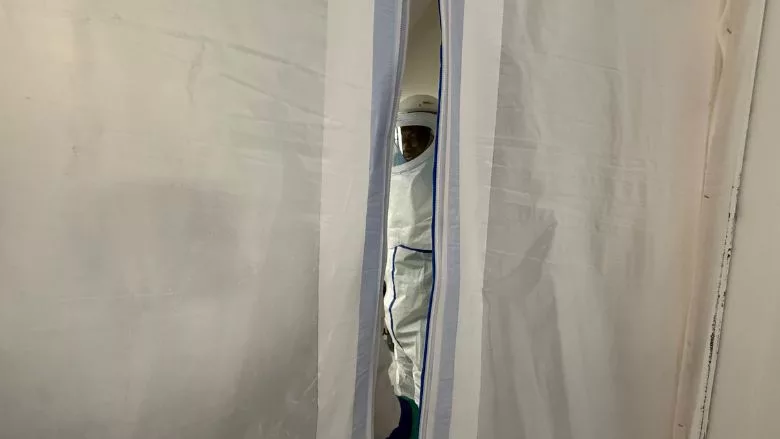
This final section explores some of the options that can be used in lieu of a standard containment. In order to make sense of how alternatives to containments may be useful, it is imperative that we understand what is meant when the term “containment” is used. As detailed in part 1, a containment is more than just barriers. It is an interconnected structure/process that includes isolation barriers (usually temporary), entry through a single or multi-stage decontamination chamber, and a combination of air flow patterns and pressure differential that minimizes the chance of airborne contamination from escaping the contained area.
Controlling Contamination by Going Less than “Whole Hog”1
According to the Merriam Webster dictionary, "going whole hog" means to do something completely, thoroughly, or without reservation. This is generally the proper approach when containments to control biological hazards like mold need to be employed. Still, there are situations when something less than full containment can be appropriate.
A good example is the use of dust barriers for general construction work. For repair and remodeling projects that involve limited demolition, field set-up of wooden framing, drywall finishing, and painting, a tightly secured dust barrier that separates the work zone is normally employed. The barriers slow down airborne dust diffusion to outside the work area. As a bonus, the normal static electric charge of the sheet plastic attracts and holds many of the particles to the barrier where they can be wiped off.
Of course, simple dust barriers should be upgraded to full-scale containment if any of the following conditions are identified as part of the project:
- Creation of dust that will contain recognized hazards such as asbestos, lead, or silica.
- Projects that will disturb mold, bacteria, or other biological hazards.
- Work that will be done in buildings with medically sensitive occupants.
- This category includes hospitals, medical centers, nursing homes, and even homes where one or more residents have pre-existing medical issues.
- Data centers or areas of office buildings where electronic communication or data equipment is found.
- Food processing facilities
- Pharmaceutical factories
The best rule of thumb for whether a dust barrier can be used instead of a full containment is that if you have even a hint of a doubt that a dust barrier is enough, add the extra items to make it a containment.
Sometimes A “Mini” Is Just Enough
Full-scale containments are the gold standard for controlling airborne contaminants, but some projects are so small that setting one up would be impractical. A mini-containment is a scaled down version of a typical negative pressure enclosure. It has tightly sealed barriers but is typically only large enough for one worker to enter. The decontamination chamber is often just large enough for a person to don or remove a protective suit. In fact, for asbestos abatement work it is quite common to use two decontamination chambers as the entire mini-containment — one for the work area and the attached chamber to make sure that the dust does not escape.
Looking for quick answers on restoration, remediation and cleaning topics?
Try Ask R&R, our new smart AI search tool.
Ask R&R →
Rather than employing an air filtration device, a pressure differential is created by running a HEPA vacuum set up outside the barrier with the suction hose placed inside the work area through a sealed breech in the plastic. The vacuum is run from the start of the project until all the work is completed.
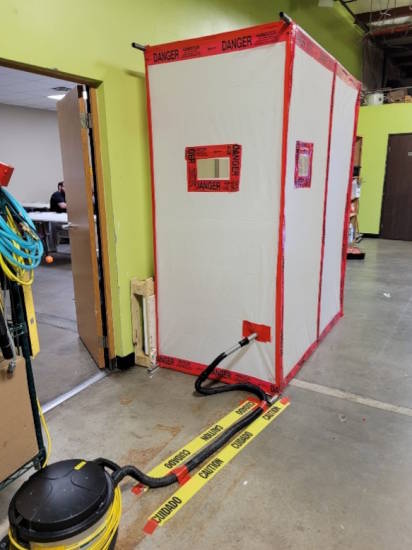
Photo 1. Two-stage decontamination chambers used as a mini-containment to cut a small hole in a wall with asbestos texturing. Note the HEPA vacuum hose running into the work area to collect dust at the point of the cut and create the necessary negative pressure to keep dangerous fibers from escaping. Photo courtesy of International Environmental & Safety Training (IEST); Aurora CO.
Not Used Enough
Although mini-containments are common for asbestos and lead remediation work, industries with significant OSHA and EPA regulations enforcing dust control, they are seldom seen in the mold control field. This is largely due to the various state and local mold rules that treat removal of less than 10 square feet of visible mold as a project that can be completed with minimal engineering control of the work area.
This erroneous thinking was picked up by the Occupational Safety and Health Administration (OSHA) in their guidance document entitled: A Brief Guide to Mold in the Workplace. In the document’s description of work practices for projects with less than 10 square feet of visible mold, it bluntly states: “Containment of the work area is not necessary”.
Studies and advances in the medical arena in the last ten years have shown how uncontrolled mold removal efforts cross-contaminate large areas. One private experiment exposed that a “standard” removal of less than six square feet of visible mold created airborne spikes of spores above 100,000 counts per cubic meter of air. The fungal contamination quickly spread beyond the test room and eventually required cleaning of the warehouse where the experiment was conducted. This real-world testing showed the value that a mini-containment could bring to the mold control industry.
With all this in mind, a good example of where a mini containment would make great sense would be a small mold removal project inside a sink cabinet. Laying the decontamination chamber on its side would allow it to be sealed to the cabinets to create a controlled work zone to protect the rest of the house.
Using Pressure Rather Than Barriers
There are some situations where barriers to form a containment just do not make sense. If an entire house needs remediation for a dangerous but unregulated contaminant like mold, putting the entire structure under negative pressure is a solid choice for controlling the risks. In a similar fashion, work to remove mold from an attic can be safely accomplished by setting up strong negative pressure in the uppermost part of the house and creating positive pressure in the living zones. Although a decontamination chamber at the entry to the attic can further prevent cross contamination to the lower level, a full-scale containment is often impractical in such situations.
A Lot of Choices For a Variety of Situations
Knowing how to construct and use temporary containments to isolate work projects is a skill that crosses many industries. The information from this series offers basic information and a wide assortment of examples of their use. Since every situation where a containment could be helpful can never be documented, understanding the core concepts of the process and the most common adaptations sets the reader up for success. Hopefully this series has accomplished that goal.
Footnote
- The phrase “going whole hog” is believed to have originated in late 1820’s from the American butcher-shop practice of buying an entire slaughtered pig at a discount rather than just prime cuts. Such a purchase implied a dedicated commitment to selling all parts of the animal within a few days; as refrigeration to prevent spoilage was not yet available. As an interesting side note, the whole hog phrase developed at approximately the same time as “living high on the hog” was used to describe rich people who ate better cuts pork from the top of the animal.
Looking for a reprint of this article?
From high-res PDFs to custom plaques, order your copy today!