The Evolution of Containment Systems in Restoration and Remediation Part 2
A science-based look at how negative-pressure containment practices were developed and why they matter
Setting The Stage
The discussion of controlling areas of buildings where contaminants, such as mold, chemicals, dust, etc.; are present during remediation projects is a large undertaking. As such, this article is the second of a four-part series. When the total package is complete, the material covered will include:
- Containment Basics
- The Evolution of Containments for Remediation/Restoration Activities
- Improving Containments for Biological Contaminants
- Alternatives to Typical Containments
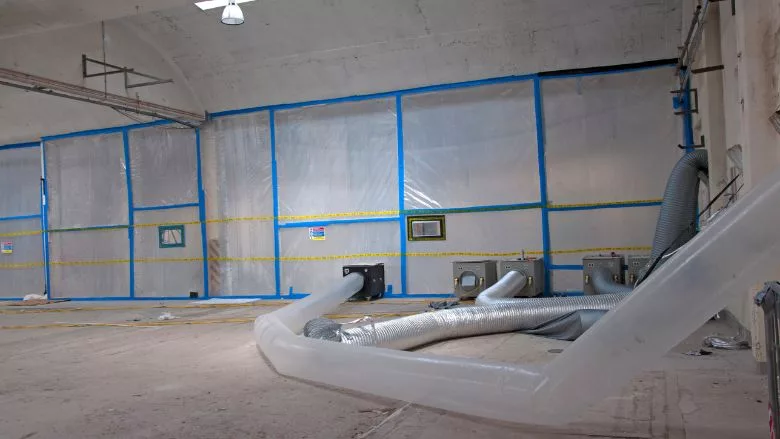
A summary of the first part of this series in the simplest terms is that containment areas are separated from surrounding spaces by using temporary barriers. This second part of the series provides a little bit of historical context to subject. While some people may find such a deviation from the basics of today’s containment science as waste of time, the modern philosopher George Santayana captured the importance of people learning a little history on current issues when he noted: “Those who cannot remember the past are condemned to repeat it”. So, to avoid making similar mistakes that have already been solved, let’s learn a bit from history.
The Earliest Temporary Plastic Containments
While the use of curtains and hard coverings over building openings to minimize the infiltration of airborne dust is as old as civilization, the modern use of temporary contaminant control containments has a history that extends back only about 70 years. The confluence of weapons development and the commercial production of polyethylene sheet plastic were outgrowths of the Second World War.
Although the initial record shows that polyethylene was accidentally discovered/produced in 1898, it was not until the plastic material was found to be valuable as an electrical insulator protecting coaxial cables of radar sets that the plastic sheeting became critical to the war effort. That need spurred the development of a reproducible and scalable synthesis of the plastic from oil. Throughout that global conflict innovations improved the ease of the synthesis of plastic sheeting and led to a diverse range products utilizing this polymer.
One of those critical uses was by the US scientists involved in the development of a nuclear bomb under the code name: “Manhattan Project”. To minimize the spread of radioactively charged dust, multiple items and techniques used today to control the spread of dangerous contaminants during remediation were developed. Some of the most significant advances included the production of HEPA filters, the design of air movement equipment using such filters that we know today as negative air machines, and the use of large sheets of plastic to temporarily isolate areas where tests and production steps were carried out.
During the war, the scientists at all three main Manhattan Project laboratories (Los Alamos, NM; Oak Ridge, TN; and Hanford, WA) used sheet plastic as temporary isolation barriers. They used the HEPA filtered air movers to replicate the negative pressure patient rooms and wards that some hospitals had pioneered in response to polio outbreaks and other infectious diseases. This approach minimized the amount of airborne dust in the areas where radioactive material was handled, since the dust would become irradiated and dangerous to breathe.
Following the surrender of Germany and Japan, the use of temporary negative pressure enclosures grew steadily because of the knowledge shared about war-related procedures and the greater availability of sheet plastic. The use of plastic sheeting to construct temporary containments grew steadily for 40 years. The practice quickly spread from a process used for nuclear safety to a common approach for controlling a variety of airborne hazards.
Looking for quick answers on restoration, remediation and cleaning topics?
Try Ask R&R, our new smart AI search tool.
Ask R&R →
Mandates and Standardization of Temporary Containments
The 1986 release of the Environmental Protection Agency’s (EPA) Asbestos Hazard Emergency Response Act (AHERA) is what moved many of the suggested controls for asbestos related work to mandatory requirements. This regulation required the use of temporary negative pressure enclosures (NPE) for asbestos removal work in schools. The requirement for stringent controls for asbestos work in schools soon spread to other types of buildings when the Occupational Safety and Health Administration (OSHA) passed regulations designed to control worker exposure to asbestos in both construction industries and general workplaces. Using NPEs, typically constructed with plastic sheeting, is a central part of those regulations.
Since the passage of these asbestos regulations in the mid 1980’s, with their focus on NPEs to control any mineral fiber hazard in the air, the requirements and expectation that containments will be used to protect both buildings and people have expanded dramatically. Temporary containments are part and parcel of industries that face lead dust, biological contaminants related to blood borne pathogens, mold, silica, and any other hazardous small particle. Although there are specific details that govern various contaminant control activities, the basic procedures for setting up and using containments as part of a NPE system are universally employed.
Medical Hazards Lead to Renewed Interest in Containments
Just when the focus on containments seemed to be evening out, the world was rocked by a resurgence of tuberculosis (TB) in the early 1990’s. Medical regulatory groups quickly mandated isolation techniques for TB patients. The hospital response was to set up Airborne Infection Isolation Rooms (AIIR). Since many TB patients are transitory in the hospital while they are having their diagnosis confirmed and are going through their initial treatment, many of the AIIRs looked suspiciously like the negative pressure containments developed for asbestos work. Because treatment to help a tuberculosis patient reach a non-contagious state may take 2-3 weeks, the initial protective containment on the room constructed with sheet plastic is commonly upgraded with hard plastic door barriers and a decontamination chamber.
The 2020 COVID pandemic brought additional attention to the necessity for temporary containments. Because of the number of infected people, temporary barriers and negative air machines were again in the forefront of safety discussions as many hospitals had to rapidly convert wings of standard hospital rooms into temporary isolation units. This practice became so common that the term “Temporary Surge Areas” was coined to refer to these larger containments. Abatement and remediation equipment and supplies were often diverted from mold and hazardous materials projects to hospitals and care facilities due to the emergency nature of the healthcare needs.
Learning From the Past
One of the earliest lessons learned from the attempts to control the dispersion of radioactive dust was that isolation barriers, no matter how secure and airtight, were not enough. Dust barriers will keep a good portion of the mess contained, but the smallest particulates will diffuse and spread well beyond the containment walls. The better approach is to match containment barriers with both negative pressure and decontamination chambers. This three-prong approach has proven its worth for controlling asbestos, lead, silica, mold, and countless other hazardous materials during their removal.
Another critical point from containment history is that pre-cleaning prior to installing contaminant control barriers and other measures is a must. Depending on the barrier system employed, sheet plastic or other materials may not only have to be secured to existing surfaces but sealed airtight as well. Getting temporary sealing material that can hold fast but later removed easily often involves using painter’s tape or other similar materials being put down as the initial layer of the barrier. Trying to get such tape to stick to dusty surfaces usually turns into a fool’s errand. The amount of time and hassle spent fighting with the barrier materials over the course of even a short project far surpasses the time and effort that would have been spent pre-cleaning.
The last critical lesson learned from a 70-year history of using temporary containments for controlling hazardous materials is to build the enclosure better than you think is necessary. This simple maxim is based on an extensive litany of containment failures. The cost of cleaning up exposures from breeches in barriers is many times the cost of taking straightforward steps to improve the containment construction. Nor does that take into consideration the cost of potential legal fees and litigation losses if the problem results in people being exposed to the hazard that the contractor was hired to eliminate. This historical truth is so rooted in reality that it continues to be one of the main drivers in the development of products that improve the setup of containments (technology which is discussed in detail in part 4 of this series).
Looking for a reprint of this article?
From high-res PDFs to custom plaques, order your copy today!