Improving Negative-Pressure Containment for Biological Contaminants
In part 3 of this series on containments, learn how NPE systems help control mold and other airborne hazards during restoration and remediation
This Article as Part of a Bigger Picture
Building containment to control the potential movement of mold, hazardous minerals, and even basic construction dust during remodeling or remediation projects is a big task. Breaking the topic into a four-part series makes it easier to understand the material. This article is the third part of this multi-article package including:
- Containment Basics
- The Evolution of Containments for Remediation/Restoration Activities
- Improving Containments for Biological Contaminants
- Alternatives to Typical Containments
So far, we have learned that, for the purposes of this series, containments protect non-work areas of a building from the spread of dust and airborne hazards by segregating areas with temporary barriers. The history of modern containments coincides with the development of sheet plastic and High Efficiency Particulate Arrestance (HEPA) filters during World War II. History since then has validated the maxim that a poorly constructed containment often costs more money in the long term than the cost of building it well when first constructed.
Improving Containment to Control Hazardous Contaminants
Over the last 80 years, the understanding that certain operations and procedures had to be isolated to protect workers and the public from a variety of hazardous small particles has advanced dramatically. Initially, two of the main industries adapted clean manufacturing techniques from the nuclear industry that emerged during World War II. It quickly became clear in both pharmaceutical manufacturing and electronics production that standard airborne contaminants could cause havoc with production. It was a short learning curve after the war to develop methods to control mold spores and fragments, bacteria, and even regular dust from production areas. While the original goal of the nuclear industry was to keep irradiated dust from escaping the production areas, the manufacturing companies used the techniques to keep outside contaminants from entering their production areas.
With the recognition of the health hazards of asbestos, the process of contaminant control reverted to a situation reminiscent of the nuclear development process, keeping hazardous contaminants inside a work zone from impacting a wide area. This was a contrast to the production facilities where clean, filtered air is supplied to a tightly enclosed work area to keep dust from contaminating the product. The restoration industry’s pivot from protecting a manufacturing process to preventing the spread of an intentionally disturbed hazard1 resulted in the adoption of several critical adjustments.
Current containment for remediation work is just one piece of a multi-part negative pressure enclosure (NPE). The temporary barriers are matched with the creation of negative pressure inside the work area (usually using a HEPA-filtered air filtration device exhausted outside the work area) and a decontamination unit at the entry with one or more chambers. This combination of barriers, decontamination chamber, negative pressure, and HEPA filtration make up the fundamentals of an NPE.
The Barrier Portion of a Negative Pressure Enclosure
One of the biggest distinctions between protecting critical manufacturing from outside dust and ensuring that remediation efforts do not cross-contaminate the areas outside the work area is the temporary nature of removing dangerous products from buildings. The barriers and controls that companies install to protect products2 are of a permanent nature. Full scale interior walls with studs, Tyvek air barriers, gypsum board, and caulk seals are the norm.
The divergence from such robust structures for remediation is eminently practical. Depending on the situation, most remediation efforts only last days or weeks, not years. In those types of cases building even a semi-permanent wall with studs and drywall would be needlessly time-consuming and expensive. That is why the earliest asbestos abatement NPEs were constructed with barrier walls made from 2”x2” studs. To these frameworks, which were wedged in place between the ceiling and floor, sheet plastic was stapled on each side. This provided a double layer of protection to keep asbestos fibers from escaping the area where abatement was underway.
Looking for quick answers on restoration, remediation and cleaning topics?
Try Ask R&R, our new smart AI search tool.
Ask R&R →
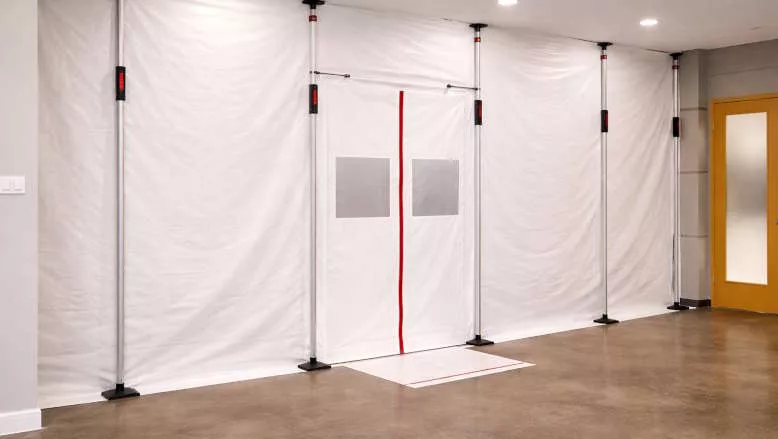
While that type of temporary barrier generally worked well, it still took relatively skilled workers and substantial time/money to put up when it might just be removed 24-48 hours later. To speed up the barrier building process, some workers started adapting the adjustable, ratcheting, ‘load locker’ poles used to keep pallets of products from shifting in the back of semi-trucks. Set the height close to the ceiling, extend an edge of the sheet plastic between the rubber flange on the top of the load locker and the ceiling, and rachet it firmly in position, the plastic could be firmly held in place with a pole every 6 to 8 feet.
With amazing speed, industry ingenuity came up with less expensive and more adaptable alternatives to load lockers. The first, in 1997, were Zipwall poles. These lighter aluminum poles had a longer range of expansion and rubber grips on each end. Their innovative two-piece top provided a way to secure the plastic to the pole before it was placed near the ceiling, eliminating significant ladder work, not to mention worker frustration. With four Zipwall poles, a barrier sealing a 12-foot-long by 10-foot-high hallway could be erected and sealed by a two-person crew in about 20 minutes. As the industry advanced, Zipwall poles were soon joined by Easy Up, Surface Shield, ProTect EZ up, Fastcap, and other innovative products to assist with building temporary barriers for NPEs.
More Than Sheet Plastic
While temporary barriers with poles and sheet plastic are the most common approach for building NPEs, some situations require greater control of either dust or air pressure. Specifications for remediation work in hospitals, nursing homes, and critical work areas like food processing plants or air traffic control towers frequently require the use of solid barriers rather than plastic film.
Once again, the remediation industry responded to the time and cost of building standard stud walls with a drywall finish for a project of limited duration. Several companies found that using Lexan, or other polycarbonate sheets, to produce reuseable, adjustable, interlocking panels simplified the construction of solid temporary barriers. As a result, contractors can now pick from Proflex, STARC, and SwiftWall for wall barriers. Other contractors opt for metal or wooden studs and screw polycarbonate panels directly to the frame before sealing the seams airtight with modified silicone polymer caulking.
More Lessons Learned
While learning from history to keep from repeating known mistakes is important, remediation assessors and contractors also must maintain a future orientation. The near constant introduction of new products and techniques for building temporary barriers is itself worth the cost of admission to any of the larger industry tradeshows.
The key is to look for new products that improve on the core principles of temporary barriers for NPE construction. Here are some significant considerations:
- Does the product reduce installation time for temporary barriers by improving the use of sheet plastic, pre-formed panels, or polycarbonate sheets?
- Is the technology easy to use?
- How expensive is the product per use?
- When used for remediation of hazardous materials, how simple is it to decontaminate (intricate angles, ridges, perforations, spring-loaded catches, and similar product features significantly increase the difficulty of cleaning and of adequately removing all residue from the parts)?
- Will the material withstand the rigors of being exposed to sanitizing agents and antimicrobials that can have a variety of chemical compounds in the mixture?
- What is the likelihood that small accessory pieces that are critical to the use will get lost?
- If the product is reusable, how many expected lifecycles of containment construction/disassembly is reasonable to expect?
Answering questions like these will allow the remediation professional to discern between the advertising hype and a valid industry advancement.
This series will conclude with Part 4, which is a discussion of some of the most common variants to the standard negative pressure enclosures, which use temporary barriers along with a specific air pressure differential to control dust and biological hazards.
Endnotes
Looking for a reprint of this article?
From high-res PDFs to custom plaques, order your copy today!