Mission Critical powered by KnowHow
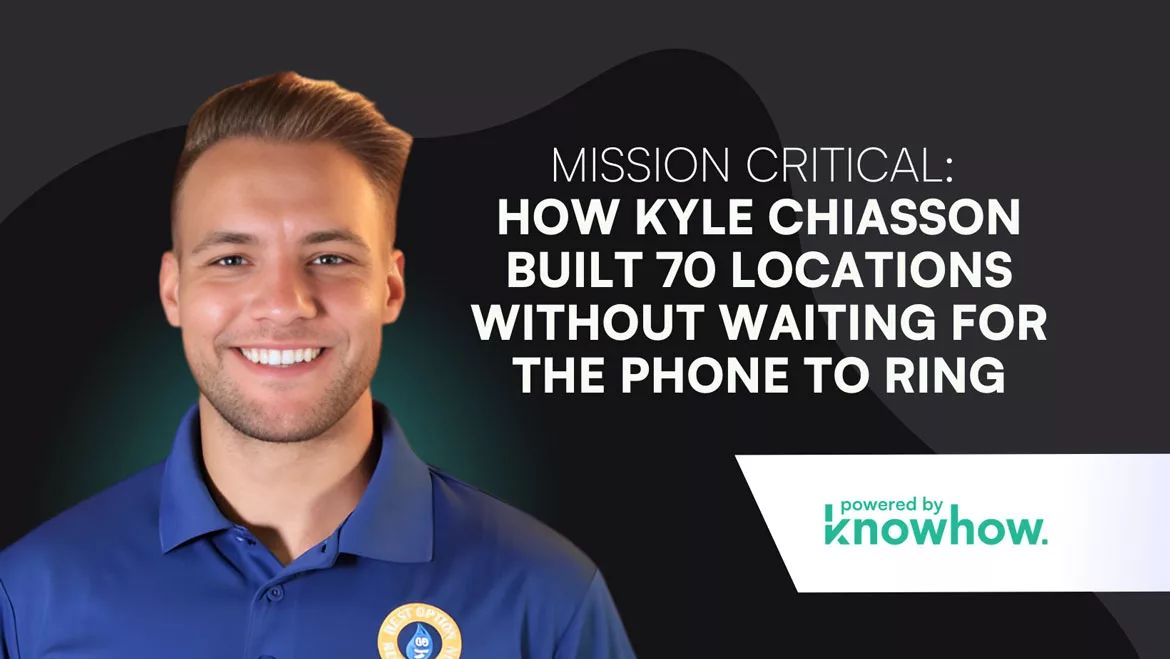
How Kyle Chiasson Built 70 Locations Without Waiting for the Phone to Ring
Best Option Restoration’s President shares their sales discipline, sales reps, and leadership mindset behind their scalable growth
Welcome to “Mission Critical,” a brand new series from KnowHow that explores how today's restoration leaders are navigating the industry's most urgent challenges. Sales are soft, margins are thin, and getting paid feels like pulling teeth. In this series, we spotlight elite restorers who share battle-tested systems and strategies from the trenches.
Each feature dives into specific tactics leaders use when everything's on the line—from stabilizing cash flow to driving profitable growth in unpredictable markets.
If you want concrete strategies to hit your sales numbers and produce work profitably, you're in the right place. Expect real advice, actionable insights, and takeaways from leaders who've been through the storm and come out sharper.
Ready for the mission brief?
It's 11:30 PM on New Year's Eve, and Kyle Chiasson is alone in an attic, pulling blown-in insulation by hand for the first time in his life.
He's 22, his phone keeps buzzing with friends asking where he is, and somewhere below him, the customer is having a perfectly good evening. He has $2,500 left to his name, no crew to call, and a $27,000 job — the biggest of his young career — that needs to get done tonight.
He keeps pulling.
“If you don't know how what you're doing is leading you where you want to go,” Kyle says, “you're gonna quit.”
Looking for quick answers on restoration, remediation and cleaning topics?
Try Ask R&R, our new smart AI search tool.
Ask R&R →
He didn't quit. He finished the job. And the lesson from that attic — not the hustle part, the why part — became the operating principle he'd eventually hand to 70 franchise locations across 26 states.
Kyle Chiasson is president of Best Option Restoration. He started as its first franchisee in 2017, scaled a team, added reconstruction, exited, and then got a call from the founder asking him to come build the brand.
“It brings so much empathy for what our franchisees are doing every day,” he says. “‘Cause I've lived that life for a long time.”
And what he sees now across the industry worries him — not because the market is hard, but because of what operators did to themselves before it got that way.
Curious to hear more from Kyle? Click on the video below to catch the full discussion!
Companies Lost the Ability to Replace Revenue.
The restoration industry didn't stumble into managed programs by accident. TPAs offered something genuinely valuable: consistent volume, predictable revenue, and a dependable stream of work. Companies built around that, and for a long time, it served them well.
The problem only became visible when claim volume dropped, and operators realised their ability to generate work independently had quietly atrophied.
“There's a tendency to think it's either independent or TPA,” Kyle says. “That's an absolutely wrong assumption.”
Best Option runs both models. Roughly 70% of their business comes from direct work: agents, property managers, plumbers, and local relationships built one conversation at a time.
TPAs have a place, and Kyle isn't dismissive of them. But a company that can't generate its own work isn't executing a strategy. It's managing a dependency. When operators come to him wanting to rebuild that atrophied capability, the instinct is always the same: plan first, build a process, get everything in order before anyone makes a call.
Kyle stops them before they start. We can have all the planning in the world, he tells them, but just do the reps.
But doing the reps the right way is its own discipline, and most teams are getting it wrong before they've made a single call.
You Can't Buy Your Way to a Pipeline. You Have to Earn It.
Kyle's starting number is 80 to 100 touchpoints a week; not leads, not qualified prospects, but genuine touchpoints: walking in, introducing yourself, starting from nothing. Most sales leaders want to optimize that number, but Kyle won't let you optimize it until you've actually hit it.
“If I'm zero for zero, there's nothing to tweak,” he says. “But if I come back with a hundred stops and I'm zero for a hundred, now let's dig in. Now there's something to work with.”
What kills reps early is the pitch. They walk in leading with the service, making statements instead of asking questions, assuming they know what problems the person across the desk actually has.
His conversation ratio is 10% business, 90% life. The goal of the first visit isn't to close, but to be someone they want to see come back through the door, and when a conversation doesn't land, to actually come back.
Kyle's prescription is simple: follow up more times than most reps are willing to. The old rule of thumb was seven touchpoints to close. Now it's more, and climbing. Give a contact a few weeks between visits, let the noise settle, and other reps cycle through, then walk back in like it's the first time.
The Leaders Who Can't Let Go Are the Ones Holding Everything Back.
Kyle runs 70 locations with a lean structure, and he's deliberate about it. He's watched what the alternative looks like: decisions traveling upward through layers of approval, simple problems taking weeks to resolve because no one along the chain feels empowered to call it.
“Inactivity kills business,” Kyle says. “We do it to ourselves. We crutch ourselves — we won't make a decision.”
Most operators diagnose that as a process problem, but Kyle thinks it's a trust problem. Rather than a new workflow, the fix is deciding what each person owns, training them to own it, and then getting out of the way. His view is that hiring someone means trusting them to do the job, not supervising them through it.
You Can't Train Someone to Want It
The right players make it all possible: coachable, accountable, and willing to work. Kyle is unambiguous that no system compensates for the wrong ones.
He's spent years building systems, frameworks, and playbooks. But none of it works without the right person on the other end. The kind of person who, at 22, with $2,500 left and somewhere to be on New Year's Eve, keeps pulling insulation until the job is done. You can teach someone the conversation ratio. You can teach them to go back more times than feels reasonable. What you can't teach is the reason they go back at all.
What You Can Learn from Kyle:
- Diagnose the dependency before you fix the revenue.If your team has lost the ability to generate direct work, that's a capability problem, not a market problem. Treat it like one.
- Start with reps, not a plan.Get to 80 to 100 touchpoints a week before you analyze why they aren't converting. Zero for zero gives you nothing to work with.
- Lead with questions, not services.Make it 90% life, 10% business. Understand their problems before you offer solutions. The close should feel inevitable, not forced.
- Follow up more times than feels comfortable.At least seven visits before writing off an account. Most of your competition quit after two.
- The bottleneck is usually you.Empower people to make the decisions their role requires. Inactivity kills businesses, and it usually starts at the top.
Looking for a reprint of this article?
From high-res PDFs to custom plaques, order your copy today!