Preparing for a CAT Event: What Restoration Contractors Need to Know
Why cash flow, licensing, logistics, and planning can determine your deployments success
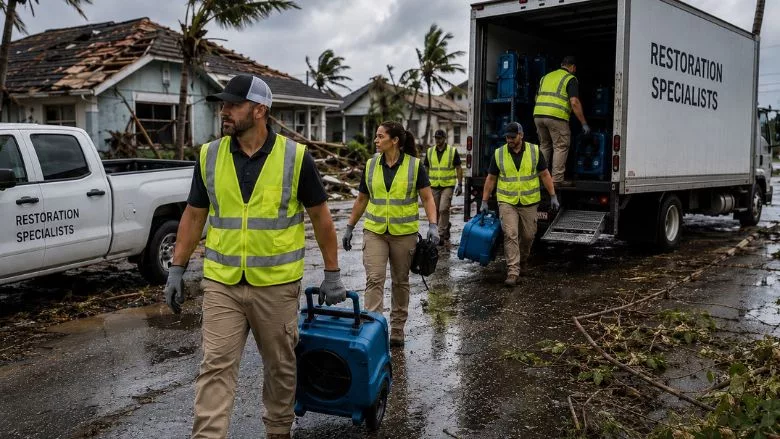
Every restoration contractor I know has had the conversation. The weather service flags a hurricane track, a hailstorm rolls through three states, a tornado outbreak fills the news, and someone at the shop says, “We should go”. The math looks simple on the whiteboard…high job volume, motivated homeowners, insurance carriers already cutting checks. What gets left off the whiteboard is everything that actually determines whether you come home with margin or come home with a mess.
I have watched firms I respect get hurt chasing storms. I have seen others do it well for several decades. The difference almost never comes down to talent or equipment. It comes down to whether the company understood, before it rolled out of its driveway, what they were actually walking into.
Hurricane Month
Prepare before the storm with specially-curated articles during the month of May. Learn more!
Here is what nobody tells you!
The Financial Picture You Don’t See Until You’re In It
The first thing to understand about a CAT deployment is that it is a working-capital event, not a revenue event — at least for the first sixty to ninety days. You will pay for everything before you collect for anything. Crews need payroll Friday. Hotel blocks want payment up front, often in cash or with a large deposit. Fuel costs climb, and if you are running box trucks, trailers, and service vehicles across multiple states, you will burn through fuel budgets that look absurd on paper. Building material prices spike in the affected zone, sometimes doubling within a week of landfall. And the insurance proceeds — the whole reason you deployed — will lag every one of those outflows.
That lag is where most storm-chasing operations die. A homeowner signs a work authorization, you perform emergency services, you submit for payment, and then you enter the adjuster queue. In a major CAT, that queue is long. Adjusters rotate in and out on fourteen-day deployments…files get reassigned... supplements sit. Emergency mitigation invoices with properly documented files commonly take 120 days to settle in a hard hurricane market. If your documentation is weak, or if you are working under an Assignment of Benefits and the carrier decides to contest it, you can push out past 180 days, or worse, years.
Here is the part people underestimate: while all of this is playing out, your home market is still there. Your existing customers still have leaks and losses. Your referral partners still expect responsiveness. If your best project managers and senior technicians are out of state for six weeks, the people paying your overhead back home are being serviced by whoever is left. I have watched contractors generate two million dollars in out-of-state revenue and lose a million in home-market attrition. Net, they went backwards — and they did not realize it for a year.
There are also quieter financial risks. General liability premiums can climb after a catastrophe deployment, especially if claims emerge from the work. Commercial auto is exposed in ways it is not at home. Your workers’ compensation experience modification can be affected by injuries sustained out of state, and the injury rate climbs when crews are working twelve-hour days, sleeping four to a room, and driving unfamiliar roads in wrecked neighborhoods. And if you do not already have a relationship with a factor or a line of credit sized for this kind of deployment, you will be negotiating financing from a position of weakness — after you are already committed.
Looking for quick answers on restoration, remediation and cleaning topics?
Try Ask R&R, our new smart AI search tool.
Ask R&R →
Before you ever load a trailer, prepare a deployment budget that accounts for a minimum of ninety days of carrying costs with no inbound revenue, a contingency reserve of at least fifteen percent above that, and a clear answer to one question: if this deployment produces half the revenue you projected, does the company survive it?
The Regulatory Wall You Will Hit
Every state has its own answer to the question of who is allowed to perform restoration work, under what license, and under what conditions. Crossing a state line does not transfer your credentials. It transfers your exposure. Just for starters:
- In some states, a general contractor’s license from your home state means nothing. Florida, Louisiana, California, and several others maintain their own licensing boards with their own examination and bonding requirements.
- Mold remediation is licensed separately in Florida, Louisiana, and Texas.
- Roofing is a distinct trade in Florida, Texas, and Oklahoma, each with its own rules.
- Even where temporary emergency waivers get issued after a declared disaster — and they sometimes do — those waivers are narrow, time-limited, and usually only cover emergency mitigation, not reconstruction.
- The moment you transition from drying and tarping to rebuilding, you are back inside the full licensing framework.
You also have to register the company. This may include:
- Most states require a foreign entity registration before you conduct business there, which means filing with the Secretary of State, appointing a registered agent, and in many cases paying a franchise or qualification fee, even under a state of emergency excemption (i.e., Florida, Alabama, Louisiana)
- Sales and use tax registration is separate from that — and restoration work has surprisingly complex sales tax treatment that varies by state and by whether you are billing an insurer, a homeowner, or a property manager.
- Some states tax labor on repairs. Some do not.
- Some tax materials only.
- Some require you to hold a certificate before you can purchase materials at wholesale without paying tax yourself.
Workers’ compensation is the one that ends careers. Your home-state policy does not automatically cover your crew working in another state. Most policies include “other states” coverage as a nominal endorsement, but that endorsement often caps at a minimum premium and does not actually provide coverage in monopolistic states like Ohio, Washington, North Dakota, and Wyoming, or in states with specific filing requirements like Florida and Virginia. If one of your technicians falls off a roof in Florida and your policy does not have a Florida filing, you personally are on the hook for that claim, and the state will treat your company as uninsured. The fines alone will make your eyes water. The liability for the injury is worse.
Then there is the consumer protection layer. Several hurricane-prone states have specific statutes governing contracts with homeowners after a declared emergency. Florida has strict rules and a specific contract form requirement. Texas has its own consumer disclosure and right-of-rescission regime. Louisiana has statutes about contractor conduct following declared disasters. Failure to comply is not a paperwork problem — in some states it voids the contract and exposes you to terrible damages and attorney’s fees.
None of this is optional, and none of it can be fixed after the fact. If you do not have a legal and compliance checklist for each state you intend to work in, built and reviewed before you deploy, you are not ready to deploy.
The Logistics Reality on the Ground
The last thing that gets glossed over is what it actually takes to keep a crew productive, supplied, and housed for weeks in a disaster zone. This is the part that looks solvable from the office and turns into a nightmare on day three.
Start with people. Finding crew members willing to be gone from their families for thirty, sixty, or ninety days is harder than it has ever been. The labor market tightened after 2020 and never loosened. When your senior technicians do agree to go, they expect a premium rate, a per diem, housing, and clear terms for rotation home. If you do not put that in writing before they leave, you will renegotiate it in a parking lot in the rain, and you will lose.
Housing is the next wall. In a hard-hit area, hotels are full of adjusters, FEMA, utility crews, other contractors, and displaced residents. Rates triple. Availability disappears. Some firms buy travel trailers and RVs specifically for CAT deployment and haul them in on trailers. Others lock down hotel blocks weeks in advance based on weather modeling, which sometimes works and sometimes produces a large non-refundable bill when the storm turns and misses the mark. I know firms that rent houses for six months at a time. None of the options are cheap, and all of them require a dedicated person to manage.
Equipment logistics are their own problem. Restoration in a post-flood environment is equipment-heavy: dehumidifiers, air movers, HEPA filtration, generators, fuel, extraction units. If the grid is down, you are running generators for days or weeks, which means you need fuel delivery, fuel storage, and someone qualified to maintain the generators in the field. You need a staging yard, which means a lease on industrial property, fencing, lights, and security — because theft of equipment during a CAT is not if, it is when. Your tracking/asset management system, which probably works fine at home will be stress-tested and may not ping correctly until it’s too late to do anything but fill out a police report.
Supply chain is where the margins disappear. For mitigation, consumables like filters, PPE items, towels, and cleaning agents; or for repair, materials like drywall, insulation, lumber, roofing materials, and mechanical components are in short supply everywhere in the impact zone. You are either paying a premium to buy locally, or you are trucking materials in from outside the region at a premium transportation cost. Either way, the estimate you wrote against the localized CAT event Xactimate pricing cannot keep up with market fluctuations and rarely reflects what you are actually paying. If you are not documenting market conditions and pursuing supplements accordingly, you are absorbing that delta, and the delta is large.
Communications, basic services, and personal wellbeing get forgotten on the deployment plan and become the loose thread that can unravel the whole deployment. Cell service is unreliable after a major storm. Banks and ATMs may be offline. Medical care for a crew member who gets hurt or sick is an hour away. Your project managers are being texted at eleven at night by homeowners in distress, they are sleeping poorly, eating badly, and driving too much. Burnout in the field is the single biggest quiet killer of CAT operations, and it shows up as careless mistakes, rework, missed documentation, and eventually as turnover of that historically reliable employee.
The Honest Conclusion
This is not a case against deploying to a CAT. The contractors who run a disciplined storm program can do very well, and the industry needs them — there is no way local capacity alone handles a major event. The argument is against deploying without knowing what you are walking into.
If you are looking at a storm right now and asking whether to go, ask some harder questions first:
- Do you have ninety days of working capital above your normal operating needs?
- Do you have a state-specific licensing, registration, and insurance package ready to file or in place?
- Do you have a logistics plan that covers crew housing, per diem, equipment staging, fuel, and supplies, with real vendors and real numbers?
- Do you have a home-market continuity plan so the business you built does not erode while you are away?
- Do you have documentation, contract, and compliance protocols that will survive a two-year lookback in a litigation environment?
If the answer to any of those is no, the most profitable decision you can make is to stay home, finish your existing work, and use this event as the catalyst to build the program properly for the next one.
There is always a next one.
Looking for a reprint of this article?
From high-res PDFs to custom plaques, order your copy today!