Assessment of Heavy Metals in a Wildfire and a Wildland-Urban Interface (WUI) Fire
Science-based guidance for restorers and IH/OEHs to assess, clean, and verify residues
Observations:
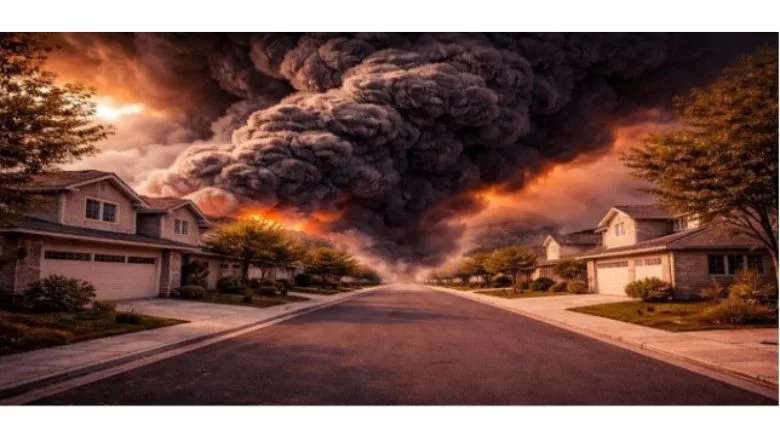
Many of today’s homeowners became educated about wildfires and associated health effects through news reports, where public health officials, university professionals, and government spoke about the effects of the wildfire damaging their community. Also, homeowners used cell phones and computers to research, where they found too much information that became overwhelming to understand, such as LA Times: “The Long-Term Health Effects of L.A. County Wildfire Smoke;” EPA: “Study Shows Some Household Materials Burned in Wildfires Can be More Toxic Than Others; Harvard “The Health Effects of Wildfires;” Harvard “Assessing Harmful Toxins in the Wake of the Los Angeles Wildfires;” National Academy of Sciences “The Chemistry of Fires, Chapter 6: Human Exposures, Health Impacts, and Mitigation;” California DIR “Respiratory Requirements During Fire Cleanup, Removal, and Demolition”; Newsweek “California Wildfires: How Smoke Harms Your Body;” Scientific America “What Makes Urban Wildfire Smoke So Toxic;” AIHA: “Technical Guide for Wildfire Impact Assessments for the OEHS Professional;” AIHA: “After the Fire;” AIHA: “The ABCs of Wildfire Residue Contamination Testing;” EPA “Wildfire Research: What is in Smoke?”, and so on.
Smoke from a wildfire which only burned vegetation produces less toxic smoke than a wildland urban interface (WUI) fire that contains more toxic and hazardous substances, such as the burning of framing, roofing, paint, cars, carpets, electronics, and furniture. While this and other information is important to understand, they do not provide specific information to a homeowner on how the smoke that impacted their house should be cleaned to remove smoke odors and toxic substances.
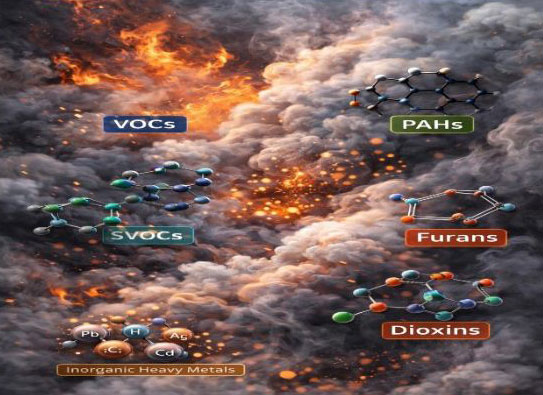
Image: AI-Generated by Chat GPT
During and After a Wildfire/WUI fire, What Just Occurred in Nearby Homes?
Smoke is a complex, heterogeneous mixture of organic and inorganic combustion byproducts (CBPs) formed when materials undergo incomplete combustion and pyrolysis. Smoke composition varies with fuel type, temperature, oxygen availability, and burn duration, where it commonly includes “volatile organic compounds (VOCs), semi-volatile organic compounds (SVOCs), polycyclic aromatic hydrocarbons (PAHs), furans, dioxins, and inorganic heavy metals.” Smoke compounds are generally at their highest levels during and shortly after the fire, resulting in indoor concentrations that can be comparable to outdoor levels.
CBPs, VOCs, SVOCs, PAHs, furans, dioxins do not remain static, meaning, over time, these constituents separate, migrate, transform, and persist in different ways based on their chemistry and the indoor environment. For example, VOCs tend to off-gas and decline where smoke odors typically become less noticeable; SVOCs, PAHs, dioxins, and furans tend to bind to surfaces and absorb into porous materials including inside HVAC systems, attic insulation, and house dust. Their toxicity may persist despite an odor reduction. Heavy metals do not degrade, where they can remain indefinitely in house dust and attic insulation. CBPs and heavy metals become less when post-cleanup measures are completed. (Fire damage restoration contractors ‘restorers’ have access to more efficient equipment and trained workers.) In other words, restorers are able to remove smoke and its byproducts more efficiently than most homeowners completing their own restoration.
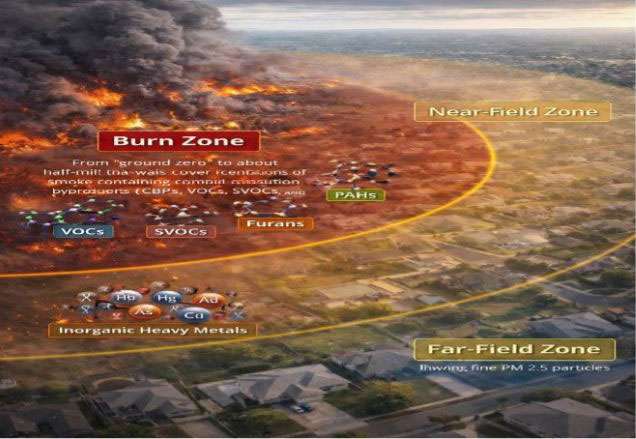
Image: AI-Generated by Chat GPT
In Determining Damage to Property, The Building’s Location and Distance from the Hot Zone/Burn Zone Is Important:
Depending on the distance the house is to the wildfire or WUI fire, that distance can estimate the degree of heat damage and smoke contamination, and the potential difficulties arising in cleaning, restoring, and bring a house back to its pre-fire loss condition. For example:
-
“Burn Zone” is a distance generally from “ground zero” to about a half mile away, where it produces heavier or more extensive concentrations of smoke containing combustion byproducts (CBPs) caused by the burning of vegetation and buildings.
- Structures in the burn zone can be affected by thermal pressures (heat) and turbulent smoke, forcing CBPs containing particulates, gaseous, volatile organic compounds (VOC), semi-volatile organic compounds (SVOCs), polycyclic aromatic hydrocarbons (PAHs), furans, dioxins, and heavy metals to ‘forcibly’ enter the building envelope.
- Restoring a home inside the burn zone is uniquely difficult because the contamination is chemically complex, physically persistent, and behaviorally unpredictable. Unlike ordinary smoke damage, burn-zone contamination involves multiple classes of combustion byproducts that behave very differently over time and respond poorly to conventional cleaning methods.
-
“Near-Field Zone” is a distance extending from the perimeter of the “burn zone” to about 6 miles away, where homes are expected to be “less affected” by the hot and turbulent smoke, but they can contain CBPs along with VOCs, SVOCs, and heavy metals.
- Restoring a home in the near-field zone (close to, but not directly within the burn perimeter) can also become difficult, because contamination can remain chemically complex, unevenly deposited, and deceptively subtle. Compared to homes inside the burn zone, near-field properties often look cleaner, where smoke odors may be less, yet they can retain persistent toxic residues. Depending on impact, the recommended cleaning procedures are similar those in the burn zone.
-
“Far-Field Zone” is a distance beyond the “near-field zone,” which can extend outwards for hundreds of miles. By the time the smoke plume reaches this area, smoke has cooled and condensed, where heavier particles and gases have fallen out or decayed. Homes in the “far-field-zone” are expected to be the “least affected” by the fire where the resulting infiltration includes fine chemically aged microfine particulate matter (PM2.5).
- Rather than seeing visible soot or debris, far-field contamination can be dominated by fine and ultrafine particulate matter (PM₂.₅ and smaller). Lingering smoke odors are often removed through ventilation with cleaner outdoor air along with HVAC filter changes. (EPA) General housekeeping cleaning measures should remove most, if not all, fine particulate matter.
Parties Involved in Assessing Property Damage and Smoke Contamination:
After the wildfire or WUI fire when homes are in the burn zone or the near-field zone, the scope of work begins with information gathering, where it is important for an insurance adjuster or restorer to inspect visible damage and contamination as part of their pre-restoration evaluation (PRE) plan. In other words, the PRE plan is a critical first step which is usually performed by a certified fire damage restoration contractor (restorer), or a field adjuster specializing in fire damage assessments.
If the property requires a pre-restoration assessment (PRA) of contaminants, odors and toxins, the PRA is a formal third-party assessment which is typically performed by an industrial hygienist (IH) or an occupational and environmental health and safety (OEHS) professional.
Looking for quick answers on restoration, remediation and cleaning topics?
Try Ask R&R, our new smart AI search tool.
Ask R&R →
Unless the homeowner or adjuster requests an independent PRA-evaluation be performed before a restorer is hired, the PRA is generally triggered by the findings of the restorer. (IICRC/RIA/CIRI “Technical Guide for Wildfire Restoration”). As the IH develops a sampling strategy, they rely on all available information and compile it, such as the occupant interview, completing a site inspection of the fire impacted community, inspection and assessment of the building, and sensing if smoke odor can be detected. (AIHA: “Technical Guide for Wildfire Impact Assessments for the OEHS Professional)
Visible and Invisible Damage and Contamination:
Visible property damage refers to damage that can be directly observed without invasive inspection, testing, or demolition. It is the apparent structural damage that is most obvious to homeowners, adjusters, licensed contractors, engineers, and building inspectors. Visible damage also includes fire debris that can damage finishes on walls, cabinetry, flooring, and upholstered furniture.
Invisible property damage refers to harm that is not readily observable during a visual inspection, yet it can affect the performance or long-term function and durability of the structure and contents, habitability, and the health of occupants.
When invisible property damage is suspected, such as damage affecting roofing, siding, windows, doors, attics, crawlspaces, insulation, HVAC systems, plumbing, and electrical, it requires licensed professionals to inspect them. Professionals use instruments, sampling, or intrusive inspection methods to identify and determine the cause and type of damage, and potential long-term failures of building components and systems, such as corrosion to electrical and electronic components.
Invisible property damage associated with combustion byproducts and heavy metals is damage that cannot be confirmed by sight or smell alone, yet, when they are left undetected, they can affect building materials, systems, and contents, and they can drive health risks and the re-emission of volatiles if they are not identified and eliminated. In this scenario, the IH/OEHS professional is expected to be the specialist parties rely on. They are expected to have a background in building science and construction, completing occupant interviews, investigation, sampling, interpreting laboratory data, and report writing. When the results of the inspection and laboratory data are positive, they are expected to report levels of contamination and write a scope of work for the restorer. Afterwards, they complete a post-restoration verification (PRV) that provides closure of the fire loss or contamination for the homeowner, restorer, and adjuster.
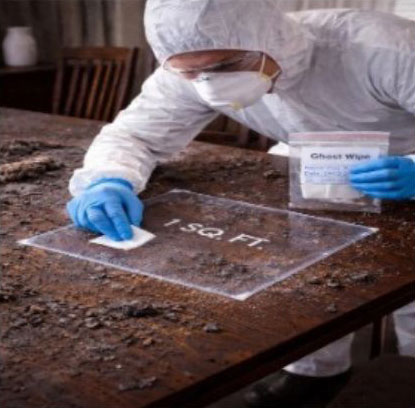
Image: AI-Generated by Chat GPT
Potential Complications for the IH/OEHS Professional:
In traveling to a project, the IH takes in the surroundings of the burned community and the remaining standing structures. In homes still standing, they may see heat damage to the exterior, where indoors, they observe debris that contains combustion byproducts, such as char, ash, and other organic matter. They may also detect smoke odor confirming the presence of VOCs.
While the IH can see fire damage and its fallout, they cannot see the physical elements making up the complex chemical mixture of smoke that remains bound to organic and inorganic debris. In other words, visually, the IH cannot confirm the presence or absence of hazardous and toxic substances and levels without the support of laboratory analysis.
Note, industrial hygiene investigations are complicated by mixed contaminant profiles, lack of regulatory clearance standards, uneven deposition, time-dependent chemical behaviors, and the absence of pre-loss baseline data. Therefore, the IH is expected to collect a sufficient number of samples for laboratory analysis that supports their hypothesis.
Without government baseline and clearance standards, sample results are interpreted using professional judgment and risk-based frameworks, rather than numeric pass/fail criteria. In addition, sampling on future dates and locations can provide supporting and sometimes conflicting results. The findings can also be subject which may result in a dispute of differing stakeholder expectations.
The remainder of this article with tables focuses on heavy metals, even though it starts by addressing combustion byproducts (CBPs).
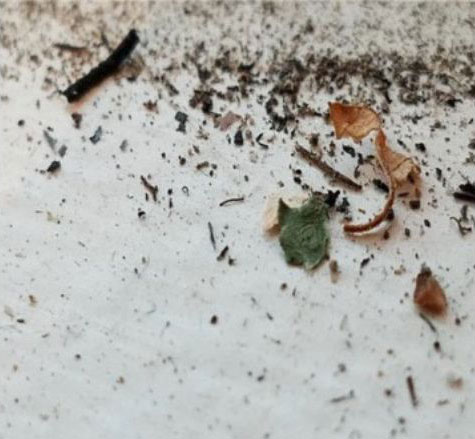
Image: Pat Moffett
Combustion Byproducts (CBPs):
In some wildfire inspections and assessments having less obvious signs of structural fire damage, the visible signs of char, soot, and ash, and smoke odors may be argued as coming from a fireplace, candles, cooking, incense, outdoor traffic and the burning of trash, and not the result of the wildfire.
In these situations, the homeowner or their insurance adjuster should have the IH collect samples that are submitted for forensic analysis, where the laboratory can distinguish whether the particulate matter is background soot or the organic matter is from a wildfire. Sometimes, the lab can identify the species of burnt vegetation and where it came from.
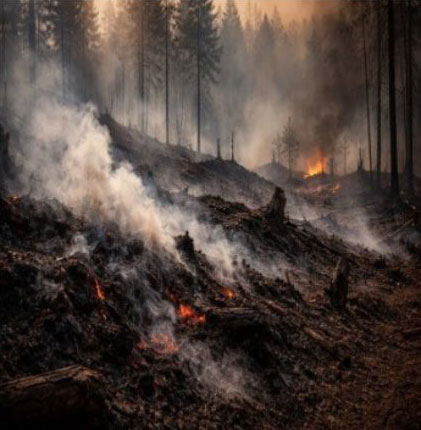
Image: AI-Generated by Chat GPT
Heavy Metals:
Depending on geography and the distance homes are to cities and industry, some heavy metals are naturally in air, indoor dust, and soil, such as iron, manganese, arsenic, zinc, aluminum, chromium, copper, cobalt, and selenium.
When the ground and buildings burn, heavy metal chemicals form, where their mobility changes, and they become a “complex mixture of smoke.” (EPA)
In wildfires and WUI fires that burn ground and buildings, the burning process does not eliminate heavy metals. In fact, the fire concentrates them and chemically transforms metals into a more mobile and toxic form of smoke that bonds to char, ash, and particulate matter, and travels in air as toxic gasses and vapors.
Sampling Strategy:
Sampling can be conducted for forensic investigations, health hazard exposure assessments, or both. A sampling objective may be to test a primary hypothesis intended to confirm or discount the presence of combustion-generated particulate matter accumulation. Another sampling objective may be to test a second hypothesis to confirm whether particle accumulation, and associated organic compounds or metals were generated by a wildfire in a nearby wildland or from a different combustion source. A third hypothesis may be to determine whether the accumulation is at levels above background or a recognized health-based exposure level. (The same objectives for particulate matter apply to heavy metals.)
Sampling involving occupant exposure assessments has similar but distinct goals, firstly, to detect the presence, and measure the concentrations of fire-related CBPs and metals, and when required VOCs, SVOCs, dioxins/furans. Next, to determine whether they infiltrated the structure with the fire particulates, or are from background sources, and, lastly, to evaluate the potential health risk to occupants by comparing the results to established exposure levels that may be a health concern. Interpretation of environmental data should be completed by medical professionals and not the IH.
When a sampling strategy does not provide for an adequate collection of samples to represent actual site conditions, the analytical results may be inadequate and may not provide the information necessary to test a hypothesis. A flawed sampling strategy may lead to incorrect inferences and data interpretation. (AIHA: “Technical Guide for Wildfire Impact Assessments for the OEHS Professional)
| Metal | Typical Range | Source Reference |
|---|---|---|
| Arsenic (As) | ~1–10 mg/kg natural range | UNH – Soils Fact Sheet |
| Beryllium (Be) | ~03 -2 mg/kg background ~<2 mg/kg background |
OEHHA – Screening Levels UCR – Background Levels |
| Cadmium (Cd) | ~0.1–1 mg/kg background | UNH – Soils Fact Sheet |
| Chromium (Cr) | Tens of mg/kg background | EPA – Guidance Soil Screening |
| Copper (Cu) | Tens of mg/kg in natural soil | EPA – Guidance Soil Screening |
| Iron (Fe) | ~15000–40000 mg/kg | EPA – Guidance Soil Screening |
| Lead (Pb) | ~15 to 40 mg/kg in natural soil | UMass., Amherst – Fact Sheet |
| Mercury (Hg) | <1 mg/kg | UNH – Soils Fact Sheet |
| Nickel (Ni) | Low tens of mg/kg | EPA – Guidance Soil Screening |
| Zinc (Zn) | Tens of mg/kg | EPA – Guidance Soil Screening |
EPA’s background guidance explains how metals occur naturally in soils and why region-specific baselines must be understood before declaring soils contamination.
| Metal | Typical Range | Source and Comment |
|---|---|---|
| Arsenic (As) | ~0.1–2 (mg/kg) (EPA) | Natural CA geology, usually low indoors |
| Beryllium (Be) | ~03 -2 mg/kg background ~1–2 (mg/kg) (USGS) ~0.28–1 (mg/kg) (Canada) |
OEHHA – Screening Levels Natural CA geology, usually low indoors |
| Cadmium (Cd) | ~0.2–20 (mg/kg) (EPA) | Pigments, batteries, smoking; generally low concentrations. EPA “Exposure Factors Handbook.” |
| Chromium (Cr) | ~17–148 (mg/kg) MDPI ~30–127 (mg/kg) PMC |
Mostly Cr (III); higher where stainless steel dust is present |
| Copper (Cu) | ~25–400 (mg/kg) | Plumbing wear; brake dust track-in concentrations |
| Iron (Fe) | ~2000–15000 (mg/kg) | Dominant mineral dust |
| Lead (Pb) | ~30–200 (mg/kg) | Found in homes that were constructed prior to 1978 having lead paint |
| Mercury (Hg) | ~0.05–0.5 (mg/kg) | Atmospheric deposition; very low in most homes |
| Nickel (Ni) | ~11–150 (mg/kg) PMC | Soil and traffic sources; higher near roadways |
| Zinc (Zn) | ~300–2000 (mg/kg) | Tire/brake wear; one of the most abundant indoor metals |
In California, there is no single statute or regulation listing “normal indoor heavy metal mg/kg values.” Instead, professionals derive acceptable levels from: California Office of Environmental Health Hazard Assessment (OEHHA) exposure assessments, EPA indoor dust research, California Department of Public Health (CDPH) investigations, California university studies, and research, such as Rasmussen et al., “Indoor Dust Metal Concentrations, Environmental Science &
Technology”
Concern arises when levels significantly exceed background or follow events like renovation, wildfire, or flooding that redistribute or concentrate contaminants.
| Metal | Post-Restoration Verification (PRV) Range | Comments |
|---|---|---|
| Lead (Pb) | 5 µg/ft² hard flooring (pre-1978 homes) | EPA says, interior floors in homes constructed prior to 1978 have lead paint until tested to show otherwise. (5 µg/ft²) is a defensible PRV “clearance” target which exceeds the current California Title 17 thresholds. In addition, the recommended defensible PRV level for pre-1978 homes that were “completely remodeled down to the studs” may still be (5 µg/ft²), as the low as reasonably achievable (ALARA). Reason being, prior data is not available to document clearance. |
| Lead (Pb) | ~03 -2 mg/kg background ~1–2 (mg/kg) (USGS) 5 µg/ft² hard flooring (post-1978 homes) | Even in a post-1978 building having no lead paint, when remediating wildfire/WUI lead-bearing dust, the most defensible “clearance” approach in California is to use lead dust wipe loading criteria (5 µg/ft²) as the acceptance benchmark (not mg/kg), because that is how regulatory lead dust standards are expressed. However, after proper cleaning (e.g., HEPA vacuuming, detergent wet washing, air drying, and a second HEPA vacuuming), hard surfaces having lead dust loading from the fire, PRV test results should be able to report, there are no detectible limit values. Meaning, lead dust loading on the sampled area was successfully removed. |
| Arsenic (As) | ~1–10 (mg/kg) (A geological background number, with higher numbers depending on geology) (EPA; USGS; OEHHA) | EPA and OEHHA have not promulgated dust-loading standards (µg/ft²) for arsenic. The value is not intended for indoor dust and is below natural background in many California soils, so it is not realistic as a dust clearance standard. Typical California indoor background (dust loading): ~1–7 mg/kg arsenic (often closer to 1–3 mg/kg). The recommended defensible PRV level is (1–3 mg/kg), as low as reasonably achievable (ALARA). In converting (mg/kg to surface µg/ft²), in “light dust loading,” the laboratory may report (1–3 µg/ft²). |
| Beryllium (Be) | ~0.1–2 (mg/kg) (PMC) | Neither EPA nor California OEHHA publish numeric “indoor dust clearance levels” or routine indoor dust mg/kg benchmarks for beryllium. Beryllium concentrations in indoor dust were evaluated against typical background ranges documented in peer-reviewed residential indoor dust studies (generally <0.12 mg/kg). Post-restoration beryllium levels at or near detection limits and within this background range support a successful cleanup relative to normal residential conditions. The recommended defensible PRV level is (<1 mg/kg), as the low as reasonably achievable (ALARA). |
| Cadmium (Cd) | ~0.2–20 (mg/kg) (EPA) ~15–40 (mg/kg) (NRC) |
Typical California indoor background (dust loading): ~0.2–20 mg/kg cadmium. The recommended defensible PRV level is (1-5 mg/kg), as the low as reasonably achievable (ALARA). In converting (mg/kg to surface µg/ft²), in “light dust loading,” the laboratory may report (<1 µg/ft²). |
| Chromium (Cr) | ~17–148 (mg/kg) (MDPI) ~30–127 (mg/kg) (PMC) |
Chromium levels in indoor household dust were evaluated against typical residential background concentrations documented in peer-reviewed studies. In a study published in Toxics (2023), chromium concentrations in indoor dust ranged from approximately 17 to 148 mg/kg. Comparable ranges have been reported in other residential settings. The recommended defensible PRV level is 17-30 mg/kg, as the low as reasonably achievable (ALARA). In converting (mg/kg to surface µg/ft²), in “light dust loading,” the laboratory may report (<17–30 µg/ft²). |
| Copper (Cu) | ~30–200 (mg/kg) | “Health Risk Assessment of Heavy Metals in Indoor Household Dust.” This peer-reviewed research measured several metals in indoor household dust. The recommended defensible PRV level is (25 mg/kg), as the low as reasonably achievable (ALARA). In converting (mg/kg to surface µg/ft²), in light dust loading, the laboratory may report (<25 µg/ft²). |
| Iron (Fe) | ~2000–15000 (mg/kg) (MDPI) | EPA and OEHHA do not publish a dedicated regulatory “clearance level” or numeric target for iron (Fe) in indoor dust (e.g., no specific mg/kg or µg/ft² standard). This is because iron is not regulated as a toxic contaminant of concern for indoor dust clearance like lead is under TSCA. The recommended defensible PRV level is (2000 mg/kg), as the low as reasonably achievable (ALARA). In converting (mg/kg to surface µg/ft²), in “light dust loading,” the laboratory may report (<2000 µg/ft²). |
| Mercury (Hg) | ~0.03–1.0 (mg/kg) (Academia) ~0.05–0.5 mg/kg) (MPDI) |
Neither EPA nor OEHHA publish numeric dust-wipe clearance criteria for mercury. Post-remediation mercury dust concentrations were compared to documented residential background levels. EPA’s mercury pages discuss mercury sources and general exposure but don’t provide dust numeric cleanup values. In a peer-reviewed study of urban house dust, median total mercury in settled dust was approximately 0.68 mg/kg. In another study, mercury was detectable at low mg/kg in ordinary home dust even without contamination from a wildfire or other source where background ranges (~0.3–1.0 mg/kg) are appropriate reference for clearance comparisons in risk-based evaluations. In converting (mg/kg to surface µg/ft²), in “light dust loading,” the laboratory may report (<0.3– 1.0 µg/ft²). |
| Nickel (Ni) | ~11–150 (mg/kg) (PMC) | A formal EPA/OEHHA nickel dust clearance number exists. Dust cleaning targets must therefore be background-based (e.g., returned to typical residential ranges) rather than compared to a fixed regulatory limit. In manufacturing there are nickel exposure limit values, but they would not normally apply in wildfire cleanup. (EPA) Background indoor dust nickel concentrations have been measured in peer-reviewed studies, with typical medium ranges of (~29 mg/kg) in residential dust. The recommended defensible PRV level is (29 mg/kg), as the low as reasonably achievable (ALARA). In converting (mg/kg to surface µg/ft²), in “light dust loading,” the laboratory may report (<29 µg/ft²). |
| Zinc (Zn) | ~450–2500 (mg/kg) (PMC) | EPA Regional Screening Levels (RSLs) provide soil screening values for residential exposure, but these are for soil, not indoor dust, and are not used as zinc dust clearance limits. OEHHA provides health-based toxicity criteria and reference exposure levels for some routes (often inhalation or soil ingestion) but does not set indoor dust mg/kg clearance levels for zinc. “Health Risk Assessment of Heavy Metals in Indoor Household Dust” (peer-reviewed, multi-metal household dust data). The recommended defensible PRV level is (450 mg/kg), as the low as reasonably achievable (ALARA). In converting (mg/kg to surface µg/ft²), in “light dust loading,” the laboratory may report (<450 µg/ft²). |
In California, there is not a wildfire-specific statewide “clearance standard.”
In practice, most projects use lead-dust wipe clearance benchmarks from Cal/EPA’s CCR Title 17, as the acceptance criteria.
Depending on the situation, when health conditions arise, applying more stringent clearance or loading levels may be necessary that fit the project (e.g., housing vs. child-occupied, vs. immune
compromised individuals, pregnant mothers, and the elderly, vs. worker exposure, vs. a remediation scope of work and clearance strategy).
Conclusions:
- This article is intended to be informative, and provides the restorer, adjuster, and the industrial hygiene professional with reliable heavy metal data along with recommended defensible PRVs as the “low as reasonably achievable” (ALARA) level.
- Sampling by an IH/OEHS professional is conducted for forensic investigations, for health hazard exposure assessments, or both. The two main sampling and analysis methods are organic combustion byproducts (CBPs) and inorganic heavy metals, where other sampling procedures and analysis methods may be required such as PAHs, VOCs, SVOCs, dioxins and furans.
- Recognizing IH/OEHS professionals do not currently have a standardized industry training program in wildfire and WUI fire assessments, or requirements for completing an IICRC or a RIA course in fire damage restoration, along with having substantial general building construction and HVAC knowledge; the inspection, assessment, sampling, analysis and interpretation of the data from the burn zone, the near-field zone, and the far-field zone can vary greatly. In these instances, when there is a question or dispute, a separate independent analysis of the report may be required to aid in interpreting the data and the recommended scope of work.
- The general interpretation of the data is completed by the IH/OEHS professional for worker protection, creating a restoration scope of work and post-restoration verification. When occupant health issues exist, the laboratory data should be interpreted by the occupant’s medical specialist.
- Organic CBPs, SVOCs, VOCs, PAHS, furans, dioxins, and inorganic heavy metals are generally at their highest levels during and shortly after the fire, resulting in indoor concentrations remaining comparable to outdoor levels. Often, the indoor/outdoor pattern of contaminants shift post-fire as weeks and months pass, where temperature, humidity, air movement, and sunlight degrade organics. When a baseline set of data was collected shortly after the fire, a second follow-up set of data for organics and inorganics taken weeks and months later, the data should have significantly reduced, especially after post-remediation verification (PRV) was completed.
- In interpreting heavy metal laboratory data, the measurement of mg/kg is used for bulk soil, ash, insulation, etc., where µg/m² is used for surface wipe sampling and analysis methods (e.g., CAM-17 sampling protocol following ASTM E1792, and for laboratory analysis, EPA Method 6020B or 3050B). If a reverse conversion of (mg/kg to µg/ft² or (µg/ft² to mg/kg) is required, such as for “light dust loading,” consult with the laboratory and ask if they can report the data, both ways.
- Knowing there are continuous updates to federal and state EPA, OSHA, and other government agency regulations involving hazard assessments, heavy metal exposures, and hazardous substances, the source materials that constructed this article may have changed, which requires the IH/OEHS professional to remain current on codes, regulations, and industry guidelines.
- With the exception of lead, there are no known federal or California regulatory clearance standards that establish acceptable post-cleaning surface load levels for heavy metals in buildings. For other metals, agencies such as EPA and OEHHA provide “health-based screening” or “exposure guidance,” but these values are not codified in the cleanup or clearance criteria for indoor surface dust.
- Neither I, as the author, nor my company can be responsible for how this article applies at a project. Recognizing this, as a courtesy to the reader, my team created an extensive resource list that is searchable.
Searchable Scientific and Academic Materials including Source References:
- https://academic.oup.com/pnasnexus/article/2/6/pgad186/7202258?login=false
- https://academic.oup.com/pnasnexus/article/3/10/pgae410/7815718?login=false
- https://www.acs.org/pressroom/presspacs/2024/october/some-wildfire-suppressants-contain-heavy-metals-and-could-contaminate-the-environment.html
- https://www.aiha.org/public-resources/healthierworkplaces/healthier-community-resources/disaster-response-resource-center/wildfire-disaster-recovery-center
- https://aiha-assets.sfo2.digitaloceanspaces.com/AIHA/resources/AIHA-University/Wildfire_Assessment_2nd_Ed_PREVIEW.pdf
- https://publications.aiha.org/201711-wildfire-residue-contamination-testing
- https://www.airnow.gov/wildfire-guide-information/
- https://ww2.arb.ca.gov/resources/documents/combustion-pollutants-indoor-air-quality
- https://ww2.arb.ca.gov/news/new-analysis-shows-spikes-metal-contaminants-including-lead-2018-camp-fire-wildfire-smoke
- https://www.aqmd.gov/home/air-quality/wildfire-health-info-smoke-tips
- https://axial.acs.org/earth-space-and-environmental-chemistry/identifying-heavy-metals-in-wildfire-suppressants
- https://ccme.ca/en/res/beryllium-canadian-soil-quality-guidelines-for-the-protection-of-environmental-and-human-health-en.pdf
- https://www.cdc.gov/niosh/outdoor-workers/about/wildfire-smoke.html
- https://www.cdc.gov/niosh/outdoor-workers/about/wildfire-cleanup-hazards.html
- https://www.cdph.ca.gov/Programs/CCDPHP/DEODC/CLPPB/Pages/lead_contaminated_dust.aspx
- https://cfpub.epa.gov/si/si_public_record_report.cfm?dirEntryId=365813&Lab=CPHEA&simplesearch=0&showcriter ia=2&sortby=pubDate&searchall=ashrae&timstype=&datebeginpublishedpresented=05/05/2023
- https://www.cityofpasadena.net/city-manager/news/public-health-department-provides-guidance-to-prevent-lead-exposure-in-response-to-eaton-fire-soil-preliminary-test-results/
- https://www.climate.gov/news-features/features/unmasking-complicated-chemistry-wildfire-smoke-how-far-have-scientists-come
- https://www.csceng.com/newsletter-blog/why-homeowners-and-businesses-should-consider-cam-17-heavy-metal-testing-for-cadmium-after-an-urban-wildfire/
- https://dornsife.usc.edu/wrigley/2025/02/12/tesearchers-test-for-lead-after-wildfires/
- https://dtsc.ca.gov/wp-content/uploads/sites/31/2025/04/HHRA-Note-3-Revised-April-2025.pdf
- https://dtsc.ca.gov/faq/what-are-acceptable-concentrations-of-lead-in-soil-in-california/
- https://environmentalhealth.ucdavis.edu/wildfires/environmental-health-impacts
- https://www.e-education.psu.edu/egee102/node/1951
- https://www.epa.gov/lead/hazard-standards-and-clearance-levels-lead-paint-dust-and-soil-tsca-sections-402-and-403
- https://www.epa.gov/sciencematters/study-shows-some-household-materials-burned-wildfires-can-be-more-toxic-others
- https://www.epa.gov/newsreleases/epa-strengthens-standards-protect-children-exposure-lead-paint-dust
- https://www.epa.gov/expobox/about-exposure-factors-handbook
- https://www.epa.gov/risk/regional-screening-levels-rsls-users-guide
- https://www.epa.gov/wildfire-smoke-course/wildfire-smoke-complex-mixture
- https://www.epa.gov/sciencematters/advancing-technology-study-toxicity-wildfire-smoke
- https://www.epa.gov/air-research/wildland-fire-research-whats-smoke#SmokefromWUIFiresChemicalComposition
- https://www.epa.gov/air-research/wildland-fire-research-whats-smoke
- https://www.epa.gov/air-research/wildland-fire-research-human-health
- https://www.epa.gov/air-research/wildland-fire-research-protect-health-and-environment
- https://www.epa.gov/mercury/basic-information-about-mercury
- https://www.epa.gov/system/files/documents/2023-09/can000903324-central-metal-site-inspection-report-2023-09.pdf
- https://www.epa.gov/emergencies-iaq/wildfires-and-indoor-air-quality-iaq
- https://www.epa.gov/air-research/wildland-fire-research-whats-smoke#SmokefromWUIFiresEstimateSmokeEmissions
- https://www.epa.gov/sciencematters/science-behind-wildfire-smokes-toxicity
- https://www.epa.gov/air-research/smoke-ready-toolbox-wildfires
- https://www.epa.gov/sites/default/files/2015-09/documents/ecossl_attachment_1-4.pdf
- https://www.epa.gov/indoor-air-quality-iaq/how-does-outdoor-air-enter-building
- https://www.epa.gov/sites/default/files/2016-09/documents/nickle-compounds.pdf
- https://www.epa.gov/emergencies-iaq/wildfires-and-indoor-air-quality-iaq
- https://fireandsafetyjournalamericas.com/usc-study-links-heavy-metal-contamination-to-wildfire-fire-retardants/
- https://hsph.harvard.edu/news/the-health-effects-of-wildfires/
- https://hsph.harvard.edu/news/assessing-harmful-toxins-in-the-wake-of-the-los-angeles-wildfires/
- https://hsph.harvard.edu/environmental-health/news/health-impacts-of-wildfires-frequently-asked-questions/
- https://iicrc.org/s700/
- https://iicrc.org/wp-content/uploads/2025/12/IICRC.RIA_.CIRI-Technical-Guide-for-Wildfire-Restoration-V2-Final-2025-12.09.pdf
- https://indoorscience.com/blog/health-effects-from-a-structural-fire/
- https://lacounty.gov/2025/04/10/public-health-releases-preliminary-soil-testing-results-with-unanticipated-elevated-lead-levels-in-parcels-downwind-from-eaton-fire/
- https://www.latesting.com/News.aspx?newsid=1456
- https://www.latimes.com/environment/story/2025-12-17/la-fires-heart-attacks-strange-blood-test-results-spiked
- https://www.latimes.com/california/newsletter/2025-03-20/protect-yourself-from-the-dangerous-haze-of-wildfire-smoke-todays-headlines
- https://www.latimes.com/environment/story/2025-05-04/la-wildfire-soil-toxins-health-risks-exposure
- https://www.mdpi.com/2076-3263/12/2/52/
- https://www.mdpi.com/2076-3298/10/8/146
- https://www.mdpi.com/2073-4433/13/4/583/
- https://www.mdpi.com/2305-6304/13/7/547/
- https://www.mdpi.com/2305-6304/11/12/1018/
- https://www.nationalgeographic.com/science/article/airborne-health-concerns-emerge-from-california-wildfire
- https://www.ncbi.nlm.nih.gov/books/NBK233490/
- https://www.ncbi.nlm.nih.gov/books/NBK588649/
- https://www.ncbi.nlm.nih.gov/books/NBK600836/
- https://www.nytimes.com/interactive/2025/12/29/us/insurers-smoke-damaged-homes-toxins.html
- https://oehha.ca.gov/chemicals/mercury-inorganic?utm
- https://oehha.ca.gov/risk-assessment/crnr/final-report-revised-california-human-health-screening-levels-lead-and-beryllium?utm
- https://oehha.ca.gov/sites/default/files/media/downloads/proposition-65/chemicals/beryllium.pdf
- https://oehha.ca.gov/library/chemicals
- https://oehha.ca.gov/chemicals/nickel-and-nickel-compounds?utm
- https://oehha.ca.gov/sites/default/files/media/downloads/crnr/032312nirelfinal.pdf?utm
- https://oehha.ca.gov/chemicals/nickel-refinery-dust?utm
- https://oehha.ca.gov/air/chemicals/nickel-and-nickel-compounds?utm
- https://oehha.ca.gov/sites/default/files/media/wildfiresmoke2016.pdf?utm
- https://oehha.ca.gov/sites/default/files/media/downloads/climate-change/document/05wildfiresmoke.pdf
- https://www.osha.gov/beryllium/rulemaking/faq?utm
- https://www.osti.gov/pages/biblio/2405201
- https://www.pbs.org/newshour/health/wildfire-smoke-inside-homes-can-cause-lingering-health-risks-here-are-some-tips-for-cleaning-and-staying-safe
- https://phys.org/news/2025-12-wildfires-harmless-minerals-soils-contaminants.html#google_vignette
- https://www.phi.org/press/la-times-phis-kelsey-lamb-on-the-health-impacts-of-wildfire-smoke/
- https://pmc.ncbi.nlm.nih.gov/articles/PMC2963595/
- https://pmc.ncbi.nlm.nih.gov/articles/PMC9076366/
- https://pmc.ncbi.nlm.nih.gov/articles/PMC10716285/
- https://pmc.ncbi.nlm.nih.gov/articles/PMC10747779/
- https://pmc.ncbi.nlm.nih.gov/articles/PMC11268558/
- https://pmc.ncbi.nlm.nih.gov/articles/PMC12299625/
- https://pmc.ncbi.nlm.nih.gov/articles/PMC12557720/
- http://publichealth.lacounty.gov/phcommon/public/media/mediapubhpdetail.cfm?prid=5138
- https://www.randrmagonline.com/articles/91271-wildfire-ash-composition-health-effects-and-cleanup?utm
- https://recovery.lacounty.gov/returning-after-a-fire-public-health/?utm
- https://www.sciencedirect.com/science/article/pii/S2950362025000414
- https://www.sciencedirect.com/science/article/pii/S2590162122000429?via%3Dihub
- https://www.sciencedirect.com/science/article/pii/S0048969724062612
- https://scienceexchange.caltech.edu/topics/sustainability/ask-expert-sustainability/ask-expert-fires/lead-after-the-fires
- https://www.scientificamerican.com/article/why-urban-wildfires-like-l-a-s-release-such-toxic-smoke/
- https://www.sfchronicle.com/california/article/toxin-starred-erin-brockovich-found-l-a-air-21020004.php?utm
- https://news.stanford.edu/stories/2023/12/wildfires-leave-trail-toxic-metal-soil
- https://www.tandfonline.com/doi/full/10.1080/15376516.2025.2561118
- https://theredguidetorecovery.com/addressing-toxic-smoke-particulates-in-fire-restoration-/
- https://tsi.com/wildfiresmokesolutions/hazard-assessment
- https://ucanr.edu/county/los-angeles-county/trace-elements-and-urban-gardens?utm
- https://www.ucdavis.edu/climate/news/chromium-6-nanosilver-detected-la-fire-cleanup-zones
- https://www.uclahealth.org/news/article/hidden-costs-wildfire-smoke-ash-and-debris-exposure
- https://newsroom.ucla.edu/stories/palisades-altadena-cleanup-zones-metals-air-quality-LA-fires
- https://newsroom.ucla.edu/releases/even-after-wildfires-smoke-damage-may-pose-risks-ucla
- https://www.umass.edu/agriculture-food-environment/soil-plant-nutrient-testing-laboratory/fact-sheets/soil-lead-fact-sheet?utm
- https://extension.unh.edu/resource/soil-testing-environmental-contaminants-interpreting-your-heavy-metals-test-results-fact?utm
Looking for a reprint of this article?
From high-res PDFs to custom plaques, order your copy today!