Why Travelers Fought a Fire Claim for Invisible Smoke Damage
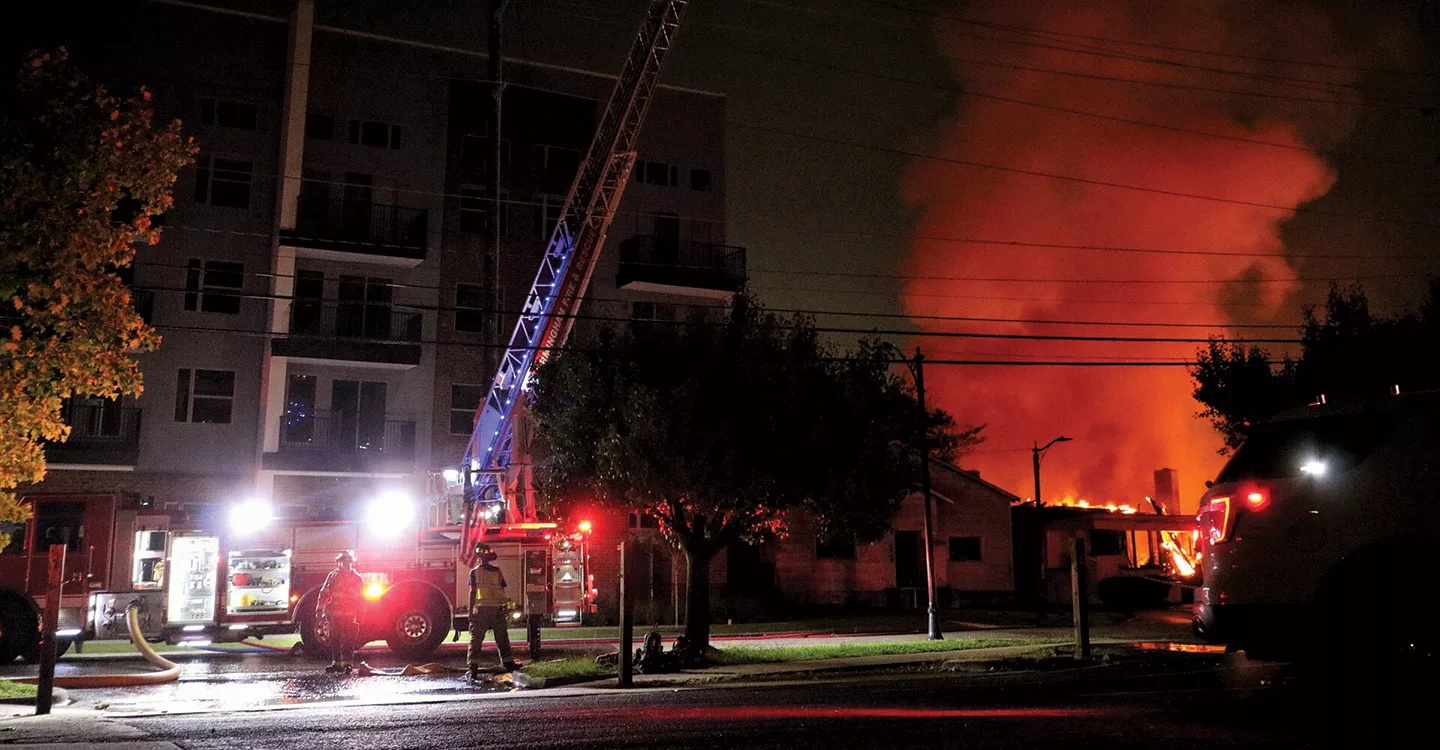
Firefighters battled the nighttime blaze in a Birmingham, Ala., apartment fire in September 2018. The legal machinations over insurance continue.
Just 40 minutes after midnight on Sept. 27, 2018, the sky lit up over Birmingham, Ala. A fire engulfed an apartment building under construction—the last-to-be completed section of a wood-framed complex called the Metropolitan. It fueled one of the largest recorded blazes in the city’s history.
After firefighters had extinguished the flames, what seemed at first like a straightforward insurance claim and payout gradually expanded into a knock-down, drag-out court battle entering its seventh year between owner and insurer over what constitutes “direct physical loss or damage.” That was the key phrase in the project owner’s builders’ risk policy and in thousands of other property policies like it.
The fire was no anomaly. As cost-conscious homebuilders framed more buildings with wood instead of other materials, construction fires had been consuming more unfinished structures. Big blazes hit in Los Angeles in 2014, Avalon, N.J., in 2016; in Waltham and Boston, Mass., and Raleigh, N.C., in 2017. Big construction claims followed each one.
In 2018, wildfires marched across much of the western U.S., with California especially hard hit. In 2017, two northern California wildfires consumed 240,000 acres and 8,900 structures. In 2018 the Woolsey Fire in southern California destroyed about 97,000 acres and more than 1,600 structures, and that same year the Camp Fire in northern California damaged or destroyed nearly 19,000 structures, including more than 14,000 homes. Countless people in western states lived through days of red skies with soot and other particles raining down.
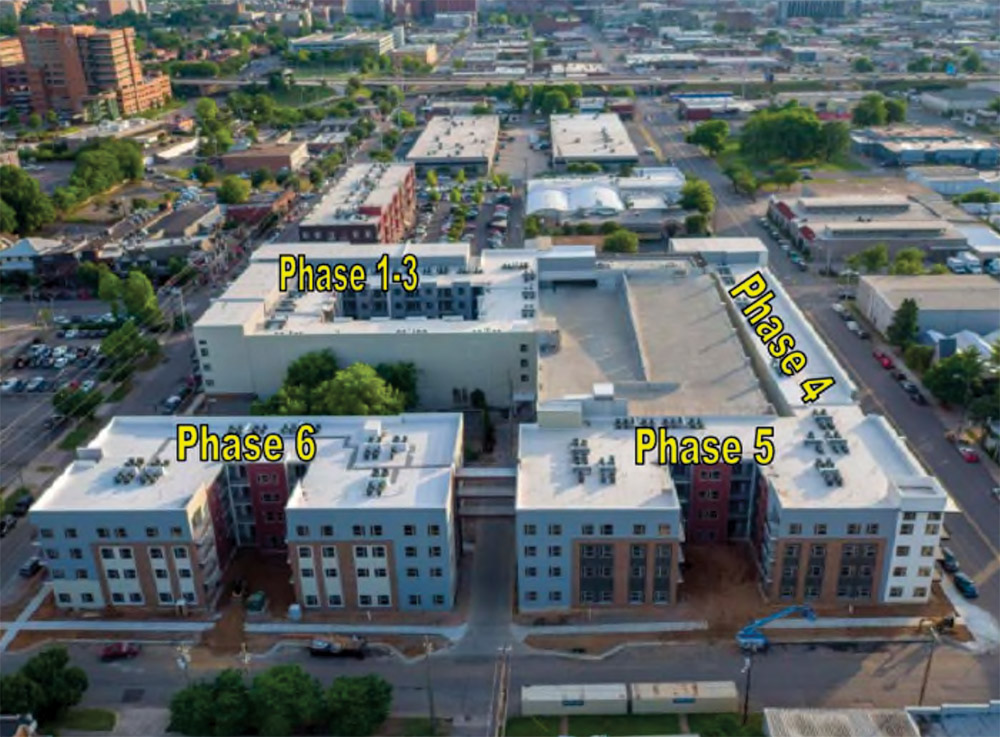
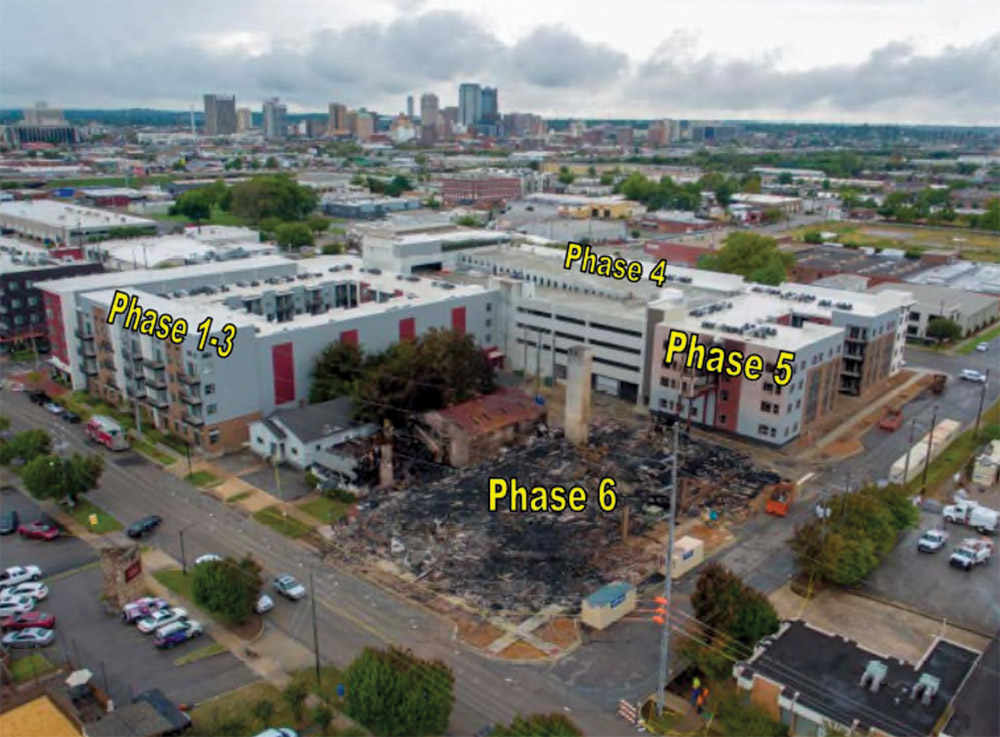
Aerial images of the Metropolitan with its various phases show the position of Phase 6, which was destroyed, and the adjacent Phase 5 building, which was connected via a passageway.
Photos: U.S. District Court Filing
While the Alabama project’s builders’ risk insurer, Travelers, and the owner of the Metropolitan apartment complex, a company called Maxus Metropolitan LLC, were still in the early stages of their insurance claim dispute, another source of potentially devastating insurance claims struck: COVID-19.
Policy holder attorneys believe the pandemic triggered a change by property insurers, including those who write builders’ risk policies.
Before COVID-19 cases flooded the courts with claims that the virus attached to surfaces in a way that constituted property damage, “insurers routinely paid for soot and smoke cleanup,” argues attorney Chip Merlin on his firm’s website. But in the case against Maxus that lasted into the pandemic years and beyond, Merlin claimed, “Travelers is fiercely battling something it used to pay for without a fight.” Travelers declined to comment on the case. Although the latest decision in the case came in the fall, the amount of interest owed on the damage award still is undetermined.
Looking for quick answers on restoration, remediation and cleaning topics?
Try Ask R&R, our new smart AI search tool.
Ask R&R →
The Birmingham fire destroyed the 315-unit Metropolitan’s last remaining section under construction, Phase 6. Like the others, Phase 6 was a four-story, wood-framed building, about 80% complete and still awaiting windows, doors, interior finishes and a functioning sprinkler system. Exposed lumber, plywood sheathing and open framing created a massive fuel load.
Phase 5, closest to the explosion and linked by a passageway, had windows shattered, aluminum frames melted and thick soot on surfaces.
Fire department and newspaper accounts provided a picture of what occurred.
Witnesses described a sudden, explosive roar shortly after 12:40 am. Thick black smoke billowed skyward in towering columns, visible for miles, carrying the stench of burning pine and engineered wood. Embers landed on the roofs of the existing building sections, including Phase 5, which was closest to the explosion and, critically, linked by an open-air passageway that was also damaged. Windows shattered from thermal shock, vinyl and aluminum frames melted, exterior siding charred and peeled. Thick, oily soot coated surfaces.
Newspaper accounts said firefighters battled for nearly three hours and continued extinguishing hot spots until early morning, pouring thousands of gallons of water from aerial ladders and ground hoses.
Birmingham Fire and Rescue Service officials classified the fire as intentionally set with an incendiary device and ruled it arson. No arrests have ever been made.
Phases 1 through 4, farther away than Phase 5 and partially shielded by the courtyard layout and existing structures, escaped direct flame contact and seemed to be unharmed.
Maxus, based in Kansas City, Mo., had recently bought the complex from the builder, Bomasada Birmingham LLC, for about $58 million, and Bomasada continued on as general contractor. The complex was insured under a builders’ risk policy by Travelers Property Casualty Co. of America, with coverage limits up to $35 million for “direct physical loss of or damage” caused by or resulting from covered causes.
Travelers sent Maxus initial claims payouts relatively promptly for the most apparent damage, court records show. These included substantial funds for fully rebuilding the destroyed Phase 6 from the ground up, repairing Phase 5’s heat-damaged exterior and heavily soot-affected interiors and addressing related structural and water damage from firefighting efforts. These fell in line with typical fire damages.
Court documents show that Travelers advanced $1 million shortly after the fire for initial cleanup, emergency repairs and obvious damage to Phase 5, and for Phase 6 rebuilding. Then in January 2019, Travelers made further payments, bringing the total payout to $3,519,607 by March 13, 2019.
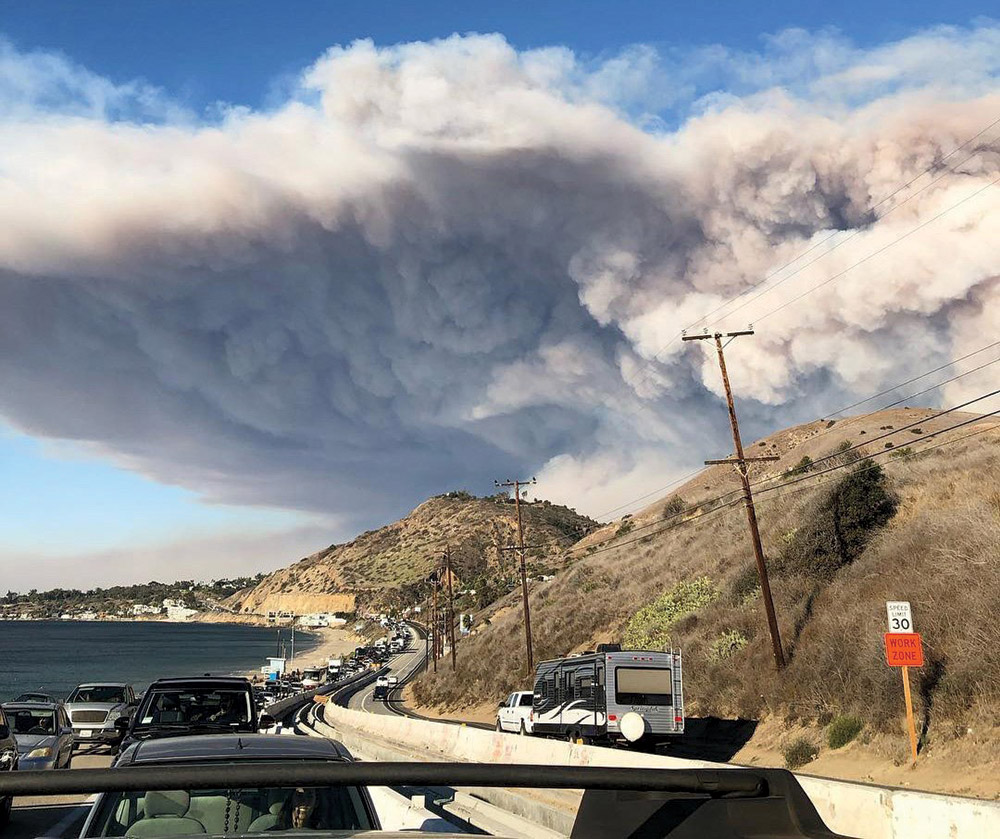
The smoke rising from the fast-moving Woolsey Fire is shown encroaching on Malibu in Los Angeles County in November 2018, as residents fled along the Pacific Coast Highway.
Photo: Cyclonebisket under C.C. License via Wikimedia commons
But that year, the relationship between Maxus and Travelers soured.
It wasn’t until April, six months after the fire, that Maxus hired Forensic Building Science (FBS) to conduct an on-site inspection and detailed testing that included the four buildings that hadn’t been severely damaged by the fire. When building materials burn, incomplete combustion leaves soot and char particles that can embed in less visible building parts, such as wall cavities, HVAC ductwork, insulation and electrical and plumbing systems. The soot and ash can contain heavy metals and carcinogens such as polycyclic aromatic hydrocarbons. These microscopic particles can penetrate lungs, and are the subject of scientific research on the damage this mix of chemicals, metals, gases and particles may inflict on human beings.
Maxus’ wipe samples, air quality monitoring, polarized light microscopy and scanning electron microscopy revealed microscopic combustion byproducts at the Metropolitan. And since there are no recognized federal standards that establish limits of combustion byproduct concentrations on interior surfaces, the only way to determine if by-products have affected the property, according to forensic fire engineering consultant Vertex, is for an independent investigator or hygienist to interpret lab data and samples.
Travelers' attorney warned of broad consequences in a time of wildfires, and argued that microscopic particles were common inside walls.
Although particle concentrations were comparatively low and there seemed to be no immediate health complaints from about a dozen tenants who had already occupied Phases 1 through 4 units, Maxus evacuated them. Citing long-term risks including soot containing known carcinogens and the need to ensure future habitability and tenant safety, the company began a comprehensive remediation and clean-up effort that included full interior gutting in affected areas, surface decontamination, HEPA vacuuming and filtration and replacement of contaminated materials.
Maxus informed Travelers of FBS’s initial findings, dated June 2019, that carcinogenic combustion byproducts were present throughout Phases 1 through 5 and that extensive remediation was needed, court documents show.
Travelers dispatched its own investigator, a hygienist, who wrote that the trace amount of combustion byproducts didn’t pose a health threat. The reports made it clear that Travelers didn’t intend to pay for the remediation work in the buildings that Maxus had already begun, and in December Maxus sued Travelers in federal court in Kansas City, Mo., for breach of contract and vexatious refusal to pay.
The insurer formally denied coverage for remediation inside Phases 1 through 4, asserting that the invisible, microscopic soot did not constitute “direct physical loss or damage” under the builders’ risk policy. No damage was visible, Travelers argued, and Maxus had no expert evidence of an imminent health hazard at the trace levels found. No structural issues or loss of function was found, either, Travelers stated.
After extensive pretrial discovery and maneuvering and pandemic-related delays, a federal jury convened in July 2023.
Maxus attorney Michael Abrams described what he said were Travelers’ unreasonable delays in investigation, selective testing practices, withholding of critical expert reports and outright refusal to pay despite mounting evidence. He tied the contamination directly to the covered fire peril in the builders’ risk policy.
In his opening argument to jurors, Travelers’ attorney Brenen Ely first described the “direct physical damage” terms of the insurance policy, and then proceeded to walk right up to the edge of saying that Maxus exaggerated the damage to inflate its claim. After hiring one consultant whose results weren’t to its liking, he said, Maxus hired FBS, and the investigation “took off in a different direction.” He said that Maxus’ extensive remediation was an overreaction to harmless microscopic particles whose levels posed no genuine risk and did not qualify for coverage under the policy’s physical loss requirement.
In several places, Ely said, Maxus took advantage of its fire claim to rebuild structures that hadn’t burned. “They basically tore down a brand new building and rebuilt it,” he said of building Phase 5.
“You think Maxus stopped leasing apartments?” Ely asked. “No, they didn’t.” And he claimed the tenants in the completed buildings were not eager to leave but that Maxus evicted them until it had performed the remediation—and wanted Travelers to pay all the costs.
Under questioning by Abrams, Maxus Chief Financial Officer Ryan Snyder explained the staggering cost disparity: $11 million to rebuild the destroyed Phase 6 building but $17 million for all the remediation and repairs in other areas.
Later in the trial, a forensic microscopist testified for Maxus that he had identified combustion-origin particles in multiple samples from wall voids, HVAC systems and other hidden areas. Full-scale remediation was essential to eliminate potential health and habitability risks, he said.
The Damage Award
The legal battle could have ended there, in 2023, and a settlement could have been reached many times between 2019 and the trial in 2023.
Policy holder attorneys suggest that the success in combatting many of the COVID-19 claims for property damage and associated business interruption emboldened carriers and their claims attorneys to try to further narrow interpretations about other microscopic or non-visible contamination scenarios.
Attorney Nicholas Insua, an insurance recovery partner with law firm Reed Smith, describes Travelers’ stance as part of a post-COVID shift. He says that without COVID and the subsequent insurance lawsuits where the denied claims were upheld, there wouldn’t have been the body of law that exists now saying that some microscopic hazards or invisible ones are not covered on standard policies.
Insurance companies, even before the pandemic, might have thought about challenging a decision about what constitutes physical loss or damage to property, Insua says. “But because insurers were so successful getting decisions saying that COVID-19, the disease [caused by] the virus, did not cause physical loss or damage to property, they’ve really been emboldened on this specific issue.”
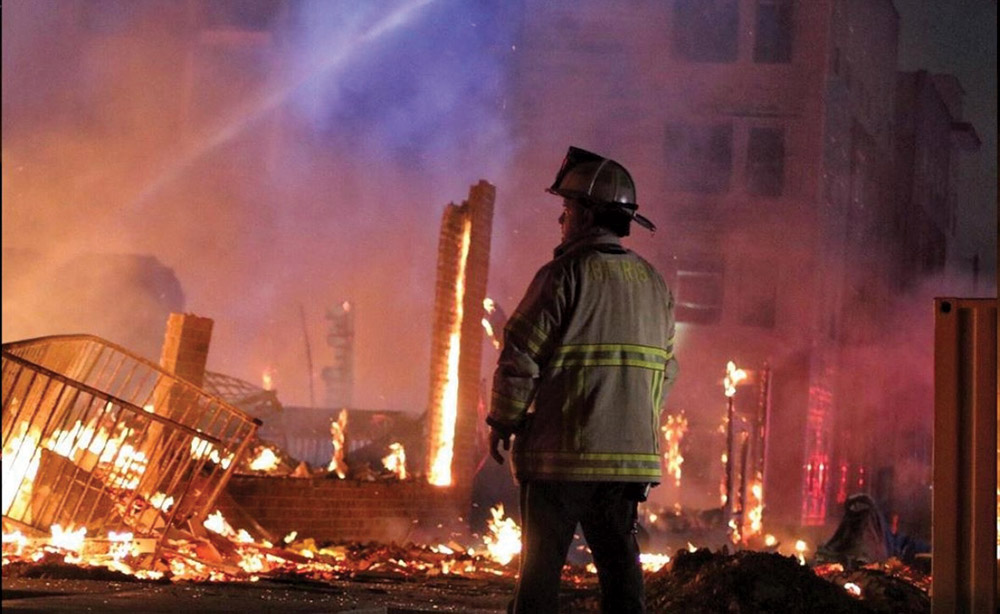
A firefighter gazes at the still-burning ruins of Phase 6 of the Metropolitan, one of Birmingham’s biggest fires.
Photo by Triggered Photography/Andrew Christopher
Travelers appealed the verdict, and the two opposing legal teams again gathered in a Kansas City, Mo., courtroom before a panel of appellate judges, almost seven years after the fire. Travelers’ counsel Tyson H. Ketchum opened, stating, “Property insurance covers physical harm to property requiring repair or replacement of the property. Some courts have also held that it covers a physical contaminant if that rises to the level of rendering the property uninhabitable or useless. Neither of those tests was satisfied here with respect to the interiors of Phases 1 through 4 of the Metropolitan building.” There is no dispute, he added, “that the quantities of microscopic soot … were not a risk to human health.”
Ketchum repeated testimony from an environmental health expert, Stuart Batterman, who stated at the jury trial that “there was no evidence indicating a risk to the tenants,” and that health risks require “heavy staining that would be easily visible.”
Judge Raymond W. Gruender asked whether physical alteration was required. “Is there any evidence that the combustion byproducts physically diminished the utility of the building?” he asked.
“No, your Honor,” Ketchum replied. “There was only one item that they found among $15.6 million worth of work … one component that looked like it could be damaged … an access panel for an alarm system component.”
He argued that microscopic soot inside walls is common. “A lot of people have a fireplace, a wood stove in their home … there’s likely going to be that sort of substance inside the walls” and no one would tear down walls for it without expert proof of harm. “You would need a qualified expert to say that this type of soot is going to damage your wiring … or it’s going to damage your plumbing … and there was no expert testimony supporting that,” he said.
Insurance law is determined on a state-by-state basis, and two California smoke claims cases show how decisions can swing to either side.
Another Travelers attorney, Wystan Ackerman, pointed to the example of a deli located closer to the fire than Phases 1 through 4. “If Maxus’ theory is correct, then the insurance company for that deli would have to pay to tear down the walls and rebuild the whole deli because … someone found, using these wipe samples or these air samples, that there was evidence of microscopic soot inside the walls. That really does defy common sense.”
Maxus’ attorney Abrams portrayed the insurer as obstinate, stating, “Travelers said we’re not paying anything” related to the buildings not directly exposed to the fire. With sarcasm, he said, “Essentially their position prior to trial was we don’t think that there’s soot there. And the soot did not come from the largest fire in Birmingham, Ala., history, which was down the block.”
In an August 2025 opinion, revised Nov. 17, the panel of judges mostly agreed with Maxus.
The judges held that under Missouri law, microscopic soot contamination can satisfy the “direct physical loss or damage” requirement when it adheres to and contaminates property, rendering it uninhabitable or unusable until remediated. The panel explicitly distinguished soot from transient, easily dissipated contaminants like COVID-19 viral particles.
The judges panel upheld the core coverage determination, the vexatious refusal to pay, and the attorney fee award.
Could all the litigation have been avoided? Michael Reich, chief underwriting officer at insurer Insight Risk Technologies, says Maxus’ delay in investigating all forms of damage was a mistake. By failing to conduct comprehensive testing of Phases 1 through 4 until nearly six months after the fire, Maxus complicated proof of direct causation and gave Travelers grounds to challenge necessity and origin.
“The more time that elapses between reporting a loss and the cause of that loss, the more likely a policyholder is to face a protracted disagreement with the carrier,” he said. For better results, he urged policy holders to investigate all insured property post-loss and report every action taken to minimize the loss.
One of Travelers’ attorneys during the trial specifically brought up the delayed investigation, suggesting that Maxus had hired another investigator of the damage and didn’t like the findings and at that point replaced it with FBS. It isn’t clear from the court record how true this is.
Where does this leave developers and contractors? In Maxus v. Travelers, writes policy holder attorney Merlin, the jury and appeals judges wisely reconfirmed the differences between invisible forms of contamination. “Only after the pandemic litigation did insurers begin reinterpreting ‘physical loss’ to dodge smoke and soot claims,” he wrote. “Maxus shows that courts still recognize the difference between fleeting viral particles and tangible, lasting contamination like soot, ash and smoke residue.”
Don’t assume that will always be the case, says Reich. Insurance law is determined on a state-by-state, case-by-case basis, he said, citing two California cases as examples. One court ruled last year in favor of a restaurant, finding smoke contamination from a 2017 wildfire constituted physical loss, likening it to asbestos, a permanent condition rather than transient COVID particles. The decision emphasized that the business could not function normally and repeated the insurer’s own admissions of smoke damage.
But in another California case, a court upheld an insurer’s denial of coverage to a homeowner seeking a payout for a 2019 wildfire. An appeals court held there was no structural change to the home, citing California state court precedent from COVID-19 cases requiring “distinct, demonstrable physical alteration.”
State Smoke Task Force Formed
That decision prompted a response from California’s insurance commissioner, Ricardo Lara, who appointed a smoke claims and remediation task force to review state standards following the last’s year’s Palisades and Eaton fires.
“Wildfire smoke is fundamentally a health and safety issue that must be addressed by experts who understand the challenges involved,” Lara stated in an announcement. He said the insurance department is currently investigating hundreds of smoke damage-related complaints from wildfire survivors and is scrutinizing State Farm Insurance’s handling of thousands of claims from the Los Angeles wildfires, with a “focus on smoke damage.”
On another level, Maxus v. Travelers suggests that while states set standards for insurance claims, a broader mindset comes into play. Insurers keep careful track of their losses by claim category. The Metropolitan fire may have burned in Birmingham, but the insurance dispute was litigated in Missouri, under that state’s law, while the total fire-related insurance losses, and national fire-related frame of mind, was colored by California and the fire-prone western states.
Cases involving “invisible” or microscopic damage—caused by soot infiltration from fires or other subtle contaminants—are likely to keep appearing and the core issue remains the same: Courts must decide what direct physical “damage” truly means.
So, Reich adds, “be prepared for things to change.”
with Richard Korman
Looking for a reprint of this article?
From high-res PDFs to custom plaques, order your copy today!