Ask the Expert
How to Integrate Mental Resilience into Your Biohazard Cleanup Protocols
Jordan Frady shares his insights on biohazard safety, misconceptions and emotional well-being
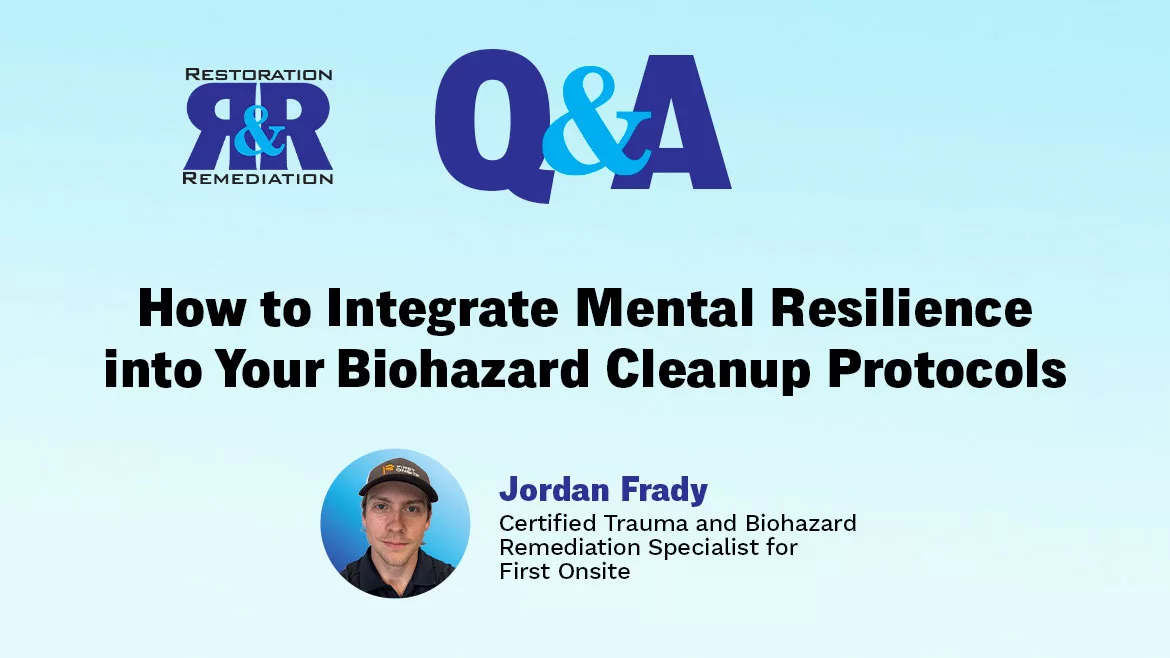
Jordan Frady, a Certified Trauma and Biohazard Remediation Specialist for First Onsite in San Antonio, shares his insights on biohazard cleanup protocols in this special Q&A honoring military veterans. Jordan is a retired U.S. Marine and brings years of hard work, dedication and leads with a servant heart. Outside of his certifications, credentials and years of field experience, Jordan has worked alongside the San Antonio Police Department and Housing Authority. Jordan shares key insights on how he handles jobs, misconceptions, the mental aspect of the job, long-term success and so much more.
Question: How do you handle a jobsite when you don’t know the full extent of the trauma or biohazard risk? What protocols should someone follow when information is limited or unclear?
Answer: This is very common in our line of work. While we always try to gather as much information as possible before arriving, that’s often easier said than done. When I am speaking directly with a grieving family member, it can be incredibly difficult and inappropriate to ask detailed questions about the incident.
That’s why we always push for a physical site assessment. If the family doesn’t have the answers, we may reach out to the responding officers or detectives, who can often provide helpful context: the area affected, the presence of a weapon, cause of death or the nature of the incident.
Once on site, I always begin with ABRA’s Bio Recovery Site Risk Assessment (BSRA). This tool helps me evaluate potential hazards and determine the level of control measures required before any work begins. No matter what the situation is, I never start the job cleanup before assessing and addressing all risks: chemical, biological, structural and emotional. Safety and scope of work always come first.
Q: What are the most common misconceptions about biohazard cleanup, and how do you educate both your clients and the public? How do you correct misinformation without causing more distress and confusion?
A: One of the biggest misconceptions about biohazard cleanup is that it's simply a big mess to clean up. Bloodborne pathogens such as HIV, Hepatitis B and Hepatitis C are serious hazards that must be considered at every scene. This work is not just about cleaning; it is about decontamination and risk mitigation.
Another area of misunderstanding involves secondary hazards. When we begin removing contaminated building materials, we often encounter substances like asbestos, lead or silica dust. These are not always obvious to the untrained eye, but they pose significant health risks if they are disturbed improperly. Trained professionals are expected to recognize suspect materials, determine when testing is required and follow the correct removal procedures in accordance with regulations.
There is also a common belief that first responders are responsible for the cleanup. In truth, their role ends once the scene is secured and released. It is up to us, the trained restoration professionals, to properly clean and restore the environment to a safe and habitable condition.
Looking for quick answers on restoration, remediation and cleaning topics?
Try Ask R&R, our new smart AI search tool.
Ask R&R →
From the beginning, communication with clients should be educational. It is not their responsibility to know the details of biohazard protocols, and they are often dealing with overwhelming emotions. However, clients or adjusters sometimes speak confidently based on outdated or incorrect information. Misunderstandings around asbestos are especially common, and it is not unusual to face some resistance when testing is required. These conversations should be handled with calm, factual explanations and a focus on protecting everyone.
Q: How do you mentally prepare yourself before entering a particularly disturbing or emotionally charged scene? Are there proven techniques or routines that help you stay grounded?
A: I don’t know that there’s a single, reliable way to prepare for some of the scenes we get called to. The truth is, they can be intense and unpredictable. What I’ve found most helpful, especially over time, is developing a deep confidence in my training and processes. When you’ve repeated the steps enough times, you don’t need to overthink it. You rely on what you know, and you focus on the task.
That mental shift from thinking to doing helps cut through the emotional overload. It doesn’t mean the situation doesn’t affect you, but it gives us something solid to fall back on when the scene itself is overwhelming.
Q: What are some signs of emotional burnout or trauma fatigue? How do you recognize when you need to step back or seek support?
A: If I start avoiding scenes, feeling irritated more often or noticing that I can’t give 100 percent on a job, those are clear warning signs. If a particular scene sticks with me long after it's done, or I find myself pulling away from people or dreading new calls, I take that seriously.
Sometimes just talking with a teammate or a therapist is enough to reset. Other times, I need to step back completely whether that means taking time off, rotating into a different role for a while or simply allowing space to decompress. The important thing is to make sure you are not ignoring the signs. This work takes a toll on you and pretending it doesn't only makes things worse over time.
Q: How do you maintain empathy for victims and their families while staying emotionally detached enough to do your job effectively? Where’s the line between compassion and emotional overload?
A: I don’t believe you need to be emotionally detached to be effective in this line of work. Empathy is shown through how you treat the people and the space, not by how deeply you absorb their pain. You can care without fully submerging yourself to where it affects you.
That balance comes with experience, but even then, there will be scenes that hit harder than others. In those moments, I remind myself that I’m here to help, not to absorb. My role is to restore safely and with dignity, not to take the grief home with me. This mindset helps me keep my compassion intact without allowing it to overwhelm my work.
Q: What kind of mindset is essential for long-term success in this line of work? Is it more about toughness, compassion or something else?
A: It’s definitely not about toughness. Some of the “toughest” people burn out fast, either because they lack the right internal processes, or because they struggle to show the empathy that this work requires.
When we’re talking about long-term mental success in this field, it comes down to what happens after the job is over. Things like team debriefs, talking about how a scene made you feel and why and seeking professional counseling when needed. Those are what keep people grounded over time.
None of that works unless it's built into your culture. People need to feel safe with opening up. That means your leadership team needs to model it, and the team needs to treat it as something normal, not as a weakness.
Q: How do you support team members who are struggling emotionally after a difficult scene? What role should peer support play in your daily operations?
A: This starts from the very beginning with onboarding and how you shape the culture of your company. As a leader, you set the tone through vulnerability. If a call comes in at 2 a.m. and it deeply affects you, a mother sobbing after finding her son or a scene involving decomposition that hits close to home, talk about it. Bring it up at the next morning meeting. Let your team see that it is okay to feel these emotions and to discuss them openly.
Peer support does not need to be formal. One of the most powerful things you can do is simply ask, “How are you feeling after that call today?” Small check-ins like this build trust and over time create a culture where people feel safe being honest. That is where real support happens.
Q: What should you do if you feel unsafe or unprepared for a particular scene? Is it okay to walk away, and how should you communicate that to clients or supervisors?
A: The consequences in this field are far too serious to take chances, both physically and emotionally. If you do not feel prepared for a scene, whether it’s emotionally, technically or both, it is safer for everyone involved for you to step back.
That does not always mean walking away entirely. Sometimes it just means supporting from a different role, partnering with another company you trust or passing the job on altogether. The important thing is recognizing your limits and speaking up.
From an employee standpoint, it is far too common to be asked to handle scenes or hazards that we are not properly trained or equipped to manage. In those moments, you must advocate for yourself. This work is about protecting others, but that also includes protecting your own health and safety.
Q: What ongoing training or certifications are most valuable for staying current and confident? Are there psychological preparedness courses in addition to the technical ones?
A: Training in this field is incredibly broad and can feel overwhelming at first. To be on site safely, you should have basic certifications like Bloodborne Pathogens, Respiratory Protection, Hazard Communication, Personal Protective Equipment, First Aid, Asbestos Awareness and Heat Stress.
Beyond that, more advanced and specialized certifications are essential. OSHA’s HAZWOPER 40 is an important one and is even argued as required by law. IICRC courses like Trauma and Crime Scene Technician (TCST), Health and Safety Technician (HST), Applied Microbial Remediation Technician (AMRT) and Building Construction Identification (BCI) all build critical skills. ABRA also offers a highly respected third-party certification process. OSHA’s 10- or 30-hour Construction Industry trainings are valuable too, and so are containment building courses for hands-on jobsite preparation.
One area that continues to be overlooked is psychological readiness. The emotional impact of this work is significant, especially for those handling the initial client contact or arriving first to assess a scene. There are few formal resources out there, but Psychological First Aid (PFA) is one of the most recognized programs. Even basic education on trauma-informed communication can go a long way. This aspect of training should be a priority across the industry, not an afterthought.
Q: How do you build a company culture that respects the emotional part of this work while maintaining high standards? What policies or practices help create a supportive environment?
A: Respecting the emotional side of this work should never come at the expense of high standards. If anything, it raises them. A strong culture isn’t built through slogans or posters. It comes from processes. When part of your process is checking in with your team, asking for help, being honest about how you're doing and having regular debriefs after hard jobs, the culture will reflect that.
You can’t have a high-performing team when key members are struggling silently. Creating space to talk about difficult jobs or emotional moments isn’t just a kindness, it’s a necessity for operational success in this field.
Team building also plays an important role. If you're asking people to be vulnerable and open with each other, that kind of trust must be grown, together. Shared experiences outside of work help strengthen the bond that carries over to tough scenes.
One piece that often gets overlooked is involving the people your team goes home to. Spouses and partners often take on a huge emotional load as part of their support system. Including them in occasional team-building events not only helps them understand the work more, but also helps reinforce the idea that this is a community effort, not just a job you clock in and out of. It can help reduce isolation and create a more stable environment at home, which circles back into workplace well-being.
Ongoing training is part of this too, and not all of it has to be formal. Regular refreshers on how to debrief, how to process a scene without carrying it or even reminders that it’s okay to step back when needed. Those small things add up to a culture that supports resilience without sacrificing quality.
Looking for a reprint of this article?
From high-res PDFs to custom plaques, order your copy today!