Selecting the Right Disinfectant for Forensic Restoration
Ensure safety and profitability during crime scene, self-cessation, hoarding cleanup, and more
Say “forensic restoration” and crime scene clean-up is what comes to mind for many people. Forensic restoration professionals, however, often find themselves engaged in work ranging from the clean-up of unsanitary dwellings to remediation after a self-cessation event. When addressing illicit drug labs, grow ops and tear gas residue, chemical safety and cleaning effectiveness are primary concerns. To get the job done right the first time, skillful utilization of the right personal protective equipment (PPE), tools, and chemicals enables a crew to achieve their objective profitably. If human pathogens contaminate the job site, as is most often the case with forensic restoration, utilizing the right disinfectant is critically important for both safety and profitability.
Unseen hazards
A human pathogen is a bacterium, virus or other organism that can cause disease in people. When a forensic restoration professional is called in to restore a pathogen contaminated structure to pre-event conditions, assessing risk is the first thing that needs to be done. In most cases where human decomposition has occurred, or where blood, body fluids or Other Potentially Infectious Materials (OPIM) are present, it’s impossible to know exactly which human pathogens are present without conducting expensive and time consuming testing.
Protect your team and your clients
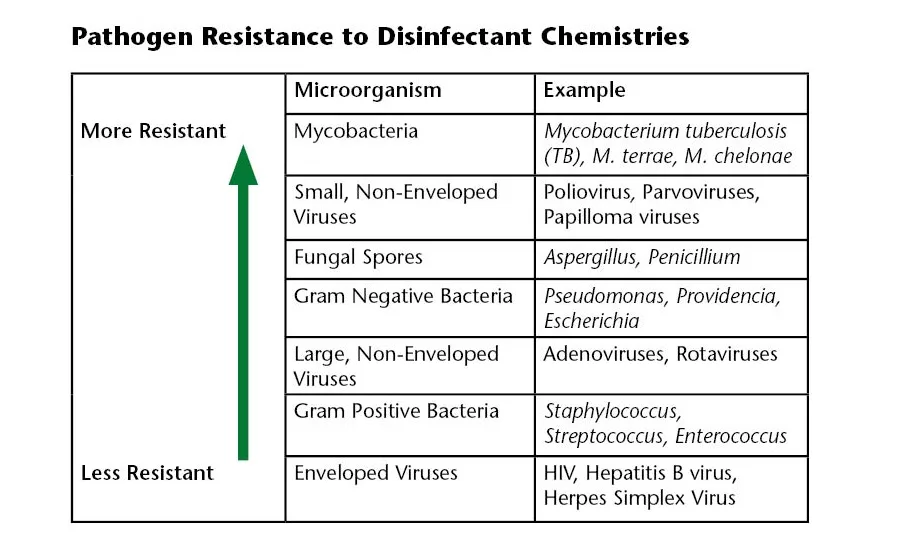
With this in mind, using a disinfectant that is effective at killing a broad range of pathogens is the best way to ensure the safety of your personnel and clients. Starting from most difficult to kill to the easiest to kill, the major types of human pathogens (examples in parenthesis) are:
- Non-enveloped viruses (poliovirus, norovirus, coronavirus)
- Mycobacterium (tuberculosis)
- Fungi (Aspergillus niger, Stachybotrys chartarum)
- Gram negative bacteria (Pseudomonas aeruginosa, Escherichia coli)
- Gram positive bacteria (Staphylococcus aureus, Streptococcus pneumoniae, Enterococcus faecalis)
- Enveloped viruses (HIV, Influenza A)
For the highest margin of safety, use a disinfectant that is effective against non-enveloped viruses and tuberculosis.
Protect your profits with hospital grade disinfectants
Look for a hospital-grade disinfectant, a disinfectant that has been proven effective against S. aureus, S. enterica and P. aerugionsa in the presence of 5% blood serum. Since active ingredients in disinfectants are consumed or deactivated by organic contamination, the 5% blood serum test is a “stress test” for disinfectants, simulating a surface that is contaminated.
Hospitals look for an extra margin of protection for patients and staff, and a disinfectant that demonstrates efficacy against particular organisms in the presence of 5% blood serum is considered “hospital grade”. Recognizing that hospitals try to turn their patient rooms in 18 minutes – less time than a maid has to clean a hotel room – disinfectants that are effective in the presence of 5% blood serum provide hospitals and their patients with an extra margin of safety. As well trained and motivated as our restoration technicians are, a hospital grade disinfectant can be difference between acceptable ATP readings during final clearance and having to rework a job at a loss.
The label says it all
The EPA requires disinfectant labels to contain important information including a list of all the organisms which that disinfectant is capable of killing. Other important information found on the label includes:
- Dwell time - The amount of time the surface must be kept wet with the disinfectant in order to achieve the full effectiveness of the product is known as dwell time. The dwell time is determined in a lab under test conditions and each pathogen listed on the label will be tested with dwell time as a factor. If the application conditions are significantly different, much colder for example, the disinfectant may take longer to achieve a complete kill. Except in conditions that cause rapid evaporation of the disinfectant, short dwell times generally do not offer a significant advantage over products with longer required dwell times.
- Use instructions – Any details that are pertinent will be listed on the label. Most labels advise against mixing the disinfectant with other chemicals because it can diminish efficacy or result in noxious off-gassing. If the disinfectant is a concentrate, dilution ratios will be listed.
- Application venues and method – The label will tell where the product is approved for use and how it should be applied.
- First aid measures, precautions and warnings – Disinfectants are tested at least 5 different ways for toxicity and the results determine the warnings that must be displayed. Look for PPE requirements on the label.
- Expiration date – Manufacturers of disinfectants conduct actual shelf life and accelerated aging tests to assure that the active ingredient levels remain high enough to deliver the efficacy promised. Some chemistries are inherently unstable and can be adversely affected by temperature extremes and direct sunlight, so check your product label.
- Environmental impact – Some disinfectant chemistries have little or no environmental impact while others can adversely affect wildlife and the environment. Review your product’s label for directions on how to dispose of properly.
To Disinfect or to Sanitize?
To meet the EPA’s standard for disinfection, a product must kill the challenge organisms within the dwell time listed on the label. Sanitization, however, only means that 99.9% of challenge organisms are killed. To put that in perspective, if your power company has 99.9999% reliability, your power will be out less than one minute each year. If their reliability drops to 99.9%, you would be in the dark for nearly nine hours per year.
Sanitizers are useful in certain applications, but when the potential threats that exist in the realm of forensic restoration are considered, disinfectants are the most reliable way to minimize risk to both employees and clients.
In conclusion
When considering which disinfectant to use in forensic restoration projects, the safety of your employees and your clients is the primary concern. Look for a disinfectant that is effective against non-enveloped viruses and TB, and check the label to see that it has been tested in the presence of a 5% serum. A product that enables your team to get the results you want the first time maximizes your profitability and your customer’s satisfaction.
Looking for a reprint of this article?
From high-res PDFs to custom plaques, order your copy today!