The Cost of Losing Good Restorers
How program fees, pricing pressures, delayed payments, and overhead are threatening restorers’ viability
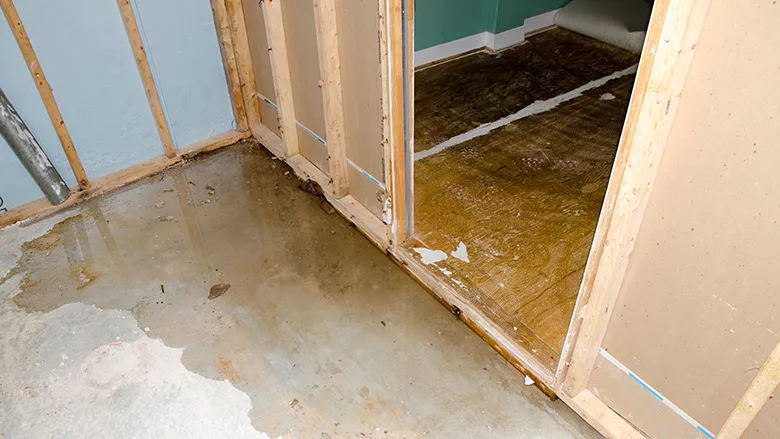
"We have all been terminated effective 4:30 today."
That was the message from a Jenkins general manager in an employee communication headlined "Jenkins update 9/23." He didn't yet know what to tell subcontractors and homeowners, or how access to the buildings and vehicles would work. Behind a closure like this, there are employees, families, partners, and homeowners who suddenly face uncertainty and are looking for answers.
Jenkins began in 1975; Jeff Yoh became majority owner in 2008. A 2023 operating summary shared with me put TPA revenue at 53% to 63%. That is historical context, not the closing-period business mix or proof of what caused the closure.
I'm a second-generation restorer and a father of four. This industry has helped me raise my family. Seeing people who built their careers in this industry and are suddenly looking for work ought to bother all of us, including competitors.
I don't know every reason as to why they reached this point, and I'm not claiming the pressures in this article caused its closure. Contractors across the restoration industry are feeling pressure from rising costs, pricing contsraints, program fees, payment timing, and the complexity of doing the work. Those specific pressure deserve a closer look.
Rather than us speculalting about what happened to one company, let’s take a closer look at the economics restorers face today, and what happens when multiple pressures are on the same job.
Let me ask you this: When the contractor is gone, who finishes the house?
Looking for quick answers on restoration, remediation and cleaning topics?
Try Ask R&R, our new smart AI search tool.
Ask R&R →
Every deduction lands on the same job
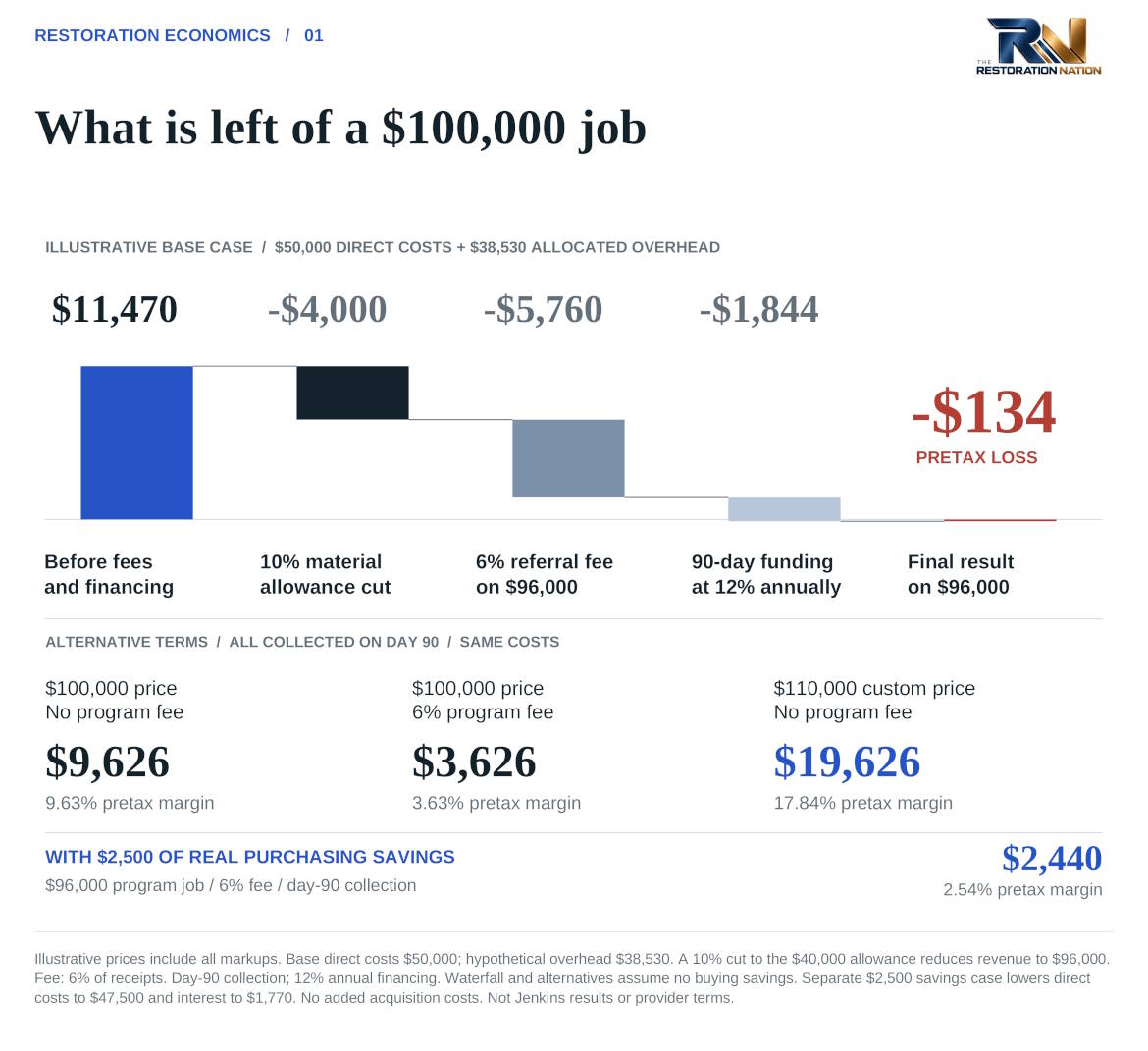
Program work can bring legitimate value. It still has to pay for itself. Start with a $100,000 repair, $50,000 in direct costs and $38,530 in separate overhead. That's a 50% gross margin and $11,470 left before program fees and financing. Now, put the job through the rest of the process.
Cut the $40,000 material allowance by 10%, and $4,000 of revenue disappears. Charge a 6% referral fee on the remaining $96,000, and another $5,760 goes. Finance the modeled cash outlays until collection on day 90, and interest costs $1,844. The job loses $134.
These are illustrative assumptions, not Jenkins' results or verified terms for any provider. The example assumes no actual purchasing savings, no additional procurement staff and no rework. It shows why looking at each deduction separately misses what happens when they land on the same job.
At a supported, accepted custom Xactimate price of $110,000, with no program fee and the same day-90 collection, modeled profit is $19,626. That's $19,760 better than the discounted program job. Raising a price doesn't eliminate a fee; leaving the program does. Add $5,000 to acquire that direct job and the advantage falls to $14,760 before any extra financing. Direct work has costs too.
Graphic: The Restoration Nation; courtesy Jeff Moore
A lower allowance is not a lower invoice
I'm all for buying better. If TrueLine, itel, or another provider can deliver the right materials for less, let's use it. RIA's own Lowe's program advertises a variable 5% to 10% discount on eligible online purchases. We support legitimate savings. Compare a new offer with the price, freight, and credit terms we already have.
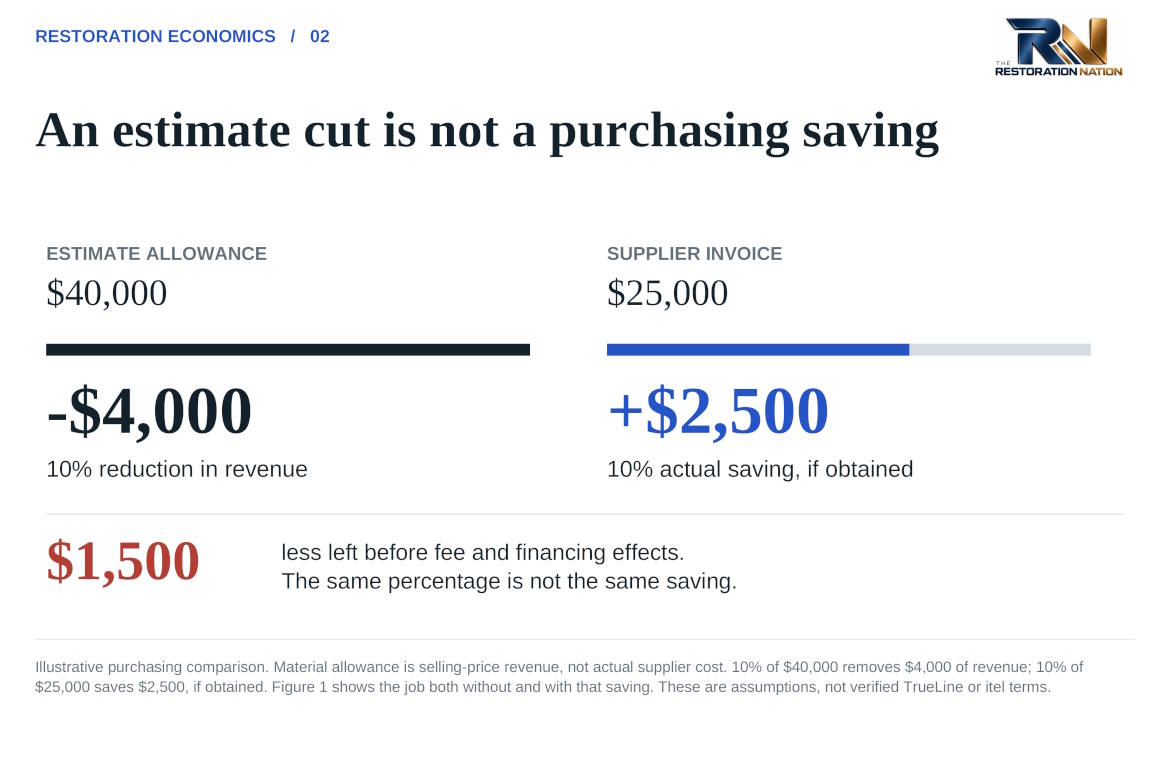
Here's where the discussion gets sloppy: a reduction in an estimate is treated as though it automatically produces the same reduction in our costs. It doesn't. A material allowance is revenue. A supplier invoice is an expense. Even the same percentage can mean very different dollars.
Graphic: The Restoration Nation; courtesy Jeff Moore
Think about a flooring subcontractor who normally furnishes and installs. Move purchasing to the restorer and somebody has to confirm selections, measure quantities, place and fund the order, receive it, store it and fix shortages or damaged goods. Reconcile the subcontractor's credit with the responsibilities being transferred. That work doesn't disappear because the material price changed.
Verisk says its third-party pricing feature can replace material pricing while retaining Xactware labor and equipment pricing. That makes the next question important: do those allowances still cover the work when the purchasing process changes?
I support RIA's material-handling request. It does not mean we accept every underlying discount or consider the problem solved. Give us an obtainable delivered price, workable terms, and a named person who can approve an alternative when the promised purchase fails.
If the work moves to the restorer, the compensation has to move with it.
We are also the bank
Payroll is due every week. Materials may be paid for at purchase. Subcontractors may expect their money in a week or 30 days. If we collect in 90 days, we're financing the repair while everybody discusses the estimate.
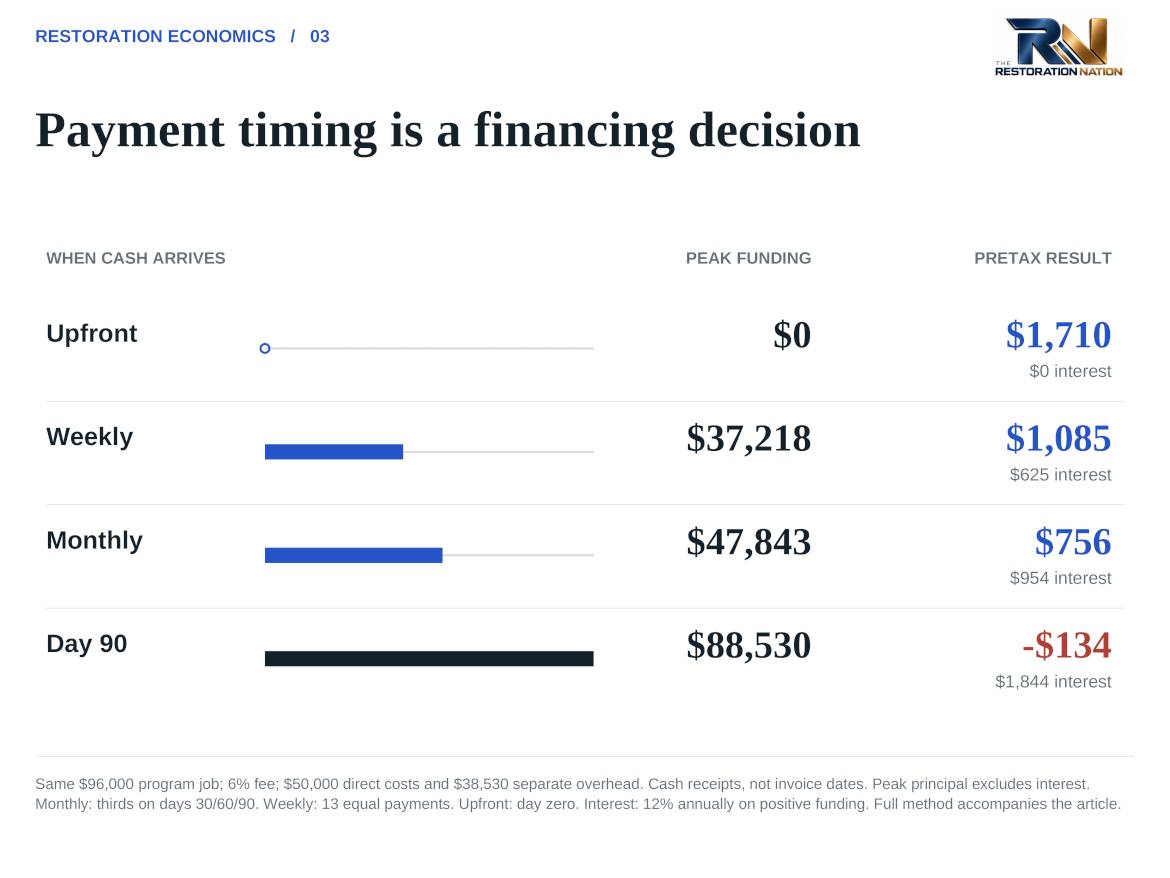
On this same $96,000 program job, collecting everything on day 90 requires up to $88,530 of principal funding. Monthly collections reduce that peak to $47,843. Weekly collections bring it to $37,218. Full payment upfront eliminates the modeled borrowing need. Those are cash receipts, not invoice dates.
Earlier collection saves interest and improves the final result. It does not raise the underlying gross margin or rescue every underpriced job. And upfront payment is a comparison case, not a recommendation to collect the amounts prohibited by law or contract.
Supplier credit belongs in the comparison too. Move a $25,000 purchase from day-60 payment to day zero and, with collection still on day 90, the added 60 days cost about $493 at 12% annually. Material advances, direct supplier payment, comparable credit and prompt progress payments can reduce that burden.
Sending an invoice isn't collecting it.
Graphic: The Restoration Nation; courtesy Jeff Moore
Ten and ten is not a business plan
RIA and KnowHow's 2024 Cost of Doing Business report estimated average overhead at about 36%; the 2025 report put it at 38.53%. Different respondents and accounting methods limit a straight year-over-year comparison. These are benchmarks, not a rate every contractor should charge. They are a reason to know your own numbers.
Fuel and trucks. Tools and equipment. Stocked supplies, loading vehicles and drive time. Estimators, supervisors, project managers and office staff. Some costs belong directly to jobs; others belong in overhead. Count each once. Check what the existing pricing already includes. Then ask whether the total price covers the total work.
A straight 20% markup represents 16.7% of the resulting selling price. Compounded 10% and 10% produces 17.4%. Neither figure is the contractor's final profit. Margins embedded in line items also matter. The long-running debate revisited in The Folly of 10 and 10 deserves more than another argument over a familiar percentage.
At a 40% gross margin, the original $100,000 job has just $1,470 left after $38,530 of separate overhead, before fees and financing. At 35%, it is already losing $3,530. A contractor who doesn't know that can mistake a busy schedule for a healthy business.
Now take assignments away without immediately taking the overhead with them. In the company example below, a 25% revenue decline turns a $114,700 monthly operating surplus into a $10,300 loss before program fees, interest and tax. Borrowing can bridge a timing problem. It cannot keep replacing profit.
| Monthly revenue | Change | Result before fees interest and tax |
|---|---|---|
| $1,000,000 | Unchanged | $114,700 |
| $800,000 | Down 20% | $14,700 |
| $750,000 | Down 25% | -$10,300 |
Illustrative company comparison: direct costs at 50% of revenue; fixed monthly overhead of $385,300.
The next failure is everybody's problem
When a restoration company can no longer finish the work, the consequences don’t end with that company. The house still needs to be finished. The trades still need to be paid. Employees and their families are affected, and the homeowner may suddenly find themselves searching for answers in the middle of an already difficult loss.
If capable restorers close or leave insurance work, less capacity is available when losses hit. Repairs can take longer. Prices can rise. Covered additional living expenses can grow. On an unfinished project, someone may face unpaid trades, deposits at risk and the cost of finding a replacement contractor. Responsibility depends on the contracts, coverage and any applicable bond. The disruption is real either way.
Carriers need dependable contractors. TPAs need a network that can perform. Consumers need somebody who answers the phone and comes back tomorrow. Contractor viability belongs in the calculation of what a claim actually costs.
- Carriers and TPAs. If the program is required, pay its fees or change the pricing and fee structure enough to support the work. Fund materials and completed work promptly. Review referral charges, price reductions and payment delays together. A lower estimate is no bargain if the repair stalls.
- Suppliers and pricing providers. Stand behind an obtainable price and document what it includes. Identify who receives fees or rebates and who handles damaged goods, returns and delays. Give a named decision-maker authority to approve a documented alternative. A failed purchasing arrangement needs a remedy.
- Restorers. We have responsibilities too. Know our costs, control waste, document the work and collect our money. Understand the total cost of each referral source. Be careful about depending on one channel. A carrier isn't responsible for fixing our management mistakes.
- RIA and the people who can decide. Bring all sides to the table. Start with 20 to 30 actual claims, including purchases that worked and those that failed. Compare the quoted price with the delivered invoice, credit terms, added labor and repair time. Publish findings in 30 days; agree on changes, owners and deadlines within 90. Correct documented failures while the review is underway.
Let's meet. Let's discuss. I want our kids to see a future in this business, and I want the families we serve to get home. We can argue about whose percentage is reasonable, or we can sit down with the whole job and make it work. I'm ready. Who else is?
Looking for a reprint of this article?
From high-res PDFs to custom plaques, order your copy today!