One Industry, Different Models: The Future of the Restoration Industry
Jeff Moore, RIA’s President, reflects on the restoration industry’s growth, challenges, and the need for unification
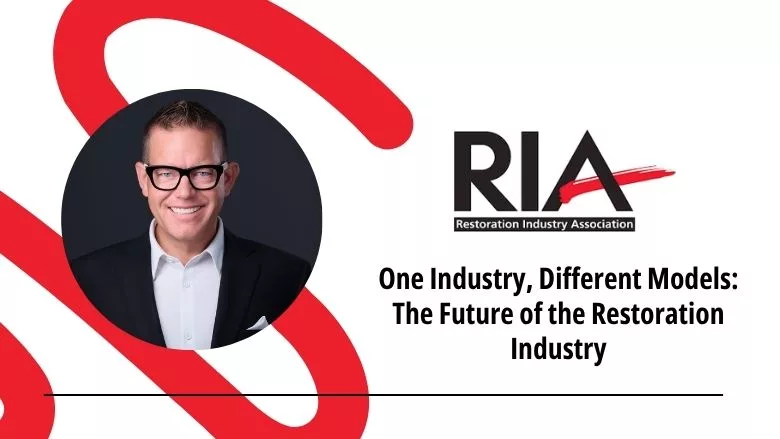
As I wind down my time serving as President of the Restoration Industry Association, I’m not interested in writing some polished recap that reads like a board report.
This isn’t that.
This is my honest take on what I saw, what we did well, what we still need to improve, and why I’m still optimistic.
I have a unique vantage point on this one.
My relationship with RIA didn’t start this year. I first ran for the board in 2011 and served in 2012 and 2013. Back then, I was younger, more impatient, and quicker to think I had the answers.
I came in thinking I could help change the place.
What I didn’t understand then was that trade associations don’t move like private companies.
They move slower.
They move by committee.
They move through volunteers.
They move through trust.
Looking for quick answers on restoration, remediation and cleaning topics?
Try Ask R&R, our new smart AI search tool.
Ask R&R →
And honestly, I wasn’t ready for that back then.
My company was growing. My time was stretched. My mindset wasn’t where it needed to be. So, I stepped away, focused on my business, focused on my family, and let life teach me a few things.
Fast forward a decade.
My company changed.
I changed.
The industry changed.
And so did RIA.
When I came back and eventually had the chance to serve as President, it was a completely different experience.
This time I didn’t come in trying to fix anything.
I came in to serve.
And that changes everything.
First, let’s be clear about how this actually works
The President of RIA is largely a figurehead.
That’s not me being dismissive. That’s just reality.
The real work happens with staff, with the board, and most importantly at the committee level. That’s where the engine runs. That’s where the actual work gets done.
The President can set the tone, communicate, show up, open doors, represent, and push things forward. But nobody should confuse the role with doing all the work.
A lot of people deserve credit for the progress we made.
And I’m proud of them.
I’m proud of the board.
I’m proud of the volunteers.
I’m proud of the staff.
And I’m proud of the members who leaned in and helped move things forward.
This role is volunteer, too. RIA does not pay its President. Our companies continue paying our salaries and benefits while we dedicate significant time to serving the industry.
In my case, that meant 50% of my time, and at times closer to 60%. Some of that was structured work. Much of it was optional: outreach, social engagement, industry conversations, one-on-one meetings with large contractors, carriers, and stakeholders.
I made it a priority to solicit input, especially from larger operators who historically sit on the sidelines. Many told me we’re doing good work. Many agreed the direction is right. Not all were ready to join or lean in.
That’s reality.
And when you’re working with roughly 10–15% of the industry as active, dues-paying members — on what is effectively a lean budget relative to the size of this trade — there’s only so much you can accomplish.
That’s not an excuse.
It’s context.
What I’m most proud of
We did some really good things.
The biggest win, in my opinion, was advocacy.
We’ve talked about advocacy for years. In 2025, we finally stopped talking and actually did it. Hiring Vince Scarfo into a full-time advocacy role was a big deal. It gave advocacy structure, consistency, and real accountability.
That matters.
We also launched a Carrier Relations Task Force. And before anybody reads too much into that, let’s be real: carriers are part of the world we operate in whether we like it or not. Pretending otherwise is stupid. Engaging that reality is smarter than avoiding it.
We made real progress with the Enterprise Membership program. Is it where it needs to be? No. Not even close. But compared to where it was, it’s a big step forward.
Same with our Affinity program. Lowe’s and Sunbelt have real traction. Some of the others don’t yet. That’s okay. Not every initiative takes off at the same pace. But directionally, it’s moving.
Convention attendance keeps growing. Membership interest keeps growing. Board interest has grown dramatically.
Those are real wins.
And another positive: welcoming Saima Hedrick into the CEO role through AH brought fresh energy and fresh perspective. She came in ready for change, ready to improve things, and ready to make the association better for members. That matters.
The board pipeline is night and day
Five years ago, if two seats opened, two people ran.
Sometimes that was it.
Today? Completely different story.
Now we’re seeing 20 to 30 people raise their hands wanting to serve. Not all are ready. Not all are the right fit. But the level of interest is dramatically better than it used to be.
That tells me something important:
People care.
People believe it matters.
People want a voice.
That’s real progress.
We are one industry whether we want to admit it or not
This past year reinforced something I already believed but maybe understand better now:
No matter how we get our work, we are still one industry.
Independent.
Franchise.
National.
Regional.
Local.
Program-heavy.
Non-program.
At the end of the day, we all do the same thing.
We restore buildings.
We help customers at their worst moments.
That’s the core of what we do.
The business model may be different. The path to the customer may be different. But the mission is the same.
And if we don’t start acting more like a unified trade, this business is only going to get harder.
Because it already is.
There’s more regulation.
More consumer-protection laws.
More third-party influence.
More margin pressure.
More people in the process trying to tell restorers how restoration should work.
Programs. TPAs. Consultants. Insurance carriers. Building consultants. Everyone has an opinion. Everyone wants a seat at the table.
Meanwhile, too many restorers are still fighting each other.
That’s a mistake.
The participation gap is real
Today only about 10–15% of restoration contractors actively participate in RIA.
That’s not me taking a shot at the association. That’s just fact.
And when you compare restoration to adjacent trades, it’s obvious we still have a long way to go as a unified trade.
Restoration, mitigation plus reconstruction, is roughly a $100 billion industry.
For context:
- AGC (General Construction): $2T+ industry / ~27,000 members
- NECA (Electrical): ~$275B industry / ~4,000 members
- MCAA (Mechanical): ~$150B+ industry / ~3,000 members
- SCRS (Collision Repair): ~$40B+ industry / ~6,000 members
- RIA (Restoration): ~$100B industry / 1,905 members
That should tell you something.
We’re not small.
We’re underorganized.
Other industries didn’t get strong because they were bigger.
They got strong because their leaders organized.
Restoration has the talent. It has the footprint. It has the economic weight.
What we still need is unity.
And just to say the quiet part out loud: three of the ten largest restoration firms in the country are not RIA members. In a more mature trade, that would be unusual.
That doesn’t discourage me.
It tells me the upside is still massive.
Leadership should reflect the whole trade
One of the things I’m most proud of is that recent RIA presidents reflect the actual diversity of restoration business models.
And when I say diversity, I’m not talking about demographics. I’m talking about how companies are built, owned, and operated.
Recent RIA Presidents / Leadership Snapshot
Mark Springer (2020–2022)
DaySpring Restoration • Privately owned • Family-founded • 2nd-generation leader • Non-franchise • Non-program • Single-state operator • Montana • 6 locations
Katie Smith (2022–2024)
PHC Restoration • Privately owned • Family-founded • 2nd-generation leader • Non-franchise • Non-program • Local • North Carolina • 1 office
Ben Looper (2024–2025)
Southeast Restoration • Privately owned • Founder-led • 1st-generation founder • Non-franchise • Program work • Regional • Georgia / Alabama / Tennessee • 7 offices
Jeff Moore (2025–2026)
ATI Restoration • PE-backed • Family-founded • 2nd-generation leader • Non-franchise • Program work • National
Justin Woodard (2026–2027)
Woodard Cleaning & Restoration • Privately owned • Family-founded • 3rd-generation leader • Non-franchise • Non-program • Missouri / St. Louis market
Mark Davis (leadership bench / future voice)
Signal Restoration / PuroClean • Privately owned • Acquired / scaled platforms • 1st-generation operator • Franchise + non-franchise • Program work • National
There is no one right model.
Local.
Regional.
National.
Family-founded.
Founder-led.
PE-backed.
Franchise.
Non-franchise.
Program.
Non-program.
All of it is restoration.
And RIA is better when all those perspectives are represented.
The part I wasn’t fully prepared for
I made it a point this year to engage people, even people who don’t agree with me.
Especially people who don’t agree with me.
I got much more vocal on social media. That was intentional. I wanted to engage the broader industry, not just the people already in the tent.
And I’ll be honest: some of that was gut-wrenching.
Not because I can’t handle criticism. I can.
But when you’re volunteering 50–60% of your time, speaking, traveling, representing the industry, taking time away from your business and family, and then some people say completely wild things online — it hits differently.
I should’ve expected some of it. You see it in politics. You see it in the media. People can be cruel online.
And yes, there were times I asked myself whether I really wanted to keep doing it.
But I made a commitment.
And I’m a man of my word.
Some of the people who were the loudest online critics later called privately asking for help, asking for advice, even apologizing.
What people say online and what they say in person are often very different.
I’ve got thick skin. But I’d be lying if I said it doesn’t affect the people around you too — your wife, your kids, your friends. They see it.
That’s part of leadership.
You don’t just lead the people who agree with you.
You lead everyone.
The good, the bad, and the ugly come with it.
And honestly? I’m better for it.
Final reflection
If I graded the experience itself, I’d give it an A+.
I loved serving in this role. I loved helping people. I loved the calls, the conversations, the advice, the perspective, the chance to give back.
If I graded my own performance, I’d probably give myself a B-.
Not because the association failed.
Because I’m hard on myself. I believe things can always be better.
That’s not disappointment.
That’s ambition.
The RIA is stronger today than it was five years ago.
That’s real.
But there is still a lot of work ahead of us.
My term officially passes the baton from Jeff Moore to Justin Woodard at the RIA Convention on Tuesday, April 28, 2026, in Savannah, Georgia.
And that’s exactly how it should be.
Leadership rotates.
Perspective changes.
The mission remains.
And if enough good people keep stepping up, this association, and this industry, will keep getting stronger.
— Jeff Moore
Looking for a reprint of this article?
From high-res PDFs to custom plaques, order your copy today!