Understanding Protein Fires: Why “Sight, Smell, and Feel” Still Matter in Restoration
What restorers need to know about protein fire residue, testing, assessment, and verification
Welcome to an exclusive Q&A with Ryan Whitney of Environmental Forensic Consultants, Inc. (EFCI). We’re taking a closer look at one of the most misunderstood fire losses restorers face, protein fires.
We discuss what makes protein fires different by breaking down residue, assessing the odor, testing, verification, and building a defensible scope. Ryan shares what restorers should know before taking on their next protein fire loss.
1. What is a protein fire and how do we as restorers define it?
When we talk about a protein fire in restoration, we’re really using an industry term, not a formal scientific fire classification. We’re typically talking about a cooking-related event that involves proteins, fats, oils, grease, and food residue.
These are often low-temperature events that can generate a lot of smoke and odor, even when there is little or no open flame. A few examples are burned food, overheated grease, or cooking incidents that fill a home with aerosolized residue.
2. How is a protein fire different from a structural fire, wildfire, or lithium-ion battery fire?
Each type of fire can leave behind a very different contamination profile.
With a structural fire, you’re dealing with building materials, plastics, insulation, furnishings, electronics, and synthetics. Wildfires and WUI fires often include vegetation, ash, soil minerals, and phytoliths. Lithium-ion battery fires introduce a broader chemical issue, including metals, acids, plastics, and compounds from the battery casing and its contents.
Protein fires are different. As I mentioned, you’re typically dealing with sticky, organic residues from fats, proteins, and cooking byproducts.
Looking for quick answers on restoration, remediation and cleaning topics?
Try Ask R&R, our new smart AI search tool.
Ask R&R →
3. Why is protein fire residue so hard to assess?
Because it doesn’t always look like traditional soot. That’s part of what makes these losses so easy to underestimate.
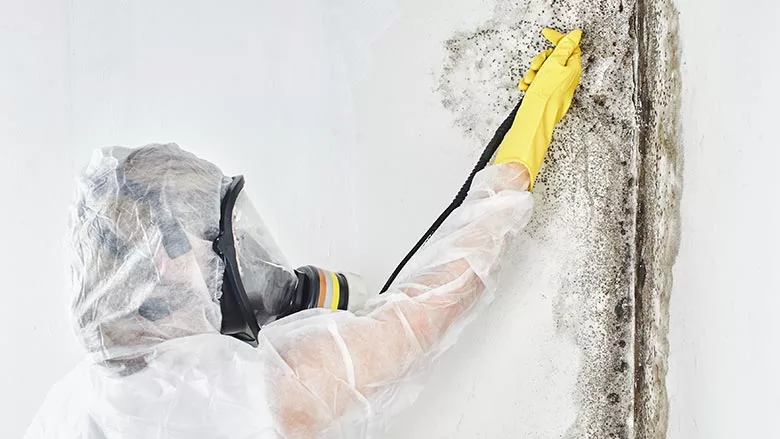
Protein fire residue may appear yellowish or sticky, and airflow can carry it well beyond the source. You may find it on vertical surfaces, cabinets, in duct pathways, carpets, and hidden cavities.
If you’re walking into the loss looking only for black soot, you can miss a significant portion of the contamination.
4. What are the biggest concerns for occupants and restorers?
One of the biggest concerns is lingering odor, but that’s only part of it. You also must consider residue on surfaces, contamination within HVAC pathways, health concerns from VOCs and fine particulates, and the possibility of under-scoping the loss.
You can’t dismiss an odor as “just a smell.” If the odor remains, you need to ask why it’s still there and whether you’ve fully addressed the source.
5. What type of testing is useful for protein fires?
This is where it gets difficult because we don’t have one established, universal laboratory method for evaluating protein fire residue the way people might expect with other contaminants.
For many protein fire losses, we still rely heavily on visual inspection, olfactory inspection, tactile assessment, occupant interviews, and targeted testing when it’s available and justified.
Labs may be able to test for amines, aldehydes, or related compounds, but those tests can become extremely expensive and aren’t always practical for the average loss.
That’s why trained inspection and interpretation still matter so much.
6. What does successful verification or clearance look like?
For protein fires, success often doesn’t come down to a single lab number.
A better verification process includes a thorough initial assessment, clear documentation and photos, identification of impacted materials and pathways, proper cleaning of the affected areas, and follow-up with occupants after remediation is complete.
If the occupants no longer detect odor and the affected areas are clean to an acceptable standard, that may provide a more realistic indicator of success than applying a rigid, one-size-fits-all test result.
Key takeaway: “Acceptable” is more realistic than “zero contamination.”
7. Why is the initial assessment so important?
The initial assessment sets the scope. If you don’t identify where the contamination has traveled, you can’t establish proper containment boundaries, determine was impacted, or identify which materials need cleaning, removal, or replacement.
Remember, a sloppy initial assessment leads to a bad scope, bad cleanup, and more pushback later.
8. What role do third-party professionals play?
A big one. An independent, unbiased assessment can bring tremendous value to the project. An IEP or IH can help interpret the data, reduce liability, and create a more defensible scope.
That matters because restorers often have to make decisions under pressure while also working with the occupants, adjusters, insurers, and other parties involved in the loss.
Important Note: Third-party assessment can protect everyone involved and improve the quality of the work.
9. What is the biggest mistake restorers make with protein fires?
Underestimating them. A lot of people assume a kitchen fire stays in the kitchen, or that if they don’t see black soot, they don’t have a significant problem. But HVAC systems, pressure pathways, airflow, and porous materials can move contamination throughout a structure.
Another major mistake I see made is restorers relying only on what they can see. You still need to use sight, smell, and feel, along with a complete inspection.
10. What should restorers do differently tomorrow?
Start with a better assessment. Inspect before you scope. Document everything. Talk to the occupants. Follow airflow and pressure pathways. Don’t assume the damage stayed near the source. Follow up after the work is complete and collect data whenever you can.
Our industry needs more field research and more consistent follow-up if we’re going to build better standards over time.
Better documentation and follow-up today can help build the data our industry still lacks.
In closing, protein fire losses reinforce why restorers can’t rely solely on what they can see. Understanding the source, following the contamination, documenting what you find, and knowing when to bring in additional expertise can help restorers build a stronger scope and deliver a better outcome.
And as Ryan reminds us, sometimes the fundamentals still matter most: sight, smell, and feel.
Looking for a reprint of this article?
From high-res PDFs to custom plaques, order your copy today!