How Many Times Does Your Restoration Team Touch the Same Insurance Claim?
An easy 10-claim audit can help restorers uncover rework, gaps, and losses

A claim can get paid and still cost you more than it should.
Most restoration owners know their accounts receivable, estimate turnaround time, and which jobs are waiting on payment. Far fewer know how many times the average claim is reopened, reassigned, revised, or re-explained before it reaches final approval.
That number matters. One quick question to a project manager does not look like much. Neither does asking a technician to find a photo or having an estimator reopen a file. But when those interruptions happen across dozens of claims, they quietly consume estimator capacity and pull managers back into work the file should have handled.
What Counts as a Claim Touch?
A claim touch is any time someone has to reopen the file, search for information, clarify what happened, revise the estimate, prepare a response, check the status, or escalate the claim.
Not every touch is a waste. Claims can be complex. Conditions change, additional damage is discovered, and legitimate questions come up. The goal is not to eliminate every interaction. It is to separate necessary work from preventable rework.
Think about a common claim. The estimator cannot confirm which rooms were affected, so the project manager is called. A photo is missing, so the technician searches for it. A reviewer later removes a line item, and the estimator goes back to the project manager to reconstruct why the work was needed. When the claim stalls, the owner gets involved.
The claim may eventually be paid in full, but it interrupted four people and delayed every other estimate in the queue.
Looking for quick answers on restoration, remediation and cleaning topics?
Try Ask R&R, our new smart AI search tool.
Ask R&R →
Why Owners Should Care
Accounts receivable shows how long money has been outstanding. Estimate turnaround shows how quickly the first estimate was completed. Supplement recovery shows whether challenged scope was eventually approved. Those numbers matter, but no one shows how much internal labor it took to get there.
When the estimating queue grows, the first instinct may be to hire another estimator. Sometimes that is the right answer. Other times, the estimator is spending too much of their week tracking down evidence, rebuilding explanations, and answering the same questions more than once. That is a workflow problem, not simply a headcount problem.
Run a 10-Claim Audit
Pull 10 recent claims. Include a few that paid cleanly, a few that required supplements, and a few that were cut or stalled. The sample does not need to be perfect. It only needs to be large enough to show a pattern.
Build a simple timeline for each claim. Every time the file was meaningfully reopened, record:
- The date.
- The person or role involved.
- Why the file was reopened.
- Whether the touch was necessary or preventable.
- The outcome or next action.
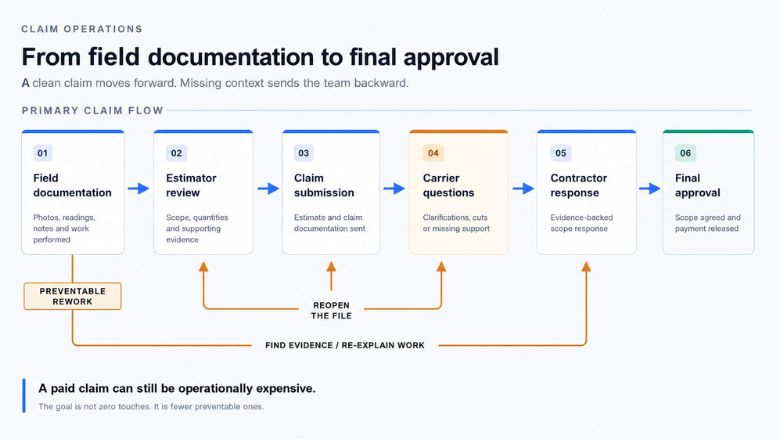
Image courtesy of Plentitude
Use simple categories such as missing evidence, scope clarification, estimate revision, carrier response, status check, customer communication, or leadership escalation. Then compare the total touches, the number of people involved, time between touches, and the most common reasons the claims were reopened.
Do not worry about finding the perfect industry benchmark. Start with your own baseline. Compare the clean claims with the high-touch claims. The difference between them will usually tell you more than an outside benchmark.
What the Patterns are Telling You
The count gets your attention, but the reason behind each touch tells you what to fix.
- If estimators repeatedly ask which rooms were affected, the field handoff is incomplete.
- If project managers keep re-explaining why work was performed, the documentation is not carrying enough context forward.
- If administrators constantly check status, claims may be missing a clear status, owner, or next action.
- If the same line item is challenged across multiple claims, the team may need better supporting evidence or a stronger pre-submission review.
Once the same issue appears across several claims, it is no longer an isolated claim problem. It is a process problem inside the business.
Five Ways to Reduce Preventable Touches
1. Define what a complete handoff looks like.
Set a minimum file standard before estimating begins. Depending on the job, that may include the cause of loss, affected rooms, measurements, photos, moisture readings, equipment logs, work performed, and unusual site conditions.
2. Connect the evidence to the scope.
A folder with hundreds of photos is not a review-ready file. Organize the photos, readings, notes, and logs so the estimator can quickly see which room, condition, or line item each item supports.
3. Give every open claim an owner and a next action.
A clear owner, next action, and follow-up date reduce internal status checks and keep several people from assuming someone else is handling the response.
4. Respond from the file, not from memory.
When a claim is challenged, the team should be able to point to the documented job conditions. If the estimator has to re-interview the field team every time a question comes up, the file is not carrying enough context.
5. Turn repeat questions into process changes.
If the same photo request, line item, or explanation creates rework across multiple claims, update the field checklist, training, or estimate review process. Fix the next claim, not only the one in front of you.
Technology Should Remove Touches
Technology only helps when it makes the workflow simpler. If a new system requires duplicate entry, another login, or another manual handoff, it may add more touches than it removes.
Judge every tool by a practical standard: Does it make job information easier to find? Does it flag missing support data before the submission? Does it connect evidence to the estimate and preserve a clear claim history? Most importantly, does it help an experienced person make a better decision without reconstructing the job?
A Better Definition of Efficiency
The fastest estimate is not always the most efficient claim. A file written quickly but reopened six times may consume more labor than one that takes a little longer to prepare and moves cleanly through review.
The best-performing claim is not just the one that gets paid. It is the one that gets paid without forcing the team to repeatedly reconstruct what happened.
Start with 10 claims. Count the touches, categorize the reasons, and compare the clean files with the high-friction ones. You will quickly see where estimator capacity is being lost and where a better handoff, clearer ownership, or stronger file can give that time back.
Looking for a reprint of this article?
From high-res PDFs to custom plaques, order your copy today!