Ask the Expert
Building a Restoration Business That Can Succeed Without You
How leadership development, succession planning, and retention can reduce owner dependence in the restoration industry
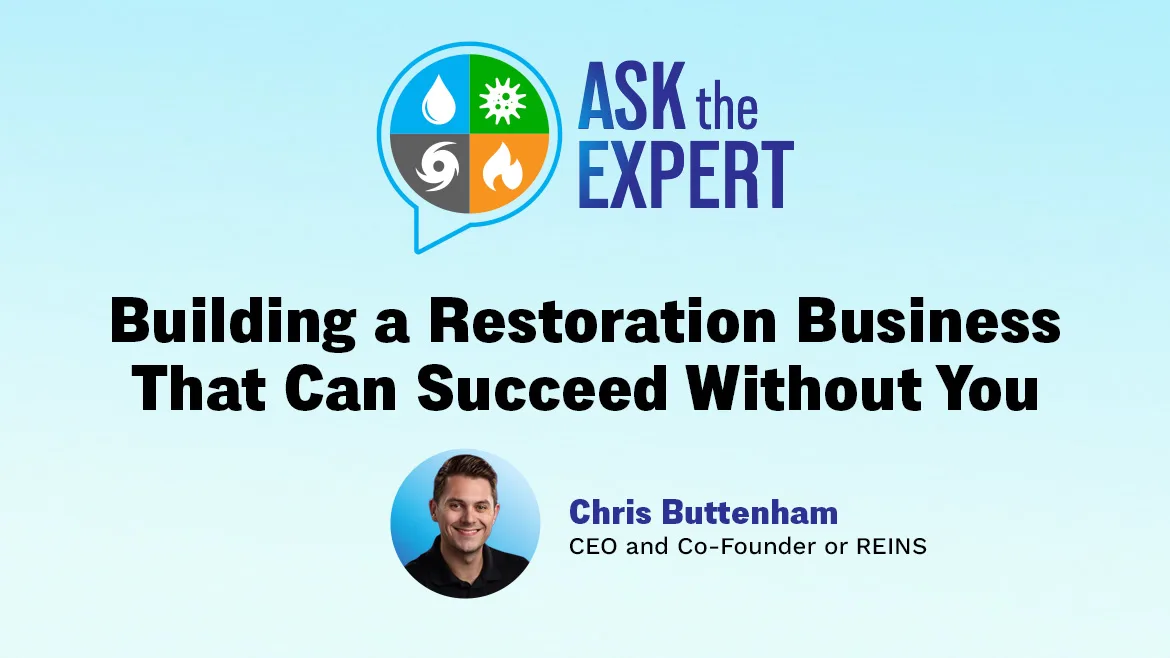
In this exclusive Ask The Expert Q&A, Chris Buttenham of Reins discusses what restoration business owners should consider when planning for long-term success, including leadership development, delegation, employee retention, key-person risk, alternative equity, and future ownership transitions. The decisions owners make today can directly impact the options available tomorrow. Whether the goal is to step away, gain more freedom from day-to-day operations, or eventually sell, what owners do now can shape the future of their business.
Building a successful restoration company is one thing. Building one that can continue to grow without the owner at the center of every decision is another. Regardless of the long-term goal, many of the variables remain the same: developing and retaining key leaders, keeping valuable employees invested in the company's future, reducing owner dependence, and protecting long-term business value.
1. If a restorer is looking to step away from day-to-day operations someday, who is prepared to run the company in their absence, and why?
Honest answer for most restoration companies: nobody, not yet. The owner is still the top salesperson, the final call on a large loss, the relationship with the carrier or the TPA, and the person who signs off on pricing exceptions. There's usually a strong ops lead who could handle the day-to-day, but who has never carried a P&L, never sat in a bank meeting, and never told a good customer no on a $400K job.
That's not a people problem. It's a rep’s problem. Nobody has been given the chance to make those decisions badly a few times and learn.
The test I'd give any owner is simple: leave for 30 days. Not a vacation where you're checking your phone at dinner — actually leave. Whatever breaks while you're gone is your org chart telling you the truth. Most owners have never run that test, which is exactly why they can't answer the question.
2. If a restorer is looking to protect long-term company value, what incentives are in place to retain key leaders after the owner is no longer front and center?
Most companies have a bonus. A bonus is a thank-you for last year — it doesn't buy next year. If your GM gets a check every December and nothing else, you have not built retention. You've built a habit.
Once the owner steps back, the thing holding a key leader in place is either real upside tied to what they help build, or it's nothing. A lot of restorers are sitting at nothing and don't realize it, because the owner's presence has been the retention plan the whole time. Take that away and there's not much left.
Looking for quick answers on restoration, remediation and cleaning topics?
Try Ask R&R, our new smart AI search tool.
Ask R&R →
The options are narrower than people think but better than they fear. You can give up real equity — most owners won’t and shouldn't have to. Or you can use alternative equity, which covers a couple of different tools. A synthetic stake tracks the value of the business, vests over years, and pays out in cash at a defined event. Structured profit sharing pays out annually against performance the team can actually move. One rewards building the asset, the other rewards running it well. Most companies need both, aimed at different people.
Either way, your key person gets the economics of an owner. You don't give up an ounce of the company.
3. If a restorer is looking to build a company that can operate without them, which decisions still require their approval, and what's preventing delegation today?
The list is always longer than the owner thinks. Pricing exceptions. Hires above a certain level. Any capex. Anything with a legal or coverage question attached. Large-loss escalations. Anything that touches a carrier relationship. Write it down for a week and it's sobering.
What prevents delegation is rarely capability. It's two things. First, the owner has never written down what a good decision looks like, so handing it off feels like gambling. Second — and this is the one nobody says out loud — the person on the other end has no economic stake in the outcome, so the owner's gut says they won't care as much. And frankly, the gut isn't always wrong.
Fix the second one and the first gets a lot easier. When someone's payout moves with the value of the business — or with the profit they're responsible for producing this year — you stop having to check their work the same way.
4. If a restorer is looking to keep future options open, how strong and stable would their leadership team appear to an outside buyer or investor today?
Buyers underwrite people, not just EBITDA. They ask three questions: who runs this without you, how long have they been here, and what keeps them here after the deal closes. If the answer to the third one is "we hope," it gets priced in — through a lower multiple, a bigger earnout, or a longer seller note that keeps you working for the next three years in a company you no longer own.
Most independents have never looked at their own leadership team through that lens. And the asymmetry is brutal: the buyer has done a hundred of these, and you're doing your first one.
The most valuable thing you can put in front of a buyer isn't a slide about your bench. It's a retention structure that's already signed and already vesting before they show up — synthetic equity holding your top people, profit sharing keeping the management layer under them engaged. Locked in two years earlier is worth a whole lot more than promised at the table.
5. If a restorer wants to keep their best people through a future ownership transition, but isn't willing to give up actual equity to do it , what options do they have today?
This is the single most common question I get, and the good news is the answer isn't as binary as people assume. It's not real stock or nothing.
There's a whole category in between, and it generally comes in two forms.
The first is synthetic or phantom equity. Your key person is granted units that track the value of the company. Those units vest over time. They pay out in cash when a defined event happens — a sale, a recap, or a date you set. No change to the cap table, no new voting member, no partner at Thanksgiving for the rest of your life.
The second is structured profit sharing. Instead of tracking enterprise value, it pays out against annual performance — a defined share, on a formula everybody can see, tied to numbers the team actually controls. It's more immediate and it reaches deeper into the org, so it tends to fit the layer below your top two or three.
Most companies I work with end up running both. Phantom units for the handful of people whose departure would change what the business is worth, profit sharing for the wider group of managers you need bought in every single year. Different problems, different tools.
The point was never to make your people owners. It's to make them think like one, and to give them a real reason to still be here in five years.
6. If a restorer is two to three years from a potential exit, how much of their company's value is tied to people who could leave at any time, and what would a buyer think about that risk?
Start with a number most owners can't answer: what is the business actually worth today? Not a rule of thumb from a peer group dinner — the real number. You can't manage risk against a value you've never measured.
Then run the harder math. If your top three people walked tomorrow, what happens to revenue, to your carrier relationships, to your ability to staff a large loss in the middle of the night? For most restoration companies that exposure is enormous, and it appears on exactly zero financial statements.
Buyers see it anyway. It's called key-person risk, and it comes straight out of your valuation as a discount. Two to three years out is actually the good news — that's enough runway to put something in place and let it vest so it's real by the time anyone's doing diligence. Six months out you have no leverage. At that point you're just asking politely for a discount not to be applied.
7. If a restorer is looking to maximize both freedom and flexibility, are they building a company people choose to stay in, or one that still depends on them to survive?
For most owners, honestly, it's the second one wearing the first one's clothes. The business runs on the owner's gravity, and everybody calls it culture.
The test I'd offer: if you weren't the owner, would you stay here for the next five years? What specifically would keep you? If the honest answer is "the pay is fine and the owner's a good guy," you don't have a company people choose. You have a company people tolerate while you're still around.
Freedom comes from the business functioning without you, and you don't get there through delegation alone. People stay when they can see what they're building toward and know exactly what it's worth to them. That's the whole game. Everything else is org charts.
Looking for a reprint of this article?
From high-res PDFs to custom plaques, order your copy today!