Lath, Plaster, and Drywall: What Restorers Need to Know About Construction Dust
An inside look at the evolution of wall systems and why plaster, drywall, and joint compound dust can create hazards for workers
Need to Know
- Before gypsum wallboard (drywall) became the predominant interior wall and ceiling material, buildings were commonly finished using wood or metal lath covered with multiple applications of wet plaster.
- During the first half of the twentieth century, gypsum lath became increasingly common as an alternative to traditional wood lath. It substantially reduced installation labor and construction time while retaining many of the characteristics associated with traditional plaster walls.
- Buildings constructed or remodeled during approximately the 1920s through the 1960s may contain several different wall systems, including wood lath and plaster, gypsum lath and plaster, and conventional gypsum drywall.
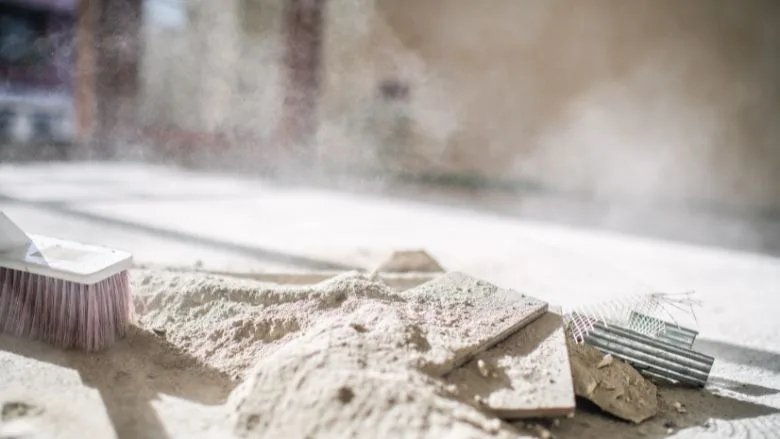
- Drywall, joint compounds, texture materials, plasters, and related gypsum-based finishing products may contain crystalline silica and other mineral ingredients that can generate substantial concentrations of airborne particulate when disturbed by construction and restoration activities.
Ancient Times
Plaster walls have a history extending thousands of years before modern wood lath, gypsum lath, or drywall. Both the ancient Greeks and Romans developed sophisticated plaster systems for interior and exterior walls, including highly polished and decorative finishes.
Greek builders were using lime-based plaster extensively by at least the Classical Greek period, approximately the 5th and 4th centuries BCE, although plaster and lime-based finishes existed much earlier in the Mediterranean and Near East. Greek wall construction commonly consisted of a structural substrate of stone, rubble masonry, or mud brick covered with one or more layers of plaster. The plaster provided a smooth finished surface and also serve as the substrate for painted decorations. Greek craftsmen could produce remarkably smooth plaster surfaces. Important buildings sometimes received multiple coats, with increasingly fine materials used toward the exposed surface.
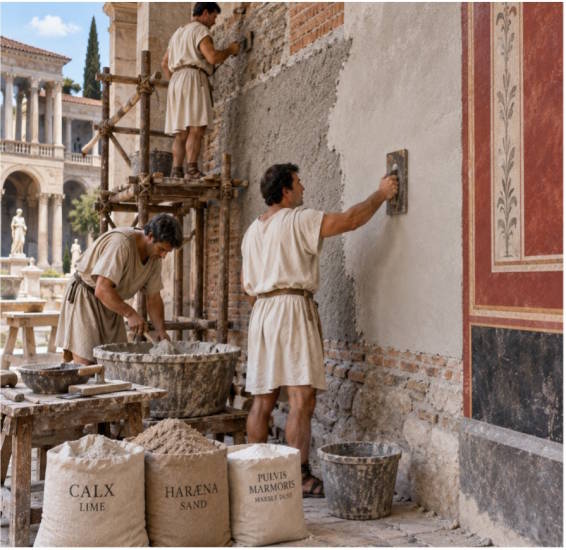
Image AI-Generated by Chat GPT
The Romans substantially expanded and refined Greek plastering techniques. From approximately the 1st century BCE through the Roman Imperial period, sophisticated multilayer plaster systems were routinely used in houses, villas, baths, temples, and public buildings. (This process is similar to today’s Venetian Plaster). Pigments were applied to fresh or appropriately prepared lime plaster. As the lime plaster cured and carbonated, the decorative surface became integrated with the plaster. This is an important distinction when comparing ancient plaster with later American construction.
Traditional Lath and Plaster
Wood lath and plaster has a much longer history than gypsum wallboard (drywall). In the United States, lath and plaster became a standard interior wall and ceiling construction method during the 18th and 19th centuries and it remained dominant ceiling and wall finish well into the early 20th century. As a timeline:
- 1600s–1700s: European settlers brought traditional plastering methods to North America. Early construction often used hand-split wood lath nailed horizontally across timber framing. Wet lime-based plaster was forced through the spaces between the lath, forming plaster “keys” that mechanically secured the plaster.
- 1700s–early 1800s: Wood lath and lime plaster became a well-established interior finish in American houses and other substantial buildings. Lath was still commonly split by hand.
- Mid-1800s: Industrialization and sawmills made machine-sawn wood lath inexpensive and widely available. By the latter half of the 19th century, wood lath and plaster was essentially a standard interior wall and ceiling system throughout much of the United States.
- Late 1800s–early 1900s: Wood lath with multiple coats of plaster was one of the predominant wall systems. Typical construction involved a scratch coat, brown coat, and finish coat. Lime plaster increasingly incorporated gypsum plaster to accelerate setting and improve production.
- 1890s–1920s: Alternatives began appearing, including metal lath, gypsum lath, and early gypsum plasterboard, including Augustine Sackett’s 1894 plasterboard.
- 1920s–1940s: Gypsum lath and other manufactured plaster bases increasingly competed with wood lath. Importantly, these systems were still often plastered, so the presence of gypsum board does not necessarily mean a building originally had modern drywall construction.
- 1940s–1950s: Wood lath declined substantially in new construction as gypsum lath and gypsum wallboard provided faster installation and reduced labor requirements.
- 1950s–1960s: Modern gypsum drywall increasingly became the standard for new residential construction, although plaster-on-gypsum-lath construction continued in some regions and higher-quality construction.
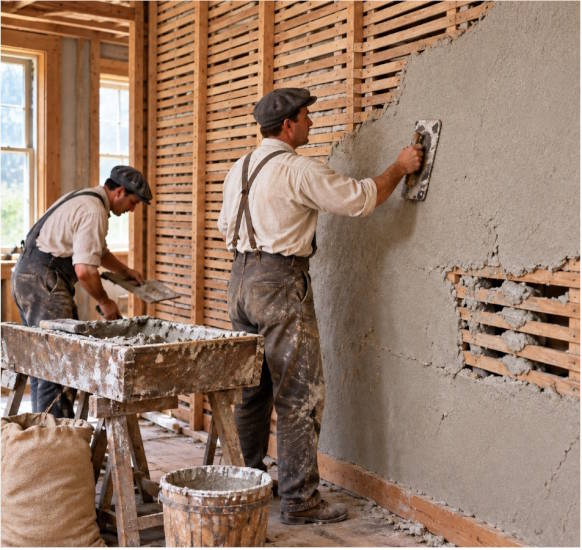
Image AI-Generated by Chat GPT
Before gypsum wallboard became the predominant interior wall and ceiling material, buildings were commonly finished using wood or metal lath covered with multiple applications of wet plaster. Traditional plaster construction was labor-intensive. Wood or metal lath first had to be attached to the framing. Plaster was then applied in multiple coats, commonly consisting of base or scratch coats followed by additional leveling and finish coats. Each stage required skilled labor and sufficient time for the plaster to set and dry before subsequent finishing operations could be completed. The process could therefore take considerably longer than installing prefabricated gypsum panels.
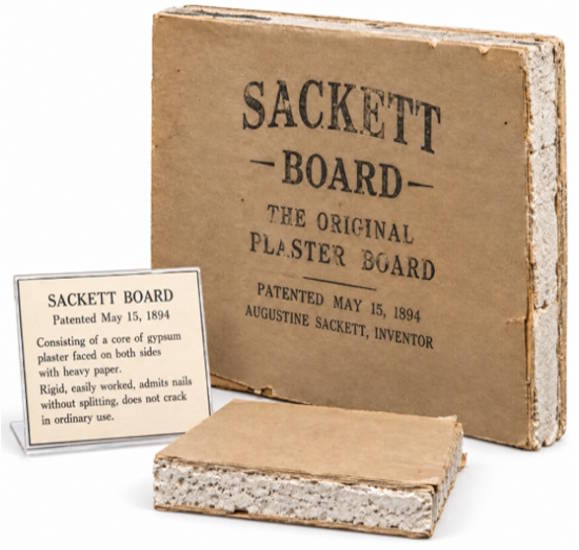
Image AI-Generated by Chat GPT
Modern drywall can trace its development to “Sackett Board,” a building panel associated with Augustine Sackett and patented during the 1890s. Sackett sought to develop a prefabricated building board that could be attached to walls and ceilings more quickly and efficiently than constructing traditional wood lath and wet-plaster assemblies.
Sackett Board consisted of layers of gypsum plaster placed between sheets of paper. The resulting panel provided a relatively rigid building surface that could be manufactured in advance, transported to the jobsite, cut to size, and mechanically fastened to framing.
Looking for quick answers on restoration, remediation and cleaning topics?
Try Ask R&R, our new smart AI search tool.
Ask R&R →
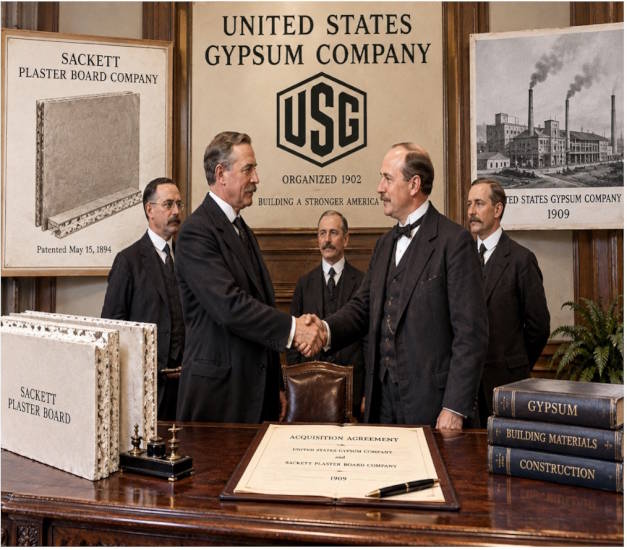
Image AI-Generated by Chat GPT
The development of plasterboard was significant, because it helped establish the basic concept that eventually became modern gypsum wallboard, where a factory was not capable of manufacturing a gypsum core enclosed between facing materials and installed as relatively large panels.
The United States Gypsum Company (USG), which had been formed in 1902 through the consolidation of a number of gypsum companies, subsequently acquired the Sackett Plaster Board Company in 1909. Further development of gypsum-panel technology followed during the early twentieth century.
Gypsum Lath as a Transitional Material
An important period in the development of modern drywall is sometimes overlooked: gypsum wallboard did not immediately replace traditional plaster construction. During the first half of the twentieth century, gypsum lath became increasingly common as an alternative to traditional wood lath. Rather than attaching hundreds or thousands of individual wood lath strips to wall and ceiling framing, workers could install manufactured gypsum-lath panels. One or more coats of plaster were then applied over the gypsum lath to produce the finished wall or ceiling surface.
Gypsum lath substantially reduced installation labor and construction time while retaining many of the characteristics associated with traditional plaster walls, including a hard, durable, relatively thick finished surface.
Gypsum-lath-and-plaster construction became particularly important during the transitional period between traditional wood-lath-and-plaster construction and modern paper-faced gypsum drywall. Consequently, buildings constructed or remodeled during approximately the 1920s through the 1960s may contain several different wall systems, including wood lath and plaster, gypsum lath and plaster, and conventional gypsum drywall.
The Post “World War II” Building Boom
The post-World War II experienced an enormous residential construction boom that followed which accelerated the use of gypsum wallboard.
After the war, the United States experienced substantial demand for rapidly constructed and affordable housing. Builders needed construction methods that reduced labor requirements, shortened construction schedules, and allowed houses and other buildings to be completed more efficiently.
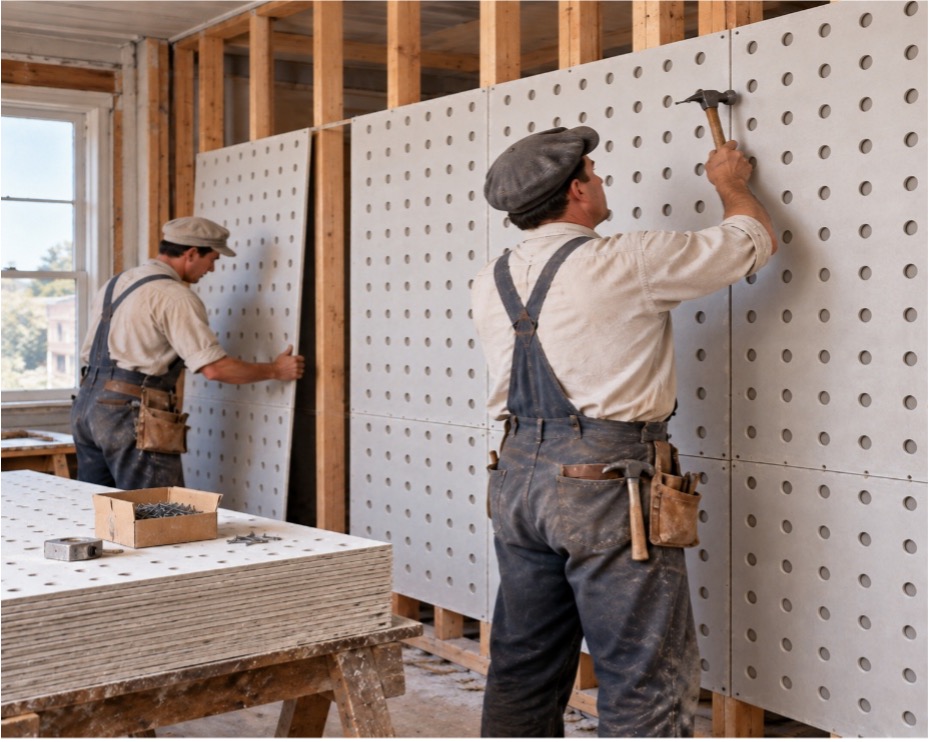
Image AI-Generated by Chat GPT
Instead of using wood and wire lath to support plaster, the development of plasterboard with holes in it was created. This type of plasterboard was called “button board” that is commonly referring to perforated gypsum lath or gypsum plaster-base panels that became increasingly popular during the 1930s and it was widely used during the 1940s and 1950s. Button board represented an important transitional building material between traditional wood-lath-and-plaster construction and modern gypsum drywall.
Note that a wall or ceiling containing button board, it should not automatically be called “drywall.” It is more accurately described as a gypsum-lath-and-plaster wall or ceiling assembly having an average 3/8-inch coat of plaster applied on top, where the round holes act as “keys” supporting a smooth or textured finish.
Another transition took place in the 1950s, gypsum wallboard without button board holes was well suited for installations where corners, joints, and imperfections can be taped and joint compounds covered nails, where surfaces became ready for paint or wallpaper.
Modern Gypsum Wallboard and Specialty Applications
Modern gypsum-based drywall has evolved considerably from the relatively simple gypsum wallboard products introduced during the early twentieth century. Today, gypsum panels are manufactured in numerous configurations designed to provide specific performance characteristics for residential, commercial, institutional, and industrial construction. One of the important characteristics of gypsum is its inherent resistance to fire. Gypsum contains chemically combined water within its crystalline structure. When gypsum is exposed to elevated temperatures, this water is progressively released as water vapor through a process known as calcination. This process absorbs heat and can help delay the transmission of heat through a wall or ceiling assembly.
Modern gypsum products include standard wallboard as well as Type X and other enhanced fire-resistant panels used as components of tested fire-resistance-rated wall, ceiling, shaft, and structural-protection assemblies. Importantly, the fire-resistance rating generally applies to the complete tested assembly, and not simply to an individual sheet of drywall. Panel type and thickness, number of layers, framing, fastener spacing, insulation, joint treatment, penetrations, and other construction details can affect the performance of the assembly.
Gypsum panels are also manufactured for specialized environments and applications, including:
- Fire-resistant gypsum board, including Type X and other enhanced fire-resistant products.
- Moisture-resistant gypsum board that is intended for locations subject to elevated humidity or intermittent moisture exposure.
- Mold-resistant gypsum board that incorporates moisture-resistant facings, treated paper, fiberglass mats, or other materials intended to reduce conditions favorable to fungal growth.
- Fiberglass-faced or fiberglass-mat gypsum panels provide alternatives to conventional paper-faced products are used in applications where improved moisture and mold resistance is required.
- Exterior gypsum sheathing is used behind exterior cladding systems.
- Abuse-resistant and impact-resistant panels are used in schools, hospitals, corridors, institutional buildings, and other high-traffic areas.
- Sound-control gypsum panels and multilayer gypsum assemblies are designed to improve acoustical performance.
- Shaft-liner and specialized fire-protection panels are used in elevator shafts, stair enclosures, mechanical shafts, and other fire-rated assemblies.
- Ceiling panels are designed to resist sagging and accommodate particular ceiling applications.
- Tile-backer and specialized gypsum panels are designed for certain moisture-exposed applications, subject to the manufacturer’s limitations and applicable building-code requirements.
Gypsum Wallboard Changed Construction, but It Did Not Eliminate Dust
Although gypsum wallboard substantially reduced the labor, time, and wet-plaster work associated with traditional lath-and-plaster construction, modern gypsumboard drywall did not eliminate the generation of construction dust. Gypsum panels must still be cut, drilled, routed, fastened, fitted around penetrations, repaired, and eventually removed or demolished. Each of these activities release varying amounts of airborne particulate.
Additional dust is generated during the finishing process. Joint compounds are applied over panel joints, fasteners, corners, and surface imperfections and are commonly sanded between or after applications to produce a smooth finished surface. Sanding joint compound can generate substantial quantities of fine airborne and settled dust that can be hazardous to breathe.
Renovation, remediation, restoration, and demolition activities can create additional hazards because workers may disturb multiple generations and layers of building materials. These can include gypsum wallboard, gypsum lath, plaster, joint compounds, skim coats, patching compounds, adhesives, texture coatings, paints, and other surface finishes.
Before cutting, grinding, sanding, drilling, abrading, or demolishing existing building materials, employers and contractors should determine what materials will be disturbed, evaluate applicable hazardous-material requirements, assess potential worker exposures, and implement appropriate engineering controls, work practices, respiratory protection, and other personal protective equipment.
Importantly, construction dust should not be characterized solely as “gypsum dust.” Depending upon the materials, their age, formulation, and the work being performed, generated dust may contain gypsum, calcium carbonate, talc, mica, clay, perlite, silica-containing mineral components, and other constituents. Older or previously altered building assemblies may also contain regulated hazardous materials, including asbestos-containing materials or lead-containing coatings.
These distinctions are particularly important for workers involved in construction and demolition, remodeling, water- and sewage-damage remediation, mold remediation, and fire- and smoke-damage restoration. Before cutting, grinding, sanding, drilling, abrading, or demolishing existing building materials, employers and contractors should determine what materials will be disturbed, evaluate applicable hazardous-material requirements, assess potential worker exposures, and implement appropriate engineering controls, work practices, respiratory protection, and other personal protective equipment.
Silica in Drywall and Joint Compounds
Drywall, joint compounds, texture materials, plasters, and related gypsum-based finishing products may contain crystalline silica. The amount varies considerably according to the manufacturer, product formulation, and ingredients used. Therefore, workers should not assume that all drywall or joint compounds contain the same amount of crystalline silica.
NIOSH reported that its review of manufacturers’ safety information for several drywall compounds identified crystalline silica (quartz) concentrations ranging from approximately 0.1% to 2.5% by weight. OSHA has also reported that drywall and drywall joint compounds frequently contain only trace amounts of crystalline silica, often less than 1%. The percentage of crystalline silica contained in a product, however, is only one part of determining worker exposure.
When drywall or dried joint compound is cut, drilled, routed, ground, sanded, demolished, or otherwise mechanically disturbed, large quantities of airborne dust can be generated. Sanding dried joint compound is particularly important because the sanding process can generate substantial concentrations of fine airborne particulate, including respirable dust and, when crystalline silica is present, respirable crystalline silica.
Health Hazard Warning
Silica:
A relatively low percentage of crystalline silica in a product does not, by itself, establish that the work activity is safe. Conversely, merely detecting crystalline silica in drywall or joint compound does not establish that a worker is being overexposed. The occupational-health determination depends upon the concentration of respirable crystalline silica in the worker’s breathing zone and the worker’s duration of exposure.
OSHA has stated that working with drywall or sanding joint compound containing crystalline silica only as a trace contaminant will typically result in exposures below 25 µg/m³, which is an 8-hour time-weighted average when performed separately from other silica-generating activities. However, OSHA also cautions that exposures can reach or exceed this concentration when employees work with these materials for long periods under dusty conditions.
Gypsum, Mica, and Talc:
In addition to crystalline silica, drywall, joint compounds, plaster, texture materials, and other construction products may contain gypsum (calcium sulfate), calcium carbonate (calcite), talc, mica, and other mineral ingredients. When these materials are cut, sanded, drilled, ground, demolished, mixed, swept, or otherwise disturbed, substantial concentrations of airborne particulate can be generated resulting in the inhalation of gypsum-based products that can cause allergic reactions and respiratory illness.
Historically, many relatively low-toxicity mineral dusts were commonly referred to as “nuisance dusts.” However, workers should not interpret the term “nuisance dust” as meaning that the dust is harmless or that unlimited exposure is acceptable. OSHA regulates occupational exposure to airborne particulates and mineral dusts. Under OSHA’s general-industry air-contaminant requirements, gypsum and calcium carbonate are addressed as Particulates Not Otherwise Regulated (PNOR), with permissible exposure limits of 15 mg/m³ for total dust as an 8-hour time-weighted average (TWA), and 5 mg/m³ for the respirable fraction as an 8-hour TWA.
Mica and talc are addressed separately within OSHA’s mineral-dust requirements. Talc also requires particular attention because its regulatory treatment depends upon its mineralogical characteristics, such as asbestos, which is a natural mineral. Talc that contains asbestos, it is subject to OSHA’s asbestos requirements.
Workers are expected to minimize unnecessary inhalation of all types of gypsum and construction dust. The use of engineering controls, HEPA-filtered vacuum sanding and dust collection, appropriate ventilation, proper housekeeping practices, and respiratory protection must be used to reduce worker exposures and contamination inside the building.
Looking for a reprint of this article?
From high-res PDFs to custom plaques, order your copy today!