What Restoration Contractors Need to Know About OSHA Hazard Communication Requirements
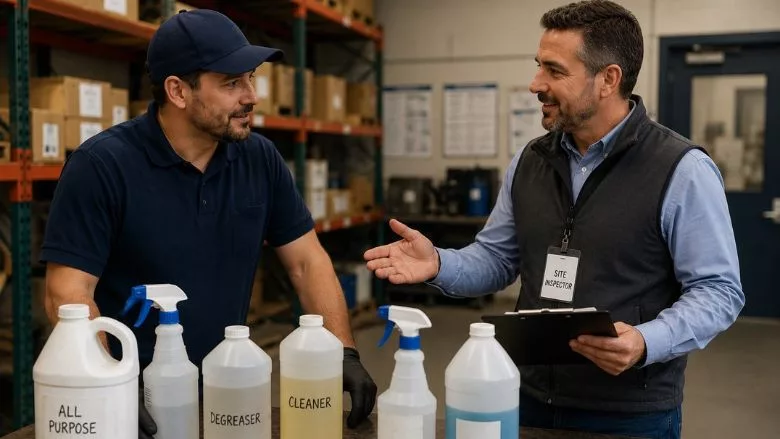
This is the third article in our OSHA Top 10 series, and we will launch into the second of the top ten most frequently cited standards for 2024 – Hazard Communication. OSHA cited 2,888 violations in 2024 for this standard. If we apply some simple math to that number, that’s 55 violations per week or roughly 10 violations each workday.
Now I know what the first question will be: “What the heck is Hazard Communication?” Let’s dive in.
Introduction
Hazard Communication is commonly referred to many ways; I have heard the following:
- Haz Comm
- Chemical Safety
- Right to Know
- Global Harmonized System (GHS)
Credit: ROAProductions / iStock / Getty Images Plus
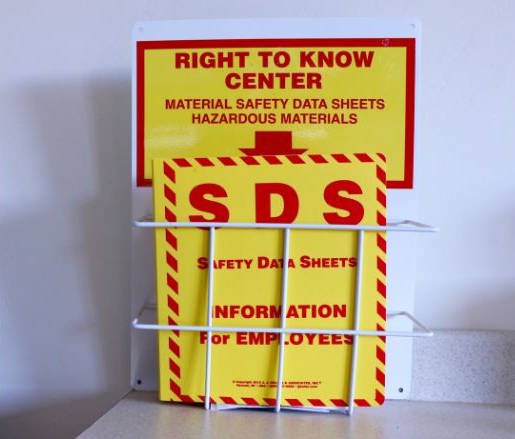
Regardless of the terminology, all of these refer to OSHA’s expectation that employees have a “Right to Know” about the chemicals they are exposed to. How Restorers meet this expectation is where many get confused or simply aren’t aware. To help with that, I’d like to briefly review the OSHA standard and the core requirements for compliance.
Author’s Note: You will see where, at times, the term ‘chemical’ is used for Haz Comm. Let me clarify that in this case, we’re actually referring to a solid, a liquid, or a gas. We’re not strictly talking about liquid chemicals. I know it’s confusing, but that’s the terminology used.
Core Requirements
A. Written Hazard Communication Program
Credit: crazychristina /iStock / Getty Images Plus
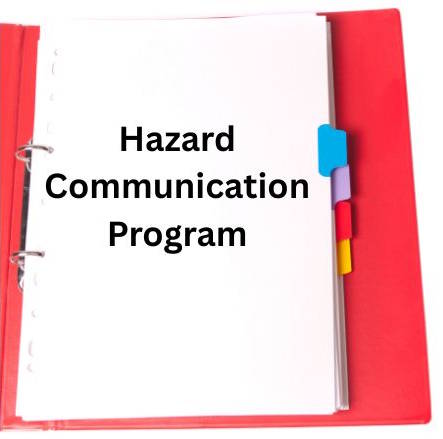
Restorers are required to have a written program that outlines how they will comply with the standard. (1) This Program will document how, for instance, SDS’s are maintained, containers are labeled, and employees trained. It will be written specifically for your restoration company. Check out the OSHA Fact Sheet listed in the Resources section at end of this article for more guidance. Additionally, Restorers can find blank written programs through resources such as insurance carries, state OSHA programs, or a safety professional.
B. Chemical Inventory
This is a list of all solids, liquids, and gases that the company has. It includes chemicals in the warehouse and company trucks/vans. It must be kept up-to-date and readily accessible by employees. Think of this as the starting point to the next topic – Safety Data Sheets (SDSs).
Looking for quick answers on restoration, remediation and cleaning topics?
Try Ask R&R, our new smart AI search tool.
Ask R&R →
C. Safety Data Sheets (SDS)
As you can guess by now; restorers are required to have an SDS for every chemical they have, whether it be in a warehouse, storage facility, or in their vans/trucks. OSHA requires employees to be able to readily access the SDS’s. Historically, employers maintained a 3-ring binder that contained printed copies of each SDS. Modern solutions include access by cell phone or tablet to cloud storage or an app. There are multiple online resources that, for a fee, provide online access and storage of SDS’s. See the Resources section of this article for an OSHA interpretation allowing electronic access to SDS’s.

Credit: Thank you for your assistant / iStock / Getty Images Plus
D. Container Labeling
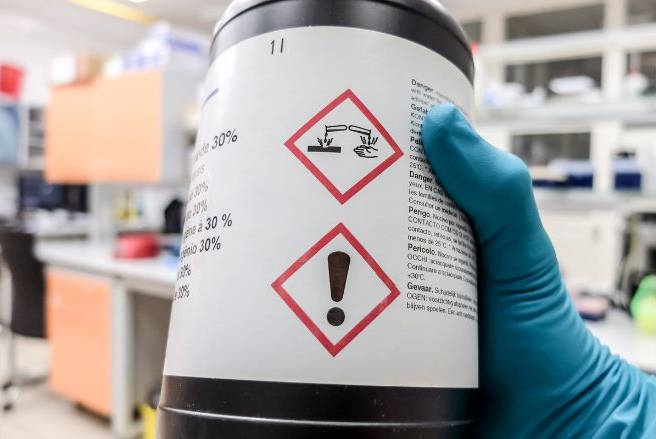
OSHA requires all containers to be labeled with the chemical it contains. This applies to chemical manufacturers who supply new products, as well as any secondar container that you fill. An example of a secondary container is an empty spray bottle that you have filled from larger container (like a one-gallon bottle).
I have found that secondary container labels are easy targets for an OSHA inspector, so pay attention to getting labels on these!
Credit: Artur Wnorowski PhD / iStock / Getty Images Plus
E. Employee Training
OSHA requires Restorers to train their employees on Haz Comm. (2) The specifics include:
- How employees can detect the presence or release of a hazardous chemical
- The hazards of the specific chemicals in the work area
- How employees can protect themselves from the hazards
- The details of the company’s written hazard communication program
Much like the written program, I recommend Restorers to use an existing training program and fine tune it to their specific hazards/chemicals. Resources include insurance carries, state OSHA programs, or a safety professional.
How Companies Get in Trouble
Between OSHA details and my personal experiences, here’s how Restorers can get cited for Haz Comm violations:
- No written program
- Outdated or missing SDSs
- Incomplete chemical inventory
- Containers missing labels; especially the secondary containers
- Lack of training/incomplete training
What Compliance Looks Like
The key here is a simple, working system that is routinely maintained. To get started, a Restorer is going to have to assign someone the task of creating an inventory, gathering the SDS collection, and organizing the collection. That’s easy to do, but it just takes some time.
From there, creation of a written program and training will require a little more advanced skills and knowledge. It helps tremendously if you have access to ‘pre-fab’ documents through an insurance carrier or state OSHA program. Otherwise, you’ll probably need to turn to a professional safety resource.
Finally, I have found that I need to set reminders during the year to keep up with the requirements; especially reviewing the chemical inventory and adding new SDSs to the collection.
Conclusion
None of this is terribly complicated; however, I fully understand that some of the requirements can exceed the knowledge or resources of the average Restorer. The fact that Haz Comm is the second most common OSHA violation hopefully motivates Restorers to prioritize this topic and reach out to different resources for compliance!
Resources
OSHA Hazard Communication website: https://www.osha.gov/hazcom
OSHA Fact Sheet: Steps to an Effective Hazard Communication Program for Employers That Use Hazardous Chemicals, FS-3696 03/2014: https://www.osha.gov/sites/default/files/publications/OSHA3696.pdf
Electronic access to SDS’s: OSHA Letters of Interpretation, February 18, 1999: https://www.osha.gov/laws-regs/standardinterpretations/1999-02-18-0
References
- OSHA Hazard Communication Purpose 1910.1200(a)(2): https://www.osha.gov/laws-regs/regulations/standardnumber/1910/1910.1200
- OSHA Hazard Communication Training 1910.1200(h)(3): https://www.osha.gov/laws-regs/regulations/standardnumber/1910/1910.1200
Looking for a reprint of this article?
From high-res PDFs to custom plaques, order your copy today!