Can Wildfire-Contaminated Hardwood Floors be Cleaned, Refinished, or Do They Need to be Replaced?
Understanding restoration options for hardwood floors that are affected by ash, soot, heavy metals, and wildfire smoke
Discussion:
After a wildland-urban interface (WUI) fire, can hardwood flooring that has adhered combustion byproducts (e.g., soot, char, ash and heavy metals) be surface cleaned by vacuuming and damp wiping, or should the hardwood floor be lightly sandpaper screened and finished, or should the floor be sanded and refinished, or does it require replacement?
The answer in part – combustion byproducts and heavy metals can be substantially removed from older hardwood floors, but whether they can be completely removed depends on the condition of the floor, type of finish, the depth of contamination, and the homeowner’s requirement to bring their floor back to pre-loss condition where it is environmentally acceptable.
WUI fire residues contain carbonaceous soot, mineral ash, fine silicates, heavy metals, polycyclic aromatic hydrocarbons (PAHs) and semi-volatile organic compounds (SVOCs). These particles and gases are often extremely fine (sub-10-micron range) and adhere electrostatically to surfaces. Some bind and adhere to organic components of wood, particularly if the WUI fire increased the heat load inside the home.
Picture Storyboard:
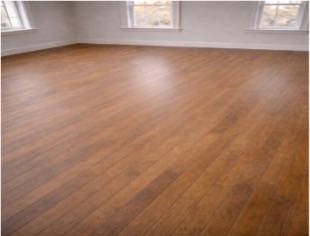
After a light buffer sandpaper screening, HEPA vacuuming, detergent washing, a second HEPA vacuuming, and floor finish was applied.
Tests confirmed that soot, char, and ash remained in small amounts, including lead dust, in grooves and cracks. After consultation with the homeowner, a floor finish was applied that sealed in the remaining smoke residue and metals that were confirmed present, such as cadmium, chromium, and lead.
Photo: Patrick Moffett
After sanding, a closeup picture of an older hardwood floor shows signs of distress, cracks, and sanded-off floor cleats.
Photo: Patrick Moffett
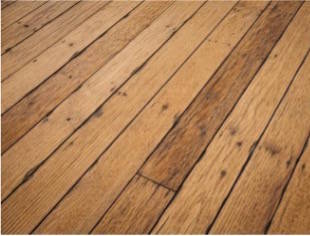
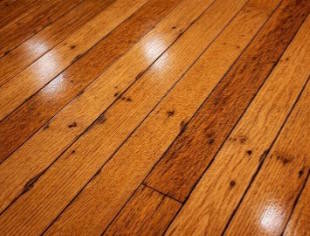
Closeup of the previous sanded floor picture, where the homeowner agreed that a clear urethane finish was sufficient.
Photo: Patrick Moffett
Cleaning and Restoration Options:
Older hardwood floors have unique challenges because they often have open grain, surface wear, cracks and gaps between planks, exposed nail heads, or worn or degraded finish that contain lead. These features allow fine contaminants from wildfire smoke to settle into micro-crevices and become embedded.
- Surface contamination vs. embedded contamination – “surface contamination” refers to residues that remain on top of the floor’s finish or on the exposed wood surface without penetrating into the material, where “embedded contamination” refers to residues that migrate and adhere into the wood’s pores, grain, seams, cracks, etc.
- When contamination is limited to settled surface particulate on a sealed floor (urethane or polyurethane finish that is intact), a thorough HEPA vacuuming followed by damp wiping with an appropriate cleaning agent can often remove the majority of loose soot, ash, and heavy metals.
- The typical progressive cleaning methods include HEPA vacuuming, damp wiping with low-residue detergents (e.g., Dawn Ultra), a detail cleaning of seams and cracks, clean water rinsing (preferably with deionized water), natural air drying (no forced air movement with fans), and a second HEPA vacuuming to capture and remove loose surface contamination.
- When contamination is limited to settled surface particulate on a sealed floor (urethane or polyurethane finish that is intact), a thorough HEPA vacuuming followed by damp wiping with an appropriate cleaning agent can often remove the majority of loose soot, ash, and heavy metals.
- When the hardwood floor finish is worn or cracked, combustion particles, smoke film, and heavy metals from the fire can more easily migrate into wood pores, end grain, gaps between planks, nail voids, and surface checking. In those situations, surface cleaning has limitations, where contaminants may continue to remain as a significant floor and environmental issue.
- This often results in the homeowner hiring a restoration company to use a floor buffer that is attached to a sanding disk (using 80 to 120 grit sanding pads), where the specialized buffer is attached to a HEPA vacuum (e.g., from Floor Mechanics).The light-screening method only removes surface contamination, which may be acceptable in some situations.
- Older floor finishes contain lead that can become easily aerosolized even during a light screening of the finish, which increases respiratory hazards to lead dust that workers may experience.
- Again, to avoid worker exposures, the screening process should only be completed by a restorer using a specialized wood floor buffer that is attached to a HEPA vacuum, and workers should wear appropriate personal protective equipment (PPE), and protect the work environment.
- Rooms should have all contents and window coverings removed, including around ventilation registers, cabinets, and light fixtures.
- Each room is to be kept under negative air pressure during light screening to avoid dust and heavy metals contaminating other rooms.
- This often results in the homeowner hiring a restoration company to use a floor buffer that is attached to a sanding disk (using 80 to 120 grit sanding pads), where the specialized buffer is attached to a HEPA vacuum (e.g., from Floor Mechanics).The light-screening method only removes surface contamination, which may be acceptable in some situations.
- When light sandpaper screening (light abrasive screening) did not or it could not completely remove contamination from grooves, pores, cracks, and openings, the next option is to completely sand and refinish the floor.
- Sanding older hardwood floors can restore appearance and remove surface contamination, but drum or belt sanding carries several risks, especially when the wood floor is aged, thin, or was previously refinished. Several sanding issues exist, such as:
- Sanding permanently removes the aged patina that developed over years, where staining and refinishing will not replace it.
- Loss of the remaining wear layer, meaning, older solid hardwood floors may only have a finite 16th to 32nd inch wear layer left above the tongue and groove.
- Sanding can further thin boards to the point where the tongue becomes exposed, nail heads (cleats, staples) become cutoff, resulting in the remaining metal shank to become visible.
- When only the shank is present, it can result in weaking floorboards, resulting in squeaks and lifting the board higher than other boards.
- The structural integrity of boards can be compromised by sanding and the boards become prone to splitting.
- Sanding older wood floors require the same building and worker protection as outlined in light sandpaper sanding methods.
- Sanding older hardwood floors can restore appearance and remove surface contamination, but drum or belt sanding carries several risks, especially when the wood floor is aged, thin, or was previously refinished. Several sanding issues exist, such as:
- When sanding is not an option or it resulted in further damaging flooring, the remaining option is to replace the floor.
- This is easier said than done because, when removing older hardwood floors that contain combustion byproducts and lead dust, workers face combined chemical, particulate, and physical hazards, including worker exposure to lead-containing finishes, along with further contamination to the interior.
Looking for quick answers on restoration, remediation and cleaning topics?
Try Ask R&R, our new smart AI search tool.
Ask R&R →
Looking for a reprint of this article?
From high-res PDFs to custom plaques, order your copy today!