3 Mold Analysis Tools Restoration Contractors Need After Hurricanes and Floods
How microscopy, culturing, and DNA testing support post-flood remediation decisions
When floodwaters recede, the visible damage often tells only part of the story. Saturated drywall, flooring, furniture, and other belongings create ideal conditions for fungal growth, which can persist long after materials appear dry. For restoration contractors, understanding how laboratories analyze mold samples is key to documenting conditions, validating remediation, and protecting occupant health in water‑impacted buildings.
This article outlines three primary laboratory approaches to mold analysis—direct microscopy, culturing, and next-generation sequencing (NGS)—through the lens of post-flood remediation projects. It focuses on how each method works, what questions it can answer, and where it fits into a practical investigation and remediation plan.
Hurricane Month
Prepare before the storm with specially-curated articles during the month of May. Learn more!
Direct Microscopy: Fast Insight During the Initial Response
Direct microscopy is the workhorse of mold analysis and is often the first tool used on post hurricane/storm and flood projects. In this method, the lab examines particles from the air, surface, or bulk samples under a microscope to identify and estimate the amount of fungal material present. Results are typically reported as spore counts or as descriptive findings (e.g., presence of spores, hyphae, and other fungal structures that indicate active growth). In a post‑flood building, direct microscopy can help to:
- Compare indoor and outdoor airborne spore profiles to determine whether indoor growth is likely contributing to the elevated levels.
- Identify moisture‑loving (hydrophilic) molds that often signal chronic dampness inside walls, under flooring, or in other concealed spaces.
- Support visual findings by confirming whether suspect staining or discoloration on building materials is fungal or from some other source.
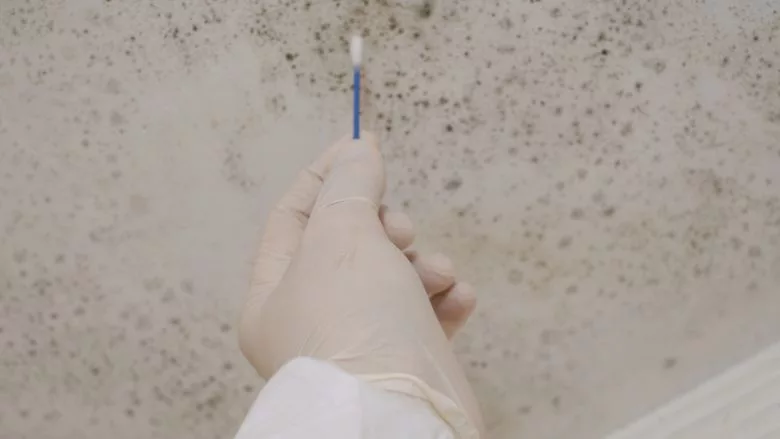
Direct microscopy is often used on tape lifts or bulk samples. For example, tape lifts from the underside of subflooring or from behind removed baseboards can confirm visual observations of active mold growth and determine the type of mold. However, laboratory results alone cannot tell a complete story about mold problems on site. Because sample collection processes can significantly impact the amount of mold spores, it is critical that a trained mold remediation specialist uses appropriate and safe sampling techniques and established protocols.
Air sampling using spore traps is another common method used for mold sampling. In this method, air is pulled through a cassette where particles impact a collection surface. The sample collection media is then sent to a laboratory for examination under a microscope. In a structure damaged by hurricanes and floods, comparing the indoor air results to outdoor levels can help eliminate outside air as the immediate cause of elevated spore counts and highlight rooms or cavities with hidden growth, such as damp wall assemblies that have not been opened yet.
Culturing: Assessing Viability and Species After Water Damage
In some flood‑related projects, it may be helpful to determine what type of mold is present and whether it is viable. Culturing helps answer these questions by allowing spores and fragments from a sample to germinate and grow into colonies on a nutrient medium. Once colonies have developed, an experienced mycologist can often identify the mold to the genus and, in some cases, the species level. Culturing is particularly useful when:
- Occupants have documented allergic or infectious diseases that may be linked to particular fungal species.
- There is concern about infections, such as allergic bronchopulmonary aspergillosis (ABPA), in which specific species like Aspergillus fumigatus may play a role.
- Facilities house vulnerable populations (e.g., healthcare settings, long‑term care, or post‑surgical units) and need to understand the spectrum of fungi present in the environment.
- In clean rooms or other sterile environments where any mold intrusion is unacceptable, detection of contamination may trigger regulatory or standards-based requirements to analyze which organisms are present.
- Visible wood decay suggests past flood damage. Certain wood‑decay fungi, such as Poria incrassata (often called the “house‑eating fungus”), are especially aggressive and can severely compromise structural integrity in a short time.
Nevertheless, culturing has limitations. Not all molds grow well on standard media, and some colonies may not develop the fruiting structures needed for visual species identification. Culturing also takes time—often several days—to incubate samples and read results, which may not fit immediate decision‑making needs during the earliest stages of post hurricane and flood response. For that reason, culturing is often used in combination with faster methods rather than as a stand‑alone tool.
Looking for quick answers on restoration, remediation and cleaning topics?
Try Ask R&R, our new smart AI search tool.
Ask R&R →
Next‑Generation Sequencing: Detecting Low-Level or Hard‑to‑Characterize Molds
For most post-hurricane and flood environments, direct microscopy and traditional culturing provide the information needed to guide remediation. However, in some challenging settings, NGS–based DNA analysis can offer a more expansive alternative by surveying fungal genetic material in a sample rather than relying solely on visual characteristics or colony growth.
In NGS workflows, the laboratory extracts DNA from an environmental sample (air, dust, surface, or bulk material), amplifies fungal marker regions, and then sequences the resulting mixture to generate a profile of the many species present and their relative quantity. Because modern sequencing technology has become more accessible, it is now feasible to capture information on dozens to hundreds of fungal types from a single sample, far beyond the limited target lists used in earlier DNA-based mold tests.
NGS-style DNA testing can be particularly useful when there is interest in understanding the overall mold community in a space, including organisms that are difficult to culture or identify microscopically. Results, however, still need to be interpreted in the context of the broader environmental picture, including moisture conditions, building history, and occupant complaints. Furthermore, NGS results do not distinguish between viable and non‑viable organisms. For decisions that hinge on growth potential or detailed building‑specific risk, NGS data are best considered alongside traditional culturing, microscopy, and a thorough site assessment.
Integrating Lab Data into Hurricane and Flood Restoration Practice
For restoration contractors, the most effective use of laboratory analysis is as part of a broader strategy that also includes source identification, moisture control, and appropriate removal or cleaning techniques. Direct microscopy can provide quick insights early in the project, culturing can refine the understanding of viability and species when needed, and PCR can detect hard‑to‑find or low‑abundance molds in complex flood‑damaged structures.
Ultimately, lab results should help answer practical questions:
- Where is the moisture coming from?
- Which materials must be removed versus cleaned?
- Are conditions improving over time? And is the built environment safe for occupants, especially those at greater risk?
By selecting and combining the right analytical tools, restorers can make more informed decisions, document their work, and better protect the people who return to hurricane and flood‑impacted buildings.
Looking for a reprint of this article?
From high-res PDFs to custom plaques, order your copy today!