Two Worlds? The Commercial Drying Difference in Restoration
How building systems, HVAC, and codes create complex drying challenges in the restoration industry
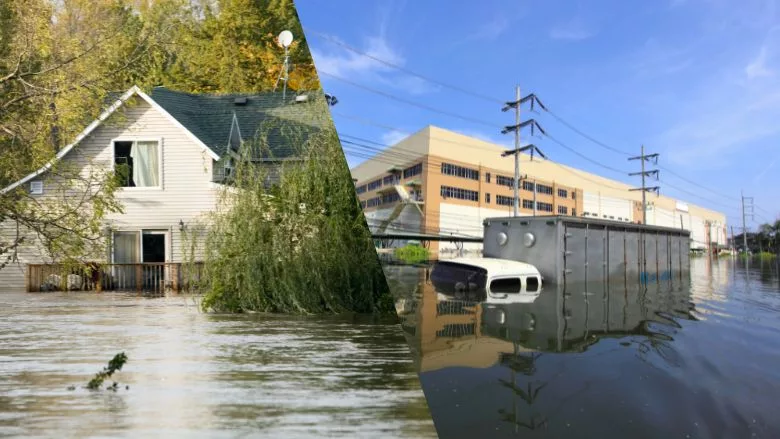
A restorer stepping from a flooded single-family home into a water-damaged Class A office building is not simply dealing with a bigger job, their stepping into a different world. The physics of moisture movement and the psychrometry may be similar, but the use of the structure, the regulatory framework that governs the work, and the structural assemblies, components, and systems that hide — or trap — water are fundamentally different. Commercial water damage restoration demands a paradigm change of how technicians think about drying science, building science, and construction knowledge, as well as the coordination, management, and administration of commercial projects.
Let’s set aside the complications of the insurance claims process, addressing Materially Interested Parties (“MIPs”), and the magnitude handling logistical challenges, and focus on the 5 major differences that put commercial and residential on not only two worlds, but dimensions apart.
Commercial water damage is not simply a large-scale residential water damage. It requires fundamentally different thought processes, diagnostic methodologies and drying strategies rooted in building science, code compliance, and the structural realities of large-format construction.
1. Construction Systems — A Different World Beneath the Surface
The single most important concept a restorer needs to wrap their head around before approaching a commercial loss is this: commercial buildings are not built like houses. The materials, assemblies, tolerances, and load paths differ dramatically, and each of those differences has a direct impact in how water behaves, moisture migrates, and how, or if, drying systems are structured. Below demonstrate just a few examples that put commercial and residential a universe apart.
Structural Framing: Wood vs. Steel and Concrete
Residential construction in North America is dominated by light wood framing — 2x4 or 2x6 dimensional lumber arranged in repetitive stud walls, floor joists, and roof rafters. Restorers know that wood is hygroscopic. It absorbs moisture, swells, and supports microbial growth. But it also releases moisture in a reasonably predictable fashion. Every experienced residential restorer has internalized the drying targets established by the ANSI/IICRC S500, and have been conditioned by their training, certifications, and experience. And what is that? Get wood to moisture content below 16% and structural assemblies to equilibrium moisture content. The math, while not always simple, is relatively contained.
Commercial structures, particularly those exceeding three or four stories, rely on structural steel, reinforced concrete, concrete masonry units (CMU), and post-tensioned concrete. These materials do not absorb moisture the way wood does. Steel will corrode; concrete will adsorb, rather than absorb moisture. Exposure can leach minerals and experience delayed efflorescence; post-tensioned cables can suffer accelerated corrosion if water penetrates the grout-filled conduits. The restorer's thought process, inspection methodology, measurement tools, and drying protocols are completely different and vary widely by material, component, assembly or system.
Interstitial Spaces
Equally important: interstitial space in commercial buildings is far more complex. The various array of steel stud framing assemblies, wallboard types, insulation, and other interstitial obstacles like glass or lead sheets create a difficult to access and dry. Suspended acoustical tile (SAT) ceilings hide miles of space above where HVAC ductwork, electrical conduit, plumbing, data infrastructure, and insulation comingle. Water migrating above an SAT ceiling may travel extraordinary horizontal distances before gravity presents it as a visible stain — or before it finds a penetration through which to drop into the occupied space. The space itself can be part of the HVAC system’s function and removal of tiles would disrupt function in unaffected areas. Chases, voids, and shafts can not only mess up your day in the work area, but also extend throughout the entire building.
Wall spaces, chases, voids, and shafts pose significant challenges and must be properly identified, followed, and addressed.
Flooring Systems
Residential floors are typically wood framed with plywood or OSB subfloor, topped with finish flooring. Commercial buildings frequently employ concrete-on-deck systems — a corrugated steel deck with a lightweight concrete top pour. These assemblies are extraordinarily dense. The top pour often contains embedded radiant heating systems, conduit, or post-tension cables. Saturated lightweight concrete over steel deck creates a diagnostic challenge: moisture meters calibrated for wood give meaningless readings on concrete, and the steel deck below prevents microwave or radar moisture measurement from penetrating to determine depth of saturation.
Looking for quick answers on restoration, remediation and cleaning topics?
Try Ask R&R, our new smart AI search tool.
Ask R&R →
Equally common in commercial settings is the raised access floor (RAF) system, particularly in data centers, trading floors, and older Class A office buildings. Raised floors create a pressurized or depressurized plenum beneath the finished floor surface from which cooling air is distributed. A water intrusion event in a raised-floor environment floods an invisible subfloor plenum, saturates concrete below, contacts energized electrical infrastructure, and may compromise the pressure differential that the building's HVAC system depends upon. Proper restoration in a RAF environment requires coordination with the building's facilities manager, IT department, and electrical engineers before drying equipment is even placed.
2. The Code Environment — IBC vs. IRC like Mars vs. Jupiter
Few factors separate commercial restoration from residential more sharply than the regulatory environment. Residential construction is governed by the International Residential Code (IRC), a prescriptive document written for one- and two-family dwellings. Commercial construction falls under the International Building Code (IBC) — or in jurisdictions that have not adopted the IBC, comparable legacy codes such as the BOCA National Building Code or local amendments.
Occupancy or Use Classifications
The IBC organizes buildings by occupancy classification: Assembly (A), Business (B), Educational (E), Factory (F), Institutional (I), Mercantile (M), Residential (R), Storage (S), and Utility (U). Each classification carries different requirements for fire resistance, egress, means of escape, and — critically for restorers — hours of permissible disruption to occupancy. A water damage event in an Institutional I-2 occupancy (hospital, nursing home) may require immediate relocation of vulnerable populations, diverse project protocols, and coordination with the state Department of Health and other AHJ. An Assembly A-2 occupancy (restaurant, bar) may have lease obligations and revenue loss that make partial occupancy during drying a contractual requirement, not a preference.
Fire-Resistance-Rated Assemblies
One consequential code consideration in commercial restoration is the prevalence of fire-resistance-rated wall and floor/ceiling assemblies. These assemblies listed by UL, FM Global, or other listing organizations, are tested combinations of specific materials in specific configurations that provide a rated barrier (1-hour, 2-hour, 3-hour, 4-hour) to fire spread. The moment a restorer opens a fire-rated assembly to dry the space behind it, that assembly is no longer listed or compliant until it is restored precisely to the listed assembly specifications.
This means the restorer must document the exact assembly configuration before opening it, source matching materials with the correct fire ratings, and install the restoration materials in the manner specified by the listing. Substituting a different manufacturer's gypsum board, even one of identical thickness and apparent specification, can void the listing. This is not a technicality; it is both a code compliance and liability issue with significant consequences in the event of a subsequent fire.
ADA and Accessibility Considerations
Commercial buildings covered under the Americans with Disabilities Act (ADA) must maintain accessible routes, restrooms, and egress paths during restoration work. Drying equipment and power distribution cables cannot block accessible routes without triggering an ADA compliance deficiency. In occupied buildings, the restorer must work with the building's accessibility coordinator to ensure compliant temporary routing throughout the project.
Opening a fire-resistance-rated assembly to perform drying work triggers a code compliance obligation. The restorer must document the existing listed assembly, restore it to the precise specifications of that listing, and obtain any required inspections before the space can be reoccupied.
3. Commercial Building Envelopes — Where Two Worlds of Moisture Theory Get Complicated
The building envelope is the collection of assemblies that separate the conditioned interior of a building from the unconditioned exterior environment. In residential construction, the envelope is relatively simple and relatively well-understood by most restoration technicians: wood-framed walls with cavity insulation, building wrap, sheathing, and cladding. On the other hand, commercial envelopes are significantly more varied, technically complex, and moisture-sensitive in ways that make your head spin and require advanced building science literacy.
Residential Envelope: The Baseline
A typical residential wall assembly consists of interior gypsum board, a vapor retarder, insulation within stud bays, OSB or plywood sheathing, a water-resistive barrier (WRB) such as housewrap, and exterior cladding (vinyl siding, fiber cement, brick veneer). The moisture dynamics are moderately predictable. Vapor drive is managed by the vapor retarder on the warm-in-winter side of the assembly. The WRB manages bulk water. The cladding provides the primary rain control.
When these assemblies are wetted from a plumbing failure or bulk water intrusion, the restorer's task, while rarely simple, is conceptually contained: extract standing water, establish drying and airflow, monitor moisture levels, and verify drying goals.
Commercial Envelope Systems: A Taxonomy
Commercial buildings employ a range of envelope systems, each with distinct moisture management strategies and failure modes. Restorers must be able to identify the envelope type before developing a drying strategy.
Exterior Insulation and Finish Systems (EIFS)
EIFS — sometimes incorrectly called synthetic stucco — consists of rigid foam insulation board adhered or mechanically fastened to a substrate, topped with a base coat and reinforcing mesh, and finished with a polymer-based finish coat. In the bad old days, classic EIFS (barrier EIFS) provided no drainage plane between the foam and the substrate. When water penetrated through cracks in the finish coat, it was trapped against the sheathing with no exit path, leading to widespread wood rot in wood-framed commercial buildings constructed in the 1980s and 1990s.
Modern drainage-plane EIFS incorporates a textured drainage mat or channel between the foam and the substrate, allowing incidental water to drain. However, even drainage-plane EIFS can trap water when its sealant joints at windows, penetrations, and terminations fail, a common occurrence on buildings over fifteen years old. A restorer encountering water damage in an EIFS-clad building must determine whether the EIFS is barrier or drainage-plane, assess sealant integrity at all penetrations, and recognize that complete drying of a saturated EIFS assembly typically requires removal of the system rather than in-place drying.
Curtain Wall Systems
The defining aesthetic of mid- and high-rise commercial construction is the curtain wall — a non-structural aluminum frame system spanning floor-to-floor and infilled with glazing, spandrel glass, or opaque panels. The curtain wall does not carry gravity loads; it carries only its own weight and transfers wind and seismic loads back to the structure through anchor connections.
Curtain walls manage water through a two-stage protection system: an outer weather seal at the face of the glazing, and an inner drained-and-back-ventilated cavity that handles any water that penetrates the face seal. This cavity drains through weep holes at the sill members. When curtain walls fail, typically due to sealant degradation, failed gaskets, or blocked weeps, water entering the cavity has direct pathways into the floor slab edge or the perimeter of the occupied space.
For restorers, a curtain wall intrusion is particularly challenging because the source of infiltration may be multiple floors above where the intrusion originates. Tracing the path of intrusion requires methodical pressure differential testing or sustained wetting tests, coordination with the curtain wall manufacturer or a building envelope consultant, and acceptance that complete remediation may require a capital re-sealing program by a specialty contractor.
Cavity Wall and Masonry Veneer Systems
Many low- and mid-rise commercial buildings, particularly in the eastern United States and Midwest, are clad in brick masonry veneer over a structural backup system. Unlike residential brick veneer over wood framing, commercial masonry veneer is typically backed by CMU or metal-stud-framed backup walls with exterior gypsum sheathing. A drainage cavity of one to two inches separates the veneer from through-wall flashing with weep openings at the base of the veneer designed to collect and discharge water that penetrates the brick.
The failure in these systems is almost always flashing-related: missing, damaged, or improperly lapped through-wall flashing allows water to migrate inward through the backup wall rather than being directed outward through the weeps. Once it infiltrates the system, it encounters interior insulation, the vapor control layer, and eventually the interior finish material. Because masonry is highly vapor-permeable and the cavity can sustain wicking over large horizontal areas, the affected areas inside are generally far wider than the specific point of intrusion.
Rain Screen Systems
The pressure-equalized rain screen (PERS) represents the state-of-the-art in commercial envelope design. The system relies on compartmentalized cavities behind the cladding in which air pressure equalizes between the exterior and the cavity interior, eliminating the pressure differential that drives rain through penetrations. Without a pressure differential, water at the face of the cladding has no driving force to enter the cavity. Even when water does enter, the ventilated cavity promotes drying and gravity drainage removes bulk water through open-jointed or gasketed cladding.
From a restoration standpoint, a PERS is a better system but harder to dry when they fail. The system's compartmentalization means intrusion is typically localized. The variety of cladding materials used in rain screen applications, like fiber cement, terracotta, aluminum composite panels (ACP), stone, and high-pressure laminate, bring different porosity, thermal mass, and drying potential. ACPs, in particular, have been the subject of intense scrutiny following fire incidents, and a restorer who encounters water damage in an ACP-clad building must be aware that the core material is often non-dryable and must be replaced.
The fundamental principle of modern commercial envelope design is the control of liquid water, air, vapor, and heat in distinct layers, each with a specific control function. A restorer who understands that will master his domain in the drying world.
4. The HVAC Variable — Pressure, Humidity, and Occupancy
Residential HVAC systems are relatively simple: a split system or packaged unit moves conditioned air through supply ducts and returns it through a single return. Relative humidity control is passive — the unit removes moisture as a byproduct of sensible cooling. In a residential drying scenario, the technician supplements the system with LGR dehumidifiers and manages airflow at the assembly level.
Commercial HVAC is an entirely different discipline. Variable Air Volume (VAV) systems, Air Handling Units (AHUs) serving multiple zones across multiple floors, dedicated outside air systems (DOAS), chilled beam systems, underfloor air distribution, and fan coil units each create different pressure relationships within and around the building. These pressure relationships directly govern vapor drive — the movement of water vapor through assemblies — and, during a drying operation, can either assist or actively work against the restorer's equipment.
Commercial buildings in humid climates are typically maintained under positive pressure relative to the exterior to prevent humid exterior air from infiltrating through envelope leakage. Shutting down the building's AHU during a drying project is efficient, as it removes a source of competing outside humidity, but it eliminates the positive pressure envelope that protects from outdoor vapor entering and condensing on cooled interior surfaces. If the lack of pressurization isn’t adequately compensated, conditions are created for secondary damage to building components that were never directly wetted.
The restorer must understand a building's mechanical sequence of operations well enough to make an informed decision about whether and how to modify HVAC system operation during drying. In most commercial projects, this conversation must include the building's mechanical engineer of record or the facilities management team.
5. Documentation, Reporting, and Standard of Care
The ANSI/S500, conceptually, applies to both residential and commercial losses, but its application in commercial settings carries significantly higher legal and financial stakes. The ANSI/S500 should be considered but there are many other regulations, codes and standards that supersede it. Business interruption losses, tenant claims, landlord-tenant disputes, and subrogation actions against responsible parties are far more common in commercial losses. A poorly documented commercial restoration project creates exposure for the restorer that no amount of technical competence can offset.
Conclusion: Competence Is a Building Science Discipline
The commercial water damage restoration market is large, growing, and underserved by generalist contractors who approach commercial losses with residential thinking. The differences in building construction, regulatory environment, and envelope design are not subtle variations on a familiar theme, they are structural realities that demand competencies beyond traditionally competent and certified restorers.
Restorers must invest in building science education, cultivate working relationships with competent tradesmen, consultants, engineers, and code officials. A restorer who approaches commercial losses with the rigor they demand will find the commercial market both technically and financially rewarding. Those who do not will find themselves repeatedly underscoping, overrunning budgets, and leaving moisture in assemblies.
Moving from world to world is like literally travelling through space. The building is trying to tell you something. You must speak its language. In commercial restoration, that language is building science…fluency is not optional.
Key Standards & References for Commercial Water Damage Restoration
- ANSI/IICRC S500 — Standard for Professional Water Damage Restoration
- International Building Code (IBC) — current adopted edition in applicable jurisdiction
- ASHRAE 62.1 — Ventilation for Acceptable Indoor Air Quality (commercial occupancies)
- ASHRAE 160 — Criteria for Moisture Control Design Analysis in Buildings
- NFPA 13 — Standard for the Installation of Sprinkler Systems
- UL Fire Resistance Directory — for listed wall and floor/ceiling assembly specifications
- Americans with Disabilities Act (ADA) — Title III, Public Accommodations
- RCI Foundation Building Envelope Technology Symposium proceedings — commercial envelope forensics
Looking for a reprint of this article?
From high-res PDFs to custom plaques, order your copy today!