How Commercial and Residential Restoration Equipment Differ
Learn how scale, equipment, and power needs vary between residential and commercial projects
The Musician vs. the Band: Equipment Differences Between Commercial and Residential Water Damage Restoration
When a pipe bursts in a single-family home, a skilled technician arrives with a van, a moisture meter, and a trailer load of equipment. When a sprinkler system fails on the fourth floor of a Class A office tower flooding 40,000 square feet of tenant space on a Friday afternoon, the response looks a little different. Both jobs carry the same fundamental mandate: clean and dry the structure completely, document the process, and restore normalcy to the customer as fast as possible. However, the equipment and tools, power demands, and equipment used to perform the work are categorically different.
The scale and expertise of the differences is like what a musician with a guitar uses in a coffee shop, versus what a band uses on a stadium tour. It’s more than just magnitude or sound volume, it’s the technology behind the equipment; the expertise of engineers, roadies, or grips for set up, and performance; and the talent of the musician.
Understanding the divide matters for every contractor looking to expand capabilities and every project manager trying to run a job to avoid the project spiraling out of control. So, let’s break down how commercial water damage restoration diverges from residential, and why simply throwing more residential gear at a large commercial project doesn’t work.
Drying Equipment
Dehumidification
The workhorse of any drying project is the dehumidifier, and the gap between residential and commercial begins here.
Residential Application
Residential applications are typically served by portable low-grain refrigerant (LGR) dehumidifiers in the 100–150 pint-per-day range. These industry staples have become near-ubiquitous on residential losses. They are compact, stack easily in a van, run on standard 120-volt circuits, and are light enough for a single technician to carry. Psychrometric performance is optimized for the 60–90°F temperature range typical of living spaces.
Commercial Application
Commercial applications demand a completely different tier. Industrial desiccant dehumidifiers operate on a different technology. Rather than cooling air to its dew point to condense moisture, the concept of an LGR, desiccant units pass air through a rotating silica gel or lithium chloride rotor that adsorbs moisture directly. This gives desiccant equipment a decisive advantage in cold environments, low-humidity conditions, and large open spaces with high ceilings where refrigerant units lose effectiveness rapidly.
Commercial desiccant dehumidifiers process 1,500 to over 10,000 cubic feet per minute (CFM) of air, compared to the 150–250 CFM through a portable LGR. Desiccants typically require 208- or 480-volt three-phase power, weigh between 500 and several thousand pounds, and are often delivered on flatbed trailers and positioned with forklifts. A single large-format desiccant trailer unit can replace dozens of residential dehumidifiers while achieving superior results in challenging psychrometric conditions. For the largest commercial projects like stadiums, data centers, hospitals, or warehouses, desiccant trailers can work together with ductwork runs spanning hundreds of feet.
Looking for quick answers on restoration, remediation and cleaning topics?
Try Ask R&R, our new smart AI search tool.
Ask R&R →
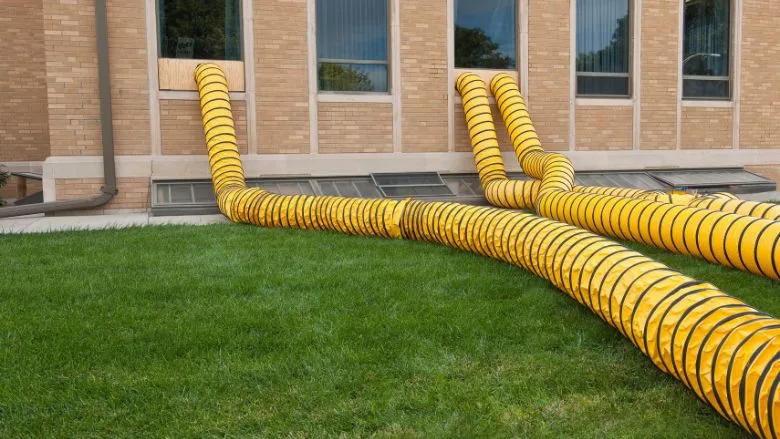
Rotary drum and heat reactivation systems add further complexity. Saturated desiccant rotors must be continuously reactivated by a heating section, which exhausts hot, moisture-laden air to the exterior. Proper exhaust ducting on a commercial job can itself become a major logistical task requiring duct runs and penetrations through exterior walls or roof assemblies.
Air Movers
On the residential side, axial air movers are standard issue. Units move approximately 1,600–3,000 CFM each, run on 120 volts, and can be daisy-chained through standard circuits.
Commercial drying requires a shift in both scale and strategy. Centrifugal blowers and high-static pressure fans replace the low-profile snails, providing the muscle needed to push air through long duct runs, beneath raised access floors in data centers and trading floors, and through cavities in concrete and steel-framed assemblies. Commercial-grade units produce 10,000+ CFM and are engineered for continuous-duty industrial operation, not the intermittent use profile of a residential air mover.
Perhaps more importantly, commercial projects frequently employ engineered airflow systems rather than simple spot placement. Breaking a space down using positive or negative pressure differential chambers are created using temporary poly containment, to direct conditioned air through structural cavities in ways that would be impractical or unnecessary in a residential setting. These chambers seal off sections of a space, like a building wing, to precisely control temperature, humidity, and air flow through large areas simultaneously.
Power Generation and Distribution
Nothing exposes the gap between residential and commercial water damage response faster than power. Residential work runs on the building’s existing electrical infrastructure. A competent technician plans circuits carefully to avoid tripping breakers, and most residential losses are fully serviced by equipment that runs on 120- or 240-volt single-phase current. There are few ways to get additional power to use, other than possibly a spider box tapped into a range or dryer outlet. Commercial losses rarely afford luxury of adequate power.
Generator Sizing and Selection
Large commercial projects, particularly those involving flooded occupied buildings, displaced tenants, or compromised building electrical systems, independent power generation is not a convenience; it is a necessity. Commercial restoration contractors maintain or contract for diesel generator sets ranging from 100 kW to over 2 MW in generating capacity. These are trailer-mounted or skid-mounted units capable of running continuously for days or weeks without interruption.
Generator sizing on a commercial loss is an engineering exercise that requires an understanding of basic electricity. A project manager must calculate the total connected load of all drying equipment, lighting, air scrubbers, dehumidifiers, and any temporary HVAC, as well as starting surge currents for motor-driven equipment, which can be two to six times the running amperage. Under-sizing a generator causes voltage sag, equipment damage, and potentially unsafe operating conditions including fire. A licensed electrician should be brought in to design the temporary power distribution plan and install the equipment.
Power Distribution
Getting power from a generator to dozens of pieces of equipment spread across a multi-story building or across 100,000 square feet of warehouse floor requires a robust temporary distribution system that has no residential equivalent. Bottom line, it’s much more than connecting a bunch of extension cords.
Spider boxes (also called power distribution units or PDUs) are the primary tool for commercial power distribution. These rugged, weatherproof junction boxes take a single high-amperage feed, typically 100–400 amps at 208 or 240 volts, and distribute it to multiple 20- or 30-amp circuits through GFCI-protected outlets. Spider boxes can be ganged together, positioned throughout a structure, and fed by appropriately sized cables rated for continuous industrial use.
Cam-lock connectors and feeder cables carry power from the generator to distribution points. These large-format connectors in 200-, 400-, and 600-amp ratings are the standard interconnection system for industrial temporary power. Feeder cables are color-coded by phase and sized to carry full load without voltage drop. On very large losses, cable runs may exceed several hundred feet, requiring careful voltage-drop calculations and appropriately upsized conductors.
Three-phase power is often required for large commercial desiccant dehumidifiers and some high-capacity air handling equipment. Distributing 480-volt three-phase power on a temporary basis requires licensed electrical work in most jurisdictions, a level of expertise well beyond the residential trade.
Other Tools of Scale: Lifts, Material Handlers, and Heavy Equipment
Aerial Work Platforms and Lifts
The ceilings of commercial spaces change everything. A flooded retail box with 24-foot ceilings, a hotel ballroom with a coffered plaster ceiling at 18 feet, or an airport terminal with 40 feet of exposed steel structure cannot be assessed, dried, or deconstructed from the floor or a stepladder. Residential technicians rarely encounter this challenge; their work does primarily happen at arm’s reach standing at floor level or from a six-foot stepladder.
Scissor lifts are a foundational aerial work platform for commercial restorers. Electric-powered indoor scissor lifts are quiet, produce no emissions, leave minimal floor marks (with appropriate mat protection), and can reach working heights of 19 to 32 feet in their most common configurations. Rough-terrain diesel scissor lifts expand the range to outdoor applications and uneven surfaces.
Articulating and telescoping boom lifts (knuckle booms and stick booms) provide reach beyond what a scissor lift can access making them particularly useful for working over obstructions, into mechanical spaces above drop ceilings, or along the edges of mezzanines and open atriums. These units require training and careful attention to load capacity and ground pressure, particularly on upper floors where structural loading limits may restrict equipment placement.
Material Handling Equipment
Debris volume on a commercial loss can be staggering. A single flooded floor in an office building may generate thousands of square feet of damaged gypsum board, saturated ceiling tile, wet carpet and pad, insulation, and damaged contents, all of which must be removed efficiently, safely, and in compliance with waste handling regulations.
Pallet jacks and electric walkie-pallet trucks are essential for moving equipment and materials across large flat floor plates. Unlike residential work, where a hand truck and a strong back usually suffice, commercial projects routinely involve moving equipment that weighs hundreds or thousands of pounds across distances from hundreds of feet to hundreds of yards.
Forklifts are used to position large dehumidifiers and air handling units, load debris containers, and manage the significant quantity of materials and equipment that flow in and out of a job site.
Dumpsters and roll-off containers in commercial-scale sizes — 20, 30, and 40-yard configurations — replace the residential practice of curbside disposal. On very large losses, debris contractors may be managing multiple roll-off rotations per day, requiring careful coordination to keep access lanes clear and job flow uninterrupted.
Material hoists and construction elevators may be deployed when building elevators are out of service or cannot be used for demolition debris due to damage or owner restrictions. Getting saturated materials from the 12th floor to a roll-off container at street level without a working service elevator requires a solution that has no residential counterpart.
Specialty Extraction Equipment
Residential water extraction typically means truck-mounted extraction units or portable extractors. These are highly effective for carpet, pad, and surface water removal in spaces sized for human habitation.
Commercial water volumes can exceed these tools entirely. A partial-floor flood in a high-rise can involve tens of thousands of gallons of standing water. Submersible pumps, from small 1/3-horsepower utility pumps to large 3- or 4-inch centrifugal trash pumps, are used to remove bulk standing water before extraction equipment is deployed. Pump-out hose management across multiple floors, with careful attention to where water is being discharged and at what rate, is a logistics problem unique to large commercial losses.
The Talent Behind the Tools
Equipment alone does not make a commercial restorer. The people operating these systems have training, including certifications and licensing outside the restoration industry, understand psychrometrics beyond traditional certification training, to interpret real-time drying data and adjust strategy. They possess the skills to coordinate subcontractors, building management, tenants, insurance representatives, and facilities teams simultaneously on a pressure cooker schedule and immense financial pressure.
The residential technician who has mastered their craft is well-positioned to grow into commercial work. But the transition requires deliberate investment in equipment, new training, new vendor relationships, and a frank assessment of the logistical and financial capacity needed to mobilize and sustain a large-loss response.
Conclusion
The residential water damage industry rewards speed, technical knowledge of the restorer, and strong customer service. Residential restorers typically self-perform most, if not all, facets of a project. Commercial restoration demands the same, plus added layers like engineering, logistics, power management, and material handling capabilities beyond the abilities of most residential contractors.
The equipment reflects those demands at every level: larger dehumidifiers, independent power systems, aerial lifts, and material handling fleets that would be overkill and unthinkable in a ranch house, yet are non-negotiable in a Class A office tower.
The musician in that café, with the proper drive and determination, can lead a band on a world tour but cannot do it alone. It requires a massive team of experts and an almost unthinkable equipment investment.
For restorers considering the move into commercial large loss, the lesson is clear: the tools are not just bigger; they are fundamentally different. Understanding that difference is the first step toward mastering it.
Looking for a reprint of this article?
From high-res PDFs to custom plaques, order your copy today!