Ask the Expert
Integrating Passive Housing into Post Disaster Restoration
Bill Shadid of Aeroseal shares insights on airtightness, duct sealing, and IAQ that speed up rebuilds without added costs
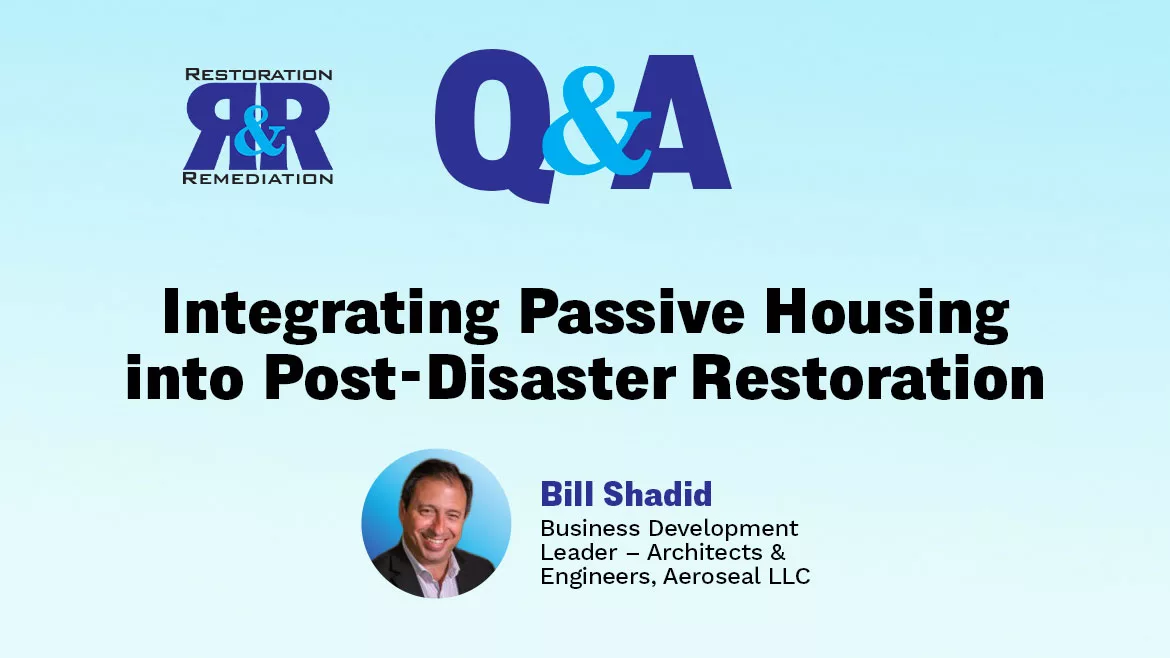
In this exclusive Q&A, we are joined by Bill Shadid of Aeroseal, and we discuss how passive house principles can be integrated into post-disaster restoration without sacrificing speed, cost-efficiency, or occupant comfort and health. From fire and water damage to duct sealing and indoor air quality Bill breaks down practical strategies that restorers can use to deliver healthier, more resilient homes.
Question: How can passive house principles be integrated into a fire-damaged home without compromising speed or cost?
Answer: After a fire, the priority for many homeowners is moving back in and restoring their home as quickly as possible. But airtightness, insulation, and healthy indoor air shouldn't be sacrificed in a rush to normalcy.
One way to bridge the gap is focusing on tactical upgrades that don’t slow down rebuilds: solutions like advanced envelope and duct sealing, high-efficiency ventilation, and smart insulation choices all offer pathways to meet code and passive house standards without blowing the budget. Efficient air distribution and airtightness are achievable without full renovations, especially with non-invasive sealing and verification tools that make the process faster.
Q: When restoring homes after water damage or mold contamination, what air sealing strategies can help prevent future moisture intrusion while improving energy performance?
A: Air sealing is one of the best tools for simultaneously reducing contamination pathways and improving energy performance. After remediation, it’s critical to seal the pathways that allowed moisture-laden air into the wall cavities or ducts. That means going after not just the obvious areas like rim joists and top plates, but also the less easy to reach areas in the vapor barrier that may have been compromised, and HVAC ductwork, which often pulls in air from mold-prone areas like basements and crawl spaces. Combine that with smart ventilation, and you create a tighter, drier, healthier infrastructure going forward.
Q: In hurricane-prone areas, how do you balance passive house airtightness and the need for structural resilience and ventilation?
A: It’s a valid concern and one we’re seeing come up more often. The trick is to remember that airtightness doesn’t mean a lack of ventilation; it means controlled ventilation. Passive house design is compatible with storm resilience, tight envelopes can reduce storm-driven infiltration, and balanced systems like Heat Recovery Ventilators (HRVs) or Energy Recovery Ventilators (ERVs) can provide fresh air without compromising safety or structural integrity. You need to detail the air control layer correctly, especially the roof-to-wall and wall-to-foundation connections.
Q: What role does duct sealing play in post-disaster restorations, especially in homes affected by smoke, mold, and other contaminants?
A: HVAC systems often act as distribution paths for contaminants during and after disasters, circulating smoke, mold, and other pollutants. Sealing ducts, especially in areas behind the walls and ceilings that pull in air from areas that are the hardest to treat after disasters. It helps stop those contaminants at the source, restoring clean, healthy airflow and protecting indoor environments from recontamination. In the wake of climate-driven disasters that leave debris and poor outdoor air quality for days or even weeks, maintaining indoor air quality becomes critical for the community’s health and wellness. This not only safeguards the occupant’s health but also improves HVAC efficiency and supports the transition to electrified, high-performance systems post-rebuild.
Q: How do you retrofit older homes damaged by tornadoes to meet emerging all-electric codes while maintaining passive house standards?
A: Older homes are often the most vulnerable to extreme weather events, but they also represent one of the biggest opportunities for progress. With such a large share of U.S. housing stock-built decades ago, improving the performance in these legacy structures is essential to meet climate and resilience goals, particularly given that older homes often lack air sealing and continuous insulation.
Looking for quick answers on restoration, remediation and cleaning topics?
Try Ask R&R, our new smart AI search tool.
Ask R&R →
After damage from a tornado, structural repairs create a unique opportunity to modernize which includes upgrading thermal envelopes, right-sizing HVAC systems, and sealing previously inaccessible leaks in the ductwork. Smart sequencing like sealing the ductwork before finishing the walls, installing high-efficiency heat pumps, and ensuring airtightness, enables compliance with all-electric mandates, even in legacy structures, while also supporting passive house-level comfort, durability, and efficiency for decades to come.
Q: Are there specific insulation materials or systems you recommend for homes recovering from flood damage that also support passive house goals?
A: Yes. In flood zones, insulation must serve a dual purpose of resisting mold while maintaining strong thermal performance. Mineral wool, closed-cell spray foam, and rigid foam boards with integrated vapor control are all strong candidates to achieve this by aligning with passive house thermal continuity goals while offering resilience against moisture re-entry.
Paired with thoughtful detailing (e.g., capillary breaks, vented claddings, etc.) and advanced air sealing solutions, such as our non-invasive duct and envelope sealing technologies, these solutions help deliver a continuous, airtight barrier, even in hard-to-reach areas. Together, these strategies support durable, high-performance envelopes that protect both energy efficiency and indoor air quality long after a rebuild is complete.
Q: What are the biggest challenges in applying passive house techniques during mold remediation, and how can you overcome them?
A: The biggest challenge is ensuring proper sequencing: mold remediation must precede any air sealing work. Once the mold is addressed, passive house principles like airtight envelopes and filtered ventilation help prevent recurrence by minimizing unwanted moisture intrusion and stagnation. Verification testing, such as blower doors and duct leakage testing, ensures the remediation aligns with long-term health and energy goals.
Q: Can passive house retrofits help improve indoor air quality in homes previously affected by fire or smoke damage? If so, how?
A: Absolutely. Passive house retrofits can dramatically improve indoor air quality in homes previously affected by fire or smoke damage. By bringing in very high airtightness (≤ 0.6 CFM50/SF) and sealing all ductwork and envelope leaks, these retrofits block pathways residual smoke, soot, and fine particulates infiltrate in living spaces.
Balanced mechanical ventilation systems (HRVs/ERVs with high-efficiency filters) provide continuous fresh, filtered air, removing lingering pollutants and odors while conserving energy via heat or energy recovery. Studies show that filtration in quality HRV/ERVs can capture particles down to ~0.3 microns, which is effective against many smoke residues.
With continuous insulation, careful sealing of thermal bridges, and a tight envelope, passive house-retrofit homes protect occupants not just during the immediate aftermath of a fire but in the weeks and months afterward, when odors, VOCs, and particulates can linger in building assemblies and ventilation systems. The result is a healthier, more comfortable indoor environment that reduces exposure risks and supports long-term wellness.
Q: How do you educate homeowners recovering from disasters about the long-term benefits of energy-efficient retrofits versus traditional restoration methods?
A: Education starts with an emphasis on comfort, health, and accessibility. After a disaster, people are in survival mode, they crave comfort, safety, and speed. Showing them that better air sealing, smarter HVAC systems, and cleaner indoor air can make their home healthier, more livable, and more comfortable, while lowering their bills, grabs their attention and helps them understand the value of energy-efficient retrofits. Using diagnostic tools like blower door or duct leakage tests makes invisible problems visible, allowing the homeowners to see the benefits firsthand. Don’t lead with kilowatt-hours, lead with comfort, peace of mind, and other long-term, tangible impacts on quality of life.
Q: Have you seen any code-related shifts in disaster recovery zones that encourage or require passive house-level efficiency in restoration projects?
A: After major storms, building codes are typically revised to strengthen resilience features, focusing on structural durability, flood and wind protection, and safety. However, energy efficiency is generally not treated as a requirement in post-disaster code updates. In some cases, efficiency may be encouraged or included as an optional pathway.
Looking for a reprint of this article?
From high-res PDFs to custom plaques, order your copy today!