When to Replace or When to Repair Damaged Stone and Tile Floor

Photo credit: Bigpra / iStock / Getty Images Plus via Getty Images
Hotels, casinos and homes who have suffered water damage to their stone and tile floors can have difficulty determining if the flood has ruined their floors. It can be difficult to determine if a floor needs to be replaced or if it can be repaired. This is going to be a question that will need to be answered in light of the recent flooding in Las Vegas, Kentucky and other parts of the country. To determine the extent of damage and to ultimately settle on a value for the claim, a thorough understanding of what can cause these damages is necessary. The following article will help you understand what can happen when a stone or tile floor is flooded. As an expert witness I have been involved in many cases where flooding is an issue. Many times, the wrong process is used for cleaning, which can cause greater, and perhaps irreversible, damage to the floor.
In addition, many insurance companies will not pay claims due to the lack of visual evidence and will sign off on a claim only to find that additional underlying problems didn’t manifest visually until months afterward.
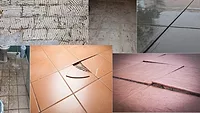
Flooding can wreak havoc on natural stone and tile floors. Flood waters not only contain water which can harm and destroy marble, granite, limestone, terrazzo, and tile flooring, but they also contain debris and dirt as well as other harmful contaminants that can cause staining and other problems. Many times, the damage that is done by the flooding will not show up until months later.
As a stone/tile forensic expert I deal with problems such as those resulting from flooding on a frequent basis. The good news is that not all of the problems that result necessarily mean the floor must be replaced. There are some tests that can be performed by forensic experts to see if it is possible to reverse the damage rather than having to resort to costly replacement.
Following are some of the most common problems that may occur.
Efflorescence
Efflorescence appears as a white powdery residue on the surface of the stone. It is a common condition on stone, terrazzo, and tile installations when the stone is exposed to a large quantity of water, such as flooding. This powder is a mineral salt from the setting bed. It can be removed by cleaning professionals, but many times will come back after the initial cleaning. The stone will continue to effloresce until it is completely dry. This drying process can take several days to many months. A major mistake that is often made — even by some professionals — is to apply a sealer to the stone or tile. The reason this is a major mistake is the sealer will block the escape of moisture which can cause further problems such as flaking and spalling of the stone.
The stone or tile should be evaluated for moisture by a professional stone and tile forensic expert to determine the extent of residual moisture.
Looking for quick answers on restoration, remediation and cleaning topics?
Try Ask R&R, our new smart AI search tool.
Ask R&R →
Sub-florescence
Sub-florescence is what happens when the mineral salts migrate and do not make it all the way to the surface. In the efflorescence condition above, the salts are deposited on the surface of the stone. In sub-florescence, the salts crystallize just below the surface, causing stress within the pores of the stone. The result is a condition known as spalling, which appears as pits in the surface of the stone. Sub-florescence is quite common on green marbles and on almost all stone and tile surfaces where flooding has occurred. The stone or tile can be tested for salts by a qualified professional stone and tile expert.
Yellowing and Discoloration
Many light-colored stones contain naturally occurring deposits of iron. Iron is a mineral found in stone and can occur randomly throughout the stone. If iron is present, it will begin to oxidize when exposed to water or other oxidizers such as acids and household bleach. Stone can remain for years without yellowing, then over time may slowly turn yellow and in severe causes may turn completely brown. This oxidation process is accelerated when the stone is saturated with water as from a flood. This process of oxidation is like the rusting of metal. If you expose a brand-new nail to water and air it will turn brown and rust. The same process is occurring with the iron in the stone. If water and/or air is eliminated, the iron will not oxidize. This is the reason certain white marbles suddenly turn yellow. The process is difficult to reverse and replacement of the stone may be necessary if not properly evaluated and the proper removal technique.
Warping
Several types of thin stone tiles are very susceptible to warping when exposed to flooding. Many of the green marbles and a few agglomerate marbles are notorious for this warping condition. Many installers have had the surprise of finding that their tile installation has mysteriously become warped overnight. Why does this a happen and can it be prevented?
Warping is caused by water. Green marble set with any water-based material will have a tendency to warp. The mechanism of why the tile warps is somewhat a mystery. Some believe that the water fills the pores of the stone and when the water evaporates the orientation of the stone’s crystal changes and causes it to warp. Whatever the reason, one thing is for sure, green marble can warp when set with water-based materials or exposed to copious amounts of water.
Once a green marble tile warps it is difficult to repair. Attempts have been made to grind the tile flat, but this usually fails since additional water is introduced during the grinding process. The green simply warps again. In order to determine if the stone can be repaired a detailed investigation must be made. This many include removing a tile to determine the type of setting bed, etc.
Erosion
Erosion is a condition found when stone is exposed to constant amounts of water. This is especially true with marble that is used in water fountains. While marble is a very decorative material, it is one of the worst materials to use in or around water. Marble is composed of calcium carbonate. Calcium carbonate is a water-soluble mineral. Quite simply this means it will dissolve in water. (Want proof? Visit the Grand Canyon.) Erosion can be recognized by a slow deterioration of the stone surface. With polished stone, the polish will be worn off. In older installations, the stone may become very soft, brittle and it will even powder in extreme conditions.
If any architects or designers are reading this article, I urge you not to specify marble for water fountains. If you do, plan on very high maintenance costs and plan on replacement in about five to ten years, if not sooner.
Hollow Sounds
I constantly get calls from insurance adjusters, contractors, attorneys, etc. about hollow sounds that occur after a floor has been exposed to flooding. The fact is those hollow sounds that occur on a floor are not caused by flooding. The reason is simple: most setting materials are made from Portland cement. It is a well-known fact that Portland cement has hydraulic properties. In other words, it cures in the presences of water. If your client is complaining about hollow sounds and is trying to blame it on a flood, keep this in mind. An inspection and evaluation of the floor is necessary to determine the extent of the hollow sounds which can cause deboning and other issues.
Mineral Crusts or Lime Putty
Mineral crusts or lime putty can be recognized by its white crust like formation on stone surfaces. These crusts are often found on outdoor stone stairs, water fountains, interior floors and other areas where stone is exposed to flooding. The crusts are a deposit of hard mineral salts consisting of calcium and magnesium. These minerals originate from the soil, setting bed or from the water itself. These salts are similar to efflorescence in that they are a mineral. They differ in that they form a hard crust that can be difficult to remove.
Conclusion
Having a stone or tile floor that has been subjected to flooding evaluated by an expert is highly recommended. It may make all the difference. For example, white marble can turn yellow months or even years after the flood. Tiles can become cracked due to swollen subfloors that are not visible to the naked eye, etc etc. Keep in mind that the damage may not be immediate but can take a long time to develop.
Looking for a reprint of this article?
From high-res PDFs to custom plaques, order your copy today!