An Overview of Photocatalytic Oxidation Technologies for Restoration Professionals
Photo credit: Muammar khalid (iStock Getty Images Plus) and Orbon Alija (E+) via Getty Images
Although the team at Wonder Makers takes pride in being knowledgeable about a wide variety of indoor environmental contaminants, we never really anticipated becoming experts in the field of hydroxyl radicals. However, as both consultants and instructors for the restoration industry, we field numerous questions about technologies promoted to fire, water, and mold remediation contractors. Of course, many of those inquiries are about the efficacy of specific products, but even those sorts of information requests about a particular item often leads to broader research.
With over three decades of service, Wonder Makers has done a lot of research supplemented by real-world testing of asbestos sampling tools, lead check swabs, spore trap sampling devices, ozone generators, ultrasonic cleaners, Esporta wash systems, hydroxyl radical generators, and a whole host of chemical products. Sharing the research and test results through white papers, articles in industry journals, and presentations at restoration conferences has helped to educate the entire industry and solidify our organization's reputation. Sometimes, as with the research we did on hydroxyl radicals, we end up being identified as an "expert" regarding those devices that is not encumbered with a potential conflict of interest of being an equipment manufacturer.
The straightforward purpose of this paper is to offer some additional information regarding a subject that seems to be growing more confusing by the day. Now that the COVID-19 pandemic is winding down, equipment manufacturers that targeted air cleaning devices that "kill" the SARS-CoV-2 virus are looking for new markets for their products, and restoration contractors are prime targets in their sights. As such, this article is designed to provide some general information regarding a number of technologies that utilize different wavelengths of light as a sanitizing process under the general heading of photocatalytic oxidation (PCO).
What Is PCO? Photocatalytic Oxidation and Reactive Oxygen Explained
One of the definitions of the word "propaganda" is information, especially of a biased or misleading nature, used to promote or publicize a particular commercial point of view. This word and definition could certainly apply to some of the advertisements that we have seen recently regarding different types of PCO products being promoted to the cleaning and restoration industry. The advertising jargon makes it seem like each advertised piece of equipment is coming to us directly from a Star Wars movie. Some of the more interesting catchphrases include:
- Reflective Electro Magnetic Energy technology
- Hydro-Peroxide plasma
- …a revolutionary device that generates “superior hydroxyls”
- Unique 360-Surround permanent nano-anatase TiO2 reactor grid
- Advanced Oxidation Products (AOP’s / Oxidizers) are produced (i.e. hydroxyls; superoxide anions; hydroperoxyls)
Putting all the advertising aside for a moment, it is best to start with a simple description. One of the interesting properties of ultraviolet (UV) light is the ability to split a molecule made up of different types of atoms into smaller pieces. Typically, the ultraviolet light energy breaks away from an oxygen atom that was bound to another material. Photocatalytic oxidation (PCO) is the term for any one of several processes where ultraviolet light reacts with different materials called catalysts (solids, liquids, or gases) and creates a chemical reaction that frees an oxygen atom. PCO happens naturally from sunlight striking the upper atmosphere and can be produced artificially with UV bulbs.
When the ultraviolet light reaction does break away from an oxygen atom, that configuration is very unstable and the freed oxygen wants to re-combine with anything around. That is why those types of PCO reaction products are often referred to as "free radicals.” Another term that is often utilized for the freed oxygen is reactive oxygen species (ROS). For the products marketed to the restoration and cleaning industry, as well as for the improvement of general indoor air quality, the term PCO is used to describe man-made reactions, as compared to the natural production of reactive oxygen species from sunlight.
Different Types of Reactive Oxygen Species, Their Benefits and Dangers
Although many industrial applications utilize UV light to cure surface coatings or cause chemical reactions on an exposed surface, in the cleaning and restoration industry, photocatalytic oxidation is used to create the reactive oxygen species that will do the actual work of cleaning.
Reactive oxygen species come in a variety of different molecular forms. The most common ROS types advertised for use in contaminant control include an oxygen singlet (O1), ozone (O3), hydroxyl radical (OH), and gaseous hydrogen peroxide (H2O2). Because these ROS tend to give up an oxygen atom during the reaction process, they function and are known as oxidizers. Their willingness to break down both their bonds and cause the bonds of other compounds to shift and break is what gives them potency as sanitizing and deodorizing agents. In contrast, stable oxygen (O2) and water (H2O) are relatively non-reactive and often require additional time or catalysts to clean or sanitize the air or surfaces.
Looking for quick answers on restoration, remediation and cleaning topics?
Try Ask R&R, our new smart AI search tool.
Ask R&R →
As noted, once the loosed oxygen atoms are created, they react to and merge with any number of other molecules. Occasionally, these additional oxygen atoms are simply absorbed by the reacting compound. Other times this addition of an oxygen atom can cause the receptive compound to become unstable itself, leading to a chain reaction where unstable compounds lead to other unstable compounds until equilibrium is achieved.
It is important to note that the creation of reactive oxygen species outside the body is different than some of the chemical processes that occur internally, which produce free radicals (the medical term for reactive oxygen species) inside the body. Internal free radicals are a known health hazard, as it is clear that the addition of extra oxygen can often injure biological materials by damaging individual cells. Generally, ROS created to assist with cleaning and deodorizing is blocked by the skin. However, breathing elevated levels of ozone or other ROS can damage the lungs and other internal organs.
Evaluating the Use of PCO Systems
With this background, it is clear that if a product label or marketing claim indicates the device uses a PCO process, somewhere in the product, a UV light is running on a tuned frequency. Usually, these lights are also set up in conjunction with reflectors, energized wire grids, or a chemical coating on surrounding materials. In this configuration, the UV light shines directly on contaminants in the air or on a particular catalyst with the intent of breaking down biological material or reacting to create an oxidizer in the form of ROS.
The difference between ozone generators, hydroxyl radical generators, and other types of PCO "air-purifying" systems is the spectrum of UV light and the type of catalyst that is utilized in the equipment. By varying those factors, you can create equipment where the majority of the ROS produced is O3, and label it as an ozone generator. Other light frequencies and catalysts will create an abundance of OH, and you put a label on the unit calling it a hydroxyl radical generator. Some combinations of light and catalysts can even produce an abundance of airborne hydrogen peroxide vapor.
A key factor to remember is that no combination of UV light frequency and catalysts are perfect and some margin of error is inevitable. In addition, no system installed or used in the real world is in precisely the same conditions as the laboratory that tested the product’s initial effectiveness and reliability. As such, ozone generators also produce hydroxyl radicals. Conversely, hydroxyl radical generators also produce some ozone, although the better ones have tighter controls and produce minuscule amounts.
When these intended and accidental ROS products are combined in an atmosphere, the cascading reaction described earlier has a proven track record of breaking down larger airborne molecules. However, the same imprecision that helps make them useful in breaking down a broad spectrum of contaminants also raises concerns about the human health if people are occupying the space while the reaction is occurring. For example, if a unit geared to generate (OH) Hydroxyl Radicals is running in an older office building with little to no off-gassing of volatile organic compounds from construction materials, then the likelihood of the occupants being exposed to hazardous reaction components is relatively low. By way of contrast, if the same machine was run in a newly built house with spray foam insulation, fresh paint, and new carpeting, the likelihood that some of the reaction byproducts could be harmful to people is real. This reality was highlighted recently in an open letter by a group of prominent academics to school administrators and engineering firms that provide services to schools1. In discussing the potential for the production of harmful byproducts, the group made a strong statement supported by an illustration (reprinted below):
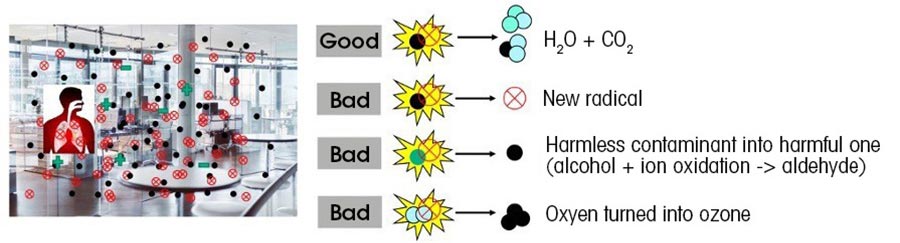
Studies also indicate that chemical compounds at harmful concentrations can be produced in real-world settings, directly as a part of the process or as by-products created from the chemical reactions occurring within the space. In the absence of regulation and with presently very little peer-reviewed research, significant questions remain regarding effectiveness and the potential impacts on human health.
Conclusions
Over the last 10 plus years, various forms of PCO systems have proven their worth in the fire damage restoration industry, as well as general odor control. While experience has proven that (O3) ozone systems need to be used with caution in closely controlled unoccupied areas, there still seems to be a wide-open range of applications for (OH) hydroxyl radical systems. Due to the lack of scholarly documentation from long-term health effects of almost all forms of ROS created by PCO-style air-cleaning devices, their use by restoration contractors should be well thought out before they are turned on in an occupied space. However, under the right circumstances, photocatalytic oxidizers that produce a variety of ROS can be powerful tools in the pursuit of contaminant and odor reduction objectives.
As cleaning and restoration contractors are bombarded with ever more aggressive advertising that borders on propaganda about the benefits of PCO machines, they are wise to remember that no such equipment is ever going to replace the real work of the mechanical removal of the source contaminant(s). Nonetheless, the distinct advantages that a gaseous application of a broad-spectrum oxidizer can provide are hard to ignore. These advantages range from the presumed ability to disrupt the airborne biological load, to the reduction in dwell time of even stubborn volatile organic compounds in the indoor air environment. In conjunction with other engineering controls, such as additional room air changes and enhanced filtration, the uses of PCO systems are an important tool to have in the cleaning and restoration repertoire.
1 Electronic air-cleaning tech: US academics issue open letter regarding negative health impacts of tech to remove Covid particles.
A letter from some of the US’s leading academics raises concerns about efficacy of air cleaning kit in real-world conditions – and worrying human health impacts. Retrieved from: https://workinmind.org/2021/04/14/electronic-air-cleaning-tech-us-academics-issue-open-letter-regarding-negative-health-impacts-of-tech-to-remove-covid-particles/.
Looking for a reprint of this article?
From high-res PDFs to custom plaques, order your copy today!