Loss Site Safety during a Pandemic
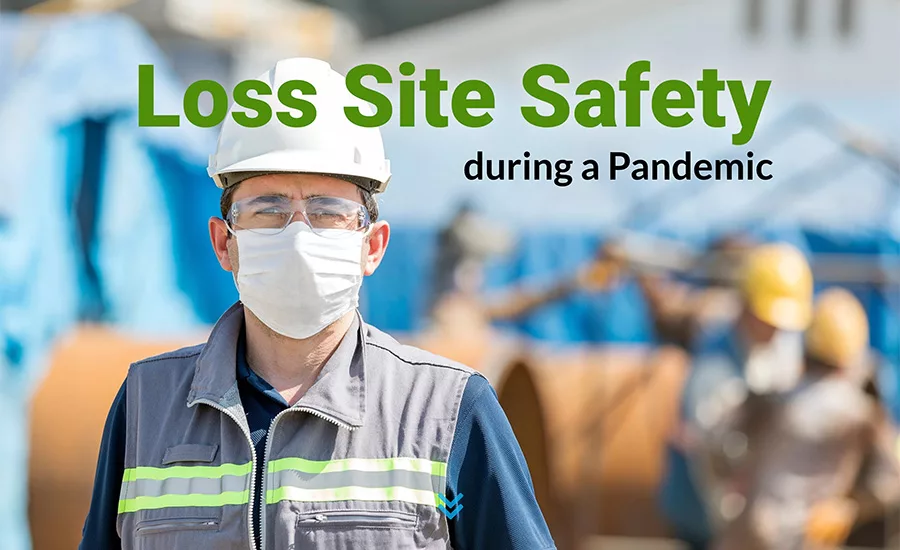
Image from Funtay/ Stock / Getty Images Plus via Getty Images
In each edition of ANSI/IICRC’s S500 Standard and Reference Guide for Professional Water Damage Restoration, dating back to 1994, the mitigation contractor’s stated first priority on a loss site has remained clear: “Eliminate safety hazards”. I am certain that SARS-CoV-2 (the virus) or COVID-19 (the disease) are not what the authors of the standard had in mind. In 2020, however, the principle applies to water and fire loss sites perhaps now more than ever.
The list of potential hazards on even the most basic mitigation loss can be lengthy. Asbestos and lead exposure. Electrical issues and ceiling collapses. Mold, soot, and bacteria – Oh my! Over the past year, new perils crept out of the shadows and onto the job site– you and me! And your coworkers to your left and right, the five other workers you drove alongside to the job site in the company truck with the windows rolled up, the 15 to 20 temporary laborers hired for the day to demo some water damaged apartments, the multiple residents in each of those apartments, the insurance adjuster, public adjuster, property manager, project manager, building consultant, industrial hygienist, anyone else who may pop in for a visit!. Proper social distancing is nearly impossible 100% of the time on a loss site. Let’s look at ways employers, technicians, and occupants can raise awareness while increasing their chances of staying safe at work during this harrowing time.
Universal Precautions
Any technician who has worked on a trauma scene or sewage loss should be familiar with this term. The Occupational Safety & Health Administration’s (OSHA) Bloodborne Pathogens standard defines Universal Precautions as: “An approach to infection control. According to the concept of Universal Precautions, all human blood and certain human body fluids are treated as if known to be infectious for HIV, HBV, and other bloodborne pathogens.”
Although OSHA’s Bloodborne Pathogen standard may not directly apply to this new danger we face on losses, Universal Precautions should be applied to every mitigation job, all other workplaces, and in general day-to-day life during this pandemic. In 2020 ,it is not just human blood that we are treating as if it were infectious, but people. All people – including ourselves. This approach may carry with it the stench of paranoia, and it is terribly sad. It is also necessary due to the nature of asymptomatic carriers as well as a latency period of up to two weeks after contracting the virus. The technician must assume that each coworker, resident, and passerby is infected.
Identify Risks
OSHA states in their Standards for General Industry that hazards in the workplace must be identified by a “competent” person. Protective measures such as training, container labels, signage, medical exams, or personal protective equipment (PPE) must then be provided in order to perform the dangerous task in a safe manner. COVID-19 is considered a job-related hazard and risks of infection must also be identified. Working in close proximity of others, multiple technicians riding in a vehicle to the job site, and eating lunch with coworkers are all daily routines that now come with inherent risk. It is up to the competent person to identify these tasks as risks and formulate a plan to “Eliminate the Safety Hazard”. Like most anything, success is heavily dependent on training and communication. Perhaps instead of cramming six technicians into a vehicle with no distancing, it becomes policy that no more than four can be in a vehicle at a time, while masked, and with the windows are at least partially rolled down in order to increase ventilation. Identify the hazard and train the worker how to do their job safely.
Face Covering vs. Mask vs. Respirators
Science and studies show that face coverings make a difference and protect people. The aforementioned competent person should communicate the limitations and differences between face coverings, masks, and respirators to employees.
Those made of paper or a cloth material are considered face coverings. These have been shown to effectively contain droplets from the wearers mouth and nose, within their own face covering. OSHA does NOT classify these as PPE since there is no seal, and protection from others’ droplets is limited.
Looking for quick answers on restoration, remediation and cleaning topics?
Try Ask R&R, our new smart AI search tool.
Ask R&R →
A mask refers to a surgical mask, which protects against splashes and sprays; therefore it is classified as PPE. Having said that, as surgical masks relate to COVID-19, the primary function is similar to that of face coverings in that they are meant to contain the wearer’s droplets. Since there is no seal, they do not offer great defense against microscopic air borne particles-such as infectious droplets from others.
A mask becomes a respirator when it is a N-95, or better. Even disposable N-95’s (often mistakenly referred to as dust masks) are classified by OSHA and their sister agency, NIOSH (National Institute of Occupational Safety and Health), as respirators. Once that competent person deems a respirator is required to safely perform a task, a proverbial can of worms is opened. Pulmonary function exams. Respirator fit testing. A written Respiratory Protection Plan. Donning, doffing, donner, and Blitzen! Facial hair procedures. Training… training...and more training! All requirements the instant an N-95 "dust mask”, or more accurately – “respirator”, is required to be worn. The N-95 has a seal, thus protecting the wearer against 95% of non-oily particles.
Beyond facial coverings, remember daily temperature checks on all workers upon entering the job site. Have a plan if somebody does contract the virus. What coworkers were they in close contact with? When can they return to work? Supplies are short-can I reuse my N95? OSHA and the Center of Disease Control (CDC) offer guidance on these, and many more questions, on their websites
Many of the above requirements are not new, just elements of long-existing safety standards. As we begin to see just a flicker of light toward the end of this long and dark tunnel, let’s keep our guard up and safely go home to our families at the end of the work day. I can’t think of a flood or fire job that is worth the alternative.
Looking for a reprint of this article?
From high-res PDFs to custom plaques, order your copy today!