Restoration logo
search
cart
facebook twitter linkedin youtube
  • Sign In
  • Create Account
  • Sign Out
  • My Account
Restoration logo
  • NEWS
  • PRODUCTS
    • New Products & Technologies
    • Submit Your Product
    • Interactive Product Spotlights
  • EDUCATION
    • KnowHow.
    • Podcasts
    • Trade Shows & Expos
    • Training & Certification
    • Webinars
    • Whitepapers
  • TOPICS
    • Water Damage
    • Fire & Smoke Damage
    • Mold
    • Contamination
    • Odor
    • Contents
    • Architecture
    • Catastrophe
    • Cleaning
  • BUSINESS
    • Managing Your Business
    • Insurance/Legal Matters
  • BUYER'S GUIDE
  • VIDEOS
    • Ask the Expert
    • TradeTalks
    • Video Channel
  • THE EXPERIENCE
    • Convention & Trade Show
    • R&R Special Issue
  • EMAG
    • eMagazine
    • Archive Issues
    • Contact
    • Advertise
  • SIGN UP
Contamination Restoration & Remediation​Managing Your Restoration Business

Disinfectant Math

By Jeff Heyd
Disinfectant Math
Disinfectant Math
Disinfectant Math
Disinfectant Math
Disinfectant Math
Disinfectant Math
Disinfectant Math
Disinfectant Math
Disinfectant Math
Disinfectant Math
June 18, 2018

It’s safe to say math was one of my least favorite subjects in school.  Well, as I have discovered over the years and I’m sure you have too… math is required in just about everything we do and there’s no escape.  Fortunately, with just a little effort and minimal math skills, we can use math to save money… and make more money! 

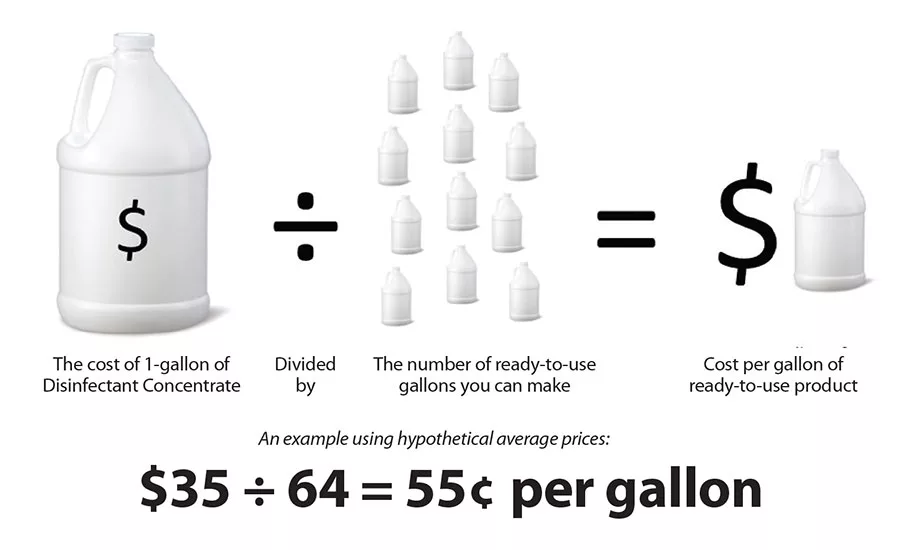
At first glance, one might be tempted to use the simplest math possible when choosing a disinfectant.  If you use a concentrated disinfectant that requires mixing with water to create the ready-to-use dilution, it looks like you can save a lot of money.  Here’s the calculation:

If you compare that to most RTU disinfectants (the kind you spray right out of the bottle without mixing), you’ll see that they range from $25 up to around $40!  So, you think to yourself, “Wow, I’m paying less than a dollar per gallon instead of 30 bucks or so!”

Well, that’s all fine and good, but there’s another side to using disinfectants and that’s getting paid for applying them.  If you are using Xactimate or just about any other line-item based billing/invoicing/estimating system, you are going to charge money for applying disinfectant.   

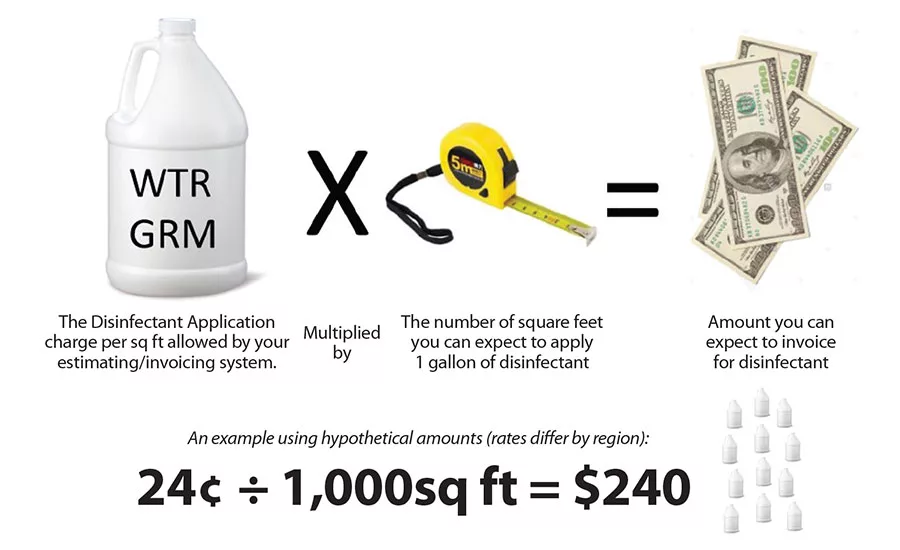
Currently the most common way to charge for applying a disinfectant is to use a line-item code for each square foot of surface applied.  Considering that most disinfectants have coverage rates somewhere between 800 and 1,200 sq ft, you are able to bill out a significant amount for that one gallon (remembering of course that the line item amount also includes the labor to apply it and other factors). Check out the math above.

Here’s where it gets weird though. Remember that “expensive” RTU disinfectant that costs around $30 per gallon to apply?  Well, if that disinfectant qualifies for the Xactimate GRMB code (or similar code in other pricing/estimating systems) you can charge a few more cents per square foot for using it.  There is some debate among a few people in the industry as to which products qualify for this special code, but I’ve always contended that there are several.  What there is no debate on is that concentrated disinfectants don’t qualify.  Here’s the current Xactimate description so you can decide for yourself if your RTU disinfectant qualifies:

Xactimate GRMB Definition:

Includes: Anti-microbial agent and labor.

Note: The surface is treated to kill harmful bacteria and/or prevent mildew. This item is for applying a plant-based or equal environmentally-safe alternative to chemical-based anti-microbials.

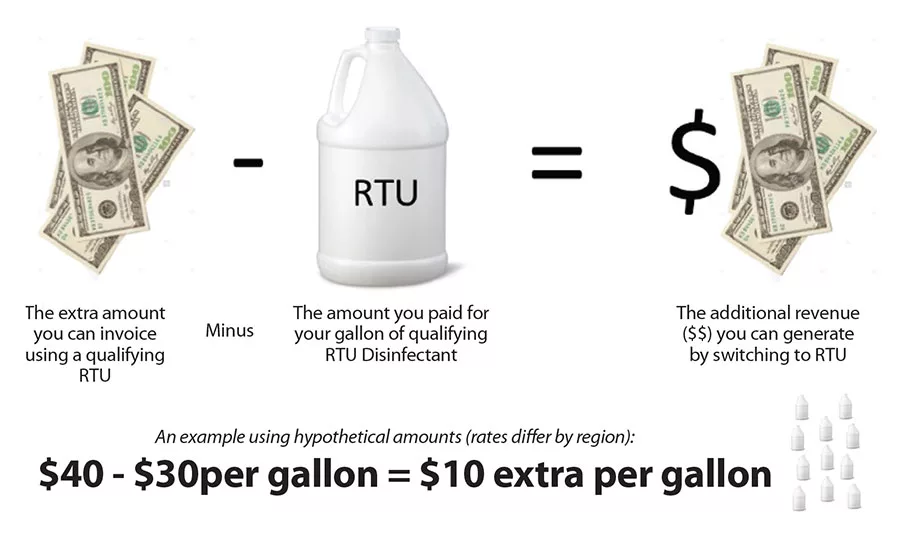
How much more per square foot can you charge for applying an RTU Disinfectant that qualifies for the GRMB code?  That depends heavily on the codes in your region, but let’s do a hypothetical example of the math:

In other words, by switching to an RTU disinfectant that qualifies for the special “Bio” code, you can invoice more additional dollars per gallon than what that RTU gallon costs!  Weird right? 

Remember, you will have to do the math for yourself since a lot depends on the pricing codes in your region and your estimating/pricing system… as well as what you are paying for a quality RTU disinfectant.  The point is, you aren’t saving much by mixing concentrates and it’s likely you are actually invoicing less than what you could be if you were using an RTU.

Where it becomes a no-brainer though is when you consider the other differences between the standard quaternary ammonia-based disinfectant concentrates and the RTU products that qualify for the GRMB code.

One of the most important factors to consider when choosing an antimicrobial (disinfectant) is liability.  Liability issues in disinfectants come in two primary forms. First, the product needs to be strong in killing a broad spectrum of microbes.  The best way to document this is to choose a disinfectant registered by the EPA as a “Tuberculocide.”  If the word, “Tuberculocidal” is not on the front label, that product is not as strong as a product that does have that on the label. 

Second, be sure to compare each section of the SDS sheet.  Products that qualify for the GRMB code are going to be safe and have no words like “Danger,” “Warning,” or “Caution,” anywhere on the label or SDS sheet.  Nowadays everything we can do to reduce liability is important.

I said it would be a no-brainer so let’s review. Switching from a concentrated disinfectant to a GRMB-qualifying RTU Tuberculocide disinfectant is going to: 1. Generally make you more money and 2. Reduce your liability exposure. 

…but don’t take my word for it, do the math! 

KEYWORDS: antimicrobial disinfection mold remediation mold removal

Share This Story

Looking for a reprint of this article?
From high-res PDFs to custom plaques, order your copy today!


Jeff Heyd is a 15-year veteran of the restoration/remediation industry, having owned and managed restoration companies around the US. He currently holds an IICRC Master Water Restorer certification and develops and teaches IICRC continuing education courses. He is currently Director of US Sales West for Concrobium Professional Restoration Products. www.concrobiumpro.com.

Recommended Content

JOIN TODAY
To unlock your recommendations.

Already have an account? Sign In

  • mold remediation

    Fighting Mold and Bacteria Damage

    Successful mold remediation can be multidisciplinary,...
    Contamination Restoration & Remediation​
    By: Josh Woolen
  • certifications and licenses for restoration professionals

    Certifications and Licenses Every Restoration Company Needs

    Restoration companies need to make sure they have the...
    Restoration Training/Education
    By: Sharon Elzarat
  • a wall covered in moss and fungus

    Zero Tolerance for Toxic Molds: Essential Steps for Successful Remediation

    Understanding the importance of zero tolerance for toxic...
    Mold Remediation
    By: Michael A. Pinto CSP, SMS, CMP, RTPE, FLS, ERS and Kendra Seymour
You must login or register in order to post a comment.

Report Abusive Comment

Manage My Account
  • eNewsletter
  • Online Registration
  • Subscription Customer Service
  • Manage My Preferences

More Videos

Popular Stories

Ask the Expert - Inside the Cost of Doing Business Survey: What It Means for Restoration Companies Today

Inside the Cost of Doing Business Survey: What It Means for Restoration Companies Today

Ask the Expert - Margin vs. Markup: The Costly Confusion in Restoration

Why Understanding Markup, Margin and Overhead is Critical for Restoration Success

mold spores

Mold and Mental Health: The Dual Crisis Facing Indoor Environmental Remediation Teams

2025 Technician Award winner - Congratulations, Kaylin Glaspie!

Events

January 20, 2026

INTRCONNECT

Dive into the latest trends, innovations, and best practices shaping the future of property insurance and restoration.

April 27, 2026

RIA Convention & Expo

This event empowers professionals through world-class education, powerful networking, and access to cutting-edge tools and services.

View All Submit An Event

Poll

Technology Innovations

Which emerging technology do you believe will have the biggest impact on restoration work in the next 5 years?
View Results Poll Archive

Products

The Cleaning, Restoration, Inspection, and Safety Glossary

The Cleaning, Restoration, Inspection, and Safety Glossary

The Cleaning, Restoration, Inspection, and Safety Glossary.

See More Products
Prepare for CATASTROPHE with R&R!

Related Articles

  • choose a disinfectant

    5 Criteria for Choosing a Disinfectant

    See More
  • Restorers Perspective Disinfectants

    Restorer's Perspective: All Disinfectants are Not Created Equal

    See More
  • mold stain removal

    Understanding Mold Stain Removal

    See More

Related Products

See More Products
  • COVER pdf.jpg

    How to Get More Restoration Jobs in 14 Days... (ebook)

  • Cover.jpg

    How To Get More Water Damage Jobs (ebook)

  • CRIS.gif

    The Cleaning, Restoration, Inspection, and Safety Glossary

See More Products

Events

View AllSubmit An Event
  • February 24, 2017

    The Goldmorr System

    The Goldmorr System is hands down the most advanced mold remediation technology on the market.
View AllSubmit An Event
×

Stay ahead of the curve with our eNewsletters.

Get the latest industry updates tailored your way.

JOIN TODAY!
  • RESOURCES
    • Advertise
    • Contact Us
    • Directories
    • Store
    • Want More
    • Submit a Press Release
  • SIGN UP TODAY
    • Create Account
    • eNewsletters
    • Customer Service
    • Manage Preferences
  • SERVICES
    • Reprints
    • Marketing Services
    • Market Research
    • List Rental
    • Survey/Respondent Access
  • STAY CONNECTED
    • LinkedIn
    • Facebook
    • Instagram
    • YouTube
    • X (Twitter)
  • PRIVACY
    • PRIVACY POLICY
    • TERMS & CONDITIONS
    • DO NOT SELL MY PERSONAL INFORMATION
    • PRIVACY REQUEST
    • ACCESSIBILITY

Copyright ©2025. All Rights Reserved BNP Media.

Design, CMS, Hosting & Web Development :: ePublishing