The Job Isn’t the Deliverable. The Documentation is.
Scope approval, supplements, and profitability are critical for defensible restoration files
Two restoration companies completed identical water losses with the same cause of loss. Same square footage. Same dry standard. Same number of drying days. One got paid in full and received approval for the supplement on the framing cleaning. The other got a 22% scope reduction and a polite note suggesting they didn't have evidence to support the line items they were billing. Neither company did better drying. One built a better file.
I've sat on both sides of that scenario. I've watched a tech do everything right on a Cat 2 loss, including proper extraction, correct equipment placement, and hitting the dry standard on schedule, and then watched the file get carved up by a desk adjuster who didn't see what we actually did. The job was perfect. The deliverable wasn't.
That gap between the work and the documentation is the entire game in 2026, and most of us in this industry are still pretending it's 2010.
Nobody Sent a Memo
Here's what makes this shift especially dangerous: nobody told us it was happening.
There was no bulletin from the insurance carrier. No press release from estimating software. No carrier-sponsored webinar titled Effective Immediately, Your Documentation Standards Have Changed. The rules didn't get rewritten in public. They got rewritten in the back end of the review software, one quiet update at a time.
It's like watching an NFL defense. The other team isn't going to tell you the next play. They're not going to walk over before the snap and explain the coverage. You have to read the formation. You have to watch the safety drift. You have to notice that the linebacker is cheating toward the line. And if you're not paying attention, you find out what the play was after you've already been sacked.
That's exactly how the documentation shift happened in restoration. Estimates that used to clear started getting flagged. Supplements that used to be routine started coming back with questions. Files that used to ship and get paid started sitting in review queues for an extra week. Each individual change was small enough to absorb. The cumulative effect was a different game.
Looking for quick answers on restoration, remediation and cleaning topics?
Try Ask R&R, our new smart AI search tool.
Ask R&R →
Most of us absorbed the first hundred small changes as bad luck. Tough adjuster. Difficult carrier. One-off file review. It took dozens of write-downs across multiple carriers before the pattern became visible, and by then, the operators who hadbeen paying attention had already adapted. They weren't smarter. They were just reading the formation.
The carriers will never tell you what changed. They don't have to. The review software speaks for them, one rejected line item at a time.
The Old Mental Model
The old mental model was that the work was the product and the documentation was the paperwork. You did the job, then you wrote it up. The estimate was a description of what you had done. The photos were proof you had been there. The notes were a justification you reached for if the adjuster pushed back.
In that model, documentation was a cost, a tax on the real work, something to minimize. Good companies pushed the burden down to the field tech with a clipboard or an app and hoped the office could clean it up before the invoice went out.
That model worked when the carrier had a human adjuster looking at one file at a time, when Xactimate defaults were less aggressive, and when the volume of restoration work meant everyone absorbed a reasonable amount of friction. None of those conditions hold anymore.
The New Mental Model
The new mental model is that the documentation is the product, and the work on site is the raw material you assemble it from. The estimate is no longer a description of what happened. It's an argument supported by evidence that an algorithm may review before a human ever sees it.
This sounds like a semantic difference. It is not. It changes what you train techs to do on site, what tools you put in their hands, what your project managers are responsible for, and which jobs are profitable.
In the old model, a tech who took fifteen photos of a basement and wrote "removed wet drywall, set air movers, will monitor" was doing the job. In the new model, that tech just lost you the supplement on the framing cleaning, the antimicrobial application, the negative air machine runtime, and probably the equipment days on the back end. He did the work. He just didn't deliver the product.
What Carriers Are Actually Reading
It's worth being concrete about what the documentation chain looks like on the carrier side now, because most operators are still optimizing for the wrong reader.
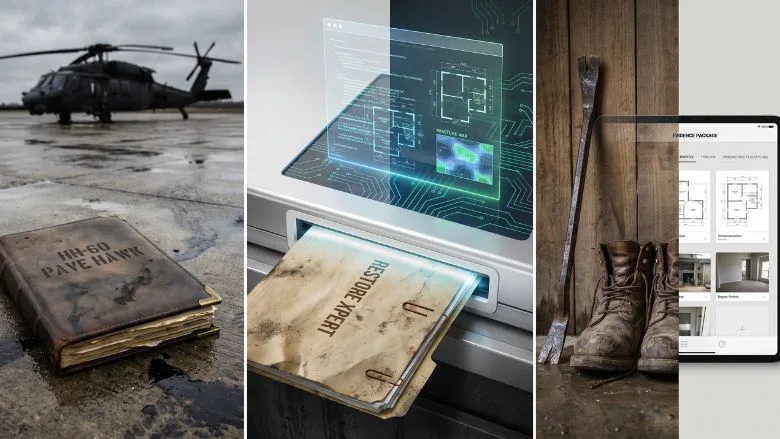
The first reader is no longer a human. It's a rules engine, XactXpert is the most visible, but every major carrier and TPA has some variant, that scans your estimate against a library of pattern rules. Does the line item make sense given the cause of loss? Is the quantity reasonable given the room dimensions? Is there photo evidence in the file that supports this scope? Are your moisture readings consistent with the drying days you're billing? The engine flags exceptions and routes them.
The second reader, if you survive the first, is a desk adjuster who is working twenty to forty other files that day. They are reading on a phone or a low-resolution monitor. They are looking for reasons to approve quickly or kick back quickly. They are not reading your psychrometric narrative; they are scanning for whether the file looks clean and the numbers feel reasonable. The quality of your documentation in their hand is the quality of your case.
The third reader, if there's a dispute, is an SIU investigator or a managed repair program QA reviewer. They are reading the file forensically. They want a timeline. They want to know that what you say happened on day three matches what your equipment was doing on day three and what your moisture log shows on day three.
A field tech with a clipboard and a phone cannot deliver a product that holds up across all three of those readers by accident. You have to engineer it.
I learned this the hard way the first time one of our cleanest jobs came back with a 30% scope reduction. The technician was a five-year vet. The PM was sharp. The drying was textbook. But the file, the actual package that went to the carrier, was a folder of unlabeled photos, a moisture log that didn't tie to the daily narrative, and an estimate that read like a description instead of an argument. We had done the work. We had not built the case.
Engineering the Documentation Chain
Engineering the chain means being intentional about three things: what gets captured, in what sequence, and how it ties together.
What gets captured is no longer just "before and after photos." A defensible water loss file today has dimensioned floor plans (Matterport, MagicPlan, or hand-drawn with measurements that match the sketch in your estimating software), moisture maps that show readings tied to specific assemblies, photos that include scale references and identify the affected materials, equipment logs that match the runtime you're billing, and a daily narrative that ties the readings to the drying strategy. Each of these has to exist as a discrete piece of evidence, not as a pile of JPEGs in a folder.
The sequence matters because the file tells a story. Cause of loss, initial assessment, scope decision, drying strategy, daily progress, completion verification, and final dry. When an adjuster or an algorithm scans your file, they should be able to follow that arc in order. A file with thirty photos in random order and a narrative that jumps around in time looks like a file you're trying to hide something in, even if you're not.
How it ties together is where most operators lose money. Your estimate line items have to be traceable to your evidence. Every line item should have an answer to the question, "where in the file is the support for this?" That answer might be a photo, a moisture reading, an IICRC reference, an OSHA citation, a manufacturer recommendation, or a building code section. F9 notes exist for this reason. The operators getting paid in full are the operators whose F9 notes are written assuming a hostile reader and a software audit, not assuming a friendly human who will give them the benefit of the doubt.
What This Means for How You Run the Company
If you accept that the documentation is the deliverable, several operational decisions change.
Your field training shifts. The tech who can dry a building but can't document one isn't a complete tech anymore. Documentation has to move from "the thing the office complains about" to a graded competency.
Your tool stack shifts. The right question isn't "what software is everyone using?" It's "what does this tool capture, in what format, and how does that evidence flow into my estimate?" A Matterport scan that doesn't connect to your scope is a parlor trick. A moisture meter that doesn't log to your job file is a clipboard with batteries.
Your project manager role shifts. The PM is no longer primarily responsible for scheduling and customer relations. The PM now serves as the editor of the documentation package. They are responsible for the file being defensible before it goes out the door. That is a different skill set than most PMs were hired for, and it is worth training for explicitly.
Your estimating discipline shifts. Estimators who write what they hope will get approved are dead. Estimators who write what they can defend, supported by what's actually in the file, get paid. Every line item is a small argument; the estimate is the brief.
The Counterintuitive Implication
Here's the part that operators resist: the better you get at documentation, the more carrier work becomes viable to take.
The instinct in our industry over the last five years has been to flee carrier work, to chase commercial direct, large loss, plumber referrals, and anything that doesn't require fighting for every dollar with an adjuster. That instinct is rational given how the work has felt. But it's solving the wrong problem.
The reason carrier work feels unprofitable is not that the carrier is paying less than they used to, although they are. It's that most operators are still delivering a 2010 documentation product into a 2026 review process. The gap between what we send and what they need has widened every year, and the write-downs absorb the difference.
A shop that has actually re-engineered its documentation chain, where the field tech captures what the estimate needs, the PM edits the file before it ships, and the estimate is supported line-for-line, has a fundamentally different conversation with the carrier than a shop that hasn't. The first shop gets supplements approved. The second shop gets nickel-and-dimed and writes it off as "the industry."
The carrier work isn't broken. The product we're shipping into it is.
The Bottom Line
When I was a crew chief on HH-60 Pave Hawks, we had a saying about pre-flight documentation: the logbook is the aircraft. Not the airframe sitting on the ramp, but the logbook. Because the airframe without the logbook is unflyable. The logbook is what proves it's airworthy. The logbook is what survives the inspection. The logbook is what gets the bird in the air.
The restoration file works the same way now. The dry building without the documented file is unflyable. It doesn't matter how good the work was. If the package can't survive the readers, the work didn't happen, at least not in a way that gets paid.
The carriers are not going to slow down their automation. The TPAs are not going to ease up on scope reviews. The AI-driven audits are going to get better, not worse. They're also not going to send a memo when the next change lands. You have to read the formation.
The job is still the job. But the deliverable is the logbook.
Looking for a reprint of this article?
From high-res PDFs to custom plaques, order your copy today!