Mission Critical powered by KnowHow
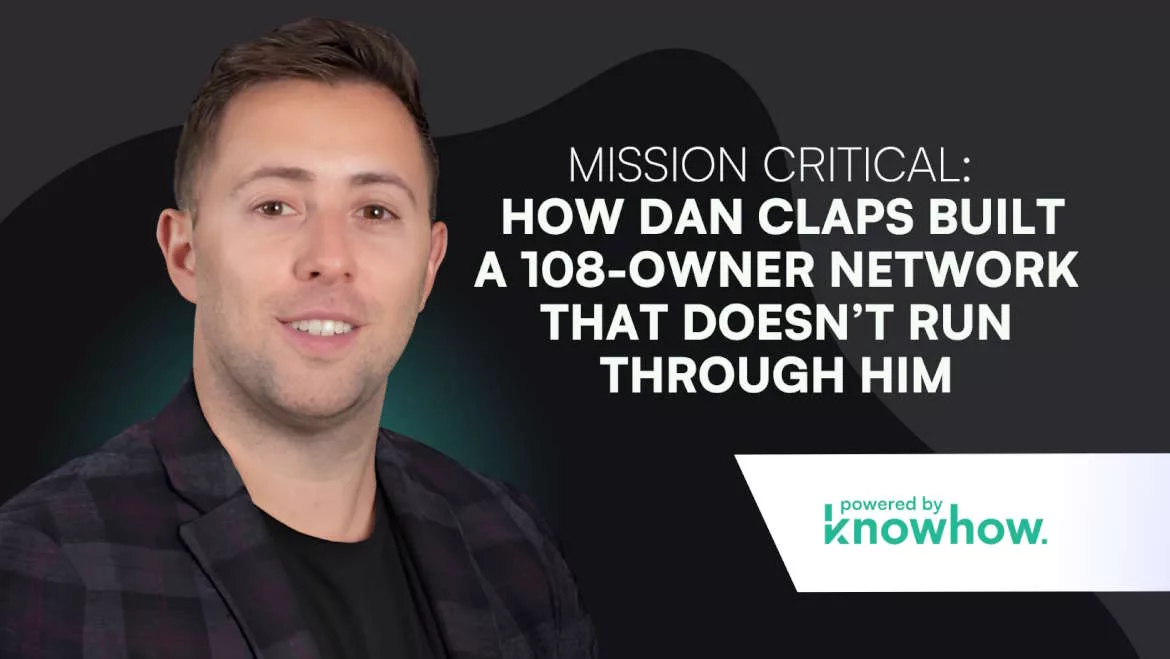
How Dan Claps Built a 108-Owner Network That Doesn't Run Through Him
Key leadership systems and a decision-making framework that drive growth across franchise teams
Welcome to “Mission Critical,” a brand new series from KnowHow that explores how today's restoration leaders are navigating the industry's most urgent challenges. Sales are soft, margins are thin, and getting paid feels like pulling teeth. In this series, we spotlight elite restorers who share battle-tested systems and strategies from the trenches.
Each feature dives into specific tactics leaders use when everything's on the line—from stabilizing cash flow to driving profitable growth in unpredictable markets.
If you want concrete strategies to hit your sales numbers and produce work profitably, you're in the right place. Expect real advice, actionable insights, and takeaways from leaders who've been through the storm and come out sharper.
Ready for the mission brief?
Dan Claps is holed up in a conference room in New York City. It's a weekend in the fall of 2024. Back-to-back hurricanes are tearing through Florida, and his franchise owners on the ground need equipment, direction, and answers he doesn't fully have yet.
He wanted to do more. VODA Restoration was still a young network then, and the gap between the ambition and the infrastructure stung.
“I remember thinking, I want to help more, but we're not ready yet,” Dan says. “We only have so many pieces of equipment and tools.”
Looking for quick answers on restoration, remediation and cleaning topics?
Try Ask R&R, our new smart AI search tool.
Ask R&R →
Most founders would respond to that feeling by centralizing things, pulling decisions closer, tightening control. Instead, Dan did the opposite. Everything he built after that weekend was designed so the network could solve problems without waiting for him.
Curious to hear more from Dan? Click on the video below to catch the full discussion!
The Fastest Way to Bottleneck a Network Is to Make Yourself the Expert
Dan Claps didn't grow up in restoration. He built and exited a lead generation company in the franchise space, then partnered in early 2023 with Dragan Krstic, a Serbian immigrant who'd spent fourteen years building a cleaning and restoration operation in Northern Virginia from nothing.
They rebranded to VODA—Serbian for “water”—and started franchising two months later.
What Dan brought wasn't technical restoration knowledge. It was a franchise operator's instinct for systems and the self-awareness that he shouldn't be the bottleneck. “I definitely don't know more than most,” he says. “But I definitely know more than that first RIA when I first washed up.”
That instinct got tested early. VODA's earliest franchise owner landed a multi-six-figure fire loss contract in Texas, and Dan posted excitedly about it on LinkedIn. Someone commented: What about the homeowners? “It was definitely a wake-up call,” he says. “We don't want to be excited that someone has an issue. [Although] I do get excited that we can help them during that time,” he adds.
A different kind of founder would have quietly adjusted and moved on. Dan turned it into a system-wide correction, reshaping how VODA talks about catastrophe work across every owner and market. It wouldn't be the last time he pulled feedback from the edges to change what happens at the centre.
One Constrained Question That Rewired the Whole Network's Priorities
That same instinct became structural after the hurricanes. Rather than retreat into a planning committee, Dan brought it to VODA's Franchise Advisory Council (FAC), a working group of owners who surface the network's biggest problems.
Seven challenges came up. The FAC narrowed seven to three. Then Dan pushed for the hardest cut.
“What's the one domino that if we fix, we'll probably fix all the other things?” he asked.
The answer became an internal tagline: How do we help our owners get more leads without spending more money on marketing? The constraint baked into the question is the strategy. “Spend more” can't be the answer because there's only so much money to go around.
That constraint forced the FAC to work through the four levers that actually grow a restoration business: cut costs, get more customers, sell more services to existing customers, or increase the average ticket. One low-hanging fruit surfaced. Estimates were lower than they should have been, not because owners were cutting corners, but because they hadn't been trained to price accurately. “There's nothing wrong with charging the actual price,” Dan says. “And if you do a job for a thousand dollars more, that's all margin.”
VODA tripled down on estimating training for the quarter. One lever, full commitment. “A lot of leaders don't want to pick one thing because you could be wrong,” Dan explains. “But I'd rather someone be wrong about their one thing, because they're going to get better at it, than pick three things. That's a cop-out.”
But committing the network to one bet only works if the people executing it can make decisions without escalating everything back to the founder. That required him to build a decision-making culture.
Five Whys, 1-3-1, and the Discipline of Staying Out of the Answer
Dan's daily operating system runs on two frameworks designed to keep him out of the answer.
The first is the Five Whys. Someone raises an issue. Dan asks why. Then again. By the fifth, the root cause surfaces, and the person who brought the problem is the one who found it.
The second is the 1-3-1. What's your biggest challenge? What are three potential solutions? Which one would you choose if you were in my seat? “Over time, once people know your culture and your way of thinking, the one they choose is usually right,” he says. “Maybe it needs a little course correction, but usually people come up with better solutions.”
Neither framework requires Dan to have the answer. That's the point. The combination builds operators who diagnose, propose, and commit rather than escalate and wait.
When Dan presented the FAC's quarterly recommendation to the full network on a recent Friday call, he spent thirty minutes on their reasons and another forty minutes on open Q&A. No pre-submitted questions. Total honesty about what they couldn't yet afford to fix.
“I love it when leaders are fighting with each other respectfully,” Dan explains. “But then, when the team makes the decision, that's it. I don't agree with you, but we went your path. I'm in.”
It's a long way from that conference room during the hurricanes, when Dan sat with the weight of a network that couldn't yet do what it needed to do. Today, with 108 franchise partners across 270 locations in 32 states, the system Dan built ensures that weight never sits with one person again.
What You Can Learn from Dan:
- Pick one thing and bet the quarter on it. Don't hedge with three priorities. Find the domino that knocks down the others. If you're wrong, you'll learn faster than the operator who spread energy across a safe list of three.
- Constrain the question to unlock the answer. "How do we get more leads?" is first-order thinking. "How do we get more leads without spending more on marketing?" forces the kind of operational creativity that actually moves margin, like discovering your estimates have been too low.
- Use the 1-3-1 to push decisions down. What's the problem? What are three solutions? Which would you pick? The person closest to the problem usually has the best answer. Your job is to give them a framework for finding it.
- Fight in the room, then commit. Healthy disagreement is a sign that the system is working. But once the decision is made, everyone moves. The operators who stall because someone on the team still disagrees are the ones who lose the quarter.
Looking for a reprint of this article?
From high-res PDFs to custom plaques, order your copy today!