How Wildland-Urban Interface (WUI) Smoke Enters Stucco Walls and Hidden Building Cavities
Heat, pressure, and drainage vents can drive smoke into stucco walls and hidden cavities
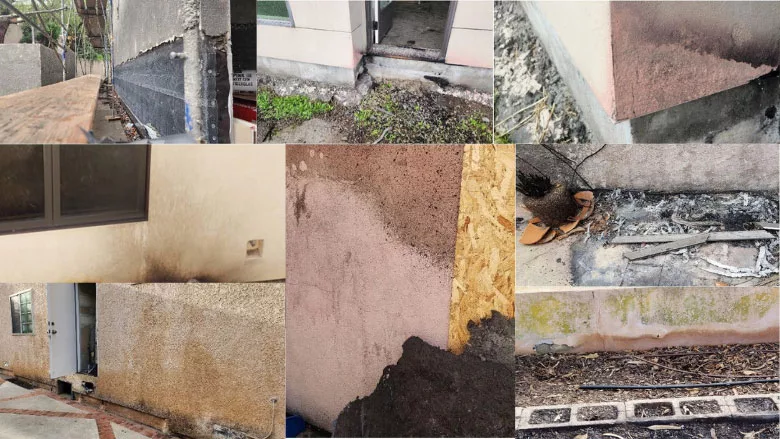
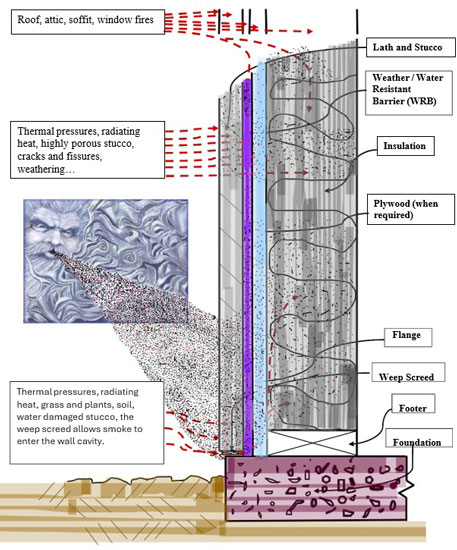
In a Wildland-Urban Interface (WUI) fire, it is entirely possible for the stucco’s weep screed to become a conduit for smoke, embers, and hot gases to penetrate and pressurize the interior of outside facing wall cavities by wind and thermal buoyancy at ventilation and drainage gaps that are at the base of stucco walls. Hot smoke can also be pressurized against the exterior of the building, where it is pulled into stucco and weep screed perforations through stack effect or it is brought indoors through negative pressure.
In other words, smoke and heated gases entered the weep screed vents by negative pressure indoors (e.g., from HVAC systems operating), flames, superheated air, or thermal pressures that are close to the base of stucco walls, filling wall cavities at the weather resistive barrier (WRB) that is behind the stucco lath.
- Thermal expansion occuring from extreme heat causes stucco to crack. Also, rapid temperature fluctuations (e.g., fire exposure followed by fire hose water putting out the fire or cool air) can result in thermal shock. (Thermal shock is an extreme change in heating and cooling.)
- In situations where heated air and thermal pressures are nearby, such as burning buildings, fences, and vegetation, stucco damage is seen in the form of blistering, yellowing, browning, cracking, or the separation of the lath and plaster from the metal weep screed. Spalling may also be seen as chipping or flaking of stucco at corners, edges, and areas of heat penetration.
- In situations where thermal pressures have contact with combustible materials (e.g., wood sheathing or framing), radiated heat can pass through the screed gap where it contributes to pyrolysis, or the ignition of interior wall cavity materials, leaving smoke in the form of char, soot, ash, and corrosive gases behind.
Construction:
- Stucco is made of cement, where it is inherently noncombustible (ASTM E136), durable, and ignition resistant to flame, radiant heat, and ember intrusion. It has a Class A fire rating.
- Exterior walls shall be constructed with approved noncombustible or ignition-resistant materials, or approved wall assemblies that provide a minimum 1-hour fire-resistance rating. (California Building Code (CBC) 2022, Section §707A.3) In designated wildfire areas building construction and stucco, they should be compliant with CBC Chapter 7A “Materials and Construction Methods for Exterior Wildfire Exposure;” ASTM E84, “Class A ignition-resistant materials having a flame-spread rating with 30-minute ignition resistance per SFM Standard 12-7A-1.”
- Depending on construction, stucco wall cavities either face towards insulation or sheathing. (Sheathing generally refers to oriented strandboard (OSB) or plywood.)
- A weep screed is a metal flashing installed at the base of an exterior stucco wall (typically at the bottom of the wall where stucco meets the foundation). The weep screed allows moisture drainage from behind the stucco and ventilate the drainage plane from the water-resistive barrier (WRB) / weather resistive barrier (WRB).
- The weep screed assembly must comply with California Building Code (CBC) §2512.1.2 and the California Residential Code (CRC) §R703.7.2.1.
Thermal Pressure and Smoke Dynamics:
- The weep screed is not sealed, meaning, its design allows vapor and liquid drainage to pass through. However, the weep screed can allow outdoor smoke-laden air to be pulled into the drainage cavity behind stucco.
- As the fire heats the exterior stucco, the air layer behind the stucco expands.
- Simultaneously, ambient air pressure drops due to wind-driven convection, especially in wind- influenced firestorms (common in WUI scenarios). This creates positive pressure outside and negative pressure inside, driving smoke into the building envelope.
- Heated smoke rises behind the stucco via convection, especially when there are air gaps between WRB and lath or improper flashing.
- When the wall cavity has penetrations (e.g., electrical boxes, missing fire blocks, plumbing, electrical, communication wiring holes) exist behind the WRB, smoke travels from the base into adjoining stud bays, upper wall cavities, and even attic spaces.
- Once heated smoke is inside the wall, thermal expansion and convection create positive pressure, forcing particulates deeper into stud bays, insulation, and sheathing layers. Heated air also expands air molecules resulting on stucco lath to expand that results in damage to lath.
| Fire Intensity | Approximate Air Temperature at 10 feet |
|---|---|
| Low, mild, to moderate-intensity fire | 800°F – 1,000°F (427°C – 536°C) |
| Active brush, crown fire, or high-intensity fire | 1,000°F – 1,400°F (538°C – 760°C) |
| Extreme fire behavior (wind-driven) | 1,400°F – 1,800°F (760°C – 982°C) |
| Fire Intensity | Approximate Air Temperature at 30 feet |
|---|---|
| Low, mild, to moderate-intensity fire | 400°F – 600°F (204°C – 316°C) |
| Active brush, crown fire, or high-intensity fire | 600°F – 1,000°F (316°C – 538°C) |
| Extreme fire behavior (wind-driven) | 1,000°F – 1,400°F (538°C – 760°C) |
| Fire Intensity | Approximate Air Temperature at 100 feet |
|---|---|
| Low, mild, to moderate-intensity fire | 120°F – 250°F (50°C – 120°C) |
| Active brush, crown fire, or high-intensity fire | 250°F – 500°F (316°C – 260°C) |
| Extreme fire behavior (wind-driven) | 500°F – 800°F (538°C – 425°C) or more |
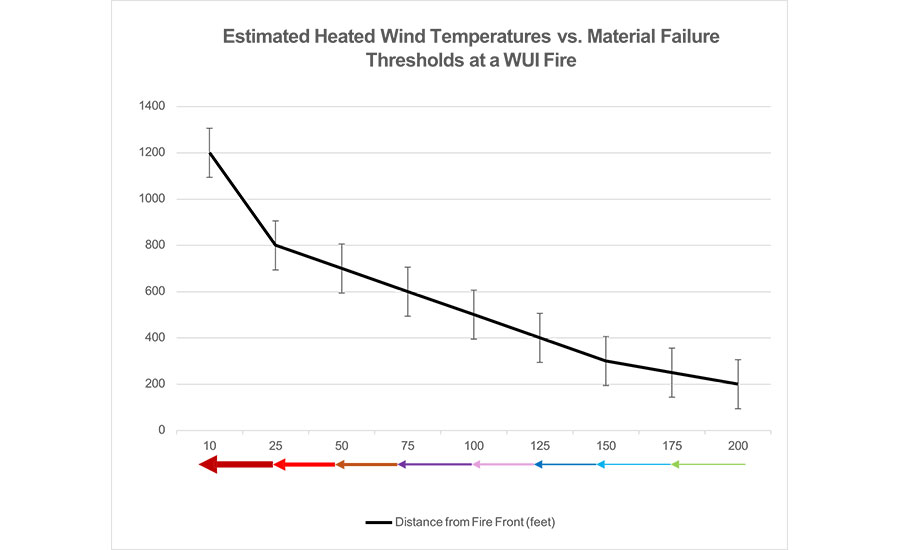
- USFS fire behavior models (BEHAVE, FARSITE) show convective heat transfer decreasing sharply with distance, but hot air can exceed 400°F (204°C) up to 100 ft away during large crown or wind-driven fires.
- NFPA 1144: At 100 feet, radiant heat exposure may drop below ignition thresholds, but convective heating and ember attack still pose serious risks.
- Note: The above values are from fire behavior models (e.g., BEHAVE, NIST, USFS fire plume studies) and live-fire experiments simulating building exposure during ember storms or flame contact.
- Note: Even without having flame contact at 100-feet, hot winds can ignite combustible siding, attic vents, or decks and carry flaming brands (embers), where at 200 feet or more with prolonged exposure, paint and vinyl, caulking, and windows can be damaged.
Credit: Pat Moffett
Risk Factors, Contributors That Increase Pressurization On and Behind Stucco:
- Wind-driven firestorms having high heat temperatures
- Direct flame impingement on siding or soffits
- Burnt foliage having contact with the side of the building
- Open or poorly installed or sealed weep screeds
- Unblocked wall cavities (e.g., balloon framing or missing fire blocking)
- Insulation gaps or deteriorated vapor barriers
- Highly porous stucco that do protect the WRB
- Older stucco systems lacking modern WRB and flashing integration
- Separations and cracks in stucco or at the weep screed
- Years of weathering resulting in swelling or decay of underlayment
- Sprinkler systems having direct contact with stucco resulting in water damage
- Ground level is close to the weep screed
- Rusted or missing weep screeds
| Stucco Exposure Type: | Typical Maximum Damage Distance: | Effects on Buildings: |
|---|---|---|
| Direct Flame Contact | 0 – 10 feet | Immediate ignition of combustible materials facing the exterior and interior stucco In addition, the recommended defensible PRV level for pre-1978 homes that were “completely remodeled down to the studs” may still be (5 µg/ft²), as the low as reasonably achievable (ALARA). Reason being, prior data is not available to document clearance. |
| Radiant Heat Exposure | Up to 30 – 100 feet | Warping, melting, spontaneous ignition of metal and vinyl materials, glass breakage removed. |
| Convective Heat (Hot Winds) | 30 – 300 +feet | Stucco and siding damage, ember carry into vents/soffitsThe value is not intended for indoor dust and is below natural background in many California soils, so it is not realistic as a dust clearance standard. Typical California indoor background (dust loading): ~1–7 mg/kg arsenic (often closer to 1–3 mg/kg). The recommended defensible PRV level is (1–3 mg/kg), as low as reasonably achievable (ALARA). In converting (mg/kg to surface µg/ft²), in “light dust loading,” the laboratory may report (1–3 µg/ft²). |
| Ember Attack | 100 – 1000 + feet | Spot fires on roofs, decks, vents, occur 100 feet, to a mile or more away(ALARA). |
NFPA & IBHS Fire Test Studies:
- Homes 30–60 feet from intense flame fronts can ignite from radiant heat if they have combustible siding, decks, or vegetation.
- Vinyl siding melts at ~165°F, which can occur as far as 40–50 feet from flames under moderate fire conditions.
- Wood can ignite with sustained exposure to radiant energy at 20–40 feet, depending on orientation and exposure time.
NIST WUI Fire Simulations:
- Convective air and embers driven by wind can carry firebrands hundreds of feet from the flame front.
- Soffits, vents, and wall gaps can admit embers and hot gases even if the flame is over 100 feet away.
| Fire Behavior and Wind Conditions: | Estimated Building Damage Radius: |
|---|---|
| Extreme wind-driven fire (>25 mph) | 1,000 feet – 1.5 miles (up to 5 miles were documented) |
| High-intensity crown fire | 30–100 feet or more |
| Moderate wind (~10–20 mph) | 300 – 1,000 feet (up to 1 mile was documented) |
| Wind-driven ember storm | 100–1,200 + feet |
| Firebrands lofted uphill | Up to 1 mile |
| Radiant heat enough to ignite wood framing | 20–40 feet (with 20–30 kW/m² exposure) |
Zone, Flame Front, Heat, and Thermal Pressure Modeling
Credit: Pat Moffett
Depending On The Study:
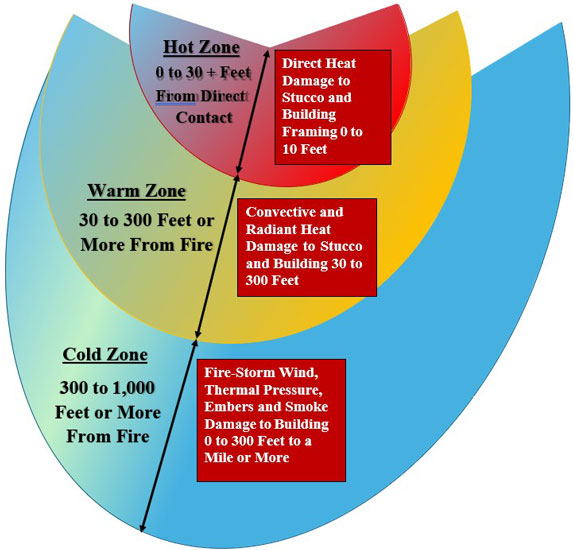
- Within 10, 30, or 60 feet, intense flame fronts can ignite building framing and heat damages stucco.
- Within 30 to 100 feet or more, radiant heat can damage building materials and stucco.
- Within 30 to 300 feet or more, convective heat can damage building materials and stucco.
- Outdoor and indoor air quality can affect communities hundreds of miles from the fire.
- Hazardous air pollutants in smoke can enter buildings miles away from a WUI fire.
Credit: Pat Moffett
Observations and Conclusions:
➢ Stucco:
- Stucco does not burn, melt, or contribute to fuels that burn. Stucco only degrades as heat has contact with painted and finished surfaces, or when heat penetrates the pores and cracks in stucco. When damage to stucco occurs it should be replaced, not repaired or painted, including replacing weather resistive barriers (WRB) that are behind stucco’s lath.
- At the front of the flame (e.g., 10 to 50-feet away from the building), WUI fires produce thermal and heat-induced stresses that can cause buildings to ignite from continuous exposure to radiant heat.
- In relation to the distance the flame front was to buildings having stucco, radiant heat damage does not generally go beyond 100 feet, unless other dynamics occurred, such as convection, fire storm wind, thermal pressure, and spot fires.
- In less severe conditions, such as 30 to 100 feet from the flame front, where signs of burning are not visible, heated stucco can mask internal wall cavity damage, where framing can have char and smoke, and where radiant or convective heat can damage insulation and the WRB.
- The most visible evidence of fire impacting stucco is discoloration, scorching, blistering, spalling, cracking, including damage to weep screeds, control joints, and other sources of penetrations, along with damage to roofing, soffits, windows, and doors.
➢ Weep Screeds:
- On the flame front side of a building, radiating heat, thermal pressures, and fire-storm winds can enter cracks in stucco, and weep screeds that are within 10, 30, to 100 feet of the fire.
- Stucco walls experiencing damage at the flame front side of the structure, damaged stucco or the weep screed should be investigated outside, and not from inside the building.
➢ Shrubbery and Plants:
- Many homes have vegetation within 5-feet of the building. Trees and vegetation near buildings are two contributors that cause buildings to burn. The burning of ground vegetation next to a building is the largest contributor to smoke entering weep screeds. To lessen heat damage to stucco and smoke entering weep screeds, a defensible space should be created.
➢ Article Limitations:
- The article does not address outdoor and indoor air quality or the health of individuals.
- Government recommends for certain populations of individuals that can have their health compromised when breathing smoke, they should not be in areas and buildings where smoke exists.
- The article does not address the cleaning of buildings and contents other than to say, homeowners should safely and methodically clean their homes and contents, replace attic insulation, and replace HVAC filters. These recommendations are in EPA and CDPH guidance articles. For homeowners that are not able to complete detailed cleaning, they should hire companies certified in fire damage restoration.
- The article does not address how to safely remove heavy metals that came into homes from burnt buildings. When lead, arsenic, cadmium, and other heavy metals enter attics and the interior living space, they tend to adhere and bind to surfaces, where specialized cleaning companies may be required to remove them. In this situation, porous contents may need to be replaced.
- The article does not address the cleaning of electrical and electronic components that can be damaged by soot, char, ash, and heavy metals. Specialized experts should be consulted. If you have a fire damage restoration cleaning company, it is expected, either they will clean them or know specialized experts that will complete cleaning.
- This article does not address industrial hygienists and environmental professional that are competent and qualified to collect samples, deliver samples to approved laboratories, interpret laboratory data, and then write a report on how to remove hazardous substances. Part of their responsibility is to bring buildings, contents, and the indoor environment back to an acceptable level of cleanliness or acceptance.
Research completed by Patrick Moffett
Approved Fire and Smoke Odor Restoration Instructor (IICRC)
California DTSC Registered Environmental Assessor (retired)
Certified Master Restorer in Fire Damage Restoration (IICRC)
Industrial and Occupational Hygienist (AIHA)
Licensed General Contractor (California) Fire Loss Specialist (RIA)
Contributor to the AIHA Technical Guide for Wildfire Impact Assessments (2018, 2025) Contributor to the S760 Standard involving Wildfire Restoration
Looking for quick answers on restoration, remediation and cleaning topics?
Try Ask R&R, our new smart AI search tool.
Ask R&R →
Looking for a reprint of this article?
From high-res PDFs to custom plaques, order your copy today!