How Drying in a Flood House Compares to Drying Structures in the Field
Pulling the Curtain Back on 3 Key Drying School Secrets
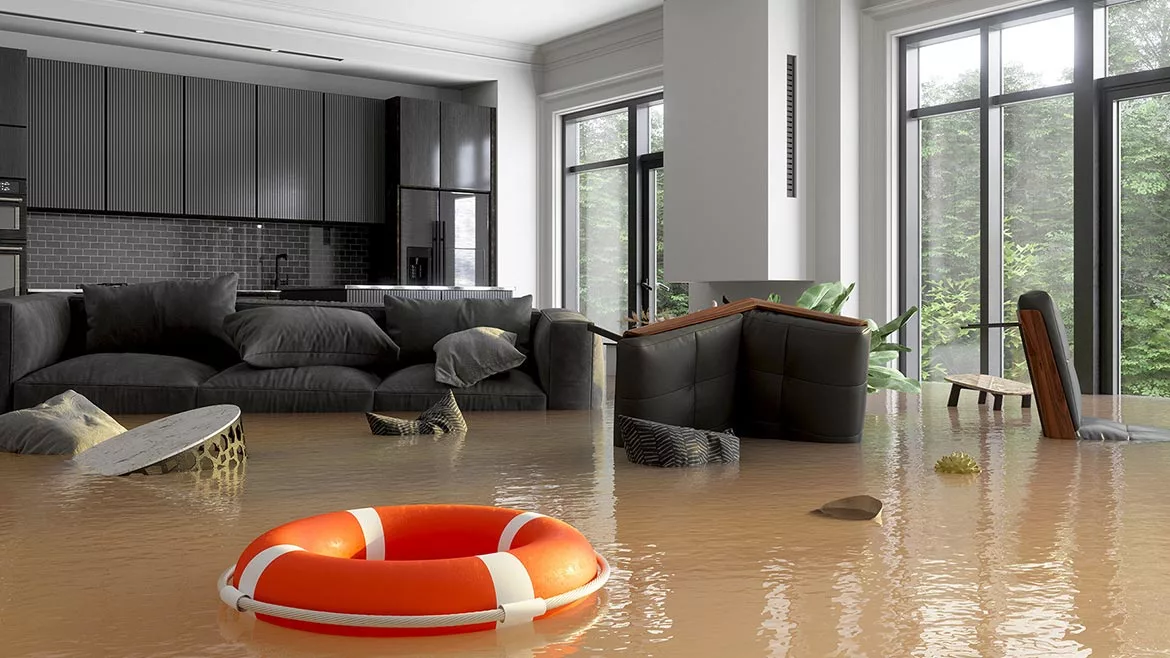
Photo credit: onurdongel iStock / Getty Images Plus via Getty Images
Not long ago, I was on a job site with an adjuster who was scoping the loss with me. I confidently informed the adjuster that we would be removing the non-restorable baseboard and underlayment from this Category 1 water loss. Immediately, I was hit with a question from the adjuster; well, it was a power statement followed by a question. “You know, you’re taking out those materials, but when I did my applied structural drying (ASD) course we dried everything in place. I think you should at least try drying those materials before determining to remove them.”
I should mention that I am friends with the adjuster, so I let both the statement and the question sink in.
If someone with his experience, who has seen a thing or two, can get this wrong, others can be making the wrong assumptions too. Over lunch, I learned a lot from my adjuster friend about his perception of drying a building.
The Flood School Experience
For three to four days, aspiring restorers put the formal education and field experience they have gained to that point in their careers to practical use. They get to dry a home that has had 1,000 gallons unleashed into the structure to saturate the materials. This house is left for 24 hours before they can start restoring it.
For first-time students, it is unnerving to see a completely flooded structure left wet and affected until the next day. All kinds of questions and uncertainties come up as they prepare themselves to get ready for the following days of instruction and hands-on tasks to dry the structure.
Students learn how the equipment and the tools work. They learn how they will affect the structure and the drying environment. A student walking in with limited knowledge will be exposed to psychrometry, vapor pressure differentials, moisture meters, equipment sizing and air changes — and how this can all change depending on the equipment you choose.
Today, there are 27 flood houses located around the world that teach the art of restoration: 24 in the U.S.; two in Canada; and one each in the U.K., Australia and Japan.
Looking for quick answers on restoration, remediation and cleaning topics?
Try Ask R&R, our new smart AI search tool.
Ask R&R →
The Secrets to Drying Schools
Drying schools hold secrets. I am going to pull the curtain back and explain the three main secrets that make the drying school experience what it is. And, dive into what you need to know before you take classroom training and unleash your knowledge to the world.
Secret 1
The first secret is that flood houses are rarely completely dried by the end of the training class. Depending on the structure, the conditions and the equipment being used, the flood house will typically require several more days past the three-to-four-day drying course to be entirely dried. The materials must be returned to their drying goal just like real-world jobs, and this takes time and energy.
You may have read articles by Ken Larsen, CR, and Kris Rzesnoski, CR, about the three-day drying myth and the death of three-day drying. The insurance and restoration industry have a false understanding of drying jobs, because of three-to-four-day classroom experiences.
However, you won’t find many people willing to attend a 10-to-14-day drying school for hardwood floors or a 3-to-6-week course for drying concrete. That leads us to the next secret.
Secret 2
Secret number two is that the building materials used in drying schools are selected for their durability — and their ability to be dried multiple times. It would not be economically viable if after every water class you had to replace paneling, MDF baseboard, laminate flooring, particle board cabinets and subfloors. The cost of each class would exceed the revenue from such events. The students’ learning experience would be more about controlled demolition and less about the science of drying.
Materials found in flood houses are solid wood floors, wood baseboard, carpet and pad, plywood cabinets, drywall, and other resilient materials that can be dried multiple times.
Secret 3
This leads to the third secret: Materials in the building dry at different rates. It might be hard to understand at first, but the degree to which a material will transmit water vapor is called moisture permeability or perm rating. Materials will transmit water vapor at varying rates. Depending on the construction and installation of the materials, it may hinder the vapor from leaving the material. The easy way to think of perm rating is thinking of it as a speed limit. For example ½ inch of gypsum board with two coats of latex paint has a perm rating of 19.54, while the perm rating of carpet is 125 or more. A restorer will expect the carpet to dry at a faster rate than the drywall. The international building code defines a vapor barrier of having a perm rating of less than 1.0. This means that with harder to dry materials we anticipate longer dry times.
Here is a simple analogy to explain this phenomenon. Place a bunch of big towels and t-shirts in a clothes dryer and dry them at the highest temperature. Which items will dry first? This is exactly what happens to building materials when they are wet.
Wrapping Up Lunch
After explaining this to my adjuster friend, he struggled to understand how anyone would be able to apply training in the real world. I explained the concept that he apparently missed while sitting in class.
Water damage is one of the restoration disciplines that you can base around science and drive consistency into your processes. We simplify restorative drying by planning to approach the job the same way. We survey the situation by understanding the environment’s air readings by taking psychrometric conditions. We survey the materials that are impacted by water and understand what it will take to reach our drying goals. This is the basis for building a drying plan that we will adjust and change as the building is drying.
Restorers take pride in arriving at a home at 2:00 a.m. to extract water and start the drying process. We pride ourselves on being able to do what many others can’t. But to learn our skills, we must practice on a structure that can test the theory and let us make mistakes without causing damage to a client’s home, while learning the principles of restorative drying.
I explained to him, “We don’t teach students how to dry a flood house, we teach students how to make drying decisions in the field.”
That conversation led to a phone call the next week for a $500,000 hotel water escape. The voice on the other end said, “I need you not because you know how to dry a hotel, but because I think you know how to make drying decisions in the field.”
Good luck on your journey of learning and I hope to see you in class in the near future.
Lorne
Looking for a reprint of this article?
From high-res PDFs to custom plaques, order your copy today!