Restoration logo
search
cart
facebook twitter linkedin youtube
  • Sign In
  • Create Account
  • Sign Out
  • My Account
Restoration logo
  • NEWS
  • PRODUCTS
    • New Products & Technologies
    • Submit Your Product
    • Interactive Product Spotlights
  • CATASTROPHE
    • Hurricane
  • TOPICS
    • Architecture
    • Cleaning & Sanitation
    • Contamination
    • Contractor Safety
    • Contents
    • Fire & Smoke
    • Mold
    • Odor
    • Recon & Reno
    • Water
  • EDUCATION
    • Training & Education
    • Business Management
    • Insurance/Legal Matters
    • KnowHow
    • Podcasts
    • Webinars
    • Whitepapers
    • Industry Events
    • Sponsor Insights
    • Ask R&R AI
  • VIDEOS
    • Ask the Expert
    • Ask Annissa
    • Marketing Monday
    • Tech Tip Tuesday
  • BUYER'S GUIDE
  • THE EXPERIENCE
    • Convention & Trade Show
    • TradeTalks
  • ABOUT
    • Contact
    • Advertise
  • SIGN UP
Water Damage RestorationFire and Smoke Damage RestorationOdor Removal

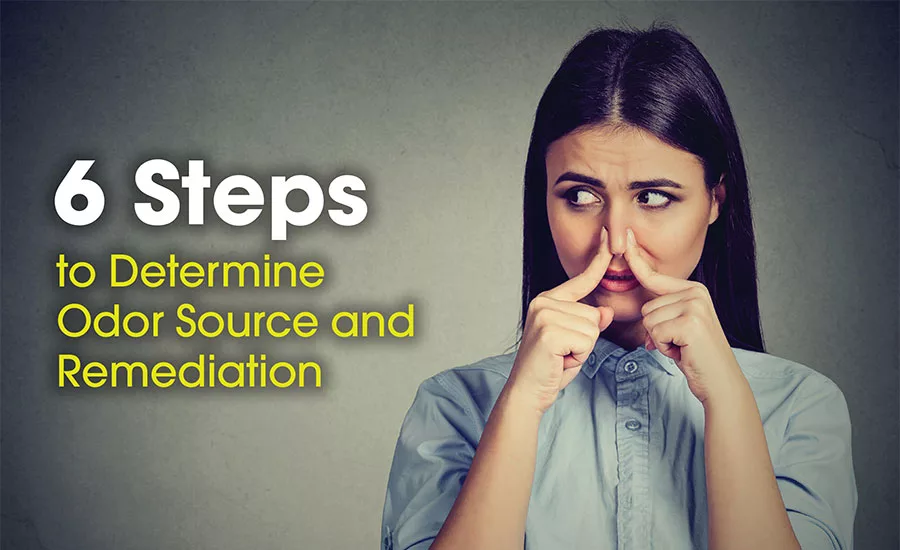
6 Steps to Determine Odor Source and Remediation

Handling real and psychological odors.
By Tony Macaluso
6 Steps to Determine Odor Source and Remediation
August 15, 2018

Odors emanate from a variety of sources: the off-gassing of incomplete combustion, decomposing organic matter, building materials, water intrusion, etc. There have been many articles written regarding various odors and the products or equipment to resolve these odors. However, an individual must understand how to perceive odors to rectify them as well as become a private investigator/detective.

The olfactory sensory system encompasses several parts in the sense of smell. First, odors enter the air in the form of volatile organic compounds (VOC’s or gases) or airborne particulates to which the gases are attached. The odors are then breathed into the nose where they contact the mucous membranes of the nose and mouth. Olfactory hairs and nerve endings that extend into the mucous membrane then interface with the odor, at which point the sensation of smell (odor detection) is achieved. The sensation (odor) is then transmitted to the brain by the olfactory nerve. There, the odor sensation terminates in the olfactory lobe, which then determines if it is a good or unpleasant odor based on past impressions, experiences, or suggestions. This interpretation of the odor will then fall into two distinct diverse types of odor: real or psychological odor.

Real odor is happening now. It is the pure sensation of smell. There must be three elements present to perceive a real odor. First, the source of the odor must be volatile, and increased temperatures enhance the volatility. For example, onion soup cooking on the stove is highly odorous because it continuously gives off vapor that reaches the nose. Second, the odor-bearing molecule must be soluble in water, even in the slightest degree. Moisture must be present either in the form of humidity within the air, or with a water intrusion. Third, the odor-bearing substance must be soluble in lipids or fatty substances. Odors are more evident especially in the spring and summer months when temperatures and moisture levels are higher.

Psychological odor is what people think they smell based on suggestions, past impressions, or experiences, but do not actually exist. However, while one person might not smell an odor, that doesn’t mean it does not exist. Women have more keen sense of smell than men and as we age, we lose our sense of smell. Real and psychological odors are equally important and must be attacked in satisfying the deodorizing job.

When deodorizing, a wise technician always considers the effect of both real and psychological odors and provides services to eliminate both. Today, we have an assortment of chemicals and equipment that makes our task in resolving these odors much easier; however, not all odors can be terminated if their source is not found.

A technician must ask the right questions, similar to a private investigator or detective, to identify the source of the odor. When doing so, the technician will need to clear their mind of any preconceived assumptions such as automatically assuming the source is urine if there are animals in the home.

Odor Source and Remediation

Here are some examples of questions a technician should answer before identifying the odor’s source:

  1. What is the pH of the urine deposit? Urine changes pH with the evaporation of moisture and time. It starts out as an acid and then transforms to an alkaline.
  2. Assuming an animal is the source, what type of animal is present and how many of them are on the premises? We always assume it is animal urine, but the deposits could be human.
  3. Were there other previous deodorization attempts – either do-it-yourself or by another company? Previous incorrect odor removal attempts can deter success.
  4. If there are animals present and the odor is from animal urine, is the animal prescribed medication? When medication is digested, the color of urine can be darker and the odor is usually stronger.
  5. Did the technician consider cleaning of the upholstery within the affected areas? Temperatures cause the volatility but also cause the odor molecules to attach to surfaces such as furniture fabrics.
  6. Does the HVAC system need consideration? Odor molecules are drawn into the system and it may require cleaning.

These are just a few of the questions a technician should consider when treating urine-specific problems. Even with the advent of today’s chemicals and equipment, without understanding  how odors are perceived and knowing the right questions to ask, success is difficult to achieve.

Finally, technicians must always remember that when unpleasant odors are present, so too could be other health-threatening pathogenic biological organisms that could pose a threat to themselves and homeowners. Technicians should always take the necessary and appropriate safety measures prior to proceeding with treatments.  

Looking for quick answers on restoration, remediation and cleaning topics?
Try Ask R&R, our new smart AI search tool.
Ask R&R →

KEYWORDS: deodorization disaster restoration hydroxyl generators mold remediation restoration business smoke cleanup

Share This Story

Looking for a reprint of this article?
From high-res PDFs to custom plaques, order your copy today!

Web macalusotony 200x200

Tony Macaluso is an accomplished professional in the restoration industry. He is the past president of the Professional Cleaning and Restoration Alliance (PCRA) and currently serves on the IICRC Board of Directors, where he also chairs the Odor Control Committee. Tony founded TM Restoration Schools, Inc., and has taught seminars globally. He holds a Bachelor of Science in Business from the University of Puget Sound and numerous industry credentials, including Certified Restorer and Certified Mold Remediation Specialist. Tony co-owns Sunshine Fabric Cleaning and Restoration in Austin, Texas, and is actively involved in several civic organizations.

Recommended Content

JOIN TODAY
To unlock your recommendations.

Already have an account? Sign In

  • Digital view of the United States with a Hurricane and coding

    Is Your Restoration Technology Ready for the Upcoming Hurricane Season?

    Here’s how restoration contractors can prepare their...
    Catastrophe Restoration
    By: Taylor Carmichael
  • Business team analyzing financial data on digital tablets during a meeting

    7 Trends Influencing the Restoration Industry in 2026

    With market uncertainty, workforce transitions, new...
    Guest Columns
    By: Oscar Collins
  • mold remediation

    Fighting Mold and Bacteria Damage

    Successful mold remediation can be multidisciplinary,...
    Cleaning and Sanitation
    By: Josh Woolen
You must login or register in order to post a comment.

Report Abusive Comment

Manage My Account
  • Newsletters
  • Online Registration
  • Subscription Customer Service
  • Manage My Preferences

More Videos

Sponsored Content

Sponsored Content is a special paid section where industry companies provide high quality, objective, non-commercial content around topics of interest to the Restoration & Remediation audience. All Sponsored Content is supplied by the advertising company and any opinions expressed in this article are those of the author and not necessarily reflect the views of Restoration & Remediation or its parent company, BNP Media. Interested in participating in our Sponsored Content section? Contact your local rep!

close
  • Violand business coaching
    Sponsored byVioland Management Associates

    The Conversation Most Owners Wait Too Long to Have

  • Water Damage Project with flooded home with stairs
    Sponsored byCotality

    Schedule smarter with DASH’s mobile restoration job management

Popular Stories

Workplace Safety Manual with Work Equipment

Why Fatigue May Be the Most Overlooked Safety Hazard in Restoration

red paper airplane on a growth trajectory

Growth vs. Grit: Why Scaling Smart Always Beats Scaling Fast in Restoration

Atmos Drying Services vehicles at commercial job

Your Contract Is More Valuable Than Your Restoration Equipment

Events

September 9, 2026

The Experience Convention and Trade Show

The Experience Convention & Trade Show logoThe Experience Convention and Trade Show unites the cleaning, restoration, inspection, indoor air quality, and HVAC industries through hands-on education, live demonstrations, and high-impact networking. Attendees gain practical skills, business insight, and connections that elevate industry standards and drive growth.

View All Submit An Event

Poll

New Business

Where does most of your new business come from?
View Results Poll Archive

Products

2026 National Renovation and Insurance Repair Estimator

2026 National Renovation and Insurance Repair Estimator

Current prices in dollars and cents and detailed descriptions for hard-to-find items needed on most insurance, repair, remodeling, and renovation jobs. All price items include labor, material, and equipment breakouts, plus special charts that tell you exactly how these costs are calculated. Includes many reinstall/salvage cost estimates, hundreds of sample product images and unique architectural items.ISBN 978-1-57218-405-3


See More Products

Submit Your New Product/Technology to R&R!

Would you like to promote a new restoration, remediation or cleaning product/technology with Restoration & Remediation? Fill out the question below to start your submission:

Related Articles

  • large loss fire

    Back to Basics: 6 Steps to Handle Large-Loss Fire Restoration

    See More
  • Contents-Corner-window-cleaning

    6 Steps to Get Fire-Damaged Windows Squeaky Clean

    See More
  • ID odor sources

    5 Tips to Find an Odor Source

    See More

Related Directories

  • LearnToRestore.com

    LearnToRestore.com is the leading IICRC-approved school with certification courses in water, fire, smoke, odor, contents processing, and more. Learn and earn your certification in person or online with our live-stream classes. Our expert-led training prepares you with essential skills to excel in the restoration industry!
×

Stay ahead of the curve with our newsletters.

Get the latest industry updates tailored your way.

JOIN TODAY!
  • RESOURCES
    • Advertise
    • Contact Us
    • Directories
    • Store
    • Want More
    • Submit a Press Release
  • SIGN UP TODAY
    • Create Account
    • Newsletters
    • Customer Service
    • Manage Preferences
  • SERVICES
    • Reprints
    • Marketing Services
    • Market Research
    • List Rental
    • Survey/Respondent Access
  • STAY CONNECTED
    • LinkedIn
    • Facebook
    • Instagram
    • YouTube
    • X (Twitter)
  • PRIVACY
    • PRIVACY POLICY
    • TERMS & CONDITIONS
    • DO NOT SELL MY PERSONAL INFORMATION
    • PRIVACY REQUEST
    • ACCESSIBILITY

Copyright ©2026. All Rights Reserved BNP Media, Inc. and BNP Media II, LLC.

Design, CMS, Hosting & Web Development :: ePublishing