Mold vs. Mildew - What Restorers Need to Know
Why fungal terminology matters and what restorers need should know about the difference between mold and mildew
Need to Know
- There is much confusion surrounding the difference between mold and mildew. Often, "mildew" is viewed as less hazardous, and this misconception can lead to safety problems.
- In the normal course of water-damage restoration, a technician will rarely, if ever, encounter what would properly be considered true biological mildews. Fungal growth resulting from elevated moisture conditions within buildings is far more likely to consist of molds or wood-decaying fungi.
- Breaking apart mold-contaminated drywall, opening contaminated wall cavities, removing carpet, scraping affected materials, or using fans around fungal growth can release spores, fungal fragments, and contaminated dust into the air, resulting in unnecessary exposure and cross-contamination of previously unaffected areas.
- What matters to restorers is recognizing the contamination, identifying and correcting the moisture condition that allowed it to develop, determining the extent of affected materials, and performing the work using appropriate controls.
It seems like a simple question. In fact, most people probably assume they already know the answer. Mold is the bad stuff. Mildew is the lighter, more superficial stuff that shows up in bathrooms, on windows, or anywhere else that stays damp for too long.
At least, that is how the terms are often understood.
The problem is that the distinction is not nearly as clear as it appears. The words mold and mildew have been used inconsistently for decades, and today their meanings vary depending on whether you are talking to a homeowner, a cleaner, a restoration contractor, a product manufacturer, or a plant pathologist.
For restorers, that confusion is more than academic. The terminology used to describe fungal growth can influence how seriously a condition is taken and, ultimately, how it is handled. Calling something “mildew” does not change the organism growing on a material, the conditions that allowed it to grow, or what may happen when that material is disturbed.
So before answering the question of mold versus mildew, it is worth looking at what people actually think those words mean.
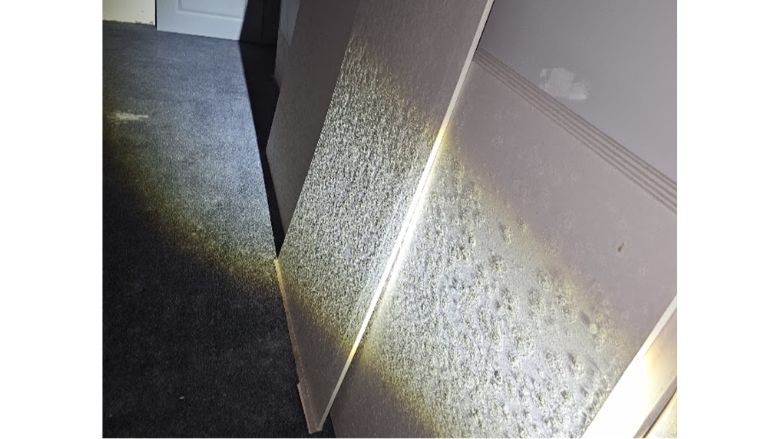
Credit: Branden Adams
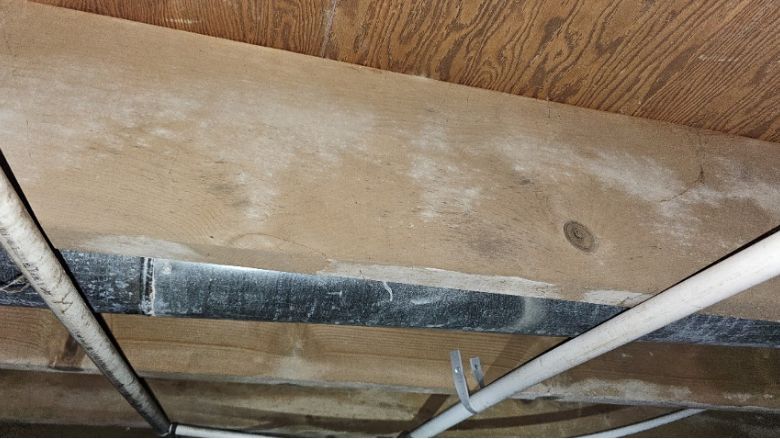
What People Think Mildew Means
Spend a few minutes searching social media and certain Facebook groups for the words mold and mildew and it quickly becomes apparent that there is very little agreement on what separates the two.
Screenshot taken by Branden Adams
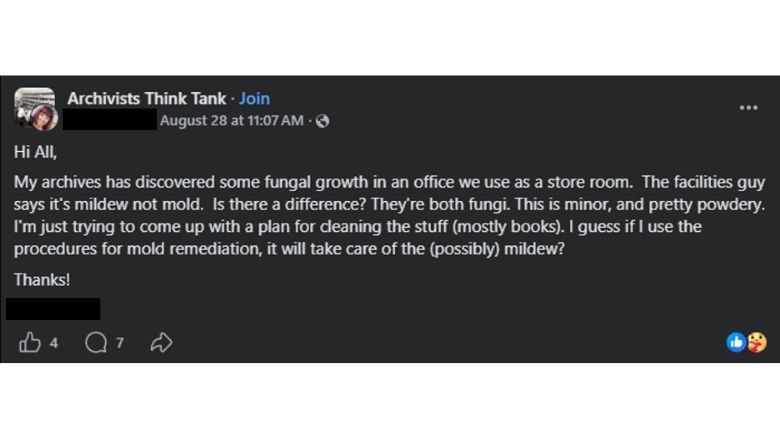
In some discussions, the words are essentially interchangeable. People refer to “mold/mildew” or use both terms for the same visible fungal growth. One archivist described fungal growth in a storage room that a facilities employee reportedly identified as “mildew not mold.” The poster then asked whether there was actually a difference and whether mold-remediation procedures would also address the supposed mildew.
Looking for quick answers on restoration, remediation and cleaning topics?
Try Ask R&R, our new smart AI search tool.
Ask R&R →
Screenshot taken by Branden Adams
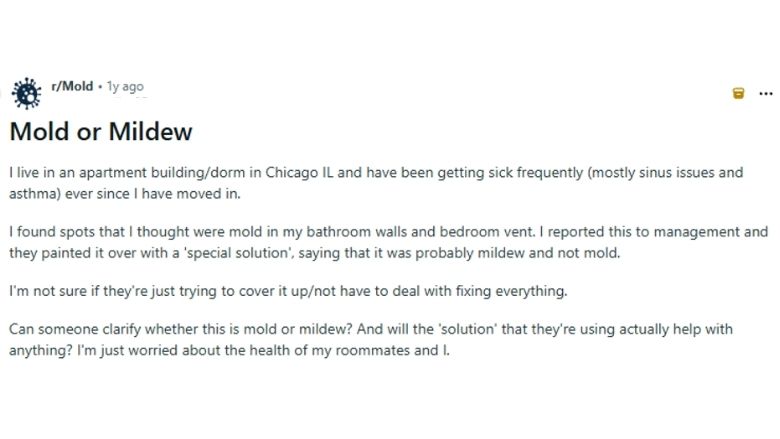
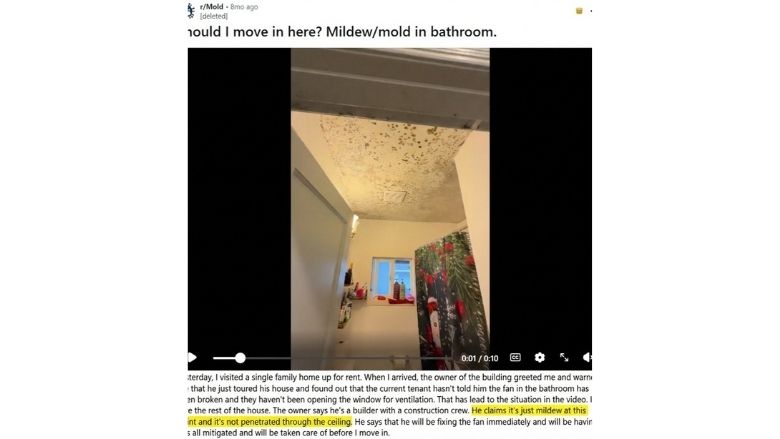
Other posts treat mold and mildew as distinctly different conditions. More importantly, mildew is frequently presented as the less serious of the two and, apparently, something that can be fixed with a fresh coat of paint. In one apartment-related post, management reportedly painted over visible growth while telling the resident it was “probably mildew and not mold.” In another, a prospective tenant photographed extensive fungal growth across a bathroom ceiling and said the property owner described it as “just mildew at this point” because it supposedly had not penetrated through the ceiling.
Screenshot taken by Branden Adams
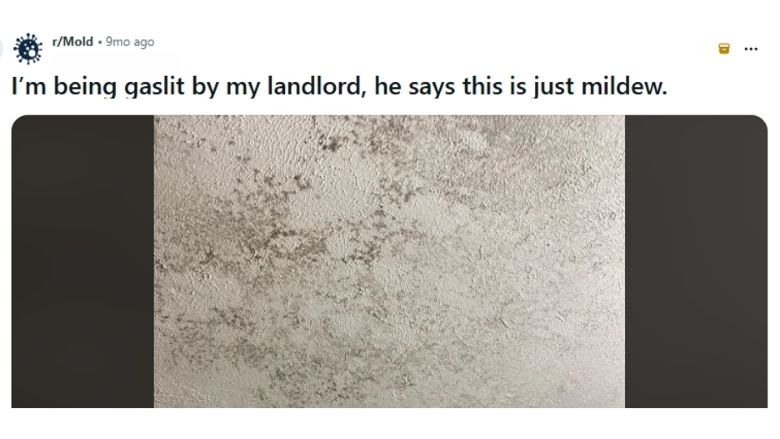
Another post summed up the frustration more bluntly: “I’m being gaslit by my landlord, he says this is just mildew.”
Screenshot taken by Branden Adams
These examples are anecdotal, but the language is revealing. Mildew often functions as an informal severity classification. Mold is perceived as the condition that may require professional remediation, while mildew is something superficial, less hazardous, and more easily cleaned.
That perceived distinction appears in countless variations. Mildew is described as early-stage mold, surface mold, white or gray mold, powdery mold, or the type of growth found in bathrooms. Mold, by comparison, is portrayed as darker, fuzzier, more invasive, and more hazardous. The word mildew is even routinely applied to odor. Musty-smelling basements, crawlspaces, and water-damaged rooms are often said to have a “mildewy smell,” even though that odor may be associated with microbial volatile organic compounds (MVOCs), VOCs released from wet or degrading materials, or other environmental conditions. The odor itself does not identify mildew or mold.
Other people take the opposite position and simply describe mildew as a type of mold.
Those descriptions are not equivalent, yet they are routinely used as though they are.
More importantly for restoration professionals, these are not always harmless differences in vocabulary. Once the label mildew is interpreted to mean “less serious,” it can begin influencing decisions about whether materials need to be removed, whether professional remediation is necessary, and what precautions are appropriate when fungal growth is disturbed.
So how did one word end up carrying so many different meanings?
Credit: Branden Adams
Where Did The Confusion Come From?
The confusion surrounding mold and mildew did not begin with social media. The two words have been paired together in household language and advertising for decades, often in ways that make them sound like two separate but closely related problems.
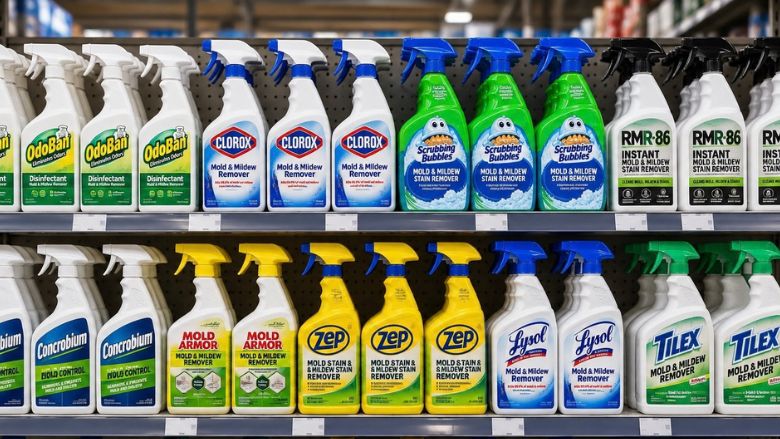
As far back as the 1970s, Lysol advertising and product labeling promoted the ability to prevent “mold and mildew.” In 1981, Clorox developed Tilex Instant Mildew Remover, a product marketed specifically around the word mildew. Early trademark filings described Tilex simply as a “mildew stain remover.” Over time, however, the familiar wording shifted toward what consumers see today: “Mold & Mildew Remover.”
That pairing is now everywhere. Walk down the cleaning aisle of almost any major retailer and it is easy to find products advertised for “mold & mildew” or similar combinations. The wording seems harmless, but putting mold and mildew side by side naturally suggests that they are two parallel categories, much like a cleaner marketed for soap scum and hard-water deposits.
Credit: AI-generated image created with DALL-E by OpenAI
That does not mean cleaning-product manufacturers created the misconception. More likely, marketing and common usage have reinforced one another for generations. Consumers recognize both terms, so manufacturers use both terms. Consumers then repeatedly see mold and mildew presented as separate things on product labels, reinforcing the perception that a meaningful distinction must exist.
Public guidance has not always made the issue much clearer. A FEMA mold brochure has described mildew as “mold in early stage” and states that mildew and molds can grow on materials including drywall, carpet, wood products, insulation, fabric, and plants. The EPA takes a somewhat different approach, explaining that mildew refers to certain kinds of mold or fungus and that the word is often used generically for mold growth, usually with a flat growth habit.
It is easy to see how a homeowner searching for an answer could come away more confused than when they started. One source says mildew is early-stage mold. Another says it is a certain kind of mold or fungus. Product labels present mold and mildew as separate targets, while everyday conversation often treats the words as interchangeable.
By the time those definitions reach social media, the confusion is already built in.
To understand whether any of these distinctions are useful, we have to step away from the cleaning aisle and look at what mold and mildew actually are.
What Mold and Mildew Actually Are
Part of the difficulty is that neither mold nor mildew is a formal taxonomic group. There is no single branch of the fungal family tree labeled “molds,” nor is there a corresponding group containing everything properly called “mildew.” The terms describe organisms and growth habits rather than formal biological classifications.
In restoration practice, mold is the broader and more useful term. Molds are microscopic fungi that grow in multicellular filaments called hyphae. As those hyphae branch, they form networks called mycelia and, under appropriate conditions, produce reproductive structures and spores. Outdoors, molds play an important role in decomposing organic matter. Indoors, available moisture and suitable nutrients can allow them to colonize building materials.
That includes familiar genera such as Aspergillus, Penicillium, Cladosporium, Chaetomium, and Stachybotrys. They can colonize gypsum wallboard, wood, paper products, carpet, accumulated dust, and other materials containing usable nutrients. Their appearance can vary considerably with the organism, substrate, environmental conditions, and stage of development.
Mildew has a much narrower historical and biological association, particularly in plant pathology.
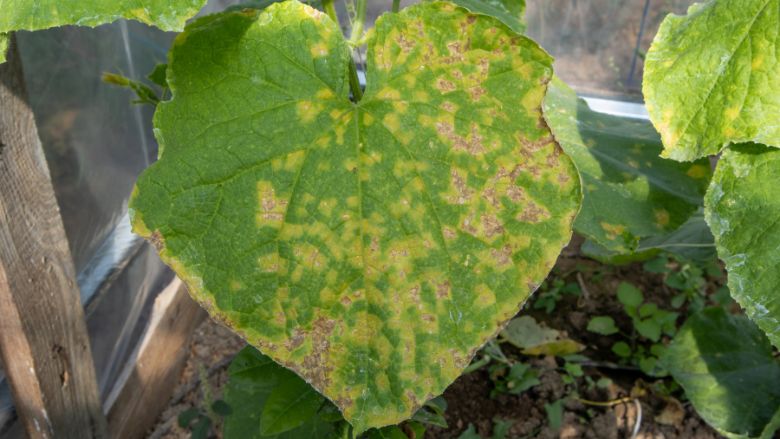
Powdery mildew is one of the best-known examples. Powdery mildews are plant diseases caused by several groups of fungi that commonly produce white or gray powder-like growth on leaves, stems, flowers, and other plant surfaces. The fungi responsible are obligate parasites, meaning they require living host tissue to grow and reproduce.
Downy mildew complicates the terminology further. Despite the name, the organisms responsible for downy mildew are not true fungi. They are oomycetes, or fungus-like organisms, related to pathogens such as Phytophthora and Pythium. Like powdery mildews, they are specialized plant pathogens that depend on living plant hosts.
Credit: Nikolay Malshakov / iStock / Getty Images Plus
So even mildew does not describe one neat biological group. Powdery mildew is caused by true fungi; downy mildew is not. What they share is a long-standing association with particular diseases and growth patterns on plants, not a status as some lesser form of indoor mold.
The EPA acknowledges the broader everyday usage of the term, noting that mildew may refer to certain kinds of mold or fungus and is often used generically for flat mold growth. That helps explain why the word appears so frequently in discussions about bathrooms, windowsills, and damp buildings. But that common usage is not the same thing as a precise biological classification.
Describing mildew simply as “a type of mold” may therefore be convenient in casual conversation, but it is an oversimplification. More importantly for restorers, the fungi colonizing water-damaged building materials are generally not the plant pathogens traditionally associated with mildew.
So, Can You Actually Tell Mold from Mildew?
Once the terms are put back into their proper context, the question becomes much easier to answer.
In many cases, yes.
The key is not simply what the growth looks like, but what it is growing on.
Credit: SBSArtDept / iStock / Getty Images Plus
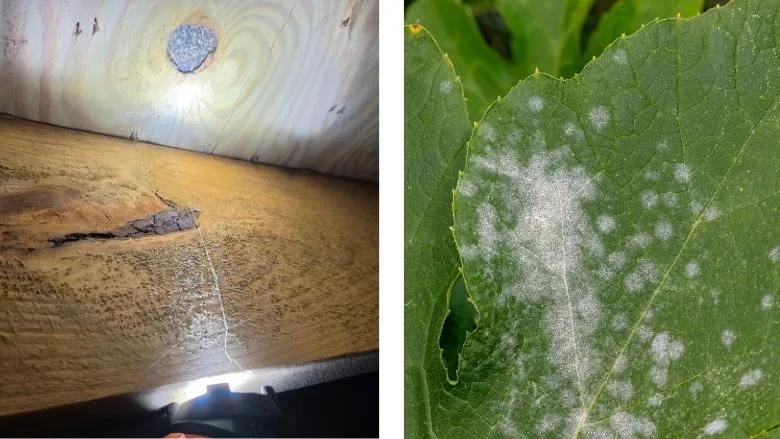
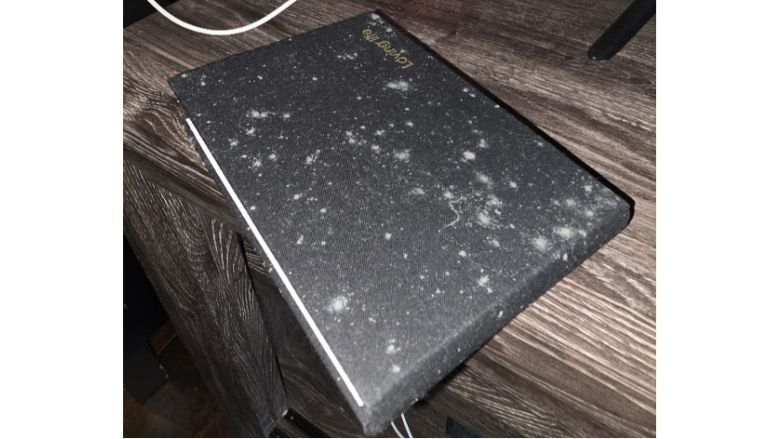
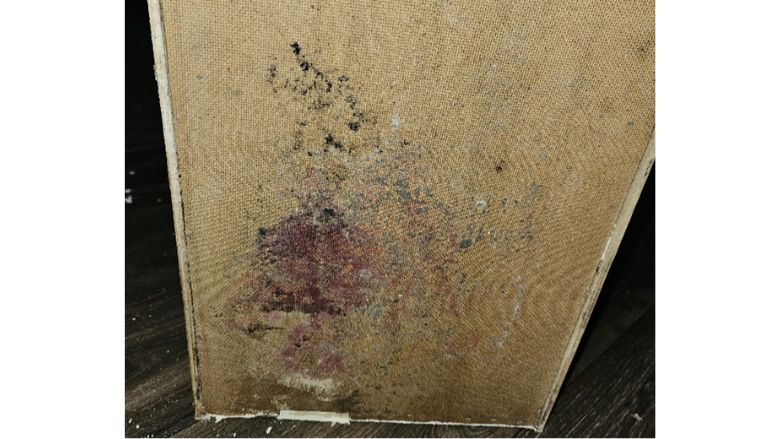
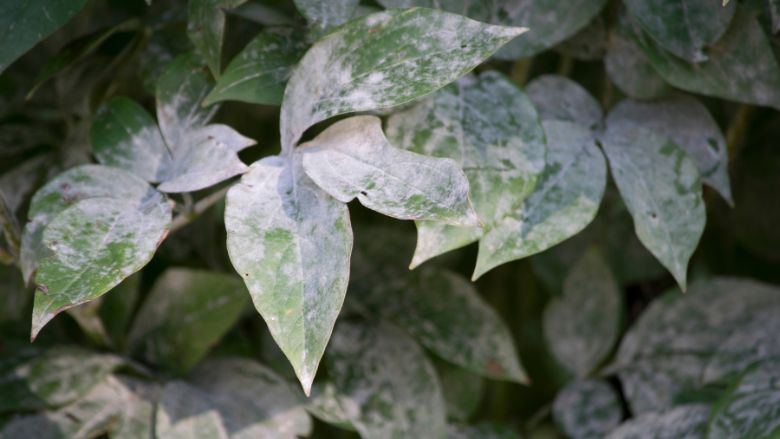
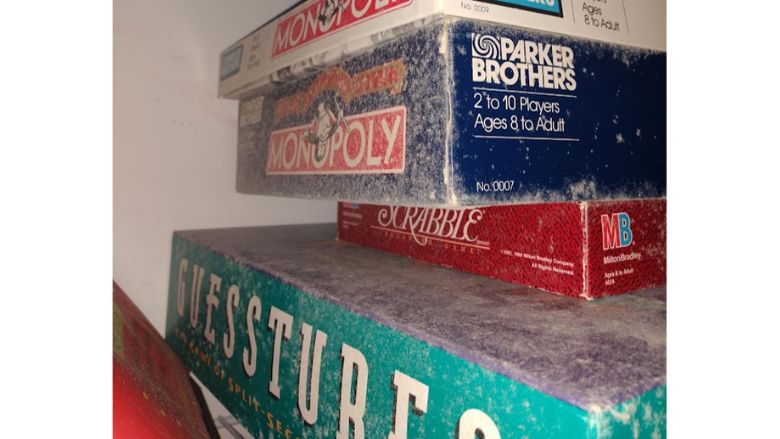
The white, powdery growth shown on the plant above is a good example of what a plant pathologist would recognize as powdery mildew. It is occurring on living plant tissue, where true mildews in the plant-pathology sense are normally found. Compare that with the fungal growth covering the cardboard game boxes in the second image. A surface sample from the boxes contained Aspergillus/Penicillium-like spores, and the visible growth is occurring on cellulose-based contents in a damp indoor environment. In restoration practice, mold is the more useful description.
Credit: Branden Adams
This is where many popular “mold versus mildew” comparisons become misleading. They often tell consumers that mildew is white or gray while mold is black, green, or blue; that mildew grows flat while mold grows fuzzy; or that mildew remains on the surface while mold penetrates materials. Those characteristics may describe some individual colonies, but they are not reliable rules for separating mold from mildew.
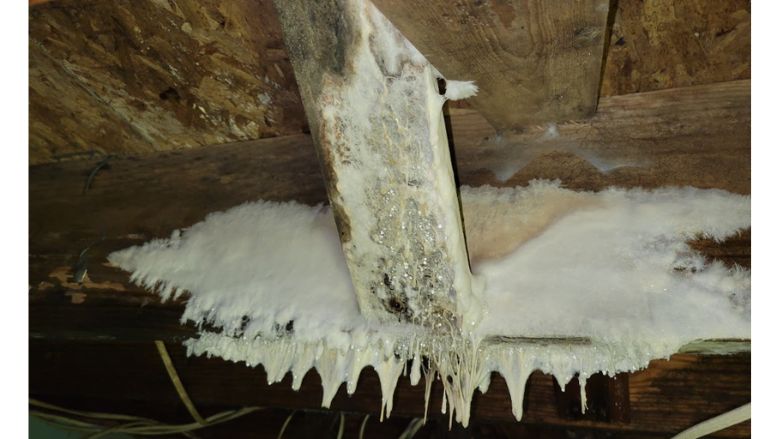
Molds can be white, gray, green, brown, black, orange, or numerous other colors. They can appear powdery, fuzzy, velvety, granular, slimy, or relatively flat. Their appearance can change depending on the organism, substrate, moisture conditions, maturity of the colony, and whether reproductive structures are present. A white powdery colony on drywall does not become mildew simply because it resembles the growth found on a plant.
Credit: Branden Adams
The same caution applies in the opposite direction. Dark fungal growth cannot be visually identified as Stachybotrys, green growth cannot automatically be called Penicillium, and a powdery colony cannot be assigned to a particular fungal genus based on appearance alone. Laboratory analysis is required when identification of genus or species is actually necessary.
Visual observation and context can therefore often provide enough information to distinguish true mildew from the mold growth commonly encountered in buildings. What they cannot reliably do is identify exactly which mold is present.
“It’s Just Mildew” – When Terminology Becomes a Safety Problem
The phrase “it’s just mildew” becomes more than a terminology problem when it changes how fungal growth is handled.
If a worker believes mildew is fundamentally different from mold, and especially if they believe it is a minor or harmless version of mold, they may be less likely to use the precautions they would normally associate with mold remediation. That can affect decisions about respiratory protection, containment, negative pressure, HVAC isolation, demolition methods, debris handling, and cleaning.
The problem is that the label does not change what happens when fungal growth is disturbed.
Breaking apart mold-contaminated drywall, opening contaminated wall cavities, removing carpet, scraping affected materials, or using fans around fungal growth can release spores, fungal fragments, and contaminated dust into the air. That creates two primary concerns: unnecessary exposure and cross-contamination of previously unaffected areas.
The misconception becomes even more problematic when appearance is used to assign health significance. White or gray growth may be dismissed as harmless mildew, while dark growth may immediately be labeled “toxic black mold.” Neither conclusion is justified by appearance alone.
Some species within genera commonly encountered in water-damaged buildings, including Stachybotrys, Aspergillus, and Penicillium, are capable of producing mycotoxins under appropriate environmental conditions. However, finding a potentially toxigenic mold does not establish that mycotoxins are actually being produced, nor does the color or appearance of a colony establish which organism is present. The CDC specifically cautions against treating so-called “toxic mold” as a unique category and recommends addressing molds capable of producing mycotoxins in the same manner as other indoor mold growth.
The concern, then, is not that every mold produces mycotoxins or that every fungal condition presents the same level of exposure risk. The concern is that dismissing fungal growth as “just mildew” can encourage workers or occupants to disturb contaminated materials without appropriate precautions.
Calling it mildew does not make it safer to disturb.
What This Means for Restorers
For restoration professionals, the distinction between mold and mildew is ultimately much simpler than decades of consumer terminology have made it seem.
In the normal course of water-damage restoration, a technician will rarely, if ever, encounter what would properly be considered true biological mildews. Restorers are not generally treating diseases of living plants. They are opening wet wall assemblies, removing water-damaged gypsum board, inspecting framing, cleaning contents, and addressing fungal growth resulting from elevated moisture conditions within buildings.
In those environments, the fungal growth encountered is far more likely to consist of molds or, particularly where wood deterioration is involved, wood-decaying fungi.
That makes mildew a relatively unhelpful term for describing fungal growth on water-damaged building materials.
The ANSI/IICRC S520:2024 Standard for Professional Mold Remediation provides a much more useful framework. The standard addresses the procedures and precautions involved in remediating mold-damaged structures and contents, including worker safety and health, structural remediation, HVAC systems, contents, and post-remediation verification. Rather than relying on informal labels such as mildew or trying to assign remediation procedures according to color or fungal genus, professional remediation focuses on the actual conditions present and the work necessary to address them.
That does not mean every mold remediation project requires identical controls. The extent of contamination, materials involved, occupancy, work methods, anticipated disturbance, and other project-specific conditions should determine the appropriate level of containment, PPE, engineering controls, and remediation procedures. What should remain consistent is the objective: prevent unnecessary exposure and prevent fungal contamination from spreading into unaffected areas.
For restorers, then, the mold-versus-mildew debate has limited practical value. On water-damaged building materials, mold or fungal growth is generally the more useful description. What matters is recognizing the contamination, identifying and correcting the moisture condition that allowed it to develop, determining the extent of affected materials, and performing the work using appropriate controls.
Homeowners may continue asking whether something is mold or mildew. Product manufacturers will probably continue printing both words on the same bottle. Restoration professionals should know the distinction and, more importantly, know when that distinction no longer matters.
Softly correcting those who confuse the two doesn’t hurt either.
Looking for a reprint of this article?
From high-res PDFs to custom plaques, order your copy today!