Restoration logo
search
cart
facebook twitter linkedin youtube
  • Sign In
  • Create Account
  • Sign Out
  • My Account
Restoration logo
  • NEWS
  • PRODUCTS
    • New Products & Technologies
    • Submit Your Product
    • Interactive Product Spotlights
  • CATASTROPHE
    • Hurricane
  • TOPICS
    • Architecture
    • Cleaning & Sanitation
    • Contamination
    • Contractor Safety
    • Contents
    • Fire & Smoke
    • Mold
    • Odor
    • Recon & Reno
    • Water
  • EDUCATION
    • Training & Education
    • Business Management
    • Insurance/Legal Matters
    • KnowHow
    • Podcasts
    • Webinars
    • Whitepapers
    • Industry Events
    • Sponsor Insights
    • Ask R&R AI
  • VIDEOS
    • Ask the Expert
    • Ask Annissa
    • Marketing Monday
    • Tech Tip Tuesday
  • BUYER'S GUIDE
  • THE EXPERIENCE
    • Convention & Trade Show
    • TradeTalks
  • ABOUT
    • Contact
    • Advertise
  • SIGN UP
Managing Your Restoration Business

Documentation That Survives an Insurance Audit: Moisture Mapping, Drying Logs & Photo Discipline

Thorough documentation helps restorers defend their estimates, reduce payment disputes, and support their claims
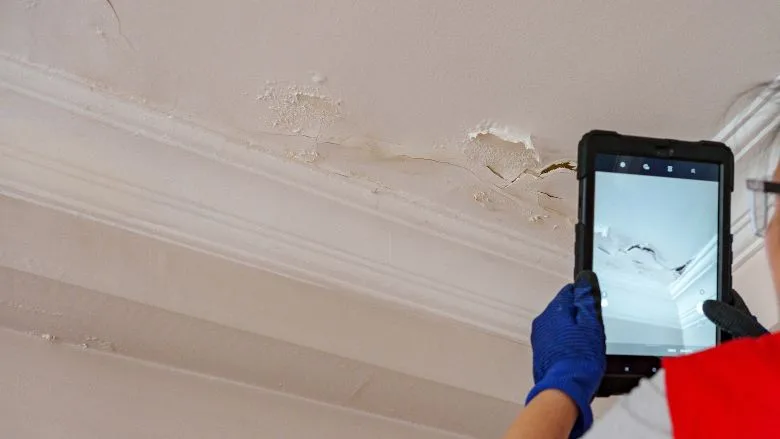
bubbling, peeling, and water-damaged plaster on a ceiling
Image Credit: Phynart Studio / iStock / Getty Images Plus
July 23, 2026

A water loss is won or lost twice. Once in the field, where your crew does the work, and again at a desk you will never see, where a reviewer who was never on site decides what to pay. The second one runs almost entirely on your file. You can dry a structure perfectly and still get short-paid if your moisture mapping, daily drying logs, and photos do not prove what you did, why you did it, and when the building was actually dry.

Carriers reinspect, desk-review, and audit, and months can pass between the loss and the review. By then nobody remembers the job, so the file has to remember it for you. Those three records carry the most weight under that kind of scrutiny, and most files are thin in exactly those places.

Moisture Mapping Starts with a Dry Standard

You cannot prove a structure is dry if you never wrote down what dry meant. Before anything else, take a reference reading, the moisture content of the same material in an unaffected part of the building, and record it as your dry standard. That is the term the ANSI/S500 uses for it, and it is the single most skipped reading in the field. Oak flooring might read 8 percent in a hallway that never got wet. That number is the finish line, and it belongs in the file on day one.

From there, the moisture mapping itself. Take moisture content readings on the wet materials at consistent points and tie each one to a sketch or floor plan so the reading has a location. Note the material and the meter mode, because a pin reading and a non-invasive scan are not the same measurement, and a reviewer who knows the difference will catch it. A map that shows where the water went, how wet it was, and what dry should look like is the backbone of the whole file. Without the dry standard, a reviewer can argue two ways at once: that you never proved the materials needed drying, and that you over-dried and billed equipment you did not need.

Daily Logs Prove the Equipment Earned its Days

Equipment line items are the first thing a desk review cuts, because they are the easiest to question and the most expensive to carry. Your defense is a daily psychrometric log. Every day on site, record temperature, relative humidity, and grains per pound at the affected area, at the dehumidifier (dehu) outlet, in an unaffected area, and outside. Log the moisture content of the wet materials the same day.

Read it together, those numbers follow a line a reviewer can trace without ever being there. The grains per pound at the dehu outlet sits below the affected area, so the equipment is pulling water. The affected reading drops day over day, so the structure is drying. The material moisture content trends toward the dry standard you set on day one, and when it gets there, you are done and you can prove it.

A flat log, or no log, reads the other way. If the numbers do not move, a reviewer assumes the equipment was not doing anything and cuts the days. If the log stops three days before the equipment came out, you billed three days you cannot defend. A crew that fills the log in the truck on Friday from memory is writing fiction, and reviewers can smell it.

Looking for quick answers on restoration, remediation and cleaning topics?
Try Ask R&R, our new smart AI search tool.
Ask R&R →

Photos that Prove Something

Most water-loss photo sets prove nothing. A folder full of wet carpet is not evidence, it is wallpaper. The photos that survive a review pair a condition with a measurement and a place.

For each affected area, the file should show the source of the loss, a wide shot that establishes the room, and the moisture meter held against the material with the reading legible in the frame. That last one is the photo every adjuster wants and almost nobody takes. A meter on a wall showing 38 percent, next to a shot wide enough to tell which wall, is worth more than fifty blurry close-ups. Photograph the equipment in place so the count matches the bill. At the end, photograph the verification reading on the same materials, at or below the dry standard, so the file closes the loop it opened. Keep everything time-stamped and in order, so a reviewer can walk the loss from start to finish in the photos alone.

The File has to Agree with Itself

The fastest way to a denial or a short-pay is a file that contradicts itself. The estimate bills five air movers and the placement photo show three. The log says the material reached the dry standard on day three and the equipment was billed through day five. The sketch stops the affected area at the hallway, and a photo shows a meter reading in the next room.

Every one of those gaps is a reason to cut, and a reviewer only needs one. Before the file leaves your office, read it the way the carrier will, as a stranger looking for the seam. The moisture map, the daily logs, the photos, and the estimate all have to describe the same job. When they do, there is very little left to argue about. When they do not, you are negotiating from behind.

Build the File in Real Time

None of this is extra work so much as a different habit. The file built as the job runs, reading by reading and photo by photo, is the one that holds up. The file reconstructed from memory at billing is the one that gets cut, because the gaps are not lies, they are just the things nobody wrote down. On a job that goes to audit, those come to the same thing.

Document the loss as if the person paying for it will never take your word, because the person paying for it was never there. Do that, and the audit stops being a threat and turns into a formality.


Author Bio: Apex Restoration, an IICRC-certified water damage restoration company serving Idaho and Eastern Washington.

KEYWORDS: drying equipment drying techniques moisture mapping restoration business restoration documentation

Share This Story

Looking for a reprint of this article?
From high-res PDFs to custom plaques, order your copy today!


Recommended Content

JOIN TODAY
To unlock your recommendations.

Already have an account? Sign In

  • Digital view of the United States with a Hurricane and coding

    Is Your Restoration Technology Ready for the Upcoming Hurricane Season?

    Here’s how restoration contractors can prepare their...
    Preparing to Respond: Hurricanes
    By: Taylor Carmichael
  • Business team analyzing financial data on digital tablets during a meeting

    7 Trends Influencing the Restoration Industry in 2026

    With market uncertainty, workforce transitions, new...
    Guest Columns
    By: Oscar Collins
  • mold remediation

    Fighting Mold and Bacteria Damage

    Successful mold remediation can be multidisciplinary,...
    Contamination Restoration & Remediation​
    By: Josh Woolen
You must login or register in order to post a comment.

Report Abusive Comment

Manage My Account
  • Newsletters
  • Online Registration
  • Subscription Customer Service
  • Manage My Preferences

More Videos

Sponsored Content

Sponsored Content is a special paid section where industry companies provide high quality, objective, non-commercial content around topics of interest to the Restoration & Remediation audience. All Sponsored Content is supplied by the advertising company and any opinions expressed in this article are those of the author and not necessarily reflect the views of Restoration & Remediation or its parent company, BNP Media. Interested in participating in our Sponsored Content section? Contact your local rep!

close
  • Violand business coaching
    Sponsored byVioland Management Associates

    The Conversation Most Owners Wait Too Long to Have

  • Water Damage Project with flooded home with stairs
    Sponsored byCotality

    Schedule smarter with DASH’s mobile restoration job management

Popular Stories

Ebola Outbreak Warning News Alert sign with close up of Ebola microbe and blood stream

Ebola Is Back: Why Restoration Professionals Must Prepare for the Biological Emergencies

Diagram illustrating Porter's Five Forces model for competitive analysis.

A Maturing Industry Under Pressure: Applying Porter's Five Forces to Analyze Disaster Restoration, Part 1

Rescue teams evacuating neighborhood from wildfire

After the Eaton Fire: Evidence-Based Priorities for Post-Wildfire Assessment and Restoration

Events

September 9, 2026

The Experience Convention and Trade Show

The Experience Convention & Trade Show logoThe Experience Convention and Trade Show unites the cleaning, restoration, inspection, indoor air quality, and HVAC industries through hands-on education, live demonstrations, and high-impact networking. Attendees gain practical skills, business insight, and connections that elevate industry standards and drive growth.

View All Submit An Event

Poll

Business Growth for the Remainder of 2026

How confident are you in your business's growth for the remainder of the year?
View Results Poll Archive

Products

The Cleaning, Restoration, Inspection, and Safety Glossary

The Cleaning, Restoration, Inspection, and Safety Glossary

The Cleaning, Restoration, Inspection, and Safety Glossary.

See More Products

Submit Your New Product/Technology to R&R!

Would you like to promote a new restoration, remediation or cleaning product/technology with Restoration & Remediation? Fill out the question below to start your submission:

Related Articles

  • Moisture Mapping Large Commercial Buildings

    See More
  • Roof Repair Leads to $1 Million Mold Claim: An Insurance Claim Case Study

    See More
  • Ask Annissa: What is a “Rider” on an Insurance Policy and What Impact does it have?

    See More

Related Products

See More Products
  • Water in Buildings: An Architect's Guide to Moisture and Mold

  • cover

    2026 National Renovation and Insurance Repair Estimator

  • secrets-of-insurance-game.jpg

    Secrets of the Insurance Game

See More Products
×

Stay ahead of the curve with our newsletters.

Get the latest industry updates tailored your way.

JOIN TODAY!
  • RESOURCES
    • Advertise
    • Contact Us
    • Directories
    • Store
    • Want More
    • Submit a Press Release
  • SIGN UP TODAY
    • Create Account
    • Newsletters
    • Customer Service
    • Manage Preferences
  • SERVICES
    • Reprints
    • Marketing Services
    • Market Research
    • List Rental
    • Survey/Respondent Access
  • STAY CONNECTED
    • LinkedIn
    • Facebook
    • Instagram
    • YouTube
    • X (Twitter)
  • PRIVACY
    • PRIVACY POLICY
    • TERMS & CONDITIONS
    • DO NOT SELL MY PERSONAL INFORMATION
    • PRIVACY REQUEST
    • ACCESSIBILITY

Copyright ©2026. All Rights Reserved BNP Media, Inc. and BNP Media II, LLC.

Design, CMS, Hosting & Web Development :: ePublishing