Mission Critical powered by KnowHow
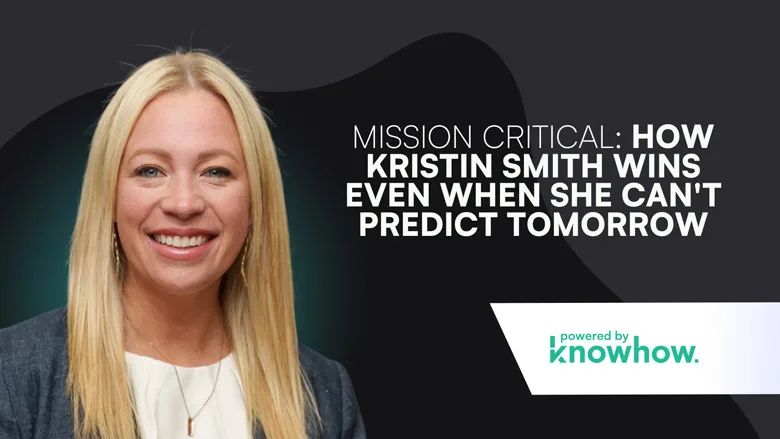
How Mooring USA’s Kristin Smith Wins Even When She Can't Predict Tomorrow
Kristin Smith shares how Mooring USA built a resilient restoration model in unpredictable markets
Welcome to “Mission Critical,” a brand new series from KnowHow that explores how today's restoration leaders are navigating the industry's most urgent challenges. Sales are soft, margins are thin, and getting paid feels like pulling teeth. In this series, we spotlight elite restorers who share battle-tested systems and strategies from the trenches.
Each feature dives into specific tactics leaders use when everything's on the line—from stabilizing cash flow to driving profitable growth in unpredictable markets.
If you want concrete strategies to hit your sales numbers and produce work profitably, you're in the right place. Expect real advice, actionable insights, and takeaways from leaders who've been through the storm and come out sharper.
Ready for the mission brief?
The question arrived on a random Tuesday afternoon, deceptively simple: "What's our capacity for the next six months?"
Kristin Smith was early in her new role as CFO at Mooring USA, still learning the ropes of the restoration industry, when the question came up.
In oil and gas, her former industry, Kristin would have pulled up a dozen dashboards and cross-referenced drilling schedules. The data existed. The models worked, mostly.
Looking for quick answers on restoration, remediation and cleaning topics?
Try Ask R&R, our new smart AI search tool.
Ask R&R →
In restoration, however, she stared at her screen and realized it was a bit trickier to predict.
“I left oil and gas partially because of the volatility,” she admits now, “and the one thing I underestimated was Mother Nature and the volatility of storm season and the disaster restoration industry.”
Now, as President of Mooring USA, Kristin has built something remarkable: a system for making smart decisions even when you can't predict the future.
Curious to hear more from Kristin? Click on the video below to catch the full discussion!
Going from a Data Mountain to a Molehill
Coming from the oil and gas industry taught Kristin to expect mountains of data. “You have these products and research tools that can tell you what every [oil] well in the world is doing at any given time,” she recalls.
Restoration felt like the opposite. “Minimal public companies, minimal research tools, minimal data. I was trying to find that information through conversations with investment bankers and financial institutions, and my peers in competitive businesses. It was just like pulling teeth.”
Without industry benchmarks, every decision became an educated guess. But the real challenge wasn't missing data; it was discovering that everyone else was guessing too, but nobody was talking about this fact out loud.
Kristin's first revelation came when she started examining Master Service Agreements. Master Service Agreements are restoration's version of insurance policies. Companies collect them, celebrate them, and build business plans around them.
“Everyone can talk about the list of MSAs that they have with really exciting prospective clients,” she says. “But MSA is just a piece of paper that oftentimes goes in a drawer.”
The uncomfortable reality: It's a license to bid with other service providers, and having an MSA doesn't guarantee work. It only guarantees the right to compete for work that may never come.
While her peers counted agreements, Kristin began tracking something nobody else measured: conversion rates. How many MSAs actually generate revenue? How long does that take? Which clients consistently convert versus those who just collect vendors?
Her solution required abandoning the traditional restoration model entirely. Instead of waiting solely for disaster revenue, Mooring began pursuing day-to-day maintenance work with MSA clients. “How can we help you out in the meantime? How can we make your life easier?”
When emergencies finally hit, they weren't just another vendor competing for trust and work—they were the partner already proving value long before a storm came around.
Building Around Uncertainty
Kristin built Mooring's revenue strategy on a simple principle: if emergency response work is completely unpredictable, create predictable revenue streams that can carry the company when storms don't come.
Three segments emerged: mitigation (emergency response), restoration (rebuild/reconstruction), and remodel. Each operates on different timelines and predictability levels.
“When I'm doing my budget, I can talk to remodel [portion of our business] and get the pipeline work and estimate that fairly accurately, and do the same with reconstruction. But mitigation? I can tell you for the next four to six weeks the cash flows, and outside of that, it's gonna be wrong a hundred percent of the time.”
Kristin uses two forecasting approaches for the unpredictable emergency work: a top-down analysis based on historical patterns and ownership expectations, combined with a bottom-up customer analysis that examines recurring loss patterns and identifies which clients consistently generate work versus those who remain dormant.
When Mooring brought in private equity partners at Crossplane Capital, this three-segment approach became proof of sophisticated thinking in an industry often run on hope and habit.
Seeing Profit Where Others See Overhead
With three revenue streams providing different levels of predictability, Kristin turned her attention to another area where the industry accepts conventional wisdom without question: subcontracting.
While most restoration companies accept subcontracting as inevitable overhead, Kristin asked the uncomfortable question: What if it's not?
“I look at our sub lists and say, How much are we utilizing sub for certain services? If I bring that in-house, can I improve margins by 10%, 15%, or more?”
The analysis is systematic: total annual spend per subcontracted service, potential margin improvement, and investment cost to build internal capacity.
“It's a straightforward analysis to say, we do enough asbestos services to hire someone with that expertise, bring them in-house, and have an immediate uplift to margins.”
Focusing on Her Best Resource: People
But identifying profitable opportunities is only half the challenge. The other half requires people—and a team—willing to stay for the long haul.
So, Kristin's approach to building these internal capabilities centers on a fundamental insight: if you can't predict the future, build systems that protect your people from the uncertainty of the restoration industry.
Mooring cross-trains employees between service lines, creating flexibility that shields both jobs and team capacity from unpredictability. “We have examples in our past of large storm events and large projects where we've had to pull restoration and remodel PMs into the mitigation side of things,” she notes.
Before hurricane season, everyone gets refresher training. “We don't ever want to turn away work. To the extent that we can keep our current remodel projects going, and we have extra resources to pull into the mitigation side of the business, that's ideal.”
This philosophy extends to how she handles inevitable cost pressures.
When forced to find cost-savings in the business, her hierarchy is methodical: technology and process improvements first, procurement optimization second, discretionary spending third.
The last place Kristin looks when trying to find cost-savings? People.
The goal, she explains, isn't just reducing costs for cost's sake. Rather, it’s troubleshooting other solutions to spending challenges while protecting what matters most (people) from the consequences of an uncertain industry.
The Change Budget Reality
But protecting people while implementing all these changes—revenue diversification, cross-training, bringing services in-house—requires understanding another limitation most leaders ignore: people's capacity for change itself.
“One of my private equity partners said, ‘You need to establish a change budget. Just like any other budget, you don't want to use it all in one month.”
Most leaders overestimate their teams' change capacity the same way they overestimate their forecasting ability. Push revenue diversification, cross-training, and new cost management simultaneously, and teams shut down completely.
“Be thoughtful and strategic about how you prioritize changes and take the temperature of your employees—their ability to put one more thing on their plate.”
Whether bringing services in-house, implementing cross-training, or restructuring operations, the execution matters as much as the strategy. Change capacity becomes the constraint that determines how quickly you can capture the opportunities you've identified, another limitation to acknowledge rather than ignore, Kristin observes.
Kristin’s Morning Ritual
All these systems come together in a daily practice that reveals how Kristin has learned to operate in an unpredictable industry.
These days, Kristin checks three things before getting out of bed: weather forecast, daily cash control, and job setups from the previous day.
But the ritual reveals everything about her approach. She's not checking the weather because she thinks she can control it. She's checking because she's made peace with uncertainty while staying prepared for whatever comes.
Her success at Mooring proves that you don't have to pretend you can predict the future to build a thriving business.
Sometimes the most powerful thing a leader can say is "I don't know"—followed by "but here's what we're going to do about it."
What You Can Learn from Kristin:
- Track MSA Conversions, Not Signatures. Calculate your actual conversion rate: how many MSAs generate work within 12 months? Focus on relationship-building with clients who consistently convert. Pursue maintenance work between disasters to stay afloat.
- Run the Subcontractor Analysis. Calculate annual spend per subcontracted service versus cost to build internal capacity. Start with the highest-volume services showing the strongest margin potential.
- Cross-Train for Protection. Identify transferable skills between service lines. Train teams to flex between work types during slow periods. This protects jobs and maintains the capacity to take on quick opportunities.
- Establish a Change Budget. Limit simultaneous changes to what teams can absorb. Queue improvements rather than overwhelming people. Most initiatives fail from ignoring change capacity, not bad ideas.
Looking for a reprint of this article?
From high-res PDFs to custom plaques, order your copy today!