Tech-Enabled or Left Behind: How Innovation Is Creating a New Class of Restoration Companies
Restoration 2.0: How technology-driven systems are reshaping operations, ROI and company valuations

There’s a quiet revolution happening in restoration.
For decades, this industry has thrived on grit, relationships and relentless execution. But the next wave of winners? They’re not just swinging hammers and submitting Xactimates. They’re engineering operational systems that look more like SaaS companies than service businesses.
Let me be blunt:
If you're still treating technology as an afterthought, you’re not just leaving money on the table, you’re capping your company’s valuation.
Restoration Is Undervalued, But Not for Long
Restoration companies are essential. Recession-resistant. Cash-flowing. But they’ve historically sold for 3–6x EBITDA on a good day.
Meanwhile, software companies with zero EBITDA get 10–15x revenue. Why?
Because they’re built for scale:
Looking for quick answers on restoration, remediation and cleaning topics?
Try Ask R&R, our new smart AI search tool.
Ask R&R →
- Margins are high
- Operations are automated
- Growth is repeatable
So what happens when you build a restoration company… like a tech company?
You get a $19MM valuation on $1MM of EBITDA.
I know this because I’ve seen it done.
The Tech-Enabled Blueprint (Not Just Tech-Stuffed)
Too many restorers think “tech” means buying the latest app their buddy uses. They focus on the best-in-class documentation tools or take advice on what app to use from the other restorer drowning in tech and stuck at $1MM. Tech-enabled doesn’t mean tech-stuffed. It means your systems drive best-in-class margins and operational leverage.
Here’s what it looks like:
- 3D scanning with Matterport that eliminates the in-home estimator role
- AI bots that replace the 24-hour customer check-in call
- Workflows that fire in real-time based on job triggers
Example: At our restoration company, we built a 24-hour follow-up automation that surveys customers as soon as the job closes. It not only replaced a repetitive admin task, it ensures we catch issues before they hit Google reviews or TPA complaints.
The Secret Weapon: N8N + All in One, Open API Restoration Software
Let me show you how we automated entire departments with an all-in-one restoration software that’s open API as the engine and N8N or Gumloop as the automation brain.
By Open API I mean a software that’s willing to talk to other software. That’s Albi’s superpower. Unlike Dash or Restoration Manager, you can hit Albi’s data from any software, anywhere in the world.
Just ask Chat GPT: “Act like a CTO with 20 years of experience in home services. Is [my restoration tool] All in One and Open API?” and it can do the research for you.
N8N and Gumloop are AI automation tools that run in the background. It’s like downloading a spreadsheet or report from your job management system and prompting chat GPT to read it and give you an action. The magic? It runs by itself, 24/7/365.
Using N8N, we’ve built bots that:
- Flag missing photos or compliance gaps
- Generate weekly sales scorecards & coaching plans for BDRs
- Trigger post-job customer journeys
- Auto-alert teams about licensing or stale project phases
Here’s how it works:
- An action is completed in your source of truth software (route stop in the CRM for example).
- An API call is sent to N8N
- AI reads the API Call and Logic kicks in: “If job >$25K and no sketch, alert ops manager”
- N8N sends a Slack, email or task back to the source of truth software.
It’s like giving your ops team 10 virtual assistants, without adding a dime to payroll.
Smart Workflows ≠ Overdocumentation
Smart workflow is simple, consistent and automated.
More documentation doesn’t mean faster payment.
What matters is capturing the right data in the right format at the right time.
At our companies, we use a Tech Prioritization Matrix to decide:
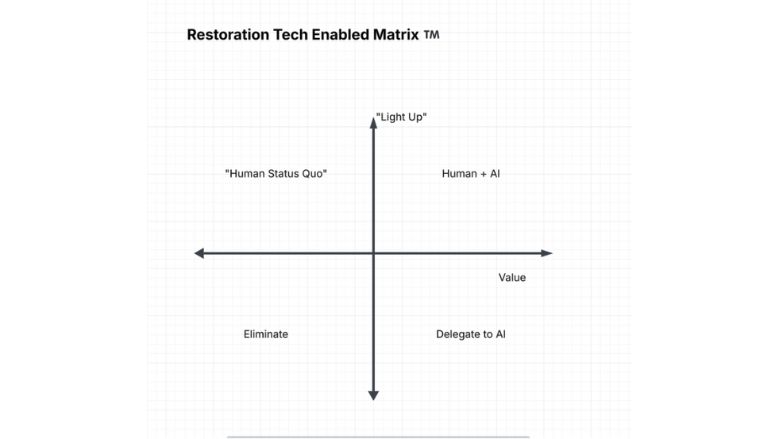
Graph courtesy of Albiware
High value + high excitement = Chocolate. Empower Humans with AI but still keep it human led. (i.e. selling in the field)
Low Value + High Excitement = Chocolate. Let humans do more of this. It’s good for them. (i.e. going to BNI groups).
Low Value + Low Excitement = Bad Broccoli. Remove this completely from their to-dos. (i.e. doing dry logs).
High Value + Low Excitement = Good Broccoli. Replace this with AI. (i.e. job file auditing or 24-hour follow-ups with customers).
Start with the workflows that eat up time and generate no ROI. That's your "broccoli." Tech exists to remove that, so your team can focus on their "chocolate"—the high-leverage stuff that makes your company great.
How to Evaluate Tech ROI: The REAL Framework
Here’s the ROI framework we teach in The Restoration Mastermind and include in the Restoration Tech Buyer’s Guide:
Revenue generated + Expenses saved + Avoided cash flow hits (e.g. interest from delays) - Lift (cost of tool + implementation) = ROI
If your tool adds $100K in revenue and saves $40K in expenses but costs you $15K to implement… your REAL ROI is $125K.
Stop picking tools because they’re popular. Pick them because they fit your operational phase. Ideally, you want to aim for a justifiable 9X ROI.
Also, stop shying away from expensive tools. I’d rather spend $100K a year on a tool that has 9x ROI than $5K a year on a tool that has 1X ROI.
Enterprise Value Is Now a Tech Game
Private equity firms are sniffing around our industry because they see what we see:
Restoration is an untapped goldmine if the operator knows how to scale with systems.
Companies that:
- Run one centralized platform
- Automate 80% of back office tasks
- Use AI to catch compliance issues
- Deliver a tech-powered customer experience
…are trading like tech companies. PE groups now ask, "What’s your stack? How automated are your ops?" before they ask about your trucks.
The 5-Year Forecast: Restoration 2.0
In the next 5 years, the top 5% of restoration companies will:
- Operate with lean teams and 30%+ EBITDA margins
- Have employees that are paid like tech employees (6 figure technician salaries).
- Use open API platforms like Albi to integrate everything
- Deploy AI agents to handle scheduling, QA, collections and reporting
- Train field staff with interactive mobile SOPs, not binders
And their owners?
They’ll either be selling at 15x EBITDA or compounding wealth while others are still chasing moisture logs.
Overwhelmed? Start Here.
If tech feels overwhelming, remember:
You don’t need to become a software company.
You just need to build your restoration company like one.
Start by:
- Automating one bottleneck
- Measuring the ROI with the REAL framework
- Consolidating your software into one system
- Training your team to leverage, not fear, new tools
And if you want a blueprint? Grab my book, Restoration Millionaire. Or join The Restoration Mastermind. Or just go to Albi’s website and see what a vertical SaaS built by restorers for restorers looks like.
The tools are here. The shift is happening. The next wave is already forming.
Build your restoration business like it’s worth 15x EBITDA, because soon, it will be.
Looking for a reprint of this article?
From high-res PDFs to custom plaques, order your copy today!