How Dehumidifiers Work: Cooling Air to Create Heat
Why dehumidifiers generate heat and what that means for restoration professionals

One day I received a text from a person who wasn’t in my contacts. I had just advertised that I have some refurbished equipment for sale. He probably saw my post and said he was looking for a dehumidifier that doesn’t create heat. I explained that by definition dehumidifiers create heat. It’s the way their design uses the laws of nature to lower the relative humidity. However, I said, if he wants to get rid of humidity without creating heat there’s a device that uses the same parts as a refrigerant dehumidifier, and is also somewhat effective in decreasing humidity, but because its parts are arranged differently it’s called an air conditioner.
How does the refrigerant dehumidifier increase the temperature of the air going through it? In my latest article, “Exposing Restoration Equipment Misconceptions,” I claimed that it’s caused by inefficiencies in the system, like the compressor heating up and the friction of the refrigerant gas in the system. Even though this is true, the inefficiencies produced by these electrical and mechanical systems generate only a small minority of the heat “created” by the dehumidifier. Most of the heat is actually produced by the process of condensation.
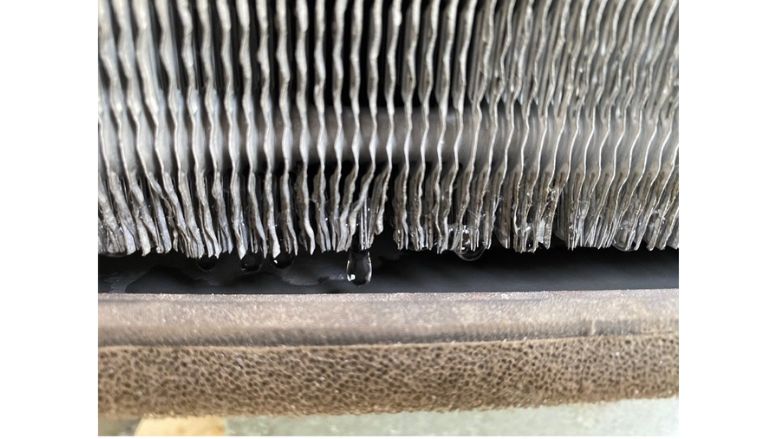
Photo Credit: Elan Pasmanick
A refrigerant dehumidifier, as most readers probably know, uses the evaporation and condensation cycle of the refrigerant in a HVAC system to move heat from one side of the system to the other. The gas in the evaporator coil evaporates and that sucks heat from its surroundings. Then it flows and condenses in the condenser. The same heat that was sucked into the gas previously is now dumped into the surroundings, heating the condenser and the air running through it.
In a refrigerant dehumidifier, the airflow goes through both evaporator and condenser before it is expelled dry and hot. In an air conditioner, the condenser and evaporator are separated so each will have its own airflow. One will be inside and the other outside, and in both, the same process is happening to the air running through the evaporator: it releases its humidity and condenses it on the cold coils. In an air conditioner the air is then expelled, dry but cold. The air running through the condenser is heated, but because this is happening outside, only cool air blows inside.
So, where does most of the heat “created” by the refrigerant dehumidifier come from? Just like I wrote before, it comes from condensation. Not the condensation of the gas in the condenser, the condensation of water on the evaporator.
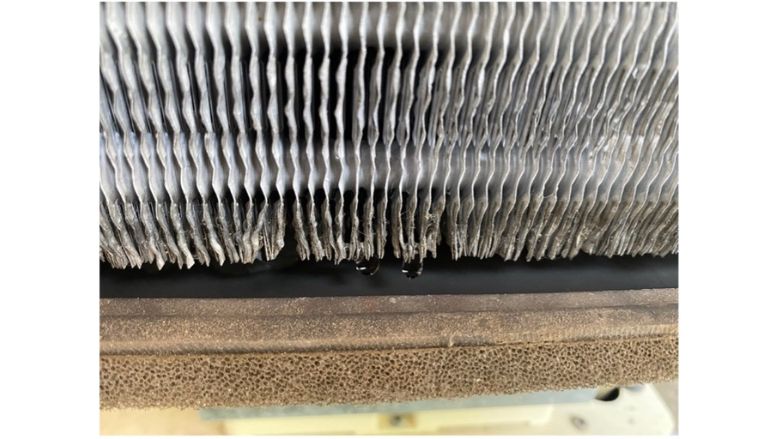
Photo Credit: Elan Pasmanick
We all learned as little children that the evaporation of sweat leaves our bodies cooler, but the opposite happens during condensation. And just like refrigerant gas absorbs and ejects heat as it evaporates and condenses, water and all other materials act in the same way. This is the source for most of the heat produced by the refrigerant dehumidifier. So much heat is produced in this way that it overcomes all other inefficiencies.
A desiccant dehumidifier produces heat too, but in a different way. It uses a desiccant material to absorb humidity from the air running through it. This material is arranged in a slow-spinning drum. A portion of the drum is always being heated with a heating element to release the humidity it absorbed to allow continuous operation. As it spins, the part of the drum that is being heated changes. It then ejects two streams of air, one dry air and one hot and humid. As the drum spins, its portion that was just heated for the release of the humidity moves to become the portion that collects humidity so air that is being dried is heated by the desiccant material. This means that even though the ejected dry air is not as hot as the ejected humid air, it is still warm. In conclusion, both types of dehumidifiers produce heat as they are drying the air. So why don’t we use air conditioners for drying?
Looking for quick answers on restoration, remediation and cleaning topics?
Try Ask R&R, our new smart AI search tool.
Ask R&R →
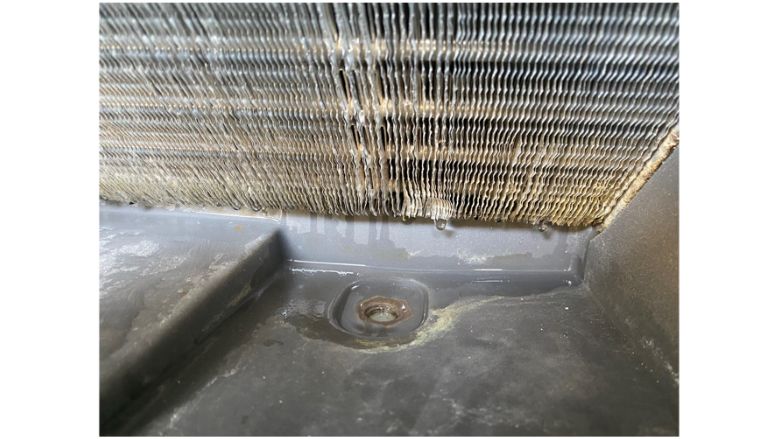
Photo Credit: Elan Pasmanick
Air conditioners do dehumidify as a side effect of cooling air, but use a temperature sensor to cycle on and off based on the air intake’s temperature, as opposed to a dehumidifier that uses a relative humidity sensor to cycle on and off. When using an air conditioner, every time the temperature in the room lowers to the set temperature, it will turn off. When using a dehumidifier, every time the humidity level lowers to the set humidity, it will turn off. In theory, a heater can be added to an air conditioner to raise back the temperature which will cause continuous operation, but in practice it’s not in any way an energy-efficient solution in situations where the use of a dehumidifier is possible.
I don’t know what the person from the beginning of this article needed a dehumidifier for. Maybe a combination of an air conditioner and a heater would be the best solution for his niche application; even if this isn’t the most energy-efficient solution, it might be best for one who wants dry air with a stable low temperature, assuming he can get the temperature to be stable. In the restoration industry we need to dry containments as fast as possible and at that dehumidifiers are the best and the most energy efficient. Monetization is a whole other story for someone else to write about, but I wonder, on an out-of-pocket job, in a property with an existing air conditioner, if turning it on in addition to installing a heater instead of using dehumidifiers, how much money could the property owner save and would it still be worth it for the restoration company?
Looking for a reprint of this article?
From high-res PDFs to custom plaques, order your copy today!