What is a "Good" Estimator?
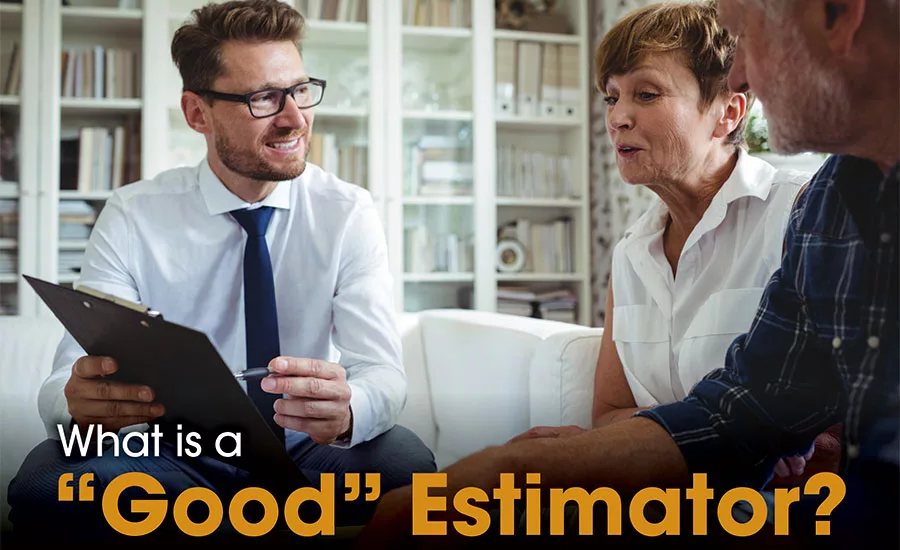
I would like to suggest some qualities that you might want to consider looking for in your search for a “good” estimator. This is certainly not an end-all list, but it will give you some direction as to what makes up a “good” estimator:
- Positive attitude and is eager to learn.
- Possesses a good work ethic.
- Uses good people skills.
- Is conscientious.
- Desires to help people.
- Wants to better themselves and their company.
- Systems-oriented.
- Team player.
A lot of companies are constantly looking for a “good” estimator, but they haven’t taken the time to write down a description of what a “good” estimator is. By doing this, both you and others will know what you are looking for and be able to help with identifying a person that would fit that which you are looking for.
Good estimators can also be found outside of the insurance repair industry. It sometimes appears to hinder the search for a “good” estimator when the mindset is to only look inside the industry. It is usually easier to find someone who can write an estimate and not run a job. Both skill sets are important, but to have one person do both tasks requires more ability and thus, those people become harder to find. It also slows down the entire process, depending on how many jobs they are responsible for, the size of the job, the complexity of the job, the working environment as to normal working conditions or catastrophe working conditions, and the geographic position of the job from the company office. Generally speaking, there is value in and consistency in having an estimator doing more of the estimating and less of running the job. It allows for more consistency and standardization of the estimating process. Could they double the number of estimates that they do? If so, could you cut your estimating staff in half?
Another option for a “good” estimator is an estimating company and not an individual person. There are estimating companies who can not only estimate jobs for you, but they will invoice for your services, get the money collected and then you pay them a percentage of money they collected on the jobs they handled. You might want to consider them as a pressure valve. They can help you when an estimator leaves suddenly or when you get inundated with a large surge of business. It allows you to be anywhere from having NO estimators in your company to having a subcontractor that helps you and your estimators when you need help. In a lot of cases, they know the system better than you do, because they work with the insurance companies more often than you. They have much more skin in the game as a subcontractor than an employee does and the estimating company is an upfront fixed expense as all subcontractors are.
Here is what I think you should consider having an estimator be responsible for:
- They bid the policy holder’s job, NOT the estimator’s job. By this I mean they bid what it will take to put the loss back to pre-loss condition. Identify the cost with a database that is maintained by the estimating software you are using. Totally document in your notes section every line item that needs repairing and then only repair what you are being paid to repair, no more, no less. Remember the insurance company will pay for what needs they think needs to be repaired; the contractor gets paid for the work on the repair.
- Get correct bids from subcontractors that are company-approved. Make sure they are aware of “sub creep”, meaning when an estimator gets too comfortable with a sub, there is a possibility of the sub raising their prices when every bid is not reviewed for accuracy.
- Make sure the estimator understands the need for getting paid for overhead and profit on EVERY Job. Not someone else’s overhead and profit, but YOUR overhead and profit.
- Have all your estimators test out at Level II in Xactimate and your lead estimator test out at Level III.
- Have EVERY bid be officially checked for errors by another estimator before it is presented. Set up a monthly incentive plan to incentivize accurate, error-free estimates.
- If the estimator cannot reach an agreed on scope with the adjuster, have the estimator meet with the adjuster and explain why the estimator has to say no to this job. It will build the trust relationship for future jobs with the adjuster.
There are “good” estimators around; you need to make them aware of what you are looking for and the work environment you offer to them. Please keep in mind that they will judge you by the actions you take to hire them and whether or not they want to come to work with you.
Good luck in your search for “good”estimators!
Looking for quick answers on restoration, remediation and cleaning topics?
Try Ask R&R, our new smart AI search tool.
Ask R&R →
Looking for a reprint of this article?
From high-res PDFs to custom plaques, order your copy today!