An Experiment Concerning the Effectiveness of a Structural Drying Approach
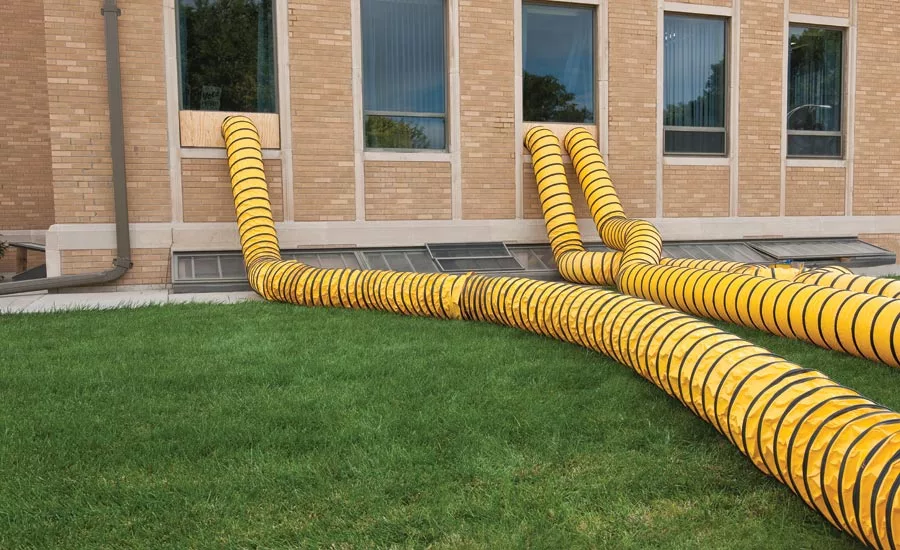

On June 28-July 1, a private IICRC-approved Applied Structural Drying (ASD) class was held in Springfield, Ohio, for consultants from YOUNG & Associates’ Environmental Team. The class was led and instructed by the authors of this article. During the class, the ambient and surface temperatures were managed throughout the flooded environment. Additionally, during the class a pilot study was conducted in one drying chamber to test the theory put forth in the ANSI/IICRC S500-2015 Standard and Reference Guide for Professional Water Damage Restoration (ANSI/IICRC S500-2015) Section 13.5.6.3, “Controlling Temperature to Accelerate Evaporation.”
The study was conducted at an IICRC-approved ASD training house. This was the 65th time this flood house had been flooded with approximately 1,500 gallons of water and dried. The gypsum board used in this test was new material not subject to previous flooding. The water remained for more than 24 hours prior to the start of mitigation.
Since 1994, the IICRC S500 Standard and Reference Guide for Professional Water Damage Restoration has promulgated procedural guidelines for drying flooded structures. In the ANSI/IICRC S500-2015 it states in part: “It is essential for remediation technicians to complete remediation techniques prior to beginning restorative drying.” This is an important factor due to the fact that a decision to dry wet gypsum board in place necessitates a decision not to demo the material and instead attempt to dry.
Materials and Methodology
In order to determine if increasing the temperature of a section of wet gypsum board in the “family room” drying chamber shortened drying times, a 32 inch x 32 inch section of an exterior wall facing the front of the flood house was selected and monitored. Gypsum board in an adjacent drying chamber exhibited elevated moisture readings for approximately an additional 24 hours.
An access panel was created in the test section of ½-inch thick gypsum board finished on one side with flat latex paint, wood base trim and fiberglass batt insulation. The panel was opened to inspect prior to drying. The sill plate was constructed of 2x6-inch pressure-treated wood on concrete slab with OSB exterior sheathing. There were no vapor barriers.
The area was flooded until water pooled on the surface of the Berber carpet. The carpet was installed by stretch-in method over bonded cushion, over concrete slab. Ambient air temperature in the test area was maintained below 100ºF and the wet surface temperatures were kept below 120ºF.
Looking for quick answers on restoration, remediation and cleaning topics?
Try Ask R&R, our new smart AI search tool.
Ask R&R →
The study was conducted under controlled conditions. As previously noted, the test area was set up in the family room exterior wall facing the front of the flood house.
A Hydro X Lite extractor was connected to a Prochem Everest HP650 truckmount employing a 50-foot length of 2-inch diameter hose. Students made four passes over the Berber carpet and 6-pound bonded cushion.
Once extraction was completed, the family room drying chamber was contained using six-mil polyethylene sheeting. One Phoenix R200 low-grain refrigerant dehumidifier was used along with with four Dry Air Force 9 axial air movers. An air mover was placed at a five degree angle against each of the walls pointed in a counterclockwise direction. A 1,500-amp portable electric heater was used to increase the temperature of the wet material along the test area wall by employing the sensible (thermal) energy heat into the air mover blowing air across the test area wall. The HVAC system thermostat was set on heat mode at 85ºF for the first night and then turned to air conditioning (AC) mode at 68ºF after the first 24 hours of drying. The HVAC fan was set to the manual “on” setting during the course of the entire drying process.
Daily Humidity & Moisture Content Readings
The drying started around 4:30 p.m. on June 28. Initial outside atmospheric readings at 7:00 a.m. were 64ºF, 73.2% relative humidity (RH) and 65.94 grains per pound (gpp) and 55.4ºF dew point temperature.
Initial readings in the drying chamber: 74.2º F, 80.4% RH and 105.4 gpp and approximately 67ºF dew point. These readings were taken at the same time as the initial outside readings. Initial moisture content reading in the test area on the gypsum board was 89.4 points using a GE Protimeter Surveymaster penetrating moisture meter. The initial sill plate reading was 55.4 points with the same meter using a hammer probe under the base trim and gypsum board. The drying target for the gypsum board and the sill plate using the GE Protimeter Surveymaster was 14 points.
Drying chamber readings after 24 hours: 96.4ºF, 43.7% RH, 113.4 gpp, and 70.7ºF dew point temperature. The wet surface temperature reading of the gypsum board in the test area was 109.2ºF. The gypsum board moisture content reading after 24 hours of drying was 13.9 points (below target for pre-loss condition) and the sill plate reading was 22.4 points.
Drying chamber readings after 48 hours: 97.8ºF, 32.9% RH, 88.97 gpp, and 63.7ºF dew point temperature. The surface temperature reading of the gypsum board was 112.1ºF. The sill plate reading was 8.2 points. (Note: Gypsum board and sill plate reached drying targets within 48 hours of the start of drying. The portable heater was removed at the 48-hour juncture and the structure’s HVAC system was utilized to lower ambient air temperature.)
Drying chamber readings after 72 hours: 74ºF, 51.7% RH, 66.9 gpp. The surface temperature reading of the gypsum board was 94.2ºF.
Wall Cavity Inspection
The wall was opened for visual inspection after 72 hours of drying. Surface temperature of the face of the insulation was 84.2ºF. No visible mold was observed on the face of the gypsum board behind the base trim, on front or back of the base trim, on insulation or in the wall cavity, including sill plate, studs and OSB exterior sheathing. Moisture content reading on fiberglass batt insulation was 7 points. Sill plate readings were observed at 9 points on the edge and 11.1 points on the top of the sill plate. OSB exterior sheathing in the wall cavity was 9.3 points.
Summary: Although this is a very small study and limited in scope, it appears it is possible to dry gypsum board, base trim, sill plate and insulation in place on an exterior wall without removing those materials. This can be accomplished within 48-72 hours, when minimal water has wicked up into the materials, by using airflow, lowering the humidity of the ambient air, and providing energy in the form of heat on the wet surface materials. Directed heat flow can be employed to dry gypsum board exterior walls with fiberglass insulation and no vapor barrier without removing base trim and drilling holes, and without any detrimental effects when affected with Category 1 water.
Looking for a reprint of this article?
From high-res PDFs to custom plaques, order your copy today!