What is "Acceptable" Dry?
There is a common belief that just will not go away: it should only take a well-trained and knowledgeable remediation contractor three to four days to dry a structure. As contractors know, while it is possible to dry a structure in a three- or four-day timeframe, it is extremely rare to do so when we consider the many categories, classifications, and the energy to change the matter (ref: current IICRC-S500 and the Leadership in Restorative Drying).
Just because we (the contractor) tell the client, after completion of remediation services, that their property meets dry standards and dry goals does not mean they actually have simply because we read some of the materials as dry with our tools. Is it possible we, as a contractor, are telling only a portion of the truth and not the whole truth?
What is a Dry Structure?
The Institute of Inspection Cleaning and Restoration Certification (IICRC) gives definition to this what is called acceptable with the term "dry-standard or dry-goal." The definitions section of the IICRC S500 current edition describes dry-standard: "a reasonable approximation of the moisture content or level of a material prior to a water intrusion," drying goal: the target moisture content or moisture level in a material to be achieved at the end of the drying process established by the restorer. (Ref: current IICRC S500 Water Remediation Standards)
How do we define an acceptably dry structure? The standard continues, "An acceptable method is to determine the moisture content or levels of similar materials in unaffected areas or use historical data for the region." In simple terms, the dry standard involves comparable pre-loss moisture levels, and they can be found by locating unaffected materials in the structure and getting the target values from there. (Ref: current IICRC S500 Water Remediation Standards)
We are asking: what happens if we cannot find anything dry? The IICRC-S500 current edition (fifth edition) has a chart that details what acceptable (dry-standard) should be. There you will find an Equilibrium Moisture Content (EMC) table, for example, that a facility that is seventy degrees (70℉) and fifty percent (50%) relative humidity (RH) would have most softwood framing materials and not hardwood materials at an approximate EMC around nine-point two percent (9.2%) wood moisture equivalent (WME).
The IICRC-S500 says that no matter what equilibrium moisture content (EMC) you get from the materials in the structure, you cannot leave material at an EMC that would support microbial growth. It also says that an acceptable dry standard is within 10% of what the other similar materials in the facilities were pre-loss.
Now, let us consider meters and how as a tool, they work and contribute to the moisture mapping and daily inspection and documenting dry facilities.
Looking for quick answers on restoration, remediation and cleaning topics?
Try Ask R&R, our new smart AI search tool.
Ask R&R →
Moisture Meters
When we as a contractor say that material or structure has been moisture mapped to identify what is affected by recent events or is acceptably dry, what we are usually saying is that your meter gave a reading that we view as either still affected or no longer affected. But truly, is it? How does your client know if we dried to acceptable-dry standard for their structure? Depending on your use of a meter, we could have completely measured all the materials or taken shallow readings in the wrong locations.
For example, non-invasive meters depending on their manufacture, are limited to depth within a material. A standard interior wall is five and a half (5½) inches thick. Using a meter that only measures the thickness or less of average drywall or baseboard and not a combination of the materials means you do not know if the rest of the assembly is wet or is comparable to other materials. How much is wet and how long it takes to reduce its excessive moisture is the issue or true question? Measure inaccurately here, and we will develop a belief that structure does not match reality.
Non-invasive meters Radio-frequency meters
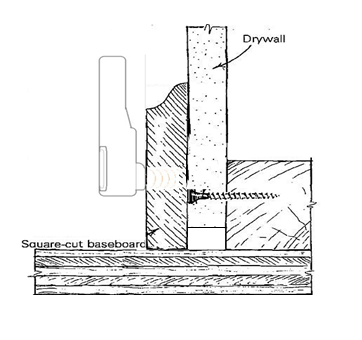
Radiofrequency (RF) is a signal that surveys a material. It measures the material it is in contact with from the sensor point down into the material and provides a relative reading on a scale, such as a scale of zero (0) to one thousand (1000), 0-100 or 0-300, depending on the meter manufacturer.
Basically, it only averages its readings in this mode, meaning it could be saturated in the middle of that piece of material and dry on the top and still give you a percentage of that reading. Why is this a problem? Because the moisture trapped (bound) in the middle of that material will not stay there. It will seek equilibrium with everything around it.
Some of us, as the operator of that device, believed that reading and declared the material at an acceptable standard, covered it with drywall, paint and trim, all we must do is wait and give it time to seek equilibrium (wick), and we will have created possible our very own microbial area.
Impedance meters
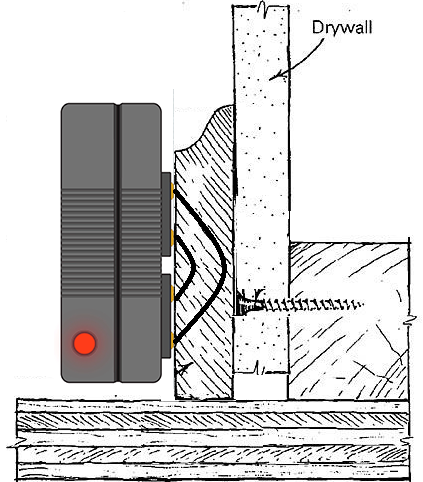
These meters read the highest moisture found first, so if moisture is on the surface (like condensation), then the reading will not penetrate below that and may indicate to the use the wall is completely wet. It could only be temporary moisture. These meters also do not work well on tile and vinyl because of the increased conductance on the surface. An impedance meter, much like the meter from earlier the RF meter, uses a small electrical current passed between two fixed points to measure resistance. It, like the RF meter, gives a reading on a relative scale (references appropriate scale).
Now that we understand these technologies are limited by penetration depths, and they average the readings across the entire thickness of the assembly, we need to know about their next limitation — insulating barriers.
Insulating barriers
In both RF and impedance meters, the readings are further limited by any insulating barriers. Neither electrical current nor RF can bridge the gap created by voids of air. The accuracy expected by putting a meter on top of a section of trim would be limited to its depth of reading per its manufactured design, meaning we know nothing about the additional materials behind it or the assembly behind the drywall. Without that information, we are exposed to liability.
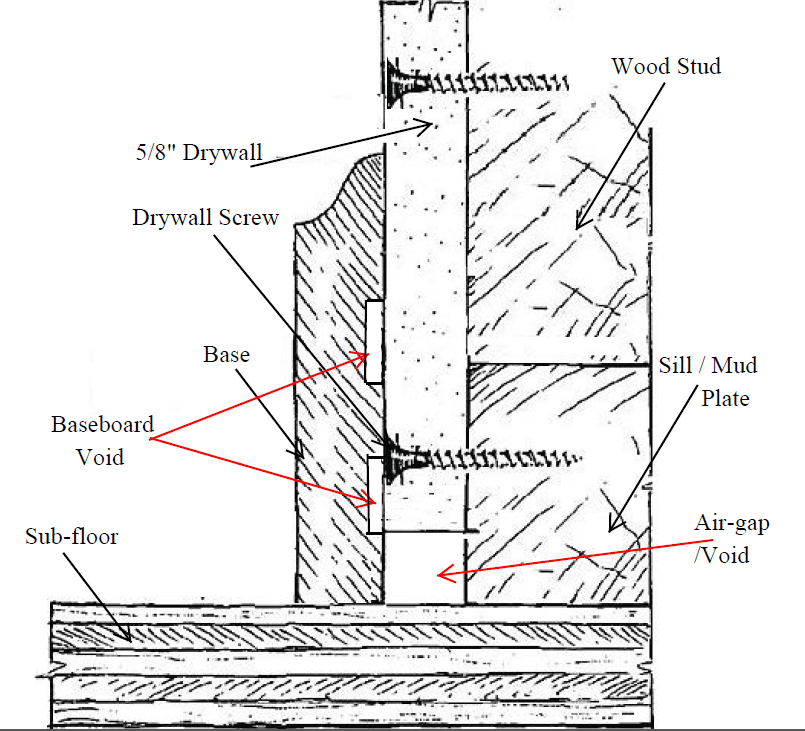
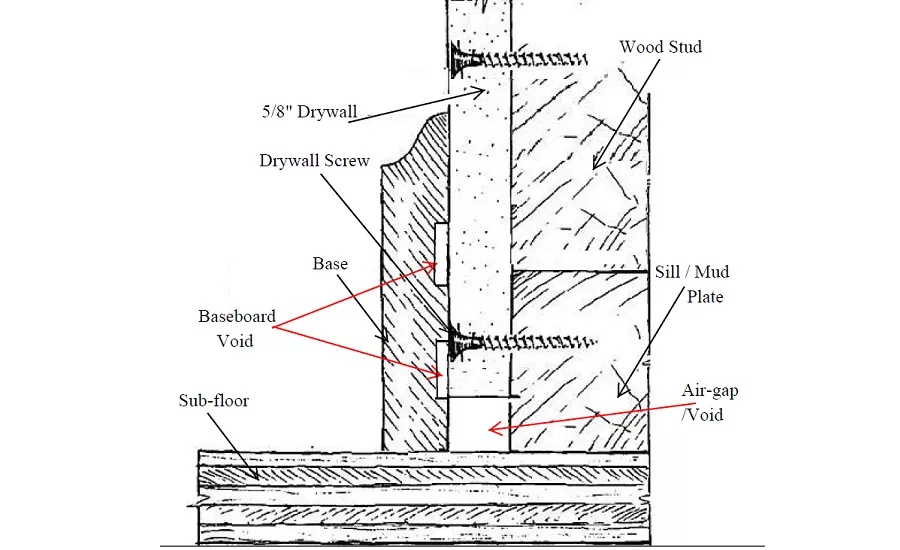
Air gaps and voids between trim and drywall can create insulating barriers.
From lack of acceptable dry knowledge and tool use often leave us to completely return a structure incomplete. The result is a return of a facility that could be a Category three (3) that requires microbial remediation and possibly a much larger restoration phase. All of this is done while the insured collects additional living expenses (ALE) residing or working outside of their structure. Half-dried structure costs an enormous amount of unnecessary money, and much of the confusion that leads to this increased severity is due to incorrect use of non-penetrating meters.
What is being buried and left for discovery later, and who is to pay for it? Proper use of penetrating meters could address the issue for everyone.
Invasive Meters (conductance)
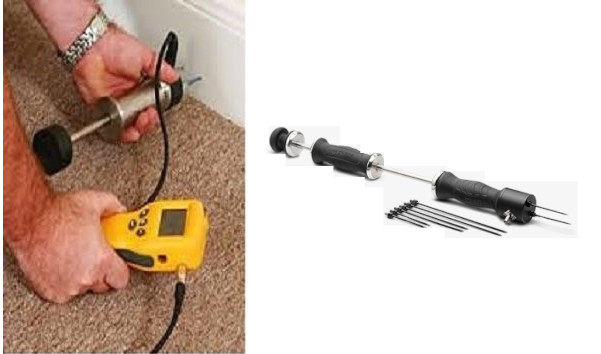
Penetrating moisture meter and Penetrating Pins 2”, 4”, & 6”
Non-invasive meters are great at quickly finding moisture but lack the accuracy and repeatability for moisture record keeping. When the potential for excessive moisture has been found with a non-invasive meter, then it is important that a pin meter (conductance) is used to quantify. Pin meter readings are more accurate and repeatable and should be the primary record-keeping measurement.
Penetrating meters, when coupled with the right probe’s accessories length of pins, can confirm whether the entire assembly is dry. The same impedance sensor technology used earlier is reused here, but with an important difference. While the non-penetrating impedance meters measure resistance between two pads and average at a depth, this setup utilizes penetrating pins and probes accessories. If it's wet anywhere between those points or probes, we will know it.
We, as a restorer, remediator, or third (3rd) party contractor, are responsible for returning or ensuring the structure is back to pre-loss moisture content and doing it in a way that doesn't support secondary damage (i.e., microbial amplification). Considering the use of Pin meters are meant to break the surfaces (paint, and the skin) only of a material; prongs accessories are manufactured to break the surfaces and depth of materials or multiple materials to find the moisture reading or readings.
Structural drying
So, how long does it take to dry a structure? It depends on how thorough and complete our survey is on materials and what meter technology is used to determine if the dry standard was obtained. Why should the remaining water matter? Does it really matter in the long run? The short answer: Yes! Structures left wet can lead to huge mitigation scopes, not to mention the cross-contamination to the contents and ALE incurred during the additional required work.
To understand or to reference the material here, the readers and end-users are to refer to manufacturers' specs, use, and recommendations of their meters, as multiple manufacturers contributed to this article.
Looking for a reprint of this article?
From high-res PDFs to custom plaques, order your copy today!