Restoration logo
search
cart
facebook twitter linkedin youtube
  • Sign In
  • Create Account
  • Sign Out
  • My Account
Restoration logo
  • NEWS
  • PRODUCTS
    • New Products & Technologies
    • Submit Your Product
    • Interactive Product Spotlights
  • CATASTROPHE
    • Hurricane
  • TOPICS
    • Architecture
    • Cleaning & Sanitation
    • Contamination
    • Contractor Safety
    • Contents
    • Fire & Smoke
    • Mold
    • Odor
    • Recon & Reno
    • Water
  • EDUCATION
    • Training & Education
    • Business Management
    • Insurance/Legal Matters
    • KnowHow.
    • Podcasts
    • Webinars
    • Whitepapers
    • Industry Events
    • Sponsor Insights
  • VIDEOS
    • Ask the Expert
    • Ask Annissa
    • Marketing Monday
    • Tech Tip Tuesday
  • BUYER'S GUIDE
  • THE EXPERIENCE
    • Convention & Trade Show
  • ABOUT
    • Contact
    • Advertise
  • SIGN UP
Fire and Smoke Damage RestorationContents RestorationRestoration Training/Education

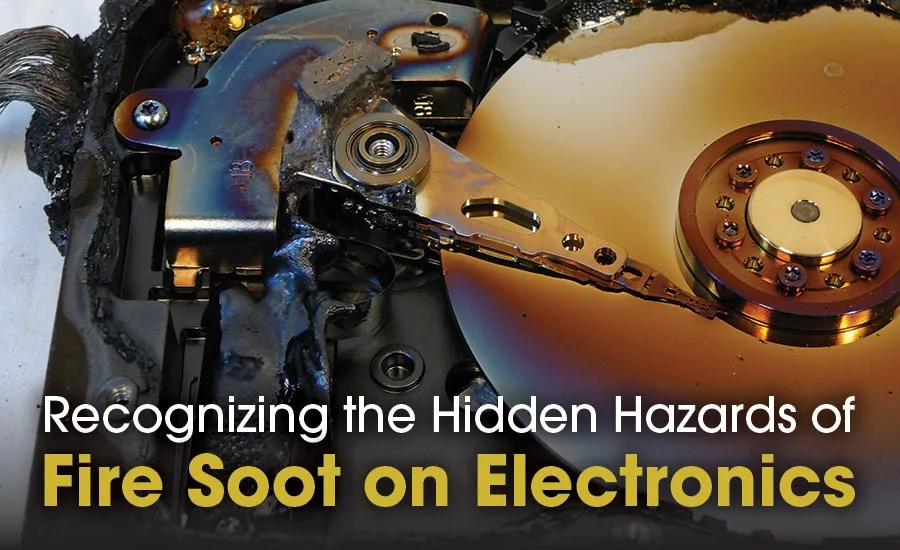
Recognizing Hidden Hazards of Fire Soot on Electronics
By James Copeland
Photos courtesy of Restoration Specialties Franchise Group

Photos courtesy of Restoration Specialties Franchise Group

October 15, 2019

Have you ever tried fixing your own electronics and appliances and ended up with extra parts? In the beginning of my career, I probably broke more electronic equipment than I ever repaired, but over the years I developed the skills needed to properly disassemble electronics and appliances as well as restore them to pre-loss condition. Also, along the way I learned a thing or two about the hidden hazards of fire soot.

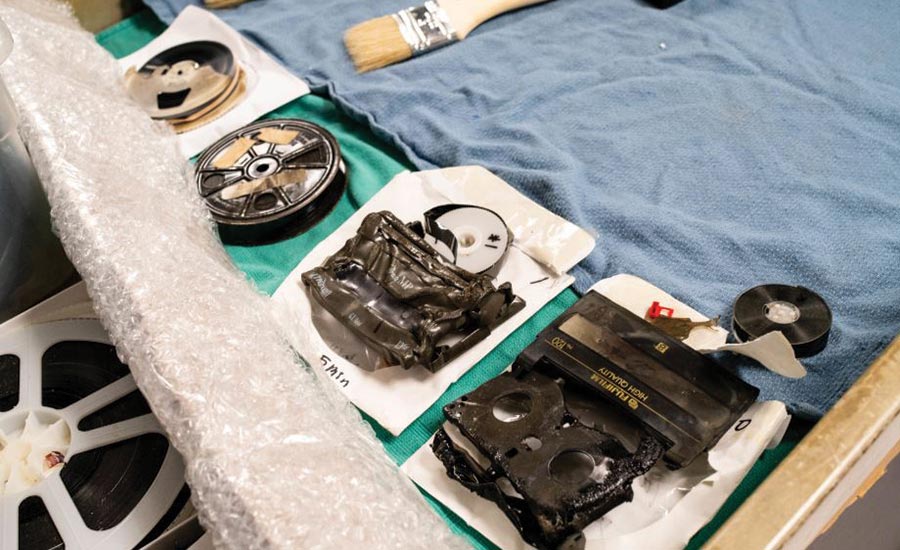
According to the insurance industry, about one in 325 insured homes has a property damage claim related to fire and lightning, and on average, Americans own approximately 25 electronic products per home. Although most of the time electronics can be restored by a professional after a fire and returned to the home afterwards, there are a lot of hidden hazards of smoke and soot damage that are commonly misunderstood and pose certain health risks when not handled properly.
electronics restoration

A typical structure (residential home or business) contains various materials such as plastics, elastomers, foams, polymers, adhesives, fabrics, wood products and asbestos containing materials. The incomplete combustion of these materials as a result of fire can produce an array of toxic organic compounds such as volatile organic compounds (VOCs), semi-volatile organic compounds (SOVCs), and polycyclic aromatic compounds (PAHs).

Exposure to these compounds during a fire may exhibit both acute and chronic toxicity. Some of the other chemicals and gases found in smoke are carbon monoxide, carbon dioxide, sulfur dioxide, water vapor, hydrogen cyanide, carbon particles, aldehydes, nitrogen oxide, benzene, toluene, styrene, metals, and dioxins. The size, quantity, character, and type of particles, gases, and chemicals in smoke varies depending on what is burning and whether it was complete or incomplete combustion.

When different types of items burn, various types of soot residue and smoke are produced including wet smoke, dry smoke, plastic or rubber smoke, protein smoke, furnace soot, and candle smoke. When restoring or cleaning electronics, it is important to be able to recognize the difference in various types of soot and smoke as they pose different risks and implications.

electronics restoration

Wet smoke is thick, smeary, sticky, has a pungent odor, and is prone to discoloration. It is very difficult to clean and requires specialized products and techniques. Wet smoke must be addressed quickly.

Dry smoke typically involves smaller, non-smeary particles, and is usually a result of hot, fast burning fires. The odor is usually not as strong as wet smoke.

Burning Plastic, foam, rubber, and polymers produce plastic or rubber smoke and burn with high energy at low temperatures. The particles produced have a high degree of ionization, therefore are attracted to other materials and form smoke webs. The smoke produced can potentially be acidic, if it is not addressed soon enough or treated properly with specialized products, bare metal surfaces can corrode and pit.

Protein smoke residue is a result of slow burning food such as meat and poultry. The particles are usually invisible and have a particularly strong pungent odor. A slow burn allows the protein to disperse and attach to everything, tends to stain painted and varnished surfaces, and is typically very difficult to clean.
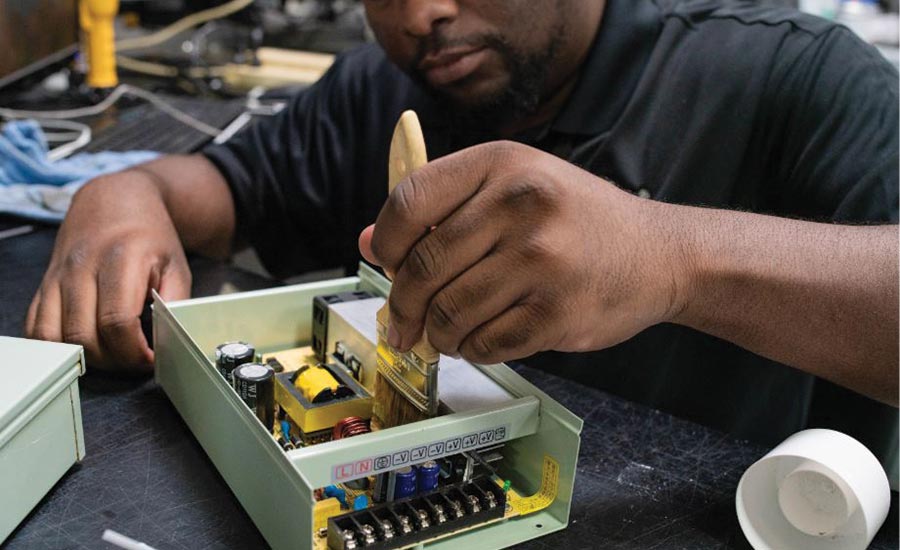
electronics restoration

Furnace soot or puff-backs result from the misfiring in a furnace or when an older furnace is replaced with a newer, high efficiency furnace. The ventilation system will aid in the distribution of the soot and can send it throughout the entire home, covering drapes, bedding, furniture, cabinets, walls, and everything in between. It is possible that before the malfunction occurred, the furnace may have been emitting small quantities of soot over an extended length of time. When this occurs, the soot bonds to the surfaces making it more difficult to clean.

Candle soot residue AKA “dirty house syndrome” is visible residue without a recognizable fire source. Studies show that it is very possible to be a result of burning cheap scented decorative candles. Candle soot production normally begins when the particulate matter produced reaches .06 to 0.1 microns in size. Because the particles are so fine, they lodge in irregular surfaces and are held by electrostatic bonds requiring complete disassembly of the item.
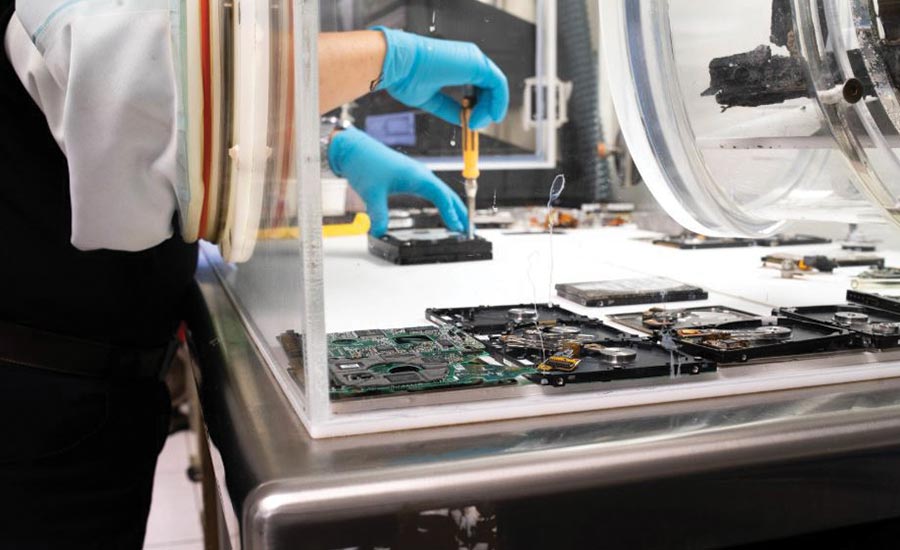
electronics restoration

Smoke aids in the distribution of soot and travels to cooler areas and continues until the fire is extinguished, thereby causing soot to be distributed everywhere in its path.

When it comes to restoration, electronics are very sensitive and when compromised by smoke and soot, become a safety hazard. Damage from smoke and soot primarily stems from increased resistance in circuits and connections by corrosive metal loss, short circuiting caused by current leakage, and overheating. Cleaning smoke and soot damage on electronics and appliances requires learned skill sets, professional cleaning products, and techniques. It is important to take the complexity of effective electronics restoration into consideration before letting your team disassemble a computer or flat screen TV and hope for the best. 

KEYWORDS: contents cleaning contents restoration deodorization specialty contents restoration

Share This Story

Looking for a reprint of this article?
From high-res PDFs to custom plaques, order your copy today!

Web jamescopeland 2 200x200

James Copeland, Director of Technical Services at Prism Specialty Restoration, a national leader in specialty restoration. Since joining Prism Specialty Restoration in 2013 as an Applications Engineer, Copeland now leads technical operations, bringing his deep expertise in electronics restoration, large loss assessments and industry standards for contamination control and recovery.

Recommended Content

JOIN TODAY
To unlock your recommendations.

Already have an account? Sign In

  • Digital view of the United States with a Hurricane and coding

    Is Your Restoration Technology Ready for the Upcoming Hurricane Season?

    Here’s how restoration contractors can prepare their...
    Catastrophe Restoration
    By: Taylor Carmichael
  • Business team analyzing financial data on digital tablets during a meeting

    7 Trends Influencing the Restoration Industry in 2026

    With market uncertainty, workforce transitions, new...
    Guest Columns
    By: Oscar Collins
  • mold remediation

    Fighting Mold and Bacteria Damage

    Successful mold remediation can be multidisciplinary,...
    Mold Remediation
    By: Josh Woolen
You must login or register in order to post a comment.

Report Abusive Comment

Manage My Account
  • Newsletters
  • Online Registration
  • Subscription Customer Service
  • Manage My Preferences

More Videos

Sponsored Content

Sponsored Content is a special paid section where industry companies provide high quality, objective, non-commercial content around topics of interest to the Restoration & Remediation audience. All Sponsored Content is supplied by the advertising company and any opinions expressed in this article are those of the author and not necessarily reflect the views of Restoration & Remediation or its parent company, BNP Media. Interested in participating in our Sponsored Content section? Contact your local rep!

close
  • restoration technician working a water damage project
    Sponsored byCotality

    Schedule smarter with DASH’s mobile restoration job management

Popular Stories

Restoration Jobsite Table before and after organization.

The New Profit War: How Restorers Will Compete in the Age of Managed Repair Programs

Restoration Golf League Full Color Logo

Restoration Golf League Announces 2026 Event Lineup and Celebrates Recent Champions

temporary containment barrier constructed with white polyethylene sheeting

Improving Negative-Pressure Containment for Biological Contaminants

Register for Webinar - Connecting the Field, Office and Carriers: How to Streamline Claims with Better Data and Communication

Events

May 19, 2026

Hurricane Response: What’s Changed, Who’s at Risk, and How to Scale Without Breaking

This webinar is part of the Preparing to Respond: Hurricanes series.  

Hurricane season isn’t what it used to be, and neither is disaster response. In this webinar, an expert‑led panel will break down what’s changed for hurricane response, and how restorers can scale responsibly without sacrificing their safety, retention, or profitability.

June 16, 2026

Connecting the Field, Office, and Carriers: How to Streamline Claims with Better Data and Communication

The modern claims ecosystem depends on seamless integration between the field, office, and carrier. Learn how a unified “golden thread” of communication transforms fragmented workflows into a transparent, high-performance process.

September 9, 2026

The Experience Convention and Trade Show

The Experience Convention & Trade Show logoThe Experience Convention and Trade Show unites the cleaning, restoration, inspection, indoor air quality, and HVAC industries through hands-on education, live demonstrations, and high-impact networking. Attendees gain practical skills, business insight, and connections that elevate industry standards and drive growth.

View All Submit An Event

Poll

Priorities for Hurricane Preparedness

What area does your team prioritize first before hurricane season?
View Results Poll Archive

Products

The Cleaning, Restoration, Inspection, and Safety Glossary

The Cleaning, Restoration, Inspection, and Safety Glossary

The Cleaning, Restoration, Inspection, and Safety Glossary.

See More Products
Hurricane Month - How Restoration Professionals Can Prepare Before the Storm

Related Articles

  • asbestos floods

    Hidden Hazards in Floods: Asbestos

    See More
  • Weekly Hands-On How-To: The Chemistry of Smoke and Soot Removal

    How To Apply Fire Cleaning Principles: The Chemistry of Smoke and Soot Removal

    See More
  • computer chip on fire

    Restoring Fire-Damaged Electronics: Why Surface Cleaning Isn’t Enough

    See More

Related Products

See More Products
  • fires out.jpg

    Fire’s Out, Now What? Vol. I & II

  • secrets-of-insurance-game.jpg

    Secrets of the Insurance Game

See More Products
×

Stay ahead of the curve with our newsletters.

Get the latest industry updates tailored your way.

JOIN TODAY!
  • RESOURCES
    • Advertise
    • Contact Us
    • Directories
    • Store
    • Want More
    • Submit a Press Release
  • SIGN UP TODAY
    • Create Account
    • Newsletters
    • Customer Service
    • Manage Preferences
  • SERVICES
    • Reprints
    • Marketing Services
    • Market Research
    • List Rental
    • Survey/Respondent Access
  • STAY CONNECTED
    • LinkedIn
    • Facebook
    • Instagram
    • YouTube
    • X (Twitter)
  • PRIVACY
    • PRIVACY POLICY
    • TERMS & CONDITIONS
    • DO NOT SELL MY PERSONAL INFORMATION
    • PRIVACY REQUEST
    • ACCESSIBILITY

Copyright ©2026. All Rights Reserved BNP Media, Inc. and BNP Media II, LLC.

Design, CMS, Hosting & Web Development :: ePublishing