Restoration logo
search
cart
facebook twitter linkedin youtube
  • Sign In
  • Create Account
  • Sign Out
  • My Account
Restoration logo
  • NEWS
  • PRODUCTS
    • New Products & Technologies
    • Submit Your Product
    • Interactive Product Spotlights
  • EDUCATION
    • KnowHow.
    • Podcasts
    • Trade Shows & Expos
    • Training & Certification
    • Webinars
    • Whitepapers
  • TOPICS
    • Water Damage
    • Fire & Smoke Damage
    • Mold
    • Contamination
    • Odor
    • Contents
    • Architecture
    • Catastrophe
    • Cleaning
  • BUSINESS
    • Managing Your Business
    • Insurance/Legal Matters
  • BUYER'S GUIDE
  • VIDEOS
    • Ask the Expert
    • TradeTalks
    • Video Channel
  • THE EXPERIENCE
    • Convention & Trade Show
    • R&R Special Issue
  • EMAG
    • eMagazine
    • Archive Issues
    • Contact
    • Advertise
  • SIGN UP
Water Damage RestorationRestoration Training/Education

Weekly Hands-on How-To powered by KnowHow

How To Remove Laminate Floors during Water Mitigation

A Step-by-Step guide to Efficiently Remove Laminate Floors During Water Mitigation
By The KnowHow Team
Weekly Hands-On How-To: How to Remove Laminate Floors During Water Mitigation

All images provided by KnowHow

January 6, 2025
✕
Image in modal.

Removing laminate flooring during water mitigation is one of those tasks that may seem simple on the surface, but it’s packed with steps that require care, precision, and the right tools. Whether you’re dealing with a small section of flooring or an entire room, this process is essential to stop further water damage and prepare the space for proper drying or restoration.

In this weekly how-to, powered by KnowHow, we’ll guide you through the step-by-step process of removing laminate flooring safely and efficiently. From prepping your tools to cleaning up the workspace, you’ll learn everything needed to handle this task with confidence.

Ready to roll up your sleeves and make that laminate a thing of the past? Let’s dive in!

Translate, share and assign this process with KnowHow


Step 1: Gather Materials

Start by assembling all the tools and safety gear you'll need for the job. This includes a utility knife, a drill with screwdriver attachments, a pry bar, a hammer, protective gloves, safety goggles, and garbage bags. Clearing the work area of furniture and obstacles is equally essential, as it ensures you have a clean and safe space to work efficiently.


Step 2: Remove All Trim, Baseboards, and Transition Strips

To prepare for laminate removal, carefully detach all trim, baseboards, and transition strips. A pry bar or other suitable tool will help you gently pry them off without damaging the walls or surrounding surfaces. For transition strips, you may also need to remove the track fastened to the floor. If caulk is present where the trim meets the wall, use a utility knife to score the joint before prying.

Step 2: Remove All Trim, Baseboards, and Transition Strips
Step 3: Start in a Corner

Identify a corner of the room away from any doorways as your starting point. Use a utility knife to cut through the edge of the laminate flooring near the wall, creating a clean entry point to begin lifting the flooring. This initial cut will make it easier to slide tools underneath the planks for removal.


Step 4: Use the Pry Bar

With your starting edge established, slide a pry bar under the cut laminate and gently lift it up. Most laminate floors are "floating" and held together by tongue-and-groove sides, which will separate into single pieces as you pull them up. If you encounter glued-down laminate, the process will require more effort and patience to separate the flooring without damaging the subfloor.


Step 5: Remove the Laminate Planks

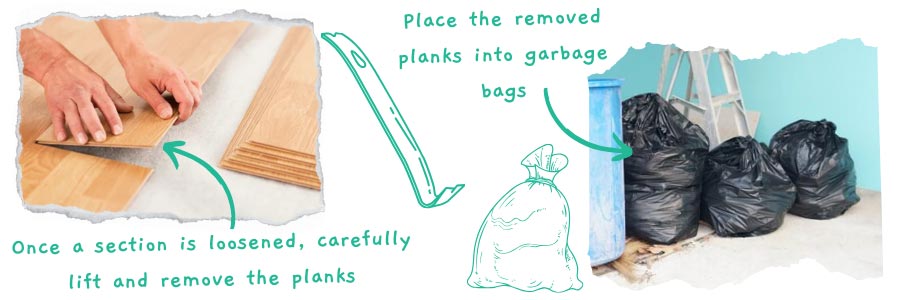
Once a section is loosened, carefully lift and remove the planks, working row by row until the floor is completely cleared. As you go, place the removed planks into garbage bags to keep the workspace tidy and simplify disposal later.
Step 5: Remove the Laminate Planks


Step 6: Dispose of the Flooring

After the removal is complete, clean the area thoroughly to eliminate any leftover debris or adhesive remnants. Bag up the flooring for proper disposal at a designated waste facility, or consider recycling it to reduce environmental impact. Leaving the area clean and clear ensures it's ready for the next phase of mitigation or restoration.


Out with the Old, In with the New

Removing laminate flooring may not be the most glamorous part of restoration work, but it’s a critical step in tackling water damage and preparing a space for the next phase of recovery. By following this process, you ensure the job is done efficiently, safely, and with minimal disruption to the rest of the property.

But let’s face it—keeping every step straight when you’re juggling multiple tasks can feel overwhelming. That’s where KnowHow comes in. With KnowHow, you can equip your team with detailed, step-by-step guides and instant on-the-job support, all tailored to your company’s SOPs. Whether you're in the office or on-site, KnowHow makes sure your processes are clear, consistent, and easy to follow.

Streamline your workflow and set your team up for success with KnowHow. Visit tryknowhow.com to see how we can help you simplify every step of your restoration projects.


KEYWORDS: KnowHow library water mitigation

Share This Story

Looking for a reprint of this article?
From high-res PDFs to custom plaques, order your copy today!


Recommended Content

JOIN TODAY
To unlock your recommendations.

Already have an account? Sign In

  • mold remediation

    Fighting Mold and Bacteria Damage

    Successful mold remediation can be multidisciplinary,...
    Cleaning and Sanitation
    By: Josh Woolen
  • certifications and licenses for restoration professionals

    Certifications and Licenses Every Restoration Company Needs

    Restoration companies need to make sure they have the...
    Restoration Training/Education
    By: Sharon Elzarat
  • a wall covered in moss and fungus

    Zero Tolerance for Toxic Molds: Essential Steps for Successful Remediation

    Understanding the importance of zero tolerance for toxic...
    Mold Remediation
    By: Michael A. Pinto CSP, SMS, CMP, RTPE, FLS, ERS and Kendra Seymour
You must login or register in order to post a comment.

Report Abusive Comment

Manage My Account
  • eNewsletter
  • Online Registration
  • Subscription Customer Service
  • Manage My Preferences

More Videos

Popular Stories

Ask the Expert - Margin vs. Markup: The Costly Confusion in Restoration

Why Understanding Markup, Margin and Overhead is Critical for Restoration Success

mold spores

Mold and Mental Health: The Dual Crisis Facing Indoor Environmental Remediation Teams

calculating profits

How Poor Documentation and Manual Billing Quietly Erode Restoration Profits

2025 Technician Award winner - Congratulations, Kaylin Glaspie!

Events

January 20, 2026

INTRCONNECT

Dive into the latest trends, innovations, and best practices shaping the future of property insurance and restoration.

April 27, 2026

RIA Convention & Expo

This event empowers professionals through world-class education, powerful networking, and access to cutting-edge tools and services.

View All Submit An Event

Poll

Technology Innovations

Which emerging technology do you believe will have the biggest impact on restoration work in the next 5 years?
View Results Poll Archive

Products

The Cleaning, Restoration, Inspection, and Safety Glossary

The Cleaning, Restoration, Inspection, and Safety Glossary

The Cleaning, Restoration, Inspection, and Safety Glossary.

See More Products
Prepare for CATASTROPHE with R&R!

Related Articles

  • Weekly Hands-On How-To: How to Remove Hardwood Floors During Water Mitigation

    How To Remove Hardwood Floors during Water Mitigation

    See More
  • KnowHow's Weekly Hands-On How-To: How to Remove Carpet During Water Mitigation

    How to Remove Carpet During Water Mitigation

    See More
  • Weekly Hands-On How-To: How to Remove Non-Salvageable Materials During Mitigation

    How to Identify and Remove Non-Salvageable Materials During Mitigation

    See More

Related Products

See More Products
  • Cover.jpg

    How To Get More Water Damage Jobs (ebook)

  • Water Damage - Part 1.pdf

    Water Damage - Mitigation & Restoration, Volume I - Management & Marketing

  • Water-Damage---Part-2.gif

    Water Damage - Mitigation & Restoration Volume II - Technical Procedures

See More Products
×

Stay ahead of the curve with our eNewsletters.

Get the latest industry updates tailored your way.

JOIN TODAY!
  • RESOURCES
    • Advertise
    • Contact Us
    • Directories
    • Store
    • Want More
    • Submit a Press Release
  • SIGN UP TODAY
    • Create Account
    • eNewsletters
    • Customer Service
    • Manage Preferences
  • SERVICES
    • Reprints
    • Marketing Services
    • Market Research
    • List Rental
    • Survey/Respondent Access
  • STAY CONNECTED
    • LinkedIn
    • Facebook
    • Instagram
    • YouTube
    • X (Twitter)
  • PRIVACY
    • PRIVACY POLICY
    • TERMS & CONDITIONS
    • DO NOT SELL MY PERSONAL INFORMATION
    • PRIVACY REQUEST
    • ACCESSIBILITY

Copyright ©2025. All Rights Reserved BNP Media.

Design, CMS, Hosting & Web Development :: ePublishing