Understanding Mold is the Basis to Prevent Mold
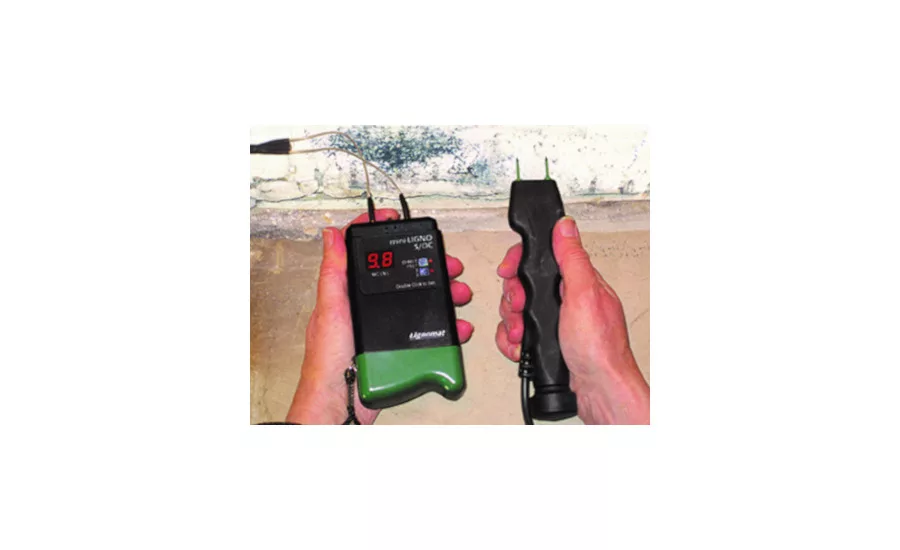
This is mold built-up after the washing machine in the basement overflowed previously. The mold is not active anymore, it happened a long time ago.
The meter is used to determine how much material needs to be removed and to check if any extra moisture is left-over in the wall, where the mold is not visible.
Understanding mold.
Mold is not a plant and not an animal. Mold is a fungi with its own unique life-style, starting from a tiny microorganism called spore. Not all fungi are as unwanted as mold. Some are great decomposers, where decomposition is wanted. Antibiotics such as Penicillin are fungi, their development is a blessing for people. Even in our food we welcome the distinctive taste of yeast-fungi when brewing or baking.
Mold in buildings is un-welcome, it presents a danger for the building and for the people living in the building.
Mold starts from spores. Spores have been around for centuries, our environment is contaminated with spores. That’s why mold can develop everywhere under the right conditions, even though nobody put “mold seeds” out.
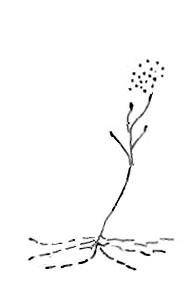
Let’s take a look at how mold grows: A tiny spore is dormant somewhere, waiting sometimes for years for the right conditions. If the right conditions occur (see below), a spore will develop into a new organism.
The new organism develops into mold by penetrating through and under the surface into the substrate looking for food and growing an ever-extending web along the surface as far as favorable conditions exist. From this web tiny extensions grow vertically up. The ends swell and new spores are produced. When the spores are ready, they are air borne by the millions and dispersed into the surrounding air. The slightest drift can carry the spores far away in a short time, where they will, if conditions allow start a new colony.
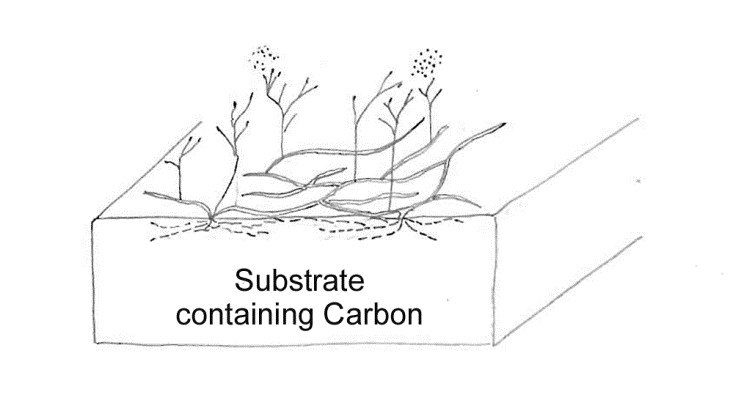
Four ingredients have to be present for mold to grow: food, water, air and moderate temperatures.
First red flag: Food: Contrary to green plants, the food source for mold is carbon, extracted from the material the mold lives on. As mold extracts carbon, it destroys carbon-containing substances: organic materials such as wood, wood-based products as well as plastics made from petroleum products, paint, etc. as well as building materials such as concrete and sheetrock. Mold infestations can have catastrophic consequences by weakening or destroying structural elements in buildings.
Looking for quick answers on restoration, remediation and cleaning topics?
Try Ask R&R, our new smart AI search tool.
Ask R&R →
Second red flag: The destruction of materials is not all. While digesting its food, mold releases toxics into the air, which can present a health hazard to humans.
Third red flag: One mold colony can grow countless spores sent into the air and inhaled by people living in mold infested areas. Mold can be a health hazard, depending on the type of fungi very serious health problems have occurred. Plus, the smell is revolting.
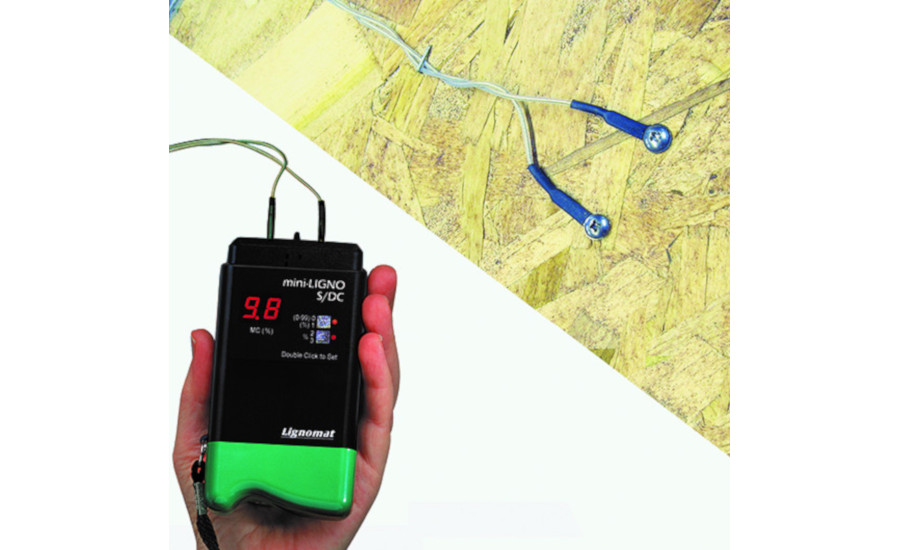
Ideal to monitor critical areas, anywhere, anytime. As long as the end of the cable is to be reached easily, this is the simplest way to measure and monitor inaccessible areas.
As mentioned before, in addition to food, the fungus needs water, air and moderate temperature.
In order to absorb food and grow, mold needs a certain moisture in the materials it likes to eat. Not too much and not too little. The fungi will not grow, if submerged in water, the fungi also cannot grow on dry materials. The moisture has to be a moisture content equivalent of 80% relative humidity to 99%, but not standing water. Example, if the relative humidity is 80% and the temperature is at 700F, the equivalent wood moisture content is 16%, which is considered a threshold for mold concerning wood.
And last not least mold will not grow, when it is very hot or very cold.
Summary: Spores are everywhere, ready to develop into mold. Mold needs food which is a main substance of all building materials. Humidity in air and moisture content of the substrate the mold grows on, are critical and have to be in a range from 80%-99% and Wood moisture equivalent of 16% and above. And, the climate has to be moderate. Considering all these factors individually, we can really only control the air humidity and the moisture content to reduce the danger of mold growth.
If all is well, we live in dry buildings, kept at a comfortable relative humidity and temperature. Mold cannot develop, because the building is dry, the food source is inaccessible for mold and its spores.
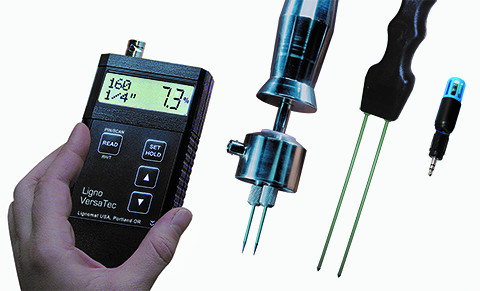
Lignomat offers pin meters, pinless meters, and thermo-hygrometers, and combination meters for pin-pinless RH: Ligno-Versatec meter.
This all changes, when a pipe brakes, a roof leaks or a flood occurs. There is a time slot of 24 hours to a few days, when something can be done before the mold gets a foothold. Restoration specialists should be called to assess the problem, dry out or remove the materials, which have gotten too wet.
To assess the damage, the moisture content in the affected parts needs to be measured and the relative humidity needs to be kept under control. Lignomat is a company offering equipment for measuring moisture content and relative humidity. We have developed easy to use effective moisture meters with hand probes to assess water damage. The same equipment will tell you, when repairs are done and later if a leak exists. We also offer a very simple monitoring device for hard-to-reach areas.
The cable-probe system has been proven helpful to monitor inaccessible areas during drying and later-on for leak detection.
Looking for a reprint of this article?
From high-res PDFs to custom plaques, order your copy today!