Measuring Moisture in Concrete Floors
Moisture in concrete floors is an important issue.

Moisture in concrete floors is an important issue. Concrete floors are an integral part of a building, and excess moisture within a slab can affect the entire structure. Other structural component, floor coverings, furniture and interior decorations can be ruined, not to mention serious health problems can be caused by mold.
Moisture tests of concrete floors are usually conducted to determine whether or not floor coverings or sealers can be applied or to find out why problems occurred. To give reliable results, the test needs to show whether or not the mid-section of the slab is dry enough.
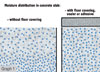
Graph 1 shows the moisture distribution in an uncovered and a covered concrete slab, which has not entirely dried out yet. Once the surface is covered or sealed, the free moisture inside the slab is trapped and over time distributes itself evenly throughout the slab. That results in an increase in moisture at the top of the concrete slab.

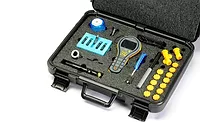
The in-situ RH test is designed to measure the mid-section of the slab (Graph 2). A relative humidity probe is inserted into a pre-drilled hole. The probe measures the evaporation from the concrete at 40% depth for slabs drying from one side and at 20% depth for slabs drying from both sides. Another advantage of the RH in-depth method is that the evaporation from the concrete slab is measured and not the moisture in the concrete. The floor covering installed on top of the concrete does not “feel” the moisture in the concrete, but the evaporation emitted from the concrete slab.

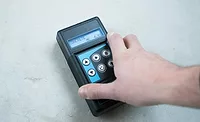
Pin or pinless moisture meters are not measuring deep enough (Graph 3) and they are measuring the moisture in the concrete and not the evaporation from the concrete. They are good for a qualitative quick check to find high and low moisture areas or as an indication that more testing is necessary.
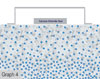
The Calcium Chloride test (Graph 4) has been used for many years. Experts have found that the test can give false negatives and positives, because it only takes into consideration the top section of the slab. Another disadvantage of the test is that the evaporation of surface moisture measured by the test depends on the ambient conditions around the slab. In a building with low relative humidity, the same concrete evaporates more moisture than in a building with high relative humidity.
Looking for quick answers on restoration, remediation and cleaning topics?
Try Ask R&R, our new smart AI search tool.
Ask R&R →
RH in-situ Probes for Measuring Moisture in Concrete Slabs
Excess concrete moisture is a continuous threat for floor coverings, whether in new construction or existing buildings. Before installing resilient floor coverings the contractor should make sure the slab is dry enough. Even after moisture problems have occurred, the concrete slab should be tested before replacing a moisture-damaged floor covering.
A lasting solution for replacing damaged floors is only possible, when the source of the problem has been detected and eliminated. The in-depth probe tests with RH sensors have proven time and time again to be able to detect hidden problems. The core moisture often stays undetected with surface moisture measurements, when using pin or pinless meters. Even the Calcium Chloride test only takes into consideration moisture close to the surface of the slab.
The ASTM standard F2170 describes the in-situ RH method used more and more as the industry standard for measuring moisture in concrete. A number of test holes is drilled and RH probes are used to measure the evaporation of the concrete in the isolated space at the bottom of the hole. Permissable RH values vary between 65% for very moisture sensitive floor coverings up to 97%.
Many floor covering manufacturer have issued recommended RH values for their floors. To avoid moisture problems the installer is advised to check the moisture in a concrete slab before covering the slab with sealer, epoxy, tile, linoleum, carpet or wood.
Looking for a reprint of this article?
From high-res PDFs to custom plaques, order your copy today!